’03 L/C U (L/O 0301)
203
The brake assist system may not work for
about 60 seconds after the engine is
started.
For an explanation of this system’s warn-
ing light, see “Service reminder indicators
and warning buzzers” on page 118.
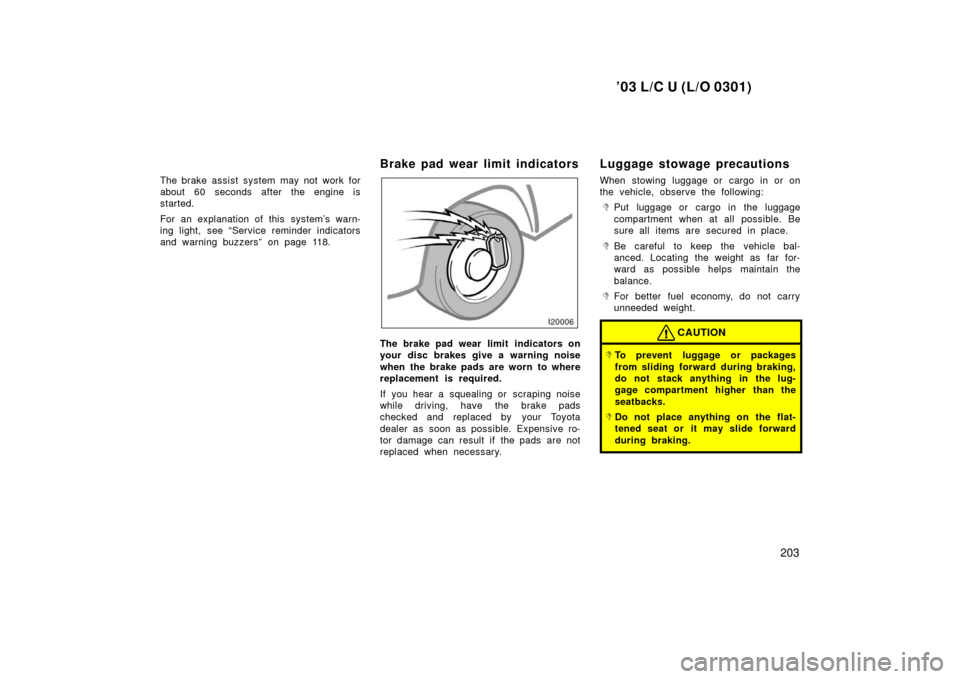
Brake pad wear limit indicators
The brake pad wear limit indicators on
your disc brakes give a warning noise
when the brake pads are worn to where
replacement is required.
If you hear a squealing or scraping noise
while driving, have the brake pads
checked and replaced by your Toyota
dealer as soon as possible. Expensive ro-
tor damage can result if the pads are not
replaced when necessary.
Luggage stowage precautions
When stowing luggage or cargo in or on
the vehicle, observe the following:
�Put luggage or cargo in the luggage
compartment when at all possible. Be
sure all items are secured in place.
�Be careful to keep the vehicle bal-
anced. Locating the weight as far for-
ward as possible helps maintain the
balance.
�For better fuel economy, do not carry
unneeded weight.
CAUTION
�To prevent luggage or packages
from sliding forward during braking,
do not stack anything in the lug-
gage compartment higher than the
seatbacks.
�Do not place anything on the flat-
tened seat or it may slide forward
during braking.
’03 L/C U (L/O 0301)
272
If any of the above parts are extremely
dirty or you are not sure of their condi-
tion, take your vehicle to a Toyota dealer.
CAUTION
To prevent burning yourself, be care-
ful not to touch the radiator or con-
denser when the engine is hot.
NOTICE
To prevent damage to the radiator
and condenser, do not perform the
work by yourself.
Checking brake fluid
To check the fluid level, simply look at
the seethrough reservoir. The level
should be between the ”MAX” and
”MIN” lines on the reservoir.
It is normal for the brake fluid level to go
down slightly as the brake pads wear or
when the fluid level in the accumulator is
high.
If the reservoir needs frequent refueling,
it may indicate a serious mechanical prob-
lem.If the level is low, add SAE J1703 or
FMVSS No. 116 DOT 3 brake fluid to
the brake reservoir.
Refilling brake fluid:
1. Turn the ignition switch off.
2. Depress the brake pedal more than 40 times.
3. Remove the reservoir cap by hand. Add brake fluid up to the ”MAX” line.
If you do not follow the procedure above,
the reservoir may overflow.
Use only newly opened brake fluid. Once
opened, brake fluid absorbs moisture from
the air, and excess moisture can cause a
dangerous loss of braking.
CAUTION
Take care when filling the r eservoir
because brake fluid can harm your
eyes and damage painted surfaces. If
fluid gets in your eyes, flush your
eyes with clean water immediately. If
you still feel uncomfortable with your
eyes, go to the doctor.
Checking the radiator and
condenser