Page 263 of 312
’03 L/C U (L/O 0301)
259
Battery electrolyte level
Make sure the electrolyte level of all bat-
tery cells is between upper and lower lev-
el lines on the case. Add only distilled
water when replenishing. See page 282 for
additional information.
Brake fluid level
Make sure the brake fluid level is correct.
See page 272 for additional information.
Engine oil level
Check the level on the dipstick with the
engine turned off and the vehicle parked
on a level ground. See page 268 for addi-
tional information.
Power steering fluid level
Check the level through the reservoir. The
level should be in the ”HOT” or ”COLD”
range depending on the fluid temperature.
See page 273 for additional information.
Exhaust system
If you notice any change in the sound of
the exhaust or smell exhaust fumes, have
the cause located and corrected immedi-
ately. (See ”Engine exhaust cautions” on
page 197.)Be on the alert for changes in perfor-
mance, sounds, and visual tipoffs that
indicate service is needed. Some impor-
tant clues are as follows:
�Engine missing, stumbling, or pinging
�Appreciable loss of power
�Strange engine noises
�A fluid leak under the vehicle (however,
water dripping from the air conditioning
after use is normal.)
�Change in exhaust sound (This may
indicate a dangerous carbon monoxide
leak. Drive with the windows open and
have the exhaust system checked im-
mediately.)
�Flatlooking tire; excessive tire squeal
when cornering; uneven tire wear
�Vehicle pulls to one side when driving
straight on a level road
�Strange noises related to suspension
movement
�Loss of brake effectiveness; spongy
feeling brake pedal; pedal almost
touches floor; vehicle pulls to one side
when braking
�Engine coolant temperature continually
higher than normal
�Engine continually runs hot; oil pres-
sure gauge stays low
If you notice any of these clues, take your
vehicle to your Toyota dealer as soon as
possible. It probably needs adjustment or
repair.
CAUTION
Do not continue driving with the ve-
hicle unchecked. It could result in se-
rious vehicle damage and possibly
personal injury.
Does your vehicle need
repairing?
Page 273 of 312
’03 L/C U (L/O 0301)
269
NOTICE
�Be careful not to spill the engine
oil on the vehicle components.
� Avoid overfilling, or the engine
could be damaged.
� Check the oil level on the dipstick
once again after adding the oil.
ENGINE OIL SELECTION
“Toyota Genuine Motor Oil” is f illed in
your Toyota vehicle. Use Toyota approved
“Toyota Genuine Motor Oil” or equivalent
to satisfy the following grade and viscos-
ity.
Oil grade:
Use API grade, SL “EnergyConserving”
or ILSAC multigrade engine oil.
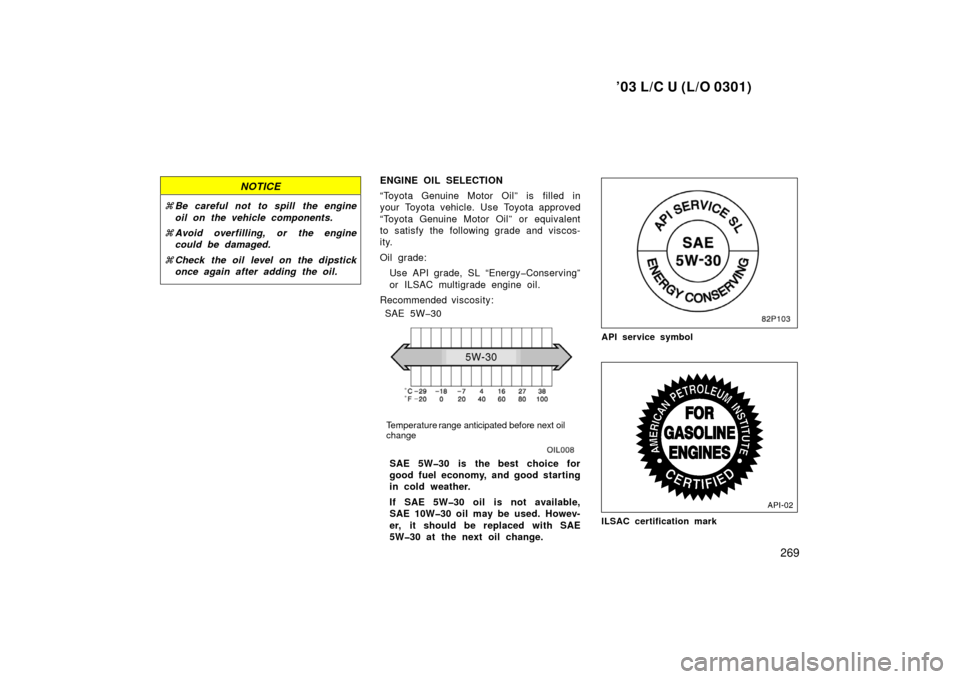
Recommended viscosity:
Temperature range anticipated before next oil
change
SAE 5W30
SAE 5W30 is the best choice for
good fuel economy, and good starting
in cold weather.
If SAE 5W30 oil is not available,
SAE 10W30 oil may be used. Howev-
er, it should be replaced with SAE
5W30 at the next oil change.
API service symbol
ILSAC certification mark
Page 274 of 312
’03 L/C U (L/O 0301)
270
Oil identification marks
Either or both API registered marks are
added to some oil containers to help
you select the oil you should use.
The API Service Symbol is located any-
where on the outside of the container.
The top portion of the label shows the oil
quality by API (American Petroleum Insti-
tute) designations such as SL. The center
portion of the label shows the SAE viscos-
ity grade such as SAE 5W30. ”Energy
Conserving” shown in the lower portion,
indicates that the oil has fuelsaving ca-
pabilities.
The ILSAC (International Lubricant Stan-
dardization and Approval Committee) Certi-
fication Mark is displayed on the front of
the container.
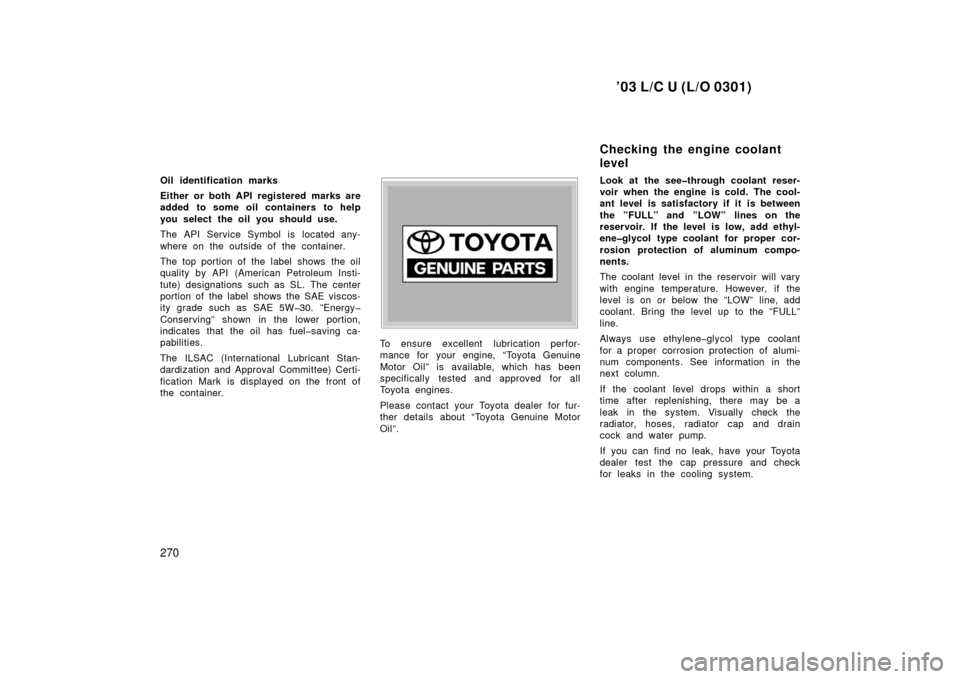
To ensure excellent lubrication perfor-
mance for your engine, “Toyota Genuine
Motor Oil” is available, which has been
specifically tested and approved for all
Toyota engines.
Please contact your Toyota dealer for fur-
ther details about “Toyota Genuine Motor
Oil”.Look at the seethrough coolant reser-
voir when the engine is cold. The cool-
ant level is satisfactory if it is between
the ”FULL” and ”LOW” lines on the
reservoir. If the level is low, add ethyl-
eneglycol type coolant for proper cor-
rosion protection of aluminum compo-
nents.
The coolant level in the reservoir will vary
with engine temperature. However, if the
level is on or below the ”LOW” line, add
coolant. Bring the level up to the ”FULL”
line.
Always use ethyleneglycol type coolant
for a proper corrosion protection of alumi-
num components. See information in the
next column.
If the coolant level drops within a short
time after replenishing, there may be a
leak in the system. Visually check the
radiator, hoses, radiator cap and drain
cock and water pump.
If you can find no leak, have your Toyota
dealer test the cap pressure and check
for leaks in the cooling system.
Checking the engine coolant
level
Page 299 of 312
’03 L/C U (L/O 0301)
295
Service specifications
ENGINE
Valve clearance (engine cold), mm (in.):Intake 0.15—0.25 (0.006—0.010)
Exhaust 0.25—0.35 (0.010—0.014)
Spark plug type: DENSO SK20R11
NGK IFR6A11
Spark plug gap, mm (in.): 1.1 (0.043)
ENGINE LUBRICATION
Oil capacity (drain and ref ill), L (qt., Imp.
qt.) With filter 6.8 (7.2, 6.0)
Without filter 6.4 (6.8, 5.6)
Oil grade:
“Toyota Genuine Motor Oil” is f illed in
your Toyota vehicle. Use Toyota ap-
proved “Toyota Genuine Motor Oil” or
equivalent to satisfy the following grade
and viscosity.
Oil grade:
API grade, SL “EnergyConserving” or
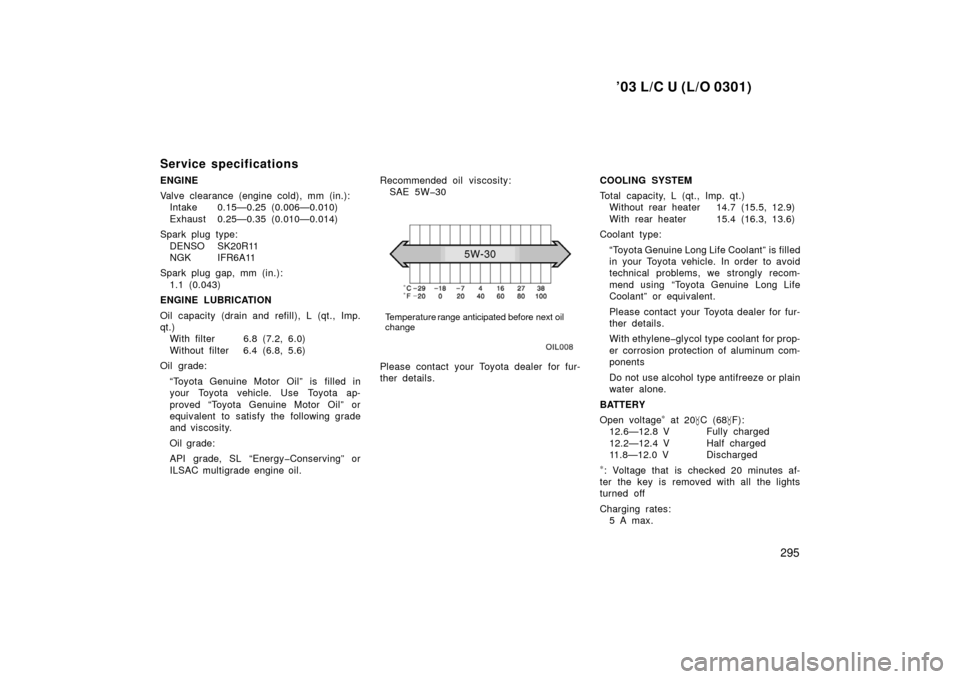
ILSAC multigrade engine oil. Recommended oil viscosity:
SAE 5W30
Temperature range anticipated before next oil
change
Please contact your Toyota dealer for fur-
ther details. COOLING SYSTEM
Total capacity, L (qt., Imp. qt.)
Without rear heater 14.7 (15.5, 12.9)
With rear heater 15.4 (16.3, 13.6)
Coolant type:
“Toyota Genuine Long Life Coolant” is f illed
in your Toyota vehicle. In order to avoid
technical problems, we strongly recom-
mend using “Toyota Genuine Long Life
Coolant” or equivalent.
Please contact your Toyota dealer for fur-
ther details.
With ethyleneglycol type coolant for prop-
er corrosion protection of aluminum com-
ponents
Do not use alcohol type antifreeze or plain
water alone.
BATTERY
Open voltage
∗ at 20 C (68 F):
12.6—12.8 V Fully charged
12.2—12.4 V Half charged
11.8—12.0 V Discharged
∗: Voltage that is checked 20 minutes af-
ter the key is removed with all the lights
turned off
Charging rates: 5 A max.