’03 4Runner_U (L/O 0305)
335
2003 4RUNNER from Apr. ’03 Prod. (OM 35820U)
When rotating tires, check for uneven
wear and damage. Abnormal wear is usu-
ally caused by incorrect tire pressure, im-
proper wheel alignment, outofbalance
wheels, or severe braking. WHEN TO USE SNOW TIRES OR
CHAINS
Snow tires or chains are recommended
when driving on snow or ice.
On wet or dry roads, conventional tires
provide better traction than snow tires.
SNOW TIRE SELECTION
If you need snow tires, select tires of
the same size, construction and load
capacity as the originally installed tires.
Also, on fourwheel drive models, all
the tires must be the same brand and
have the same tread patterns.
Do not use tires other than those men-
tioned above. Do not install studded tires
without first checking local regulations for
possible restrictions.
CAUTION
Observe the following instructions.
Otherwise, an accident may occur re-
sulting in death or serious injuries.
�Do not use snow tires other than
the manufacturer ’s recommended si-
ze, as this may cause dangerous
handling characteristics resulting in
loss of control.
�Fourwheel drive models:
Do not use snow tires of different
brands, sizes, construction or tread
patterns, as this may cause danger-
ous handling characteristics result-
ing in loss of control.
SNOW TIRE INSTALLATION
Snow tires should be installed on all
wheels.
Installing snow tires on the front w
heels
only can lead to an excessive difference
in road grip capability between the front
and rear tires which could cause loss of
vehicle control.
When storing removed tires, you should
store them in a cool dry place.
Mark the direction of rotation and be sure
to install them in the same direction when
replacing.
CAUTION
�Do not drive with the snow tires
incorrectly inflated.
�Never drive over 120 km/h (75 mph)
with any type of snow tires.
Installing snow tires and
chains
’03 4Runner_U (L/O 0305)
356
2003 4RUNNER from Apr. ’03 Prod. (OM 35820U)
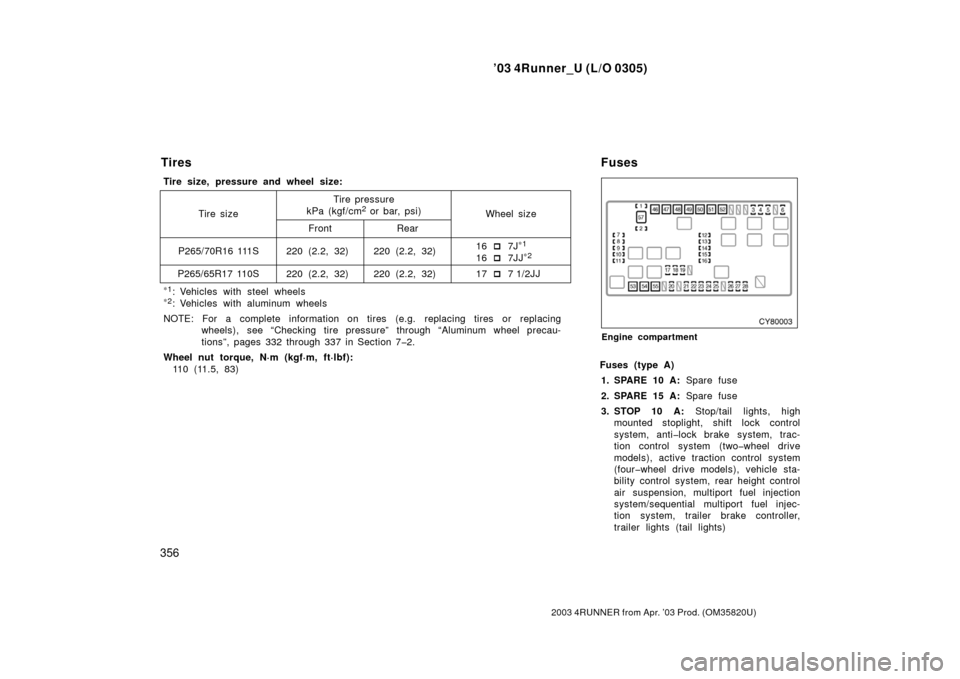
Engine compartment
Fuses (type A)
1. SPARE 10 A: Spare fuse
2. SPARE 15 A: Spare fuse
3. STOP 10 A: Stop/tail lights, high
mounted stoplight, shift lock control
system, antilock brake system, trac-
tion control system (twowheel drive
models), active traction control system
(fourwheel drive models), vehicle sta-
bility control system, rear height control
air suspension, multiport fuel injection
system/s equential multiport fuel injec-
tion system, trailer brake controller,
trailer lights (tail lights)
Tires
Tire size Tire pressure
kPa (kgf/cm2 or bar, psi)
Front Rear
P265/70R16 111S
P265/65R17 110S 220 (2.2, 32) 220 (2.2, 32)
220 (2.2, 32) 220 (2.2, 32) Wheel size
16 �7J
∗
1
16 �7JJ∗
2
17 �71/2JJ
Tire size, pressure and wheel size:
∗
1: Vehicles with steel wheels∗2: Vehicles with aluminum wheels
NOTE: For a complete information on tires (e.g. replacing tires or replacing wheels), see “Checking tire pressure” through “Aluminum wheel precau-
tions”, pages 332 through 337 in Section 72.
Wheel nut torque, N·m (kgf·m, ft·lbf): 11 0 ( 11 . 5 , 8 3 )
Fuses