Page 281 of 373
’03 4Runner_U (L/O 0305)
275
2003 4RUNNER from Apr. ’03 Prod. (OM 35820U)
When restarting out after parking on a
slope:
1. With the transmission in “P” position, start the engine. Be sure to keep the
brake pedal depressed.
2. Shift into gear.
3. Release the parking brake and brake pedal and slowly pull or back away
from the wheel blocks. Stop and apply
your brakes.
4. Have someone retrieve the blo cks.
CAUTION
�Do not exceed 72 km/h (45 mph) or
the posted towing speed limit,
whichever is lower. Because insta-
bility (swaying) of a towing vehicle
trailer combination usually in-
creases as the speed increases, ex-
ceeding 72 km/h (45 mph) may
cause loss of control.
�Slow down and downshift before
descending steep or long downhill
grades. Do not make sudden down-
shifts.
�Avoid holding the brake pedal down
too long or too frequently. This
could cause the brakes to overheat
and result in reduced braking effi-
ciency.
Improving fuel economy is easy—just take
it easy. It will help make your vehicle last
longer, too. Here are some specific tips
on how to save money on both fuel and
repairs:
�Keep your tires inflated at the cor-
rect pressure. Underinflation causes
tire wear and wastes fuel. See page
332 in Section 72 for instructions.
�Do not carry unneeded weight in
your vehicle. Excess weight puts a
heavier load on the engine, causing
greater fuel consumption.
�Avoid lengthy warmup idling. Once
the engine is running smoothly, begin
driving—but gently. Remember, howev-
er, that on cold winter days this may
take a little longer.
�Put the selector lever into the “D”
when engine braking is not required.
5speed automatic transmission—Driv-
ing with the selector lever in “4” will
reduce the fuel economy. (For details,
see “Automatic transmission (5speed)”
on page 129 in Section 16.)
4speed automatic transmission—Driv-
ing with the selector lever in “3” will
reduce the fuel economy. (For details,
see “Automatic transmission (4speed)”
on page 134 in Section 16.)
How to save fuel and make
your vehicle last longer
Page 297 of 373
’03 4Runner_U (L/O 0305)
291
2003 4RUNNER from Apr. ’03 Prod. (OM 35820U)
CAUTION
�When lowering the vehicle, make
sure all portions of your body and
all other persons around will not be
injured as the vehicle is lowered to
the ground.
�Have the wheel nuts tightened with
torque wrench to 110 N·m (11.5
kgf·m, 83 ft·lbf), as soon as pos-
sible after changing wheels. Other-
wise, the nuts may loosen and the
wheels may fall off, which could
cause a serious accident.
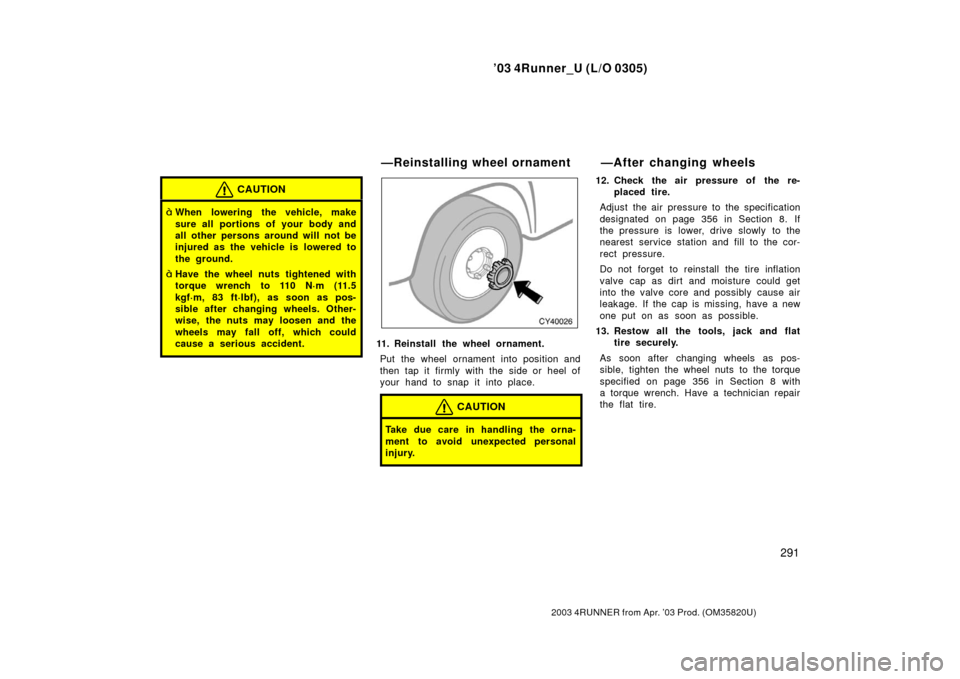
11. Reinstall the wheel ornament.
Put the wheel ornament into position and
then tap it firmly with the side or heel of
your hand to snap it into place.
CAUTION
Take due care in handling the orna-
ment to avoid unexpected personal
injury.
12. Check the air pressure of the re- placed tire.
Adjust the air pressure to the specification
designated on page 356 in Section 8. If
the pressure is lower, drive slowly to the
nearest service station and fill to the cor-
rect pressure.
Do not forget to reinstall the tire inflation
valve cap as dirt and moisture could get
into the valve core and possibly cause air
leakage. If the cap is missing, have a new
one put on as soon as possible.
13. Restow all the tools, jack and flat tire securely.
As soon after changing wheels as pos-
sible, tighten the wheel nuts to the torque
specified on page 356 in Section 8 with
a torque wrench. Have a technician repair
the flat tire.
—Reinstalling wheel ornament —After changing wheels
Page 338 of 373
’03 4Runner_U (L/O 0305)
332
2003 4RUNNER from Apr. ’03 Prod. (OM 35820U)
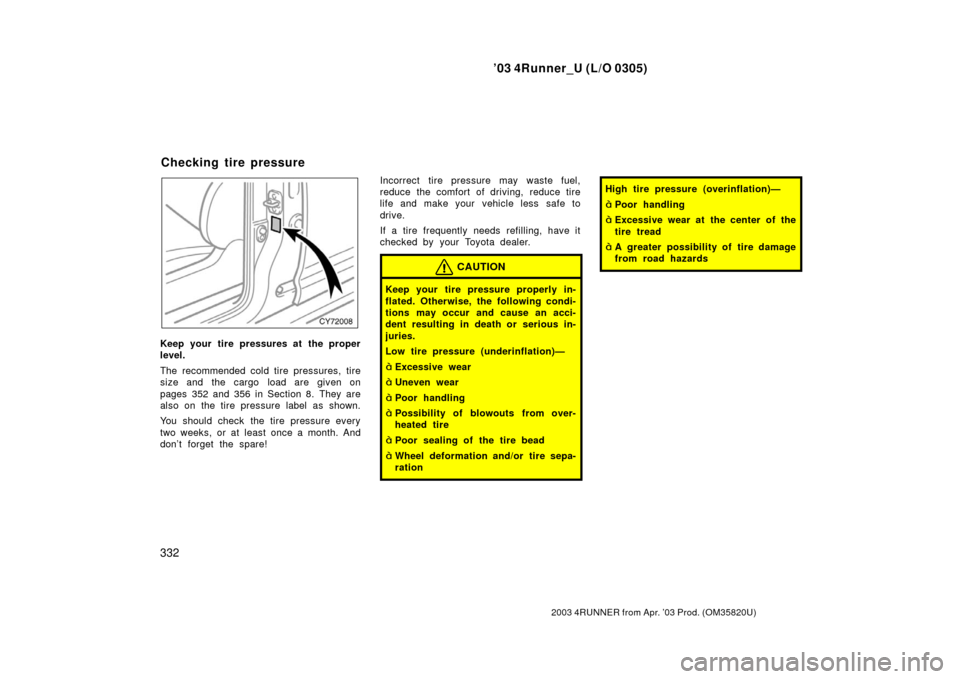
Keep your tire pressures at the proper
level.
The recommended cold tire pressures, tire
size and the cargo load are given on
pages 352 and 356 in Section 8. They are
also on the tire pressure label as shown.
You should check the tire pressure every
two weeks, or at least once a month. And
don’t forget the spare! Incorrect tire pressure may waste fuel,
reduce the comfort of driving, reduce tire
life and make your vehicle less safe to
drive.
If a tire frequently needs ref
illing, have it
checked by your Toyota dealer.
CAUTION
Keep your tire pressure properly in-
flated. Otherwise, the following condi-
tions may occur and cause an acci-
dent resulting in death or serious in-
juries.
Low tire pressure (underinflation)—
�Excessive wear
�Uneven wear
�Poor handling
�Possibility of blowouts from over-
heated tire
�Poor sealing of the tire bead
�Wheel deformation and/or tire sepa-
ration
High tire pressure (overinflation)—
�Poor handling
�Excessive wear at the center of the
tire tread
�A greater possibility of tire damage
from road hazards
Checking tire pressure
Page 339 of 373
’03 4Runner_U (L/O 0305)
333
2003 4RUNNER from Apr. ’03 Prod. (OM 35820U)
The following instructions for checking
tire pressure should be observed:
�The pressure should be checked only
when the tires are cold. If your ve-
hicle has been packed for at least 3
hours and has not been driven for
more than 1.5 km or 1 mile since, you
will get an accurate cold tire pressure
reading.
�Always use a tire pressure gauge.
The appearance of a tire can be mis-
leading. Besides, tire pressures that
are even just a few pounds off can
degrade ride and handling.
�Do not bleed or reduce tire pressure
after driving. It is normal for the tire
pressure to be higher after driving.
�Never exceed the vehicle capacity
weight. The passenger and luggage
weight should be located so that the
vehicle is balanced.
�Be sure to reinstall the tire inflation
valve caps. Without the valve caps,
dirt or moisture could get into the valve
core and cause air leakage. If the caps
have been lost, have new ones put on
as soon as possible.
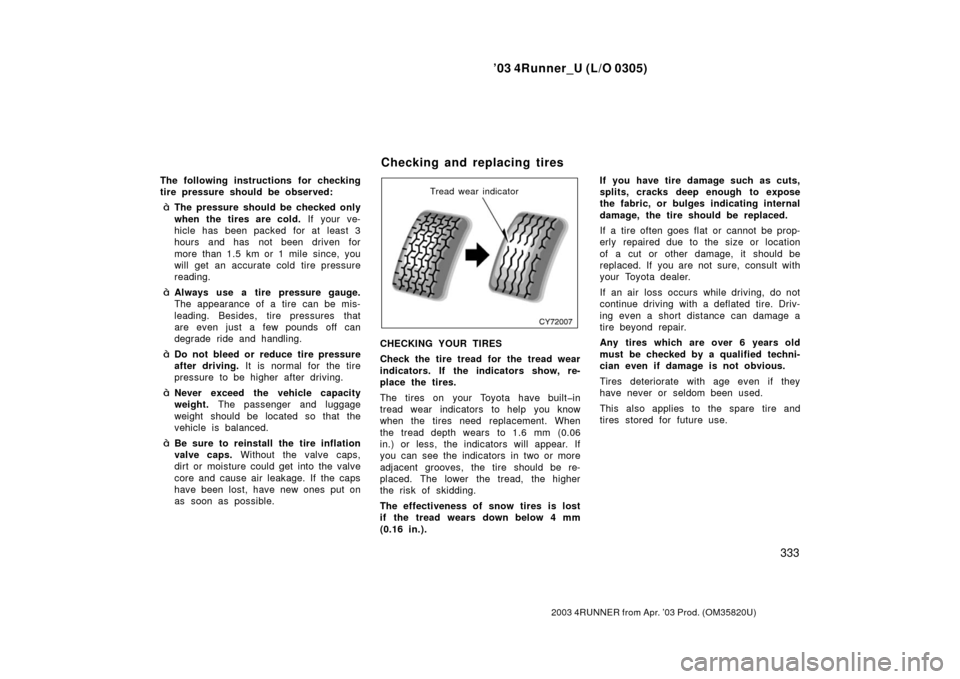
Tread wear indicator
CHECKING YOUR TIRES
Check the tire tread for the tread wear
indicators. If the indicators show, re-
place the tires.
The tires on your Toyota have builtin
tread wear indicators to help you know
when the tires need replacement. When
the tread depth wears to 1.6 mm (0.06
in.) or less, the indicators will appear. If
you can see the indicators in two or more
adjacent grooves, the tire should be re-
placed. The lower the tread, the higher
the risk of skidding.
The effectiveness of snow tires is lost
if the tread wears down below 4 mm
(0.16 in.). If you have tire damage such as cuts,
splits, cracks deep enough to expose
the fabric, or bulges indicating internal
damage, the tire should be replaced.
If a tire often goes flat or cannot be prop-
erly repaired due to the size or location
of a cut or other damage, it should be
replaced. If you are not sure, consult with
your Toyota dealer.
If an air loss occurs while driving, do not
continue driving with a deflated tire. Driv-
ing even a short distance can damage a
tire beyond repair.
Any tires which are over 6 years old
must be checked by a qualified techni-
cian even if damage is not obvious.
Tires deteriorate with age even if they
have never or seldom been used.
This also applies to the spare tire and
tires stored for future use.
Checking and replacing tires