2003 SUBARU FORESTER engine
[x] Cancel search: enginePage 316 of 420
9-11
In case of emergency
–CONTINUED –
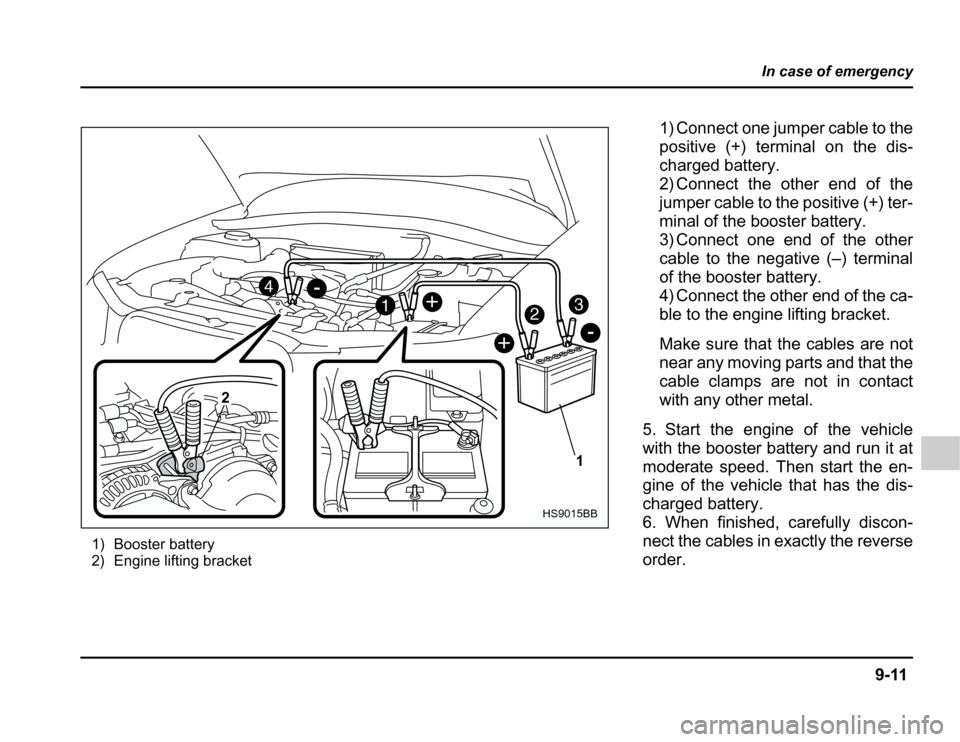
1) Booster battery
2) Engine lifting bracket
23
1
4
+
-
-
+
1
2
HS9015BB
1) Connect one jumper cable to the
positive (+) terminal on the dis-
charged battery.
2) Connect the other end of the
jumper cable to the positive (+) ter-
minal of the booster battery.
3) Connect one end of the other
cable to the negative (–) terminal
of the booster battery.
4) Connect the other end of the ca-
ble to the engine lifting bracket.
Make sure that the cables are not
near any moving parts and that the
cable clamps are not in contact
with any other metal.
5. Start the engine of the vehicle
with the booster battery and run it at
moderate speed. Then start the en-
gine of the vehicle that has the dis-
charged battery.
6. When finished, carefully discon-
nect the cables in exactly the reverse order.
Page 317 of 420

9-12
In case of emergency
Engine overheating
Never attempt to remove the radiator cap until
the engine has been shut off and has fully
cooled down. When the engine is hot, the cool-
ant is under pressure. Removing the cap while
the engine is still hot could release a spray of
boiling hot coolant, which could burn you very
seriously.
If the engine overheats, safely pull off the road and
stopthevehicleinasafeplace. If steam is coming from the engine compartment
Turn the engine off and get everyone away from the
vehicle until it cools down. If no steam is coming from the engine compartment
1. Keep the engine running at idling speed.
2. Open the hood to ventilate the engine compart- ment. Confirm that the cooling fan is turning. If the fan is not
turning, immediately turn the engine off and contact
your authorized dealer for repair.
3. After the engine coolant temperature has dropped,
turn off the engine.
If the temperature gauge stays at the overheated
zone, turn the engine off.
4. After the engine has fully cooled down, check the
coolant level in the reserve tank.
If the coolant level is below the “LOW” mark, add cool-
ant up to the “FULL” mark.
5. If there is no coolant in the reserve tank, add cool-
ant to the reserve tank. Then remove the radiator cap
and fill the radiator with coolant.
If you remove the radiator cap from a hot radiator, first
wrap a thick cloth around the radiator cap, then turn
the cap counterclockwise slowly without pressing
down until it stops. Release the pressure from the ra-
diator. After the pressure has been fully released, re-
move the cap by pressing down and turning it.
Page 321 of 420
9-16
In case of emergency
2. Release the parking brake and put the transmis-
sion in neutral.
3. The ignition switch should be in the “ACC” position
while the vehicle is being towed.
4. Take up slack in the towline slowly to prevent dam-
age to the vehicle.
Never turn the ignition switch to the “LOCK”
position while the vehicle is being towed be-
cause the steering wheel and the direction of
thewheelswillbelocked. Remember that the brake booster and power
steering do not function when the engine is not
running. Because the engine is turned off, it will
take greater effort to operate the brake pedal
andsteeringwheel.
If transmission failure occurs, transport your
vehicle on a flat-bed truck. Do not run the engine while being towed in
this method. Transmission damage could re-
sult if the vehicle is towed with the engine run-
ning.
For vehicles with automatic transmission,
the traveling speed must be limited to less than
20 mph (30 km/h) and the traveling distance to
less than 31 miles (50 km). For greater speeds
and distances, transport your vehicle on a flat-
bed truck.
Page 327 of 420
10-2
Appearance care
Appearance care
Exterior care
Washing
The best way to preserve your vehicle’s beauty is fre-
quent washing. Wash the vehicle at least once a
month to avoid contamination by road grime.
Wash dirt off with a wet sponge and plenty of luke-
warm or cold water. Do not wash the vehicle with hot
water and in direct sunlight.
Salt, chemicals, insects, tar, soot and bird droppings
should be washed off by using a light detergent, as re-
quired. If you use a light detergent, make certain that
it is a neutral detergent. Do not use strong soap or
chemical detergents. All cleaning agents should be
promptly flushed from the surface and not allowed to
dry there. Rinse the vehicle thoroughly with plenty of
lukewarm water. Wipe the remaining water off with a
chamois or soft cloth.
When washing the vehicle, the brakes may
get wet. As a result, the brake stopping dis-
tance will be longer. To dry the brakes, drive the
vehicle at a safe speed while lightly pressing
the brake pedal to heat up the brakes.
Do not wash the engine compartment and
area adjacent to it. If water enters the engine air
intake, electrical parts or the power steering flu-
id reservoir, it will cause engine trouble or
faulty power steering respectively.
NOTE
When having your vehicle washed in an automatic
car wash, make sure beforehand that the car wash
is of suitable type. Automatic car wash brushes or
other equipment may damage the rear wiper and
roof spoiler (if equipped). Washing the underbody
Chemicals, salts and gravel used for deicing road sur-
faces are extremely corrosive, accelerating the corro-
sion of underbody components, such as the exhaust
system, fuel and brake lines, brake cables, floor pan
and fenders, and suspension.
Thoroughly flush the underbody and inside of the
fenders with lukewarm or cold water at frequent inter-
vals to reduce the harmful effects of such agents. Using a warm water washer
Keepagooddistanceof12in(30cm)ormorebe-
tween the washer nozzle and the vehicle. Do not wash the same area continuously.
Page 332 of 420

11 - 1
11
Maintenance and service
Maintenance schedule ................................ 11-3
Maintenance precautions ........................... 11-3 Before checking or servicing in the engine
compartment ................................................... 11-4
When you do checking or servicing in the
engine compartment while the engine is
running ............................................................. 11-5
Engine hood ................................................. 11-5
Engine compartment overview .................. 11-8
Engine oil ..................................................... 11-9 Checking the oil level ..................................... 11-9
Changing the oil and oil filter ........................ 11-10
Recommended grade and viscosity .............. 11-12
Recommended grade and viscosity under
severe driving conditions .............................. 11-14
Synthetic oil ..................................................... 11-14
Cooling system ............................................ 11-14 Cooling fan, hose and connections .............. 11-15
Engine coolant ................................................ 11-15
Air cleaner element ..................................... 11-19 Replacing the air cleaner element ................. 11-19
Spark plugs .................................................. 11-20 Recommended spark plugs ........................... 11-21
Drive belts .................................................... 11-21
Manual transmission oil .............................. 11-22 Checking the oil level ..................................... 11-22
Recommended grade and viscosity .............. 11-23
Automatic transmission fluid ..................... 11-24 Checking the fluid level .................................. 11-24 Recommended fluid ....................................... 11-25
Front differential gear oil (AT vehicles) ..... 11-26 Checking the oil level ..................................... 11-26
Recommended grade and viscosity ............. 11-26
Rear differential gear oil .............................. 11-27 Checking the gear oil level ............................ 11-27
Recommended grade and viscosity ............. 11-28
Power steering fluid ..................................... 11-29 Checking the fluid level .................................. 11-29
Recommended fluid ....................................... 11-30
Brake fluid .................................................... 11-30 Checking the fluid level .................................. 11-30
Recommended brake fluid ............................. 11-31
Clutch fluid (MT vehicles) ........................... 11-31 Checking the fluid level .................................. 11-31
Recommended clutch fluid ............................ 11-32
Brake booster ............................................... 11-32
Brake pedal ................................................... 11-33 Checking the brake pedal free play .............. 11-33
Checking the brake pedal reserve distance . 11-33
Clutch pedal (MT vehicles) .......................... 11-34 Checking the clutch function ........................ 11-34
Checking the clutch pedal free play ............. 11-34
Hill holder (MT vehicles — if equipped) ..... 11-35
Replacement of brake pad and lining ........ 11-35 Breaking-in of new brake pads and linings .. 11-36
Parking brake stroke ................................... 11-37
Tires and wheels .......................................... 11-37 Types of tires .................................................. 11-37
Page 335 of 420

11 - 4
Maintenance and service
the materials in the vehicle may be hazardous if
improperly used or handled, for example, bat-
tery acid.
Your vehicle should only be serviced by per-
sons fully competent to do so. Serious person-
al injury may result to persons not experienced
in servicing vehicles. Always use the proper tools and make certain
that they are well maintained. Never get under the vehicle supported only
by a jack. Always use a safety stands to sup-
port the vehicle. Never keep the engine running in a poorly
ventilated area, such as a garage or other
closed areas. Do not smoke or allow open flames around
the fuel or battery. This will cause a fire. Because the fuel system is under pressure,
replacement of the fuel filter should be per-
formed only by your SUBARU dealer. Wear adequate eye protection to guard
against getting oil or fluids in your eyes. If
something does get in your eyes, thoroughly
wash them out with clean water. Do not tamper with the wiring of the SRS air-
bag system or seatbelt pretensioner system, or
attempt to take its connectors apart, as that may activate the system or it can render it inop-
erative. The wiring and connectors of these
systems are yellow for easy identification. NEV-
ER use a circuit tester for these wiring.
If your SRS airbag or seatbelt pretensioner
needs service, consult your nearest SUBARU
dealer.
Before checking or servicing in the en-
gine compartment
Always stop the engine and set the parking
brake firmly to prevent the vehicle from mov-
ing. Always let the engine cool down. Engine
parts become very hot when the engine is run-
ning and remain hot for some time after the en-
gine is stopped. Do not spill engine oil, engine coolant, brake
fluid or any other fluid on hot engine compo-
nents. This may cause a fire. Always remove the key from the ignition
switch. When the ignition switch is in the “ON”
position, the cooling fan may operate suddenly
Page 336 of 420
11 - 5
Maintenance and service
–CONTINUED –
even when the engine is stopped.
When you do checking or servicing in
the engine compartment while the en-
gine is running
A running engine can be dangerous. Keep your
fingers, hands, clothing, hair and tools away
from the cooling fan, belts and any other mov-
ing engine parts. Removing rings, watches and
ties is advisable.
Engine hood
0
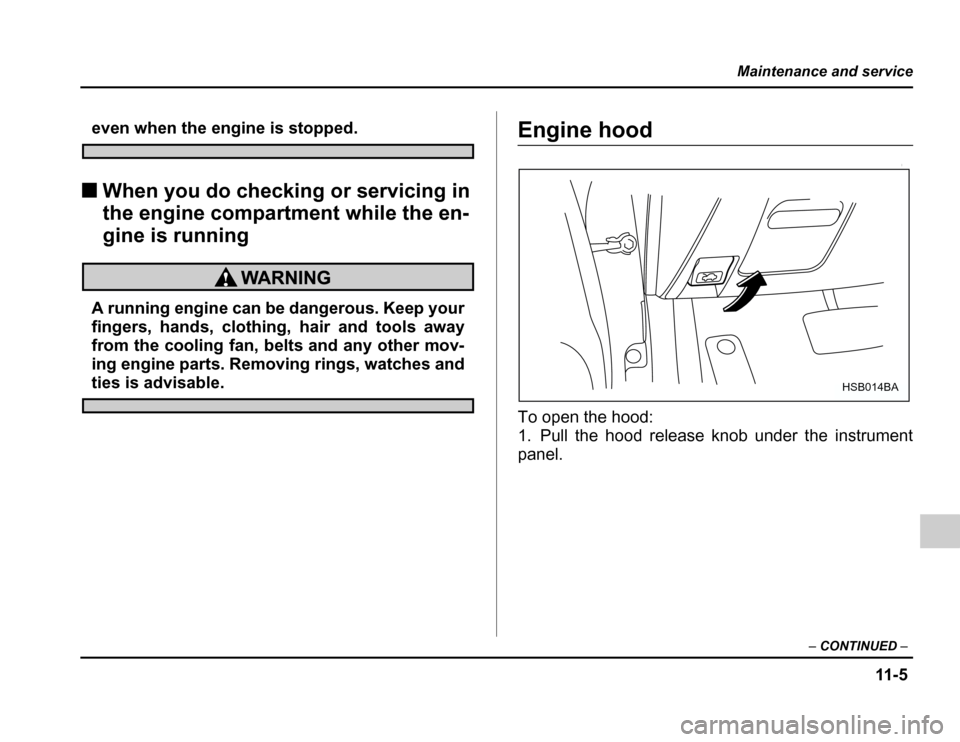
To open the hood:
1. Pull the hood release knob under the instrument
panel.
HSB014BA
Page 339 of 420
11 - 8
Maintenance and service
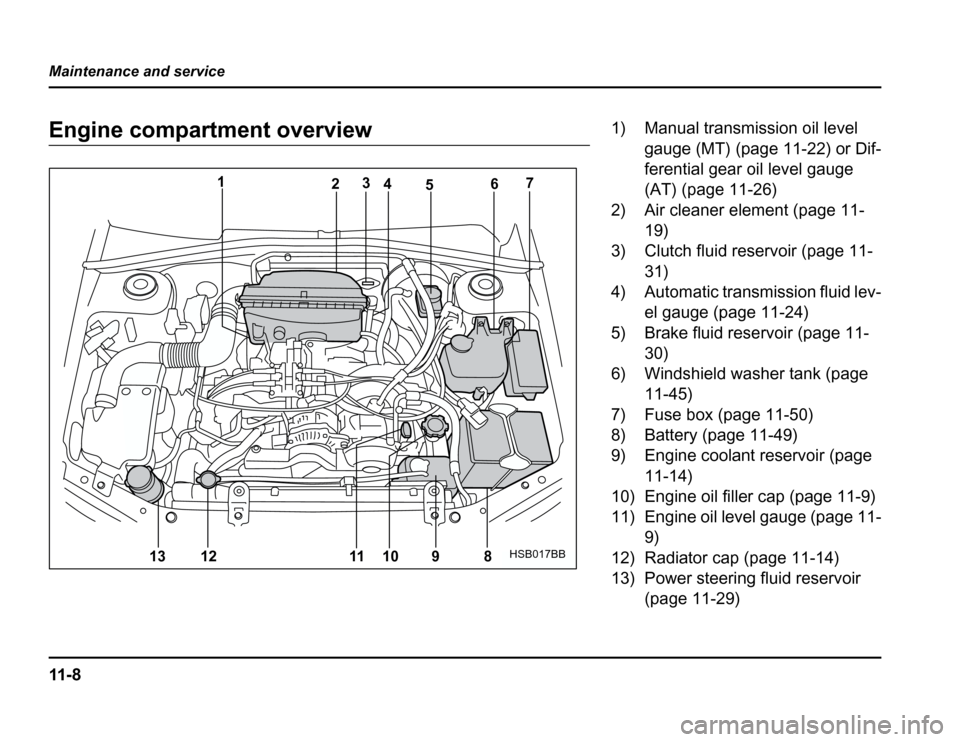
Engine compartment overview
1
23
4 5 67
8
9
10
11
12
13
HSB017BB
1) Manual transmission oil level
gauge (MT) (page 11-22) or Dif-
ferential gear oil level gauge
(AT) (page 11-26)
2) Air cleaner element (page 11- 19)
3) Clutch fluid reservoir (page 11-
31)
4) Automatic transmission fluid lev-
el gauge (page 11-24)
5) Brake fluid reservoir (page 11- 30)
6) Windshield washer tank (page
11-45)
7) Fuse box (page 11-50)
8) Battery (page 11-49)
9) Engine coolant reservoir (page 11-14)
10) Engine oil filler cap (page 11-9)
11) Engine oil level gauge (page 11- 9)
12) Radiator cap (page 11-14)
13) Power steering fluid reservoir (page 11-29)