Page 79 of 420
1-52
Seat, seatbelt and SRS airbags
front seatback, which bears an “SRS AIRBAG” label.
In a moderate to severe side impact collision, the SRS
side airbag on the impacted side of the vehicle de-
ploys between the occupant and the door panel and
supplements the seatbelt by reducing the impact on
the occupant’s chest and head.
The SRS side airbag is designed as only a sup-
plement to the primary protection provided by
the seatbelt. It does not do away with the need
to fasten seatbelts. It is also important to wear
your seatbelt to help avoid injuries that can re-
sult when an occupant is not seated in a proper
upright position.
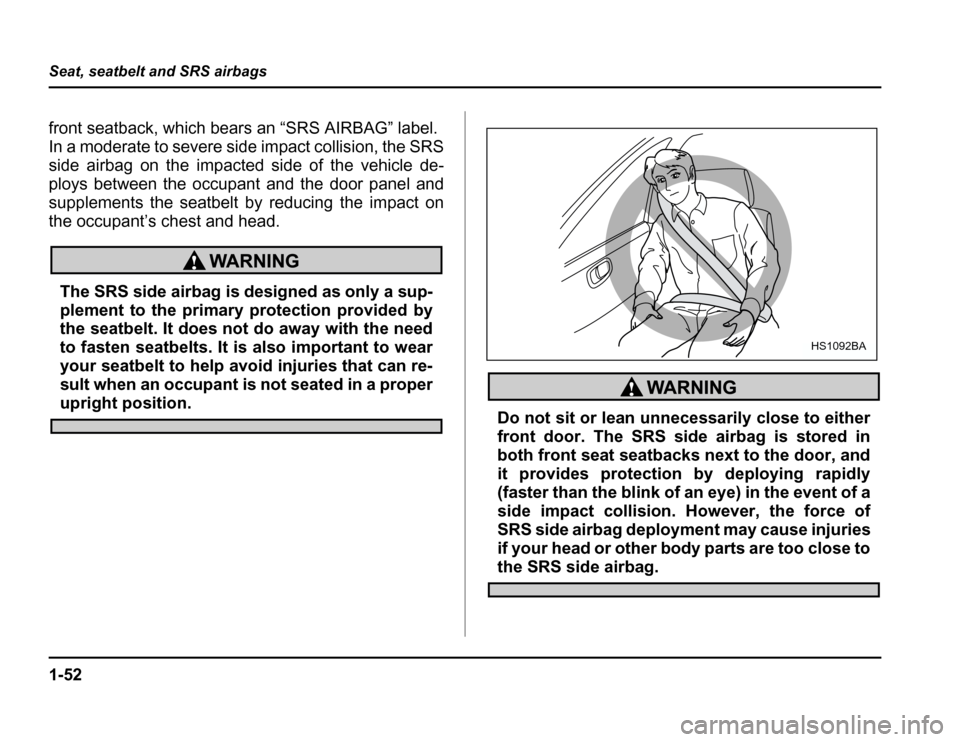
Do not sit or lean unnecessarily close to either
front door. The SRS side airbag is stored in
both front seat seatbacks next to the door, and
it provides protection by deploying rapidly
(faster than the blink of an eye) in the event of a
side impact collision. However, the force of
SRS side airbag deployment may cause injuries
if your head or other body parts are too close to
the SRS side airbag.
HS1092BA
Page 80 of 420
1-53
Seat, seatbelt and SRS airbags
–CONTINUED –
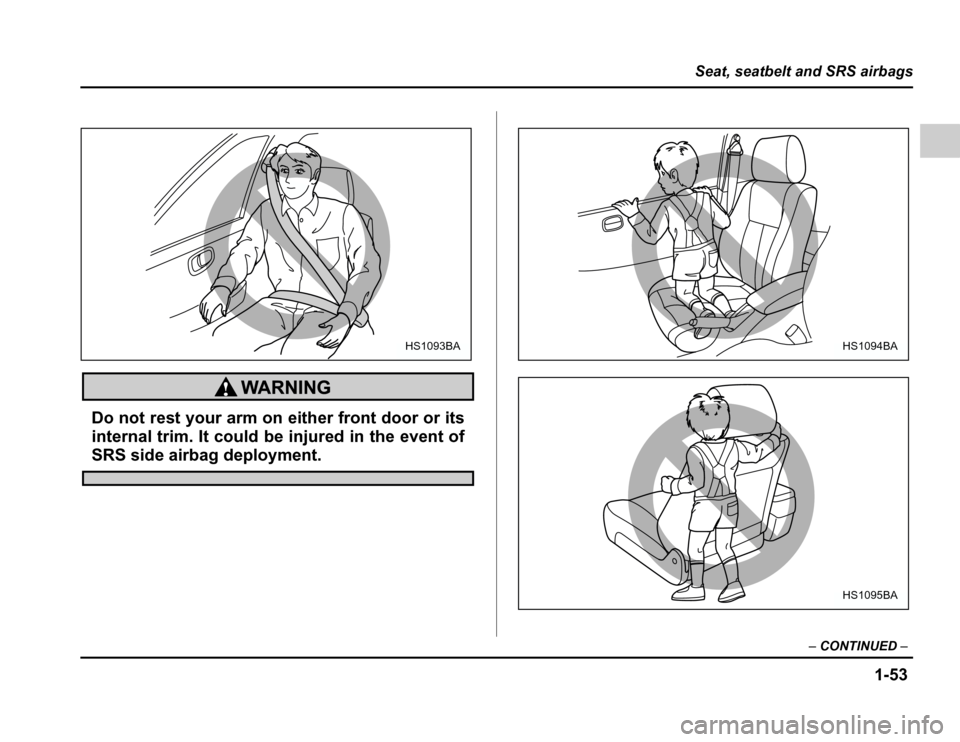
Do not rest your arm on either front door or its
internal trim. It could be injured in the event of
SRS side airbag deployment.
HS1093BAHS1094BA
HS1095BA
Page 81 of 420
1-54
Seat, seatbelt and SRS airbags
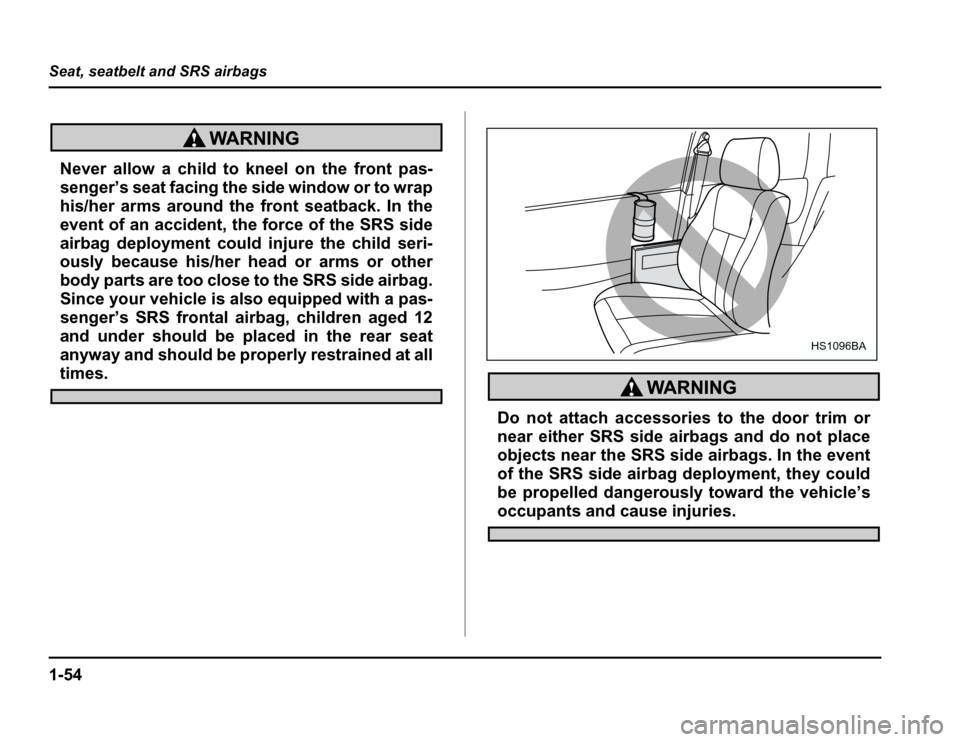
Never allow a child to kn
eel on the front pas-
senger
Page 82 of 420
1-55
Seat, seatbelt and SRS airbags
–CONTINUED –
Do not put any kind of cover or clothes or other
objects over either front seatback and do not
attach labels or stickers to the front seat sur-
face on or near the SRS side airbag. They could
prevent proper deployment of the SRS side air-
bag, reducing protection available to the front
seat
Page 83 of 420

1-56
Seat, seatbelt and SRS airbags
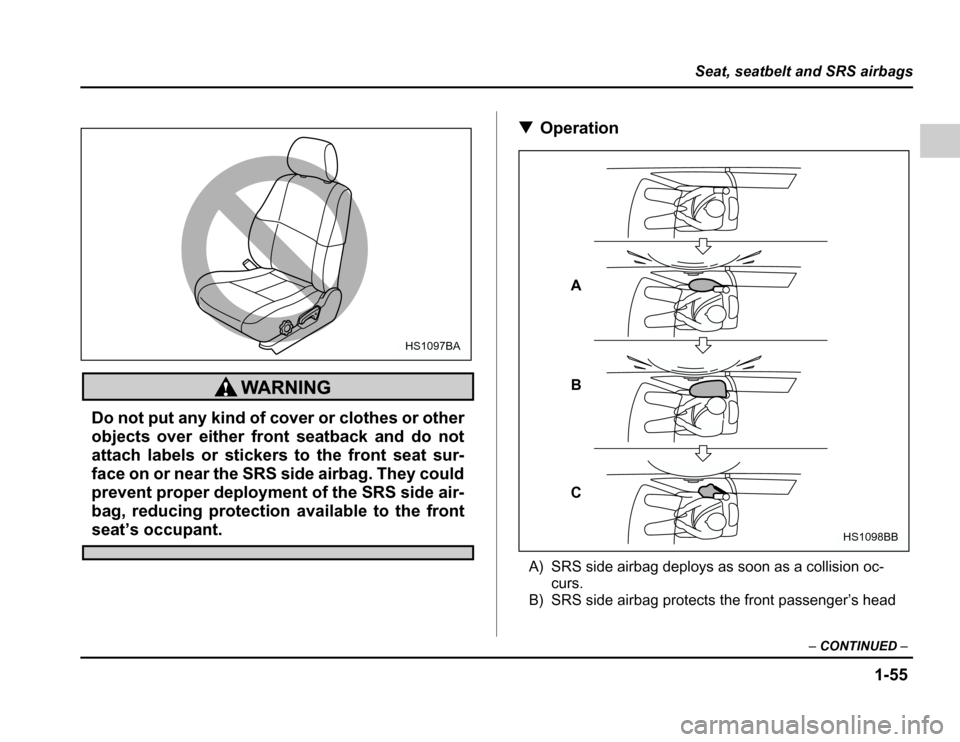
and chest.
C) After deployment, SRS side airbag starts to deflate im- mediately.
The SRS side airbag can function only when the igni-
tion switch is in the “ON” position.
The driver’s and front passenger’s SRS side airbags
deploy independently of each other since each has its
own impact sensor. Also, the SRS side airbag deploys
independently of the frontal airbags in the steering
wheel and instrument panel.
An impact sensor is incorporated into each of the ve-
hicle’s center pillars. If either sensor detects a certain
predetermined amount of force during a side impact
collision, the control module sends a signal to the side
airbag module on the impacted side of the vehicle, in-
structing it to inflate the SRS side airbag. Then the
side airbag module produces gas, which instantly in-
flates the SRS side airbag. After the deployment, the
SRS side airbag immediately starts to deflate. The
time required from detecting impact to the deflation of
the SRS side airbag after deployment is shorter than
the blink of an eye.
The SRS side airbag deploys even when no one occu-
pies the seat on the side on which an impact is ap-
plied. When the SRS side airbag deploys, a sudden, fairly
loud inflation noise will be heard and some smoke will
be released. These occurrences are normal result of
the deployment. This smoke does not indicate a fire in
the vehicle.
Do not touch the SRS side airbag system com-
ponents around the
front seatback with bare
hands right after deployment. Doing so can
cause burns because the components can be
very hot as a result of deployment.
The SRS side airbag is designed to deploy in the event
of an accident involving a moderate to severe side im-
pact collision. It is basically not designed to deploy in
lesser side impact. Also, it is basically not designed to
deploy in frontal or rear impacts because SRS side air-
bag deployment would not help the occupant in those
situations.
Each SRS side airbag is designed to function on a
one-time-only basis.
SRS side airbag deployment depends on the level of
force experienced in the passenger compartment dur-
ing a side impact collision. That level differs from one
Page 84 of 420
1-57
Seat, seatbelt and SRS airbags
–CONTINUED –
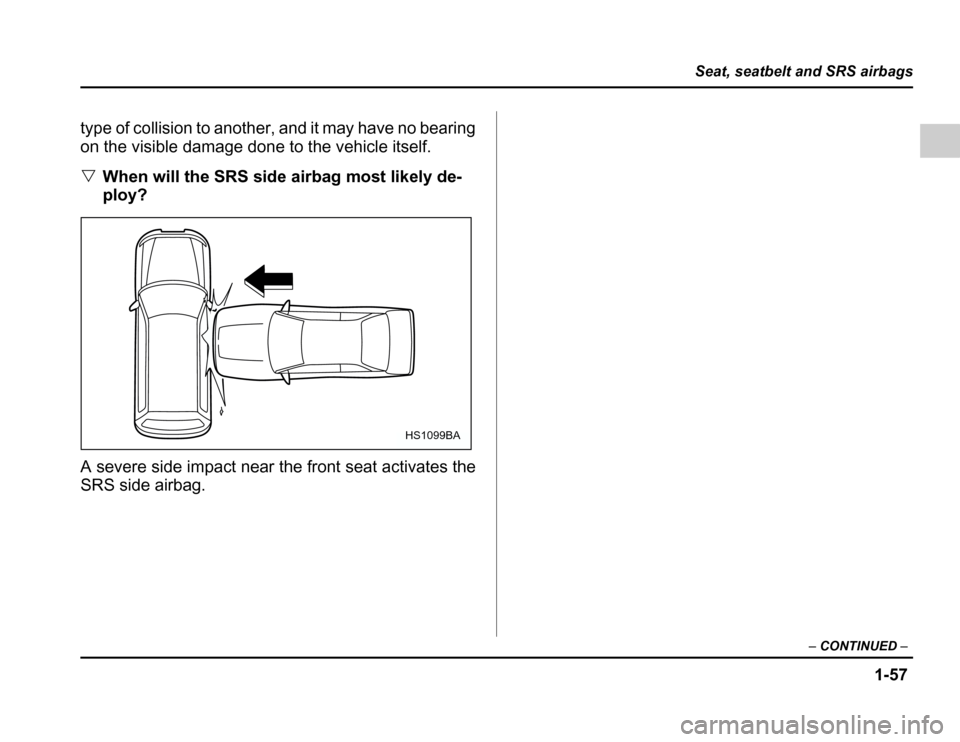
type of collision to another, and it may have no bearing
on the visible damage done to the vehicle itself. When will the SRS side airbag most likely de-
ploy?
A severe side impact near the front seat activates the
SRS side airbag.
HS1099BA
Page 85 of 420
1-58
Seat, seatbelt and SRS airbags
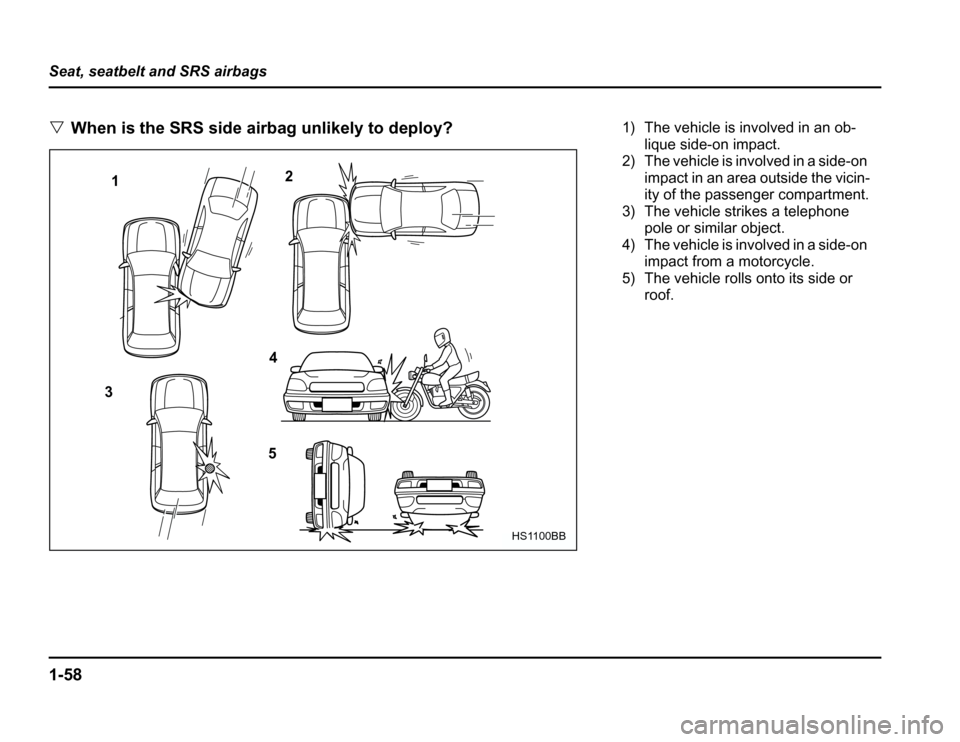
When is the SRS side airbag unlikely to deploy?
1 2
3 4
5
HS1100BB
1) The vehicle is involved in an ob- lique side-on impact.
2) The vehicle is involved in a side-on impact in an area outside the vicin-
ity of the passenger compartment.
3) The vehicle strikes a telephone pole or similar object.
4) The vehicle is involved in a side-on impact from a motorcycle.
5) The vehicle rolls onto its side or
roof.
Page 86 of 420
1-59
Seat, seatbelt and SRS airbags
–CONTINUED –
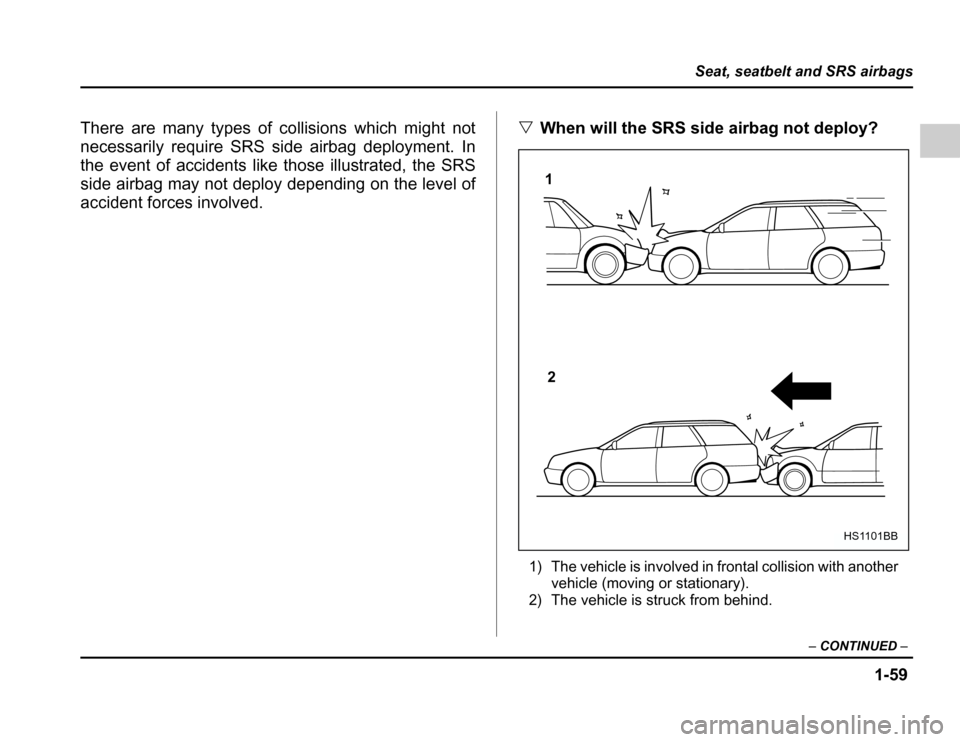
There are many types of collisions which might not
necessarily require SRS side airbag deployment. In
the event of accidents like those illustrated, the SRS
side airbag may not deploy depending on the level of
accident forces involved.
When will the SRS side airbag not deploy?
1) The vehicle is involved in frontal collision with another vehicle (moving or stationary).
2) The vehicle is struck from behind.
1
2
HS1101BB