2003 SUBARU FORESTER wheel
[x] Cancel search: wheelPage 246 of 420

7-13
Starting and operating
–CONTINUED –
When shifting down a gear, ensure that the ve-
hicle is not traveling at a speed exceeding the
Maximum Allowable Speed for the gear which
is about to be selected. Failure to observe this
precaution can lead to engine over-revving and
this in turn can result in engine damage.
In addition, sudden application of engine
brakes when the vehicle is travelling on a slip-
pery surface can lead to wheel locking; as a
consequence, control of the vehicle may be lost
and the risk of an accident increased.
Driving tips
Do not drive with your foot resting on the clutch pedal
and do not use the clutch to hold your vehicle at a
standstill on an upgrade. Either of those actions may
cause clutch damage.
Do not drive with your hand resting on the shift lever.
This may cause wear on the transmission compo- nents.
When it is necessary to reduce vehicle speed due to
slow traffic, turning corners, or driving up steep hills,
downshift to a lower gear before the engine starts to labor.
On steep downgrades, downshift the transmission to
4th, 3rd or 2nd gear as necessary; this helps to main-
tain a safe speed and to extend brake pad life.
In this way, the engine provides a braking effect. Re-
member, if you “ride” (over use) the brakes while de-
scending a hill, they may overheat and not work
properly.
Page 249 of 420
7-16
Starting and operating
A shift interlock function is employed in the automatic
transmission system to ensure safe starting of the ve-
hicle.
To shift the selector lever from the “P” to the any other
position, you have to depress the brake pedal fully
when the ignition switch is in the “ON” position. This
prevents the vehicle from lurching when it is started.
If the shift lever does not move from the “P” position
with the brake pedal depressed, refer to the “Shift lock
release” section in this chapter.
R (Reverse)
This position is for backing the vehicle.
To shift from the “N” to “R” position, first stop the vehi-
cle completely then move the lever to the “R” position. N(Neutral)
This position is for restarting a stalled engine.
In this position the wheels and transmission are not
locked. In this position, the transmission is neutral; the
vehicle will roll freely, even on the slightest incline un-
less the parking brake or foot brake is on.
Do not drive the vehicle with the selector lever
in the “N” (neutral) pos ition. Engine braking has no effect in this condition and the risk of an
accident is consequently increased.
D(Drive)
This position is for normal driving.
The transmission automatically shifts into a suitable
gear from 1st to 4th according to the vehicle speed
and the acceleration you require.
When more acceleration is required in this position,
press the accelerator pedal fully to the floor and hold
that position. The transmission will automatically
downshift to 3rd, 2nd or 1st gear. When you release
the pedal, the transmission will return to the original
gear position. While climbing a grade
When driving up hill, undesired upshift to 4th gear is
prevented from taking place when the accelerator
pedal is released. This minimizes the chances of sub-
sequent downshifting to a lower gear when accelerat-
ing again. This prevents repeated upshifting and
downshifting resulting in a smoother operation of the vehicle.
NOTE
The transmission may downshift to 2nd or 1st
Page 251 of 420
7-18
Starting and operating
ter’s needle will enter the red area if these speeds are
exceeded.
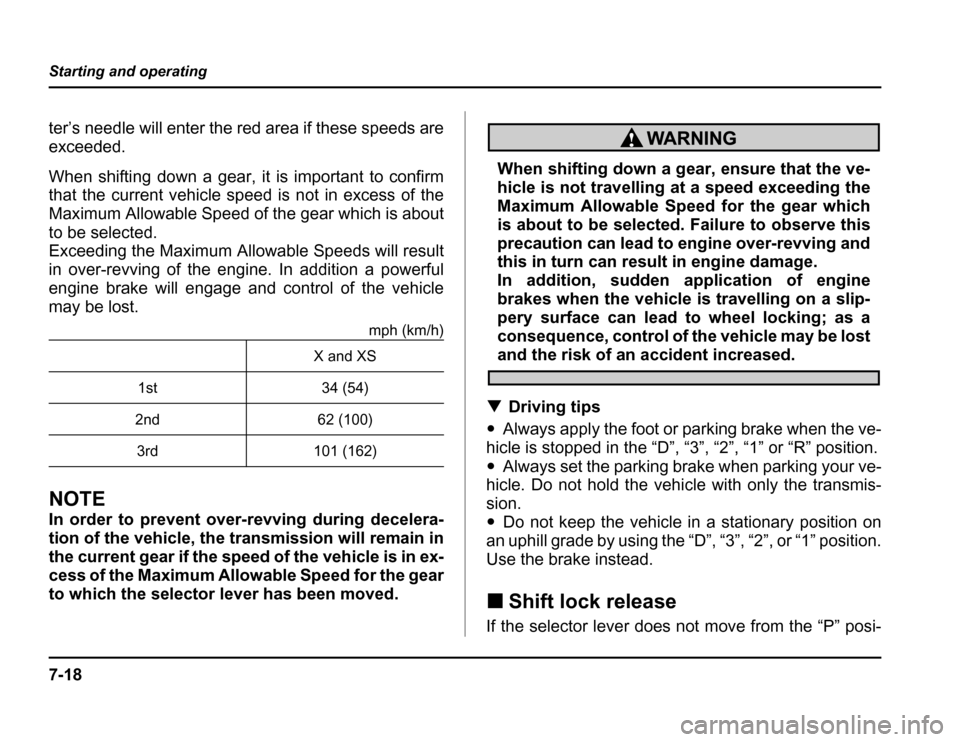
When shifting down a gear, it is important to confirm
that the current vehicle speed is not in excess of the
Maximum Allowable Speed of the gear which is about
to be selected.
Exceeding the Maximum Allowable Speeds will result
in over-revving of the engine. In addition a powerful
engine brake will engage and control of the vehicle
may be lost.
mph (km/h)
NOTE
In order to prevent over-revving during decelera-
tion of the vehicle, the transmission will remain in
the current gear if the speed of the vehicle is in ex-
cess of the Maximum Allowable Speed for the gear
to which the selector lever has been moved.
When shifting down a gear, ensure that the ve-
hicle is not travelling at a speed exceeding the
Maximum Allowable Speed for the gear which
is about to be selected. Failure to observe this
precaution can lead to engine over-revving and
this in turn can result in engine damage.
In addition, sudden application of engine
brakes when the vehicle is travelling on a slip-
pery surface can lead to wheel locking; as a
consequence, control of the vehicle may be lost
and the risk of an accident increased.
Driving tips
Always apply the foot or parking brake when the ve-
hicle is stopped in the “D”, “3”, “2”, “1” or “R” position. Always set the parking brake when parking your ve-
hicle. Do not hold the vehicle with only the transmis-
sion. Do not keep the vehicle in a stationary position on
an uphill grade by using the “D”, “3”, “2”, or “1” position.
Use the brake instead. Shift lock release
If the selector lever does not move from the “P” posi-
X and XS
1st 34 (54)
2nd 62 (100)
3rd 101 (162)
Page 253 of 420
7-20
Starting and operating
Rear viscous limited slip differential
(LSD) (if equipped)
The LSD provides optimum distribution of power ac-
cording to the difference in revolutions between the
right and left rear wheels that may be caused by cer-
tain driving conditions, thereby improving driving sta-
bility on snow-covered, muddy or other slippery roads.
Never start the engine while a tire on one side
is jacked up, as the vehicle may move. If one rear tire is spinning in mud, avoid con-
tinued spinning at high speed as this could ad-
versely affect the LSD. If a different size rear tire is temporarily used
(as in an emergency), it will adversely affect the
LSD. Always replace it with a regular size tire as
soon as possible.
Power steering
The power steering system operates only when the
engine is running.
If you lose power steering assist because the engine
stops or the system fails to function, you can steer but
it will take much more effort.
NOTE
Right after the engine has been started and before
it has warmed up, you may hear a noise coming
from areas adjacent to the power steering pump
which is located at the right-front area of the en-
gine compartment. This noise is normal. It does
not indicate power steering system trouble.
Do not hold the steering wheel at the fully
locked position left or right for more than five
seconds. This may damage the power steering
pump.
Page 255 of 420
7-22
Starting and operating
than normal and the braking distance will increase.
Disc brake pad wear warning indica- tors
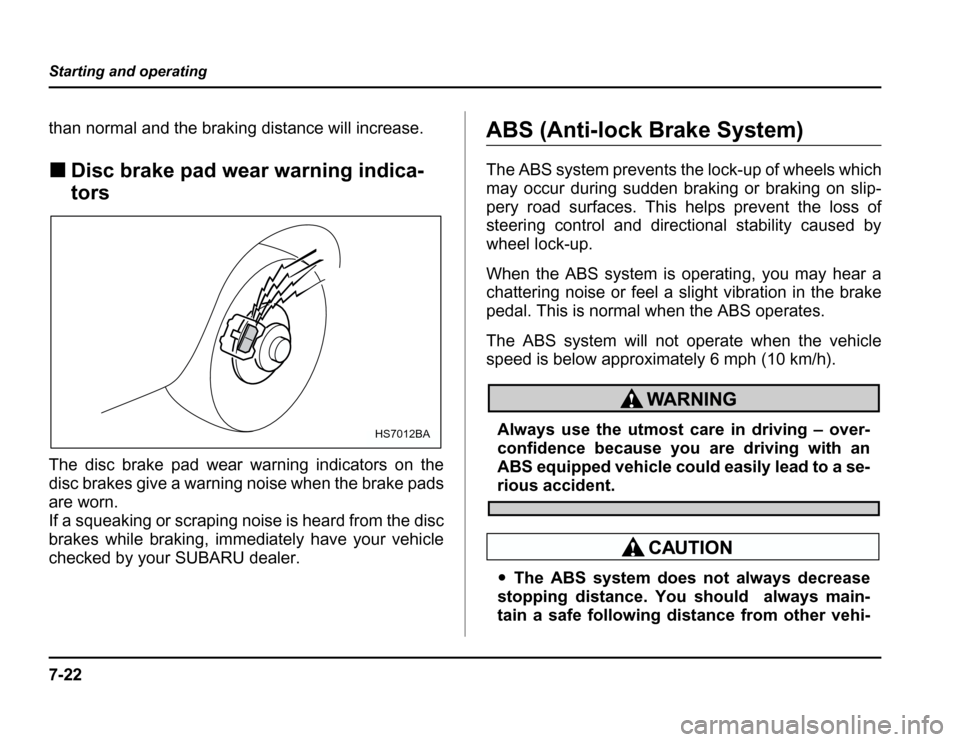
The disc brake pad wear warning indicators on the
disc brakes give a warning noise when the brake pads
are worn.
If a squeaking or scraping noise is heard from the disc
brakes while braking, immediately have your vehicle
checked by your SUBARU dealer.ABS (Anti-lock Brake System)
The ABS system prevents the lock-up of wheels which
may occur during sudden braking or braking on slip-
pery road surfaces. This helps prevent the loss of
steering control and directional stability caused by
wheel lock-up.
When the ABS system is operating, you may hear a
chattering noise or feel a slight vibration in the brake
pedal. This is normal when the ABS operates.
The ABS system will not operate when the vehicle
speed is below approximately 6 mph (10 km/h).
Always use the utmost care in driving – over-
confidence because you are driving with an
ABS equipped vehicle could easily lead to a se-
rious accident.
The ABS system does not always decrease
stopping distance. You should always main-
tain a safe following distance from other vehi-
HS7012BA
Page 258 of 420
7-25
Starting and operating
–CONTINUED –
Electronic Brake Force Distribution
(EBD) system (if equipped)
The EBD system maximizes the effectiveness of the
brakes by allowing the rear brakes to supply a greater
proportion of the braking force. It functions by adjust-
ing the distribution of braking force to the rear wheels
in accordance with the vehicle’s loading condition and
speed.
The EBD system is an integral part of the ABS system
and uses some of the ABS system’s components to
perform its function of optimizing the distribution of
braking force. If any of the ABS components used by
the EBD function fails, the EBD system also stops
working.
When the EBD system is operating, you may hear a
chattering noise or feel a slight vibration in the brake
pedal. This is normal and does not indicate a malfunc- tion.
Steps to take if EBD system fails
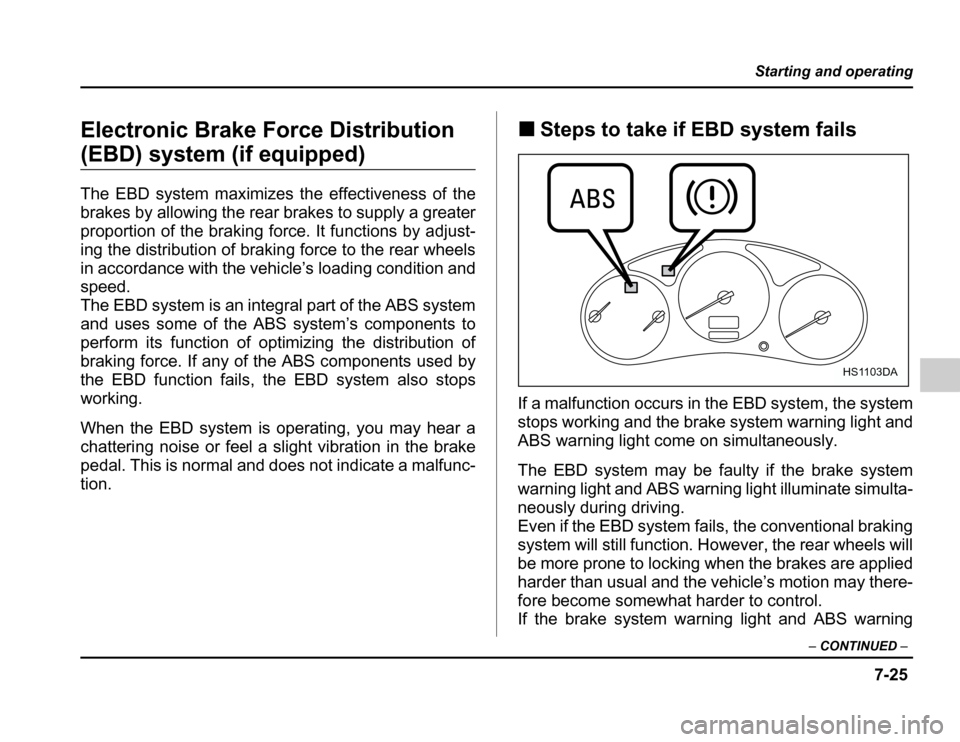
If a malfunction occurs in the EBD system, the system
stops working and the brake system warning light and
ABS warning light come on simultaneously.
The EBD system may be faulty if the brake system
warning light and ABS warning light illuminate simulta-
neously during driving.
Even if the EBD system fails, the conventional braking
system will still function. However, the rear wheels will
be more prone to locking when the brakes are applied
harder than usual and the vehicle’s motion may there-
fore become somewhat harder to control.
If the brake system warning light and ABS warning
HS1103DA
Page 261 of 420
7-28
Starting and operating
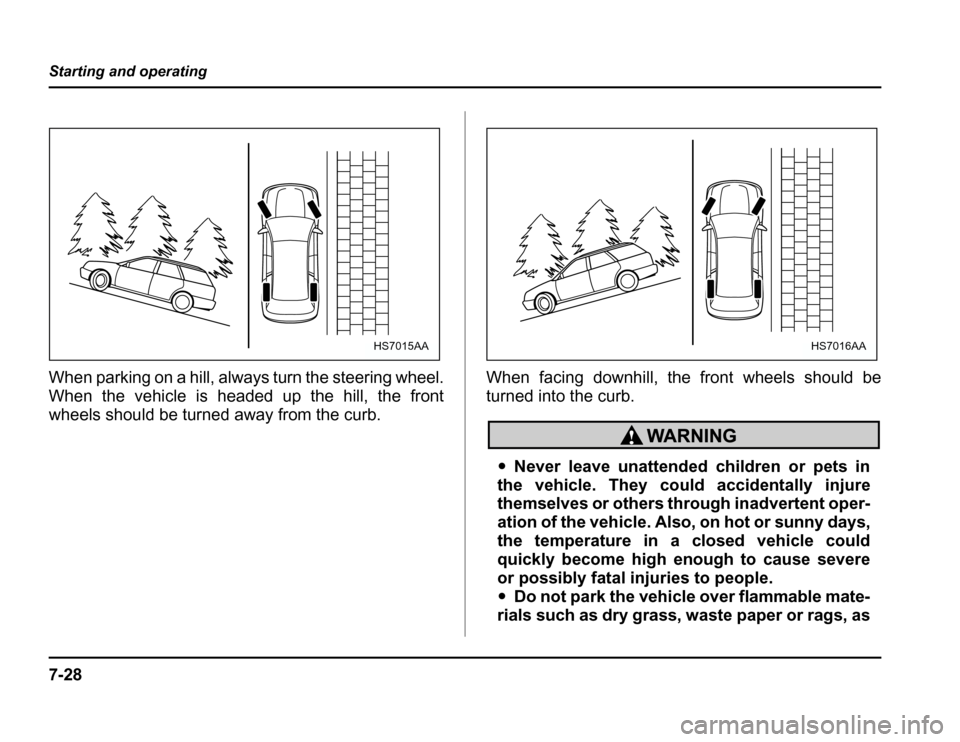
When parking on a hill, always turn the steering wheel.
When the vehicle is headed up the hill, the front
wheels should be turned away from the curb.
When facing downhill, the front wheels should be
turned into the curb.
Never leave unattended children or pets in
the vehicle. They could accidentally injure
themselves or others through inadvertent oper-
ation of the vehicle. Also, on hot or sunny days,
the temperature in a closed vehicle could
quickly become high enough to cause severe
or possibly fatal injuries to people. Do not park the vehicle over flammable mate-
rials such as dry grass, waste paper or rags, as
HS7015AAHS7016AA
Page 271 of 420

8-2
Driving tips
Driving tips
New vehicle break-in driving – the
first 1,000 miles (1,600 km)
The performance and long life of your vehicle are de-
pendent on how you handle and care for your vehicle
while it is new. Follow these instructions during the
first 1,000 miles (1,600 km):
Do not race the engine. And do not allow engine
speed to exceed 4,000 rpm except in an emergency. Do not drive at one constant engine or vehicle
speed for a long time, either fast or slow. Avoid starting suddenly and rapid acceleration, ex-
cept in an emergency. Avoid hard braking, except in an emergency.
The same break-in procedures should be applied to
an overhauled engine, newly mounted engine or when
brake pads or brake linings are replaced with new
ones.
Fuel economy hints
The following suggestions will help to save your fuel. Select the proper gear position for the speed and
road conditions. Avoid sudden acceleration or deceleration. Always
accelerate gently until you reach the desired speed.
Then try to maintain that speed for as long as possible. Do not pump the accelerator and avoid racing the
engine. Avoid unnecessary engine idling.
Keep the engine properly tuned.
Keep the tires inflated to the correct pressure shown
on the tire placard, which is located under the door
latch on the driver’s side. Low pressure will increase
tire wear and fuel consumption. Use the air conditioner only when necessary.
Keep the front and rear wheels in proper alignment.
Avoid carrying unnecessary cargo.