Page 306 of 420

9-1
9
In case of emergency
If you park your vehicle in case of an
emergency .................................................... 9-2
Flat tires ........................................................ 9-3 Changing a flat tire ......................................... 9-3
Jump starting ............................................... 9-9 How to jump start ........................................... 9-10
Engine overheating ...................................... 9-12 If steam is coming from the engine
compartment ................................................... 9-12
If no steam is coming from the engine
compartment ................................................... 9-12
Towing .......................................................... 9-13 Towing and tie-down hooks .......................... 9-13
Using a flat-bed truck ..................................... 9-15
Towing with all wheels on the ground .......... 9-15
Rear gate — if the rear gate cannot be
unlocked ....................................................... 9-17
Moonroof – if the moonroof cannot be
closed ............................................................ 9-18
Maintenance tools ........................................ 9-19 Jack and jack handle ...................................... 9-19
Page 308 of 420
9-3
In case of emergency
–CONTINUED –
Flat tires
If you have a flat tire while driving, never brake sud-
denly; keep driving straight ahead while gradually re-
ducing speed. Then slowly pull off the road to a safe
place. Changing a flat tire
Do not jack up the vehicle on an incline or a
loose road surface. The jack can come out of
the jacking point or sink into the ground and
this can result in a severe accident. Use only the jack provided with your vehicle.
The jack supplied with the vehicle is designed
only for changing a tire. Never get under the ve-
hicle while supporting the vehicle with this jack. Always turn the engine off before raising the
flat tire off the ground using the jack. Never
swing or push the vehicle supported with the
jack. The jack can come out of the jacking point
due to a jolt and this can result in a severe acci-
dent. 1. Park on a hard, level surface, whenever possible,
then stop the engine.
2. Set the parking brake securely and shift a manual
transmission vehicle in reverse or an automatic trans-
mission vehicle in the “P” (Park) position.
3. Turn on the hazard warning flasher and have ev-
eryone get out of the vehicle.
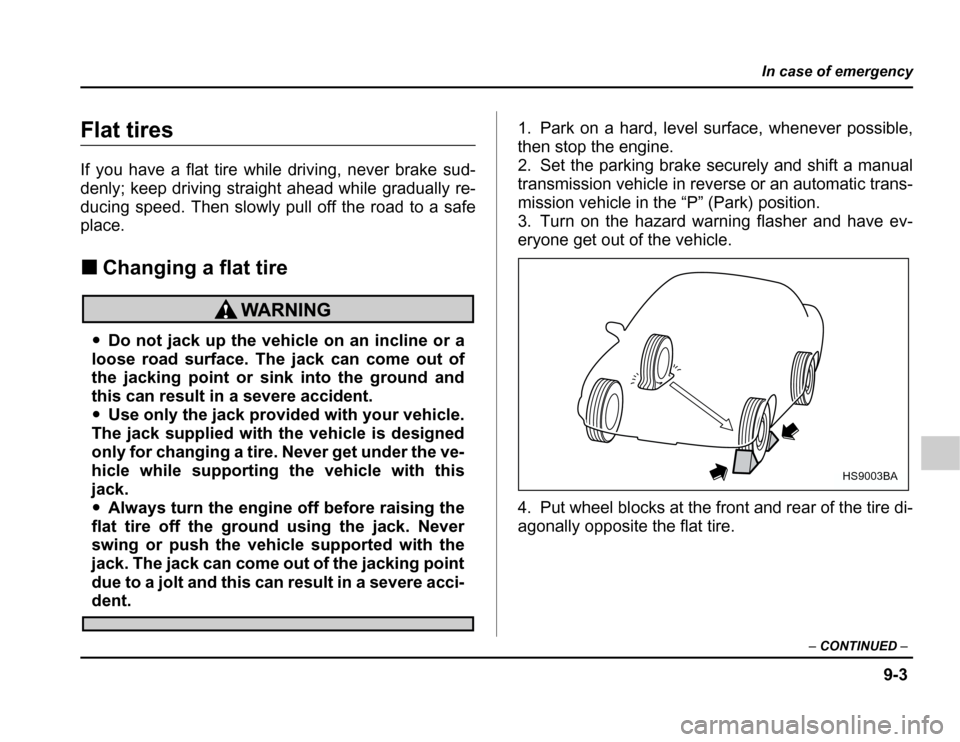
4. Put wheel blocks at the front and rear of the tire di-
agonally opposite the flat tire.
HS9003BA
Page 325 of 420
9-20
In case of emergency
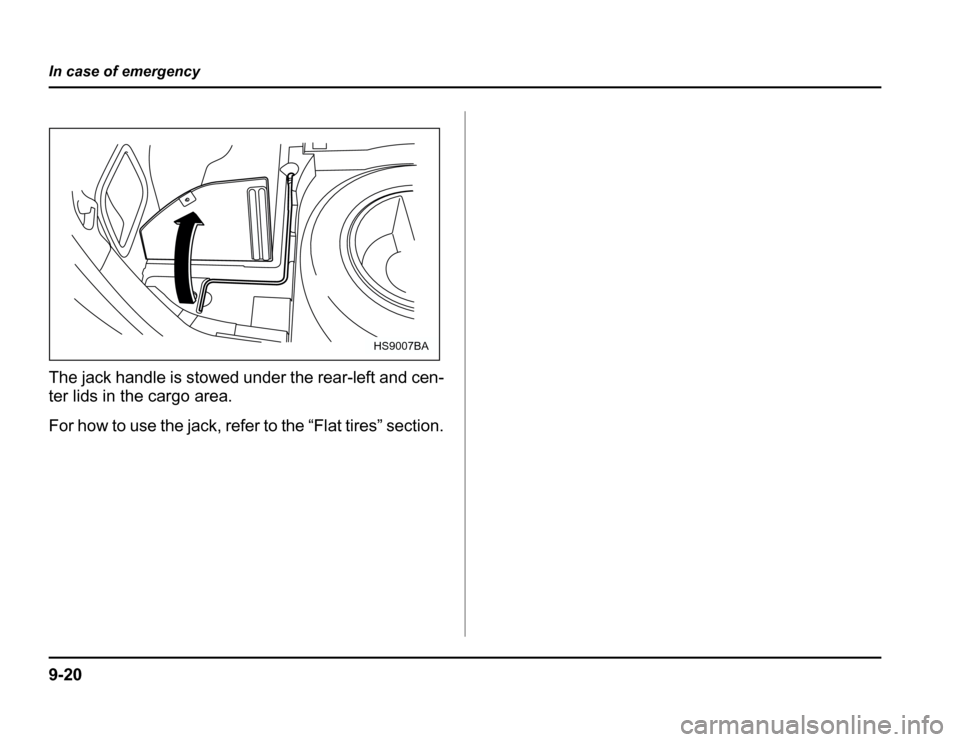
The jack handle is stowed under the rear-left and cen-
ter lids in the cargo area.
For how to use the jack, refer to the “Flat tires” section.
HS9007BA
Page 332 of 420

11 - 1
11
Maintenance and service
Maintenance schedule ................................ 11-3
Maintenance precautions ........................... 11-3 Before checking or servicing in the engine
compartment ................................................... 11-4
When you do checking or servicing in the
engine compartment while the engine is
running ............................................................. 11-5
Engine hood ................................................. 11-5
Engine compartment overview .................. 11-8
Engine oil ..................................................... 11-9 Checking the oil level ..................................... 11-9
Changing the oil and oil filter ........................ 11-10
Recommended grade and viscosity .............. 11-12
Recommended grade and viscosity under
severe driving conditions .............................. 11-14
Synthetic oil ..................................................... 11-14
Cooling system ............................................ 11-14 Cooling fan, hose and connections .............. 11-15
Engine coolant ................................................ 11-15
Air cleaner element ..................................... 11-19 Replacing the air cleaner element ................. 11-19
Spark plugs .................................................. 11-20 Recommended spark plugs ........................... 11-21
Drive belts .................................................... 11-21
Manual transmission oil .............................. 11-22 Checking the oil level ..................................... 11-22
Recommended grade and viscosity .............. 11-23
Automatic transmission fluid ..................... 11-24 Checking the fluid level .................................. 11-24 Recommended fluid ....................................... 11-25
Front differential gear oil (AT vehicles) ..... 11-26 Checking the oil level ..................................... 11-26
Recommended grade and viscosity ............. 11-26
Rear differential gear oil .............................. 11-27 Checking the gear oil level ............................ 11-27
Recommended grade and viscosity ............. 11-28
Power steering fluid ..................................... 11-29 Checking the fluid level .................................. 11-29
Recommended fluid ....................................... 11-30
Brake fluid .................................................... 11-30 Checking the fluid level .................................. 11-30
Recommended brake fluid ............................. 11-31
Clutch fluid (MT vehicles) ........................... 11-31 Checking the fluid level .................................. 11-31
Recommended clutch fluid ............................ 11-32
Brake booster ............................................... 11-32
Brake pedal ................................................... 11-33 Checking the brake pedal free play .............. 11-33
Checking the brake pedal reserve distance . 11-33
Clutch pedal (MT vehicles) .......................... 11-34 Checking the clutch function ........................ 11-34
Checking the clutch pedal free play ............. 11-34
Hill holder (MT vehicles — if equipped) ..... 11-35
Replacement of brake pad and lining ........ 11-35 Breaking-in of new brake pads and linings .. 11-36
Parking brake stroke ................................... 11-37
Tires and wheels .......................................... 11-37 Types of tires .................................................. 11-37
Page 368 of 420

11 -3 7
Maintenance and service
–CONTINUED –
Parking brake stroke
Check the parking brake stroke according to the main-
tenance schedule in the “Warranty and Maintenance
Booklet”. When the parking brake is properly adjusted,
braking power is fully applied by pulling the lever up
seven to eight notches gently but firmly (about 44 lb,
196 N, 20 kg). If the parking brake lever stroke is not
within the specified range, have the brake system
checked and adjusted at your SUBARU dealer.Tires and wheels Types of tires
You should be familiar with type of tires present on
your vehicle. All season tires
The factory-installed tires on your new vehicle are all
season tires.
All season tires are designed to provide an adequate
measure of traction, handling and braking perfor-
mance in year-round driving including snowy and icy
road conditions. However all season tires do not offer
as much traction performance as winter (snow) tires in
heavy or loose snow or on icy roads.
All season tires are identified by “ALL SEASON” and/
or “M+S” (Mud & Snow) on the tire sidewall. Summer tires
Summer tires are high-speed capability tires best suit-
ed for highway driving under dry conditions.
Summer tires are inadequate for driving on slippery
roads such as on snow-covered or icy roads.
If you drive your vehicle on snow-covered or icy roads,
we strongly recommend the use of winter (snow) tires.
When installing winter tires, be sure to replace all four
tires.
HS7014CA
Page 369 of 420
11 - 3 8
Maintenance and service
Winter (snow) tires
Winter tires are best suited for driving on snow-cov-
ered and icy roads. However winter tires do not per-
form as well as summer tires and all season tires on
roads other than snow-covered and icy roads. Tire inspection
Check on a daily basis that the tires are free from se-
rious damage, nails, and stones. At the same time,
check the tires for abnormal wear.
Contact your SUBARU dealer immediately if you find
any problem.
NOTE When the wheels and tires strike curbs or are
subjected to harsh treatment as when the vehicle
is driven on a rough surface, they can suffer dam-
age that cannot be seen with the naked eye. This
type of damage does not become evident until
time has passed. Try not to drive over curbs, pot-
holes or on other rough surfaces. If doing so is un-
avoidable, keep the vehicle
Page 370 of 420
11 -3 9
Maintenance and service
–CONTINUED –
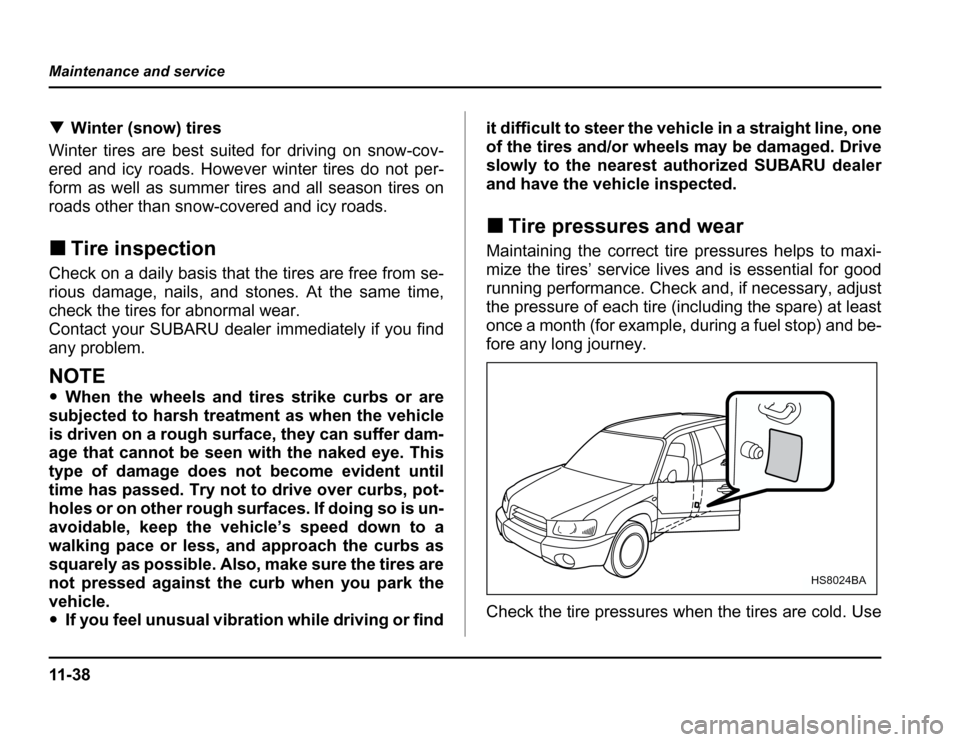
a pressure gauge to adjust the tire pressures to the
values shown on the tire placard. The tire placard is lo-
cated on the door pillar on the driver’s side.
Driving even a short distance warms up the tires and
increases the tire pressures. Also, the tire pressures
are affected by the ambient temperature. It is best to
check tire pressure outdoors before driving the vehi- cle.
When a tire becomes warm, the air inside it expands,
causing the tire pressure to increase. Be careful not to
mistakenly release air from a warm tire to reduce itspressure.
NOTE The air pressure in a tire increases by approxi-
mately 4.3 psi (30 kPa, 0.3 kg/cm 2
)whenthetire
becomes warm. The tires are considered cold when the vehicle
has been parked for at least three hours or has
been driven less than one mile (1.6 km).
Do not let air out of warm tires to adjust press-
rue. Doing so will result in low tire pressure. Incorrect tire pressures detract from controllability and
ride comfort, and they cause the tires to wear abnor-mally.
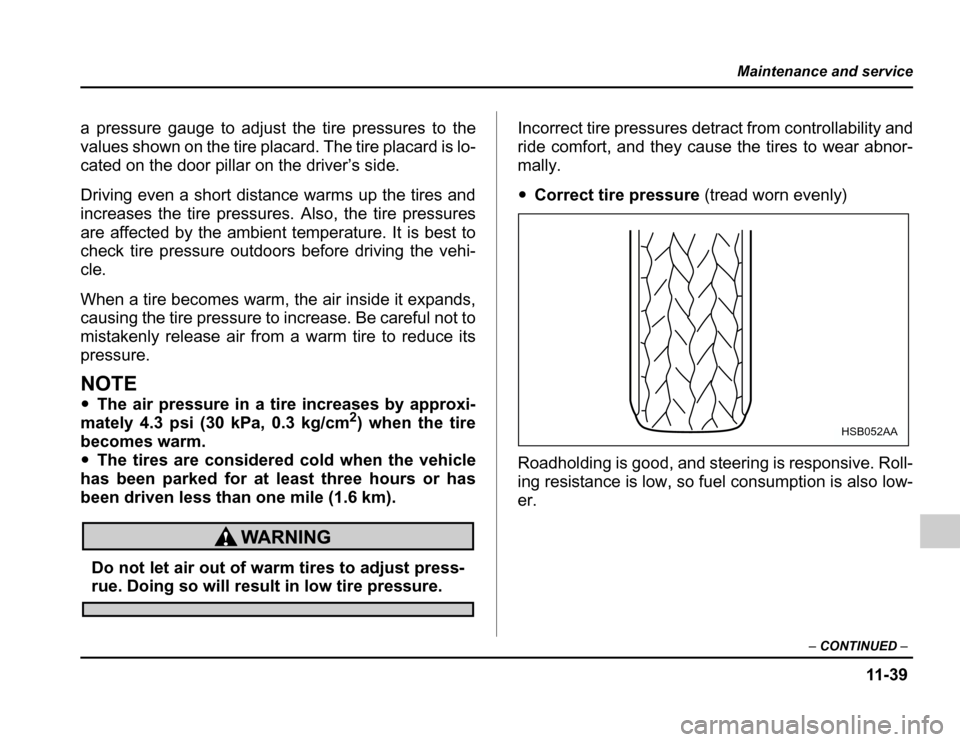
Correct tire pressure (tread worn evenly)
Roadholding is good, and steering is responsive. Roll-
ing resistance is low, so fuel consumption is also low-er.
HSB052AA
Page 371 of 420
11 - 4 0
Maintenance and service
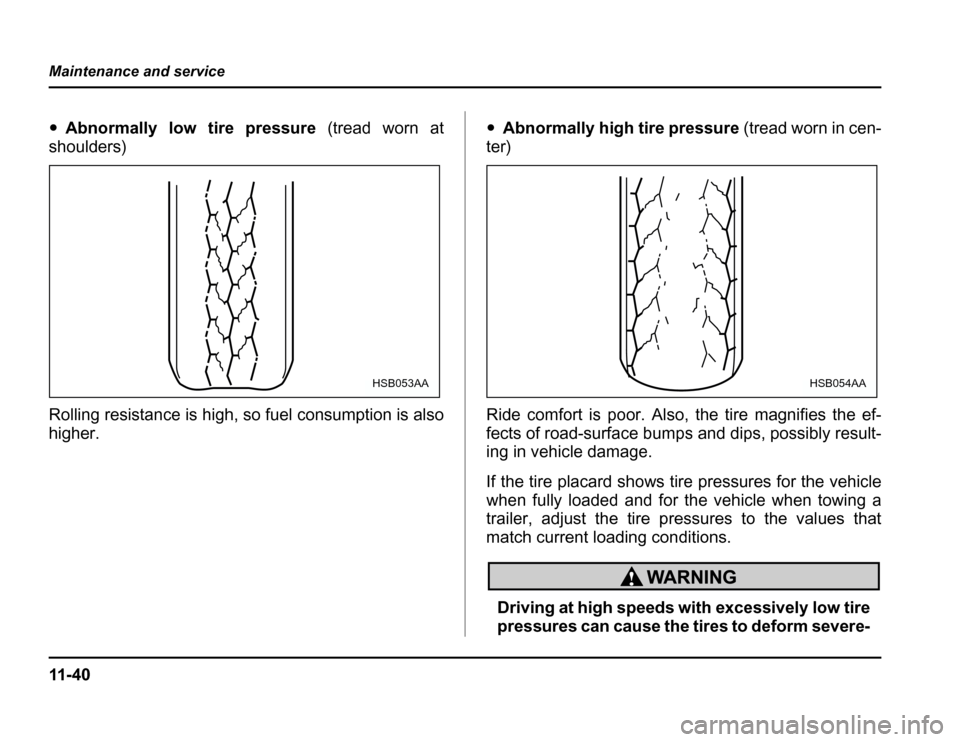
Abnormally low tire pressure (tread worn at
shoulders)
Rolling resistance is high, so fuel consumption is also
higher.
Abnormally high tire pressure (tread worn in cen-
ter)
Ride comfort is poor. Also, the tire magnifies the ef-
fects of road-surface bumps and dips, possibly result-
ing in vehicle damage.
Ifthetireplacardshowstirepressuresforthevehicle
when fully loaded and for the vehicle when towing a
trailer, adjust the tire pressures to the values that
match current loading conditions.
Driving at high speeds with excessively low tire
pressures can cause the tires to deform severe-
HSB053AAHSB054AA