Page 218 of 400
7-12
The manual transmission is a fully synchromeshed 5-forward and 1-re-
verse speed transmission.
OM-H2241
The shift pattern is shown on the shift lever knob. When shifting from 5th
gear to reverse gear, first return the shift lever to the neutral position then
shift into reverse gear.
To change gears, fully depress the clutch pedal, move the shift lever, and gradually let up on the clutch pedal.
If it is difficult to shift into gear, put the transmission in neutral, release the
clutch pedal momentarily, and then try again.Shifting speeds
n Recommended shifting speeds
The best compromise between fuel economy and vehicle perfor-
mance during normal driving is ensured by shifting up at the speedslisted in the following table.
Shift up
mph (km/h)
1st to 2nd15 (24)
2nd to 3rd25 (40)
3rd to 4th40 (65)
4th to 5th45 (73)
Page 219 of 400
Starting and operating7-13
–
CONTINUED –
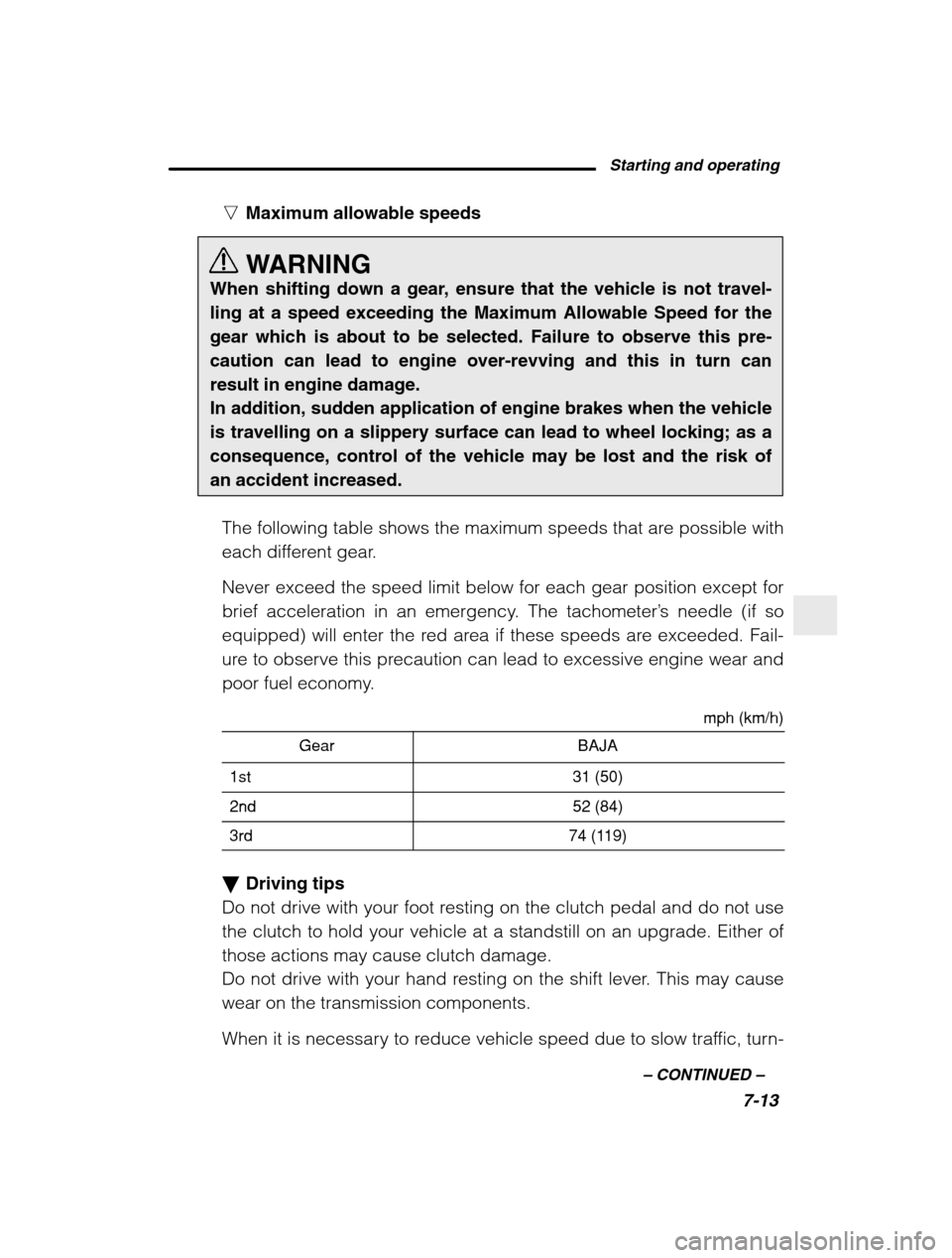
nMaximum allowable speeds
WARNING
When shifting down a gear, ensure that the vehicle is not travel- ling at a speed exceeding the Maximum Allowable Speed for thegear which is about to be selected. Failure to observe this pre-caution can lead to engine over-revving and this in turn canresult in engine damage.In addition, sudden application of engine brakes when the vehicleis travelling on a slippery surface can lead to wheel locking; as a
consequence, control of the vehicle may be lost and the risk ofan accident increased.
The following table shows the maximum speeds that are possible with
each different gear. Never exceed the speed limit below for each gear position except for
brief acceleration in an emergency. The tachometer ’s needle (if so
equipped) will enter the red area if these speeds are exceeded. Fail-
ure to observe this precaution can lead to excessive engine wear and
poor fuel economy.
mph (km/h)
Gear
BAJA
1st31 (50)
2nd52 (84)
3rd74 (119)
Driving tips
Do not drive with your foot resting on the clutch pedal and do not use the clutch to hold your vehicle at a standstill on an upgrade. Either ofthose actions may cause clutch damage.
Do not drive with your hand resting on the shift lever. This may causewear on the transmission components.
When it is necessary to reduce vehicle speed due to slow traffic, turn-
Page 220 of 400
7-14
ing corners, or driving up steep hills, downshift to a lower gear before
the engine starts to labor.
On steep downgrades, downshift the transmission to 4th, 3rd or 2nd
gear as necessary; this helps to maintain a safe speed and to extendbrake pad life.
In this way, the engine provides a braking effect. Remember, if you
“ride” (over use) the brakes while descending a hill, they may over-
heat and not work properly.
The engine may, on rare occasions, knock when the vehicle rapidly
accelerates or rapidly pulls away from a standstill. This phenomenondoes not indicate a fault.
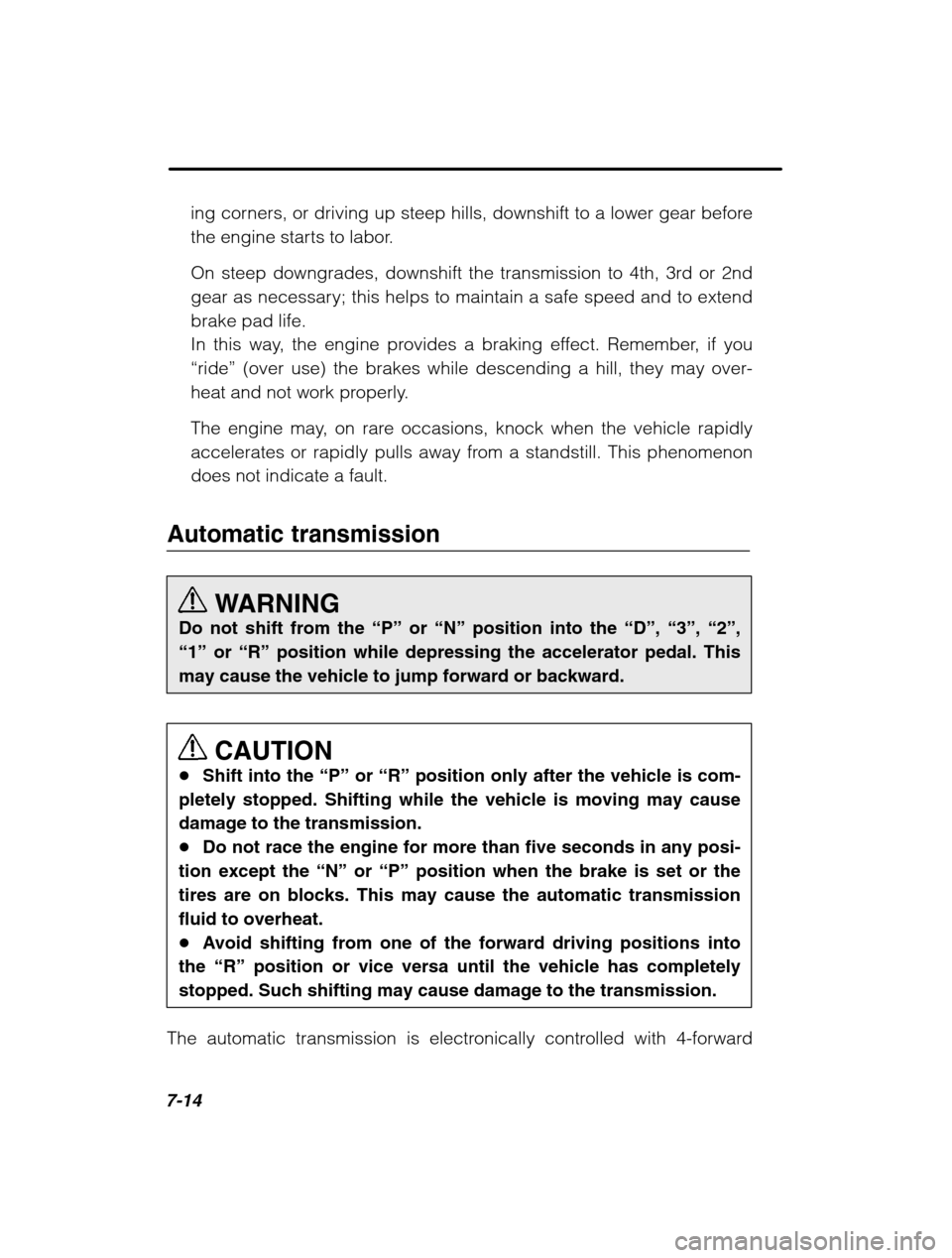
Automatic transmission
WARNING
Do not shift from the “P” or “N” position into the “D”, “3”, “2”,
“1” or “R” position while depressing the accelerator pedal. This
may cause the vehicle to jump forward or backward.
CAUTION
Shift into the “P” or “R” position only after the vehicle is com-
pletely stopped. Shifting while the vehicle is moving may cause
damage to the transmission. Do not race the engine for more than five seconds in any posi-
tion except the “N” or “P” position when the brake is set or the
tires are on blocks. This may cause the automatic transmissionfluid to overheat. Avoid shifting from one of the forward driving positions into
the “R” position or vice versa until the vehicle has completely
stopped. Such shifting may cause damage to the transmission.
The automatic transmission is electronically controlled with 4-forward
Page 221 of 400
Starting and operating7-15
–
CONTINUED –
speeds and 1-reverse speed. NOTE
Immediately after a disconnected battery is reconnected or ATF (au- tomatic transmission fluid) is replaced, you may feel that the auto-matic transmission operation is somewhat unusual.This results from erasure or invalidation of data the on-board com-puter has collected and stored in memory to allow the transmissionto shift at the most appropriate times for the current condition ofyour vehicle. Optimized shifting will be restored as the vehicle con-tinues to be driven for a while. Selector lever
HB7010AA
HB7036BB
The selector lever has seven positions.
Page 222 of 400
7-16
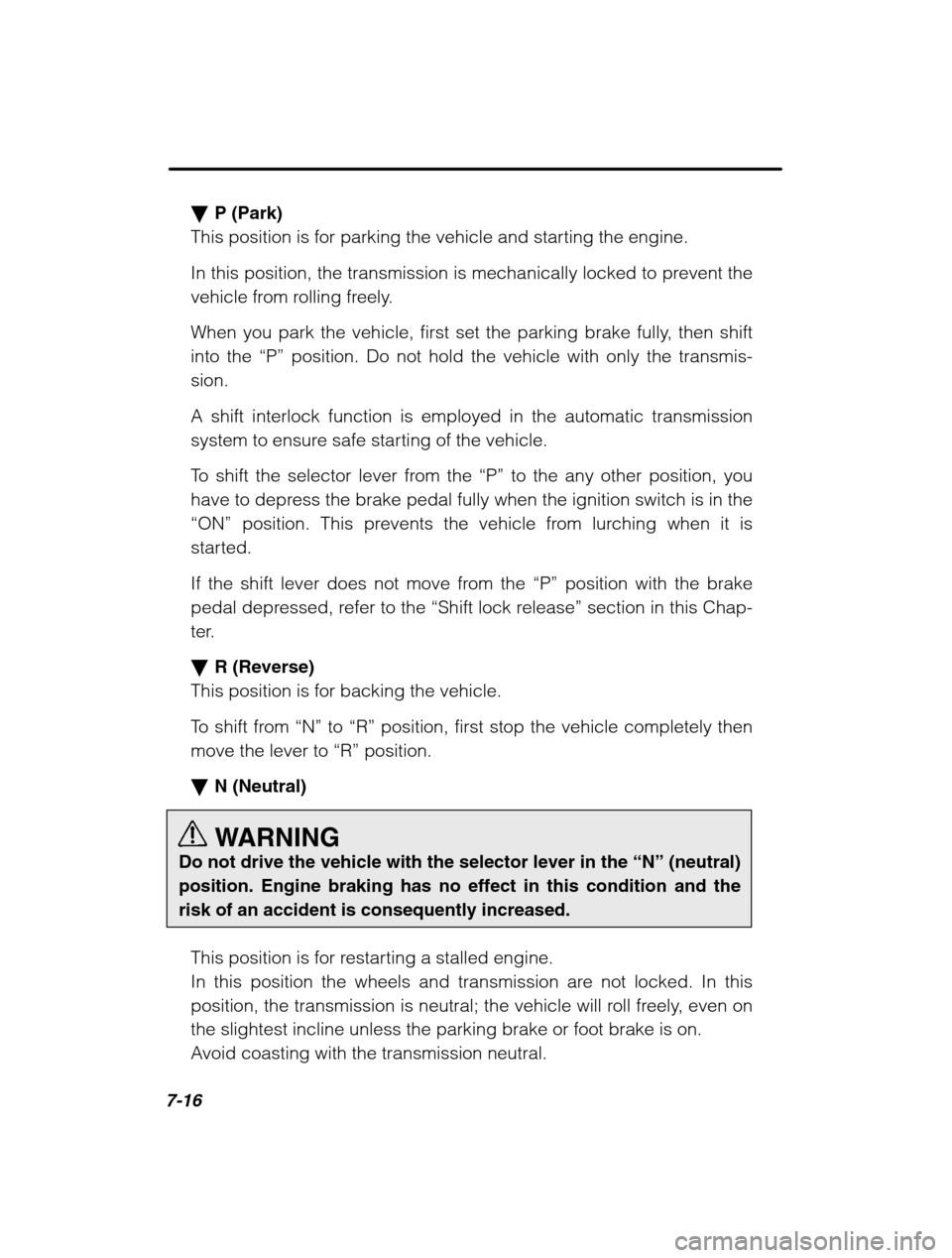
P (Park)
This position is for parking the vehicle and starting the engine.
In this position, the transmission is mechanically locked to prevent the
vehicle from rolling freely.
When you park the vehicle, first set the parking brake fully, then shift
into the “P” position. Do not hold the vehicle with only the transmis-
sion. A shift interlock function is employed in the automatic transmission
system to ensure safe starting of the vehicle.
To shift the selector lever from the “P” to the any other position, you
have to depress the brake pedal fully when the ignition switch is in the
“ON” position. This prevents the vehicle from lurching when it is
started.
If the shift lever does not move from the “P” position with the brake
pedal depressed, refer to the “Shift lock release ” section in this Chap-
ter. R (Reverse)
This position is for backing the vehicle.
To shift from “N” to “R” position, first stop the vehicle completely then
move the lever to “R” position.
N (Neutral)
WARNING
Do not drive the vehicle with the selector lever in the “N” (neutral)
position. Engine braking has no effect in this condition and the risk of an accident is consequently increased.
This position is for restarting a stalled engine.
In this position the wheels and transmission are not locked. In this
position, the transmission is neutral; the vehicle will roll freely, even onthe slightest incline unless the parking brake or foot brake is on.
Avoid coasting with the transmission neutral.
Page 223 of 400

Starting and operating7-17
–
CONTINUED –
During coasting, the engine braking does not act. D (Drive)
This position is for normal driving.
The transmission automatically shifts into a suitable gear from 1st to
4th according to the vehicle speed and the acceleration you require.
When more acceleration is required in this position, press the acceler- ator pedal fully to the floor and hold that position. The transmission
will automatically downshift to 3rd, 2nd or 1st gear. When you release
the pedal, the transmission will return to the original gear position. n While climbing a grade
When driving up a hill, undesired upshift to 4th gear is prevented from
taking place when the accelerator is released. This minimizes the
chance of subsequent downshifting to a lower gear when accelerat-
ing again. This prevents repeated upshifting and downshifting result-ing in a smoother operation of the vehicle. NOTE
The transmission may downshift to 2nd or 1st gear, depending on the way the accelerator pedal is pressed to accelerate the vehicleagain. n While going down a hill
When descending a steep hill, depressing the brake pedal will cause
the transmission to downshift to 3rd gear, thus applying engine brak-
ing. Reacceleration for a short time will cause the transmission to up-
shift normally. NOTE In some cases, depressing the brake pedal on a downhill grade
does not result in an automatic downshift to 3rd gear. This canhappen when the automatic transmission fluid temperature is
very low, for example, during driving shortly after the vehicle has
been parked for an extended period of time. When the ATF tem-perature has risen to a certain level, automatic downshift normal-ly takes place. In the meantime, downshift manually for engine
Page 224 of 400
7-18
braking as required. Also, downshifting when braking downhill will not occur at
speeds above approximately 50 mph (80 km/h). 3 (Third)
This position is for using engine braking when going down a hill or for
climbing a grade.
The transmission automatically shifts into a suitable gear from 1st to
3rd according to the vehicle speed and the acceleration you require.
When more acceleration is required in this position, press the acceler- ator pedal fully to the floor and hold that position. The transmission
will automatically downshift to 2nd or 1st gear. When you release the
pedal, the transmission will return to the original gear position. 2 (Second)
This position is for using engine braking when going down a hill or for
climbing a steep grade.
In this position, the transmission holds in the 2nd gear.
Use this position when starting off from a standstill on slippery road
surfaces such as mud or snow. It will ensure greater traction. 1 (First)
This position is for driving up or down very steep grades, or driving
through mud or sand, or on slippery surfaces. In this position, the
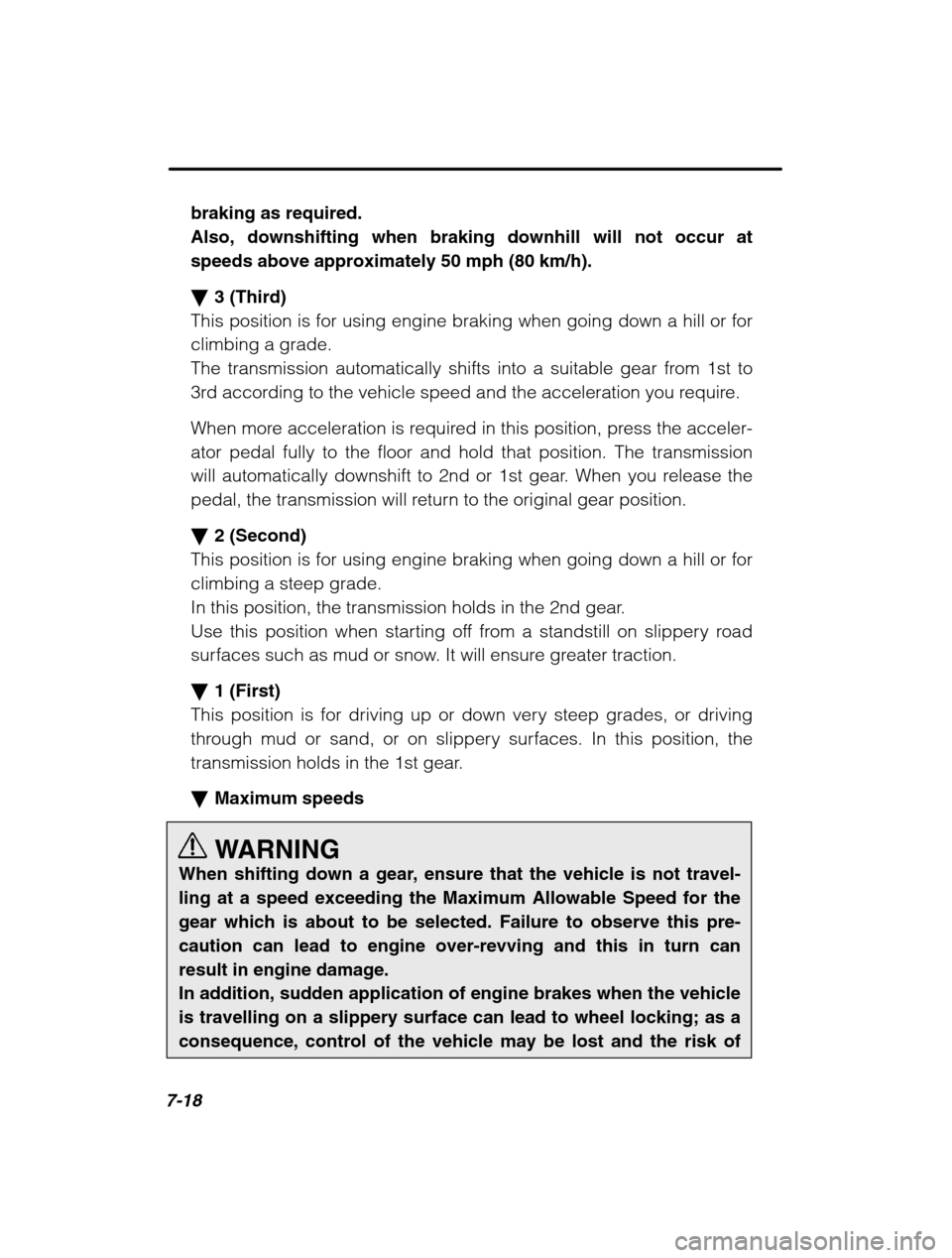
transmission holds in the 1st gear. Maximum speeds
WARNING
When shifting down a gear, ensure that the vehicle is not travel- ling at a speed exceeding the Maximum Allowable Speed for thegear which is about to be selected. Failure to observe this pre-caution can lead to engine over-revving and this in turn canresult in engine damage.In addition, sudden application of engine brakes when the vehicleis travelling on a slippery surface can lead to wheel locking; as a
consequence, control of the vehicle may be lost and the risk of
Page 225 of 400
Starting and operating7-19
–
CONTINUED –
an accident increased.
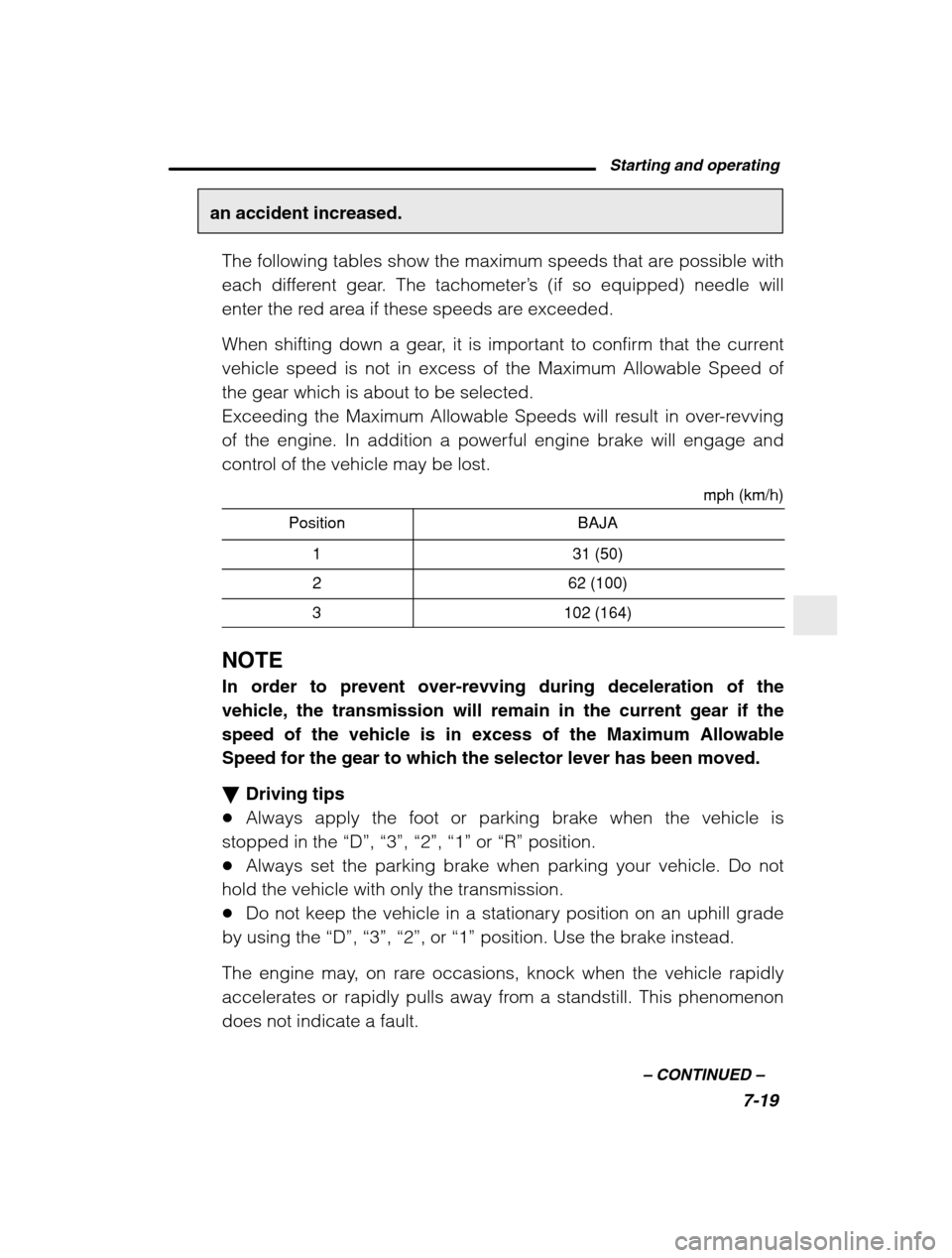
The following tables show the maximum speeds that are possible with
each different gear. The tachometer ’s (if so equipped) needle will
enter the red area if these speeds are exceeded.
When shifting down a gear, it is important to confirm that the current
vehicle speed is not in excess of the Maximum Allowable Speed ofthe gear which is about to be selected.
Exceeding the Maximum Allowable Speeds will result in over-revving
of the engine. In addition a powerful engine brake will engage and
control of the vehicle may be lost.
mph (km/h)
Position
BAJA
131 (50)
262 (100)
3102 (164)
NOTE In order to prevent over-revving during deceleration of the
vehicle, the transmission will remain in the current gear if thespeed of the vehicle is in excess of the Maximum AllowableSpeed for the gear to which the selector lever has been moved. Driving tips
Always apply the foot or parking brake when the vehicle is
stopped in the “D”, “3”, “2”, “1” or “R” position.
Always set the parking brake when parking your vehicle. Do not
hold the vehicle with only the transmission. Do not keep the vehicle in a stationary position on an uphill grade
by using the “D”, “3”, “2”, or “1” position. Use the brake instead.
The engine may, on rare occasions, knock when the vehicle rapidly
accelerates or rapidly pulls away from a standstill. This phenomenondoes not indicate a fault.