2003 SKODA SUPERB wheel
[x] Cancel search: wheelPage 71 of 259
Seats and Stowage
70
– Release the lever and push the seat further until the lock is heard to engage.
Adjusting height of seat
– Lift the seat if required by pulling or pumping lever ⇒page 69, fig. 51 upwards.
– Lower the seat if required by pushing or pumping lever downwards.
Adjusting angle of backrest
– Move forward away from the backrest (do not lean against it).
– Turn the handwheel in order to adjust the angle of the backrest accordingly.
Adjusting lumbar support*
– Turn the handwheel until you have set the most comfort- able curvature of the seat upholstery in the area of your spine.
Adjusting front seats electrically*
Adjusting seats
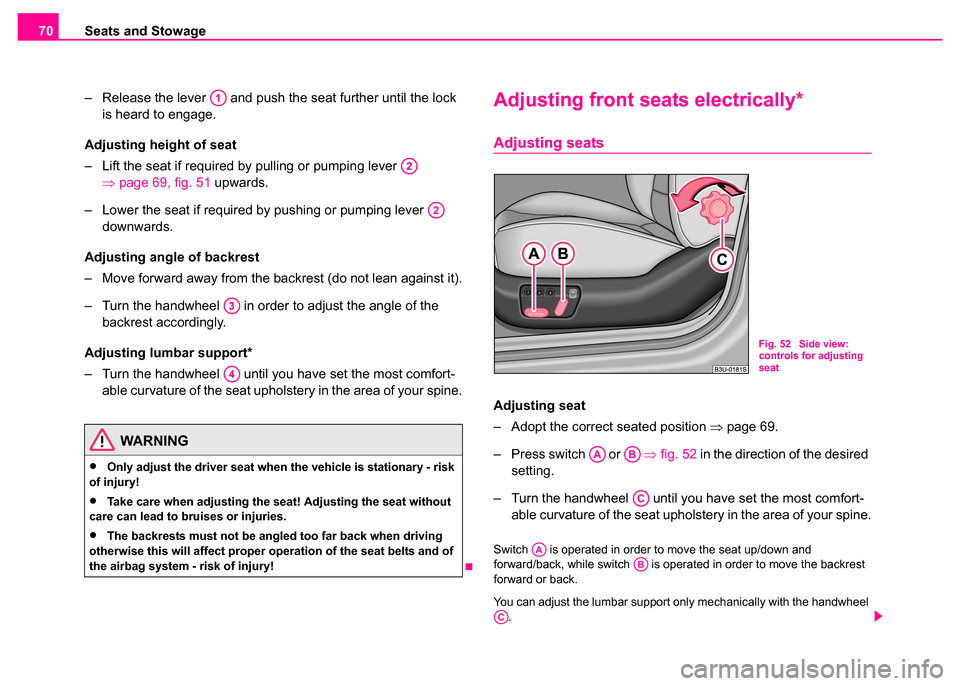
Adjusting seat
– Adopt the correct seated position ⇒page 69.
– Press switch or ⇒fig. 52 in the direction of the desired
setting.
– Turn the handwheel until you have set the most comfort- able curvature of the seat upholstery in the area of your spine.
Switch is operated in order to move the seat up/down and
forward/back, while switch is operated in order to move the backrest
forward or back.
You can adjust the lumbar support only mechanically with the handwheel
.
WARNING
•Only adjust the driver seat when the vehicle is stationary - risk
of injury!
•Take care when adjusting the seat! Adjusting the seat without
care can lead to bruises or injuries.
•The backrests must not be angled too far back when driving
otherwise this will affect proper operation of the seat belts and of
the airbag system - risk of injury!
A1
A2
A2
A3
A4
Fig. 52 Side view:
controls for adjusting
seat
AAAB
AC
AAAB
AC
Page 80 of 259

Seats and Stowage79
Using the systemSafetyDriving TipsGeneral MaintenanceBreakdown assistanceTechnical Data
Note
•You have to adjust the inflation pressure of the tyres to the load of the
car - refer to tyre inflation pressure sticker on the inside of the fuel filler
flap.
•The backrest of the rear seats is a fixed element and can therefore not
be folded forward to increase the size of the luggage compartment!
Lashing eyes
Eyes are located on the sides of the loading area for lashing the goods to
be loaded ⇒fig. 62 .
You can also attach a securing net* to these eyes for lashing small objects.
The securing net* and the fixing instruction is located in the well under the
floor covering of the lugagge compartment behind the spare wheel.
WARNING
•Please note that the handling properties of your vehicle may be
affected when transporting heavy objects as a result of the
displacement of the centre of gravity. The speed and style of
driving must be adjusted accordingly.
•The items carried in the luggage compartment should be stored
in such a way that no objects are able to slip forward if there are
any sudden driving or braking manoeuvres undertaken - risk of
injury!
•Never drive with the boot lid slightly ajar or even fully opened
otherwise exhaust gases may get into the interior of the vehicle -
risk of poisoning!
•On no account exceed the permissible axle loads and the
permissible gross weight of th e vehicle - risk of accident!
WARNING
The load to be transported must be fixed in place in such a way that
it cannot move during the journey and when braking.
Fig. 62 Position of
lashing eyes in luggage
compartment
Page 96 of 259

Seats and Stowage95
Using the systemSafetyDriving TipsGeneral MaintenanceBreakdown assistanceTechnical Data
Storage facilities
An overview
You will find the following storage facilities in your vehicle:
Storage compartment on the front passenger side
The storage compartment on the front passenger side is
lockable* and illuminated.
Opening the storage compartment
– Pull the handle in the lid in direction of arrow ⇒fig. 86 and pull
the lid down.
Closing the stor age compartment
– Raise the lid and press it until the catch is heard to engage.
Locking the storage compartment*
– Turn the master key or emergency key in the lock to the right.
Unlocking the stor age compartment*
– Turn the master key or emergency key in the lock to the left.
First-aid box⇒ page 227
Stowage compartment for warning triangle⇒page 227
Storage compartment on the front passenger
side⇒page 95
Storage drawer*⇒page 96
Stowage compartment in centre console⇒page 97
Stowage compartment for spectacles*⇒page 97
Stowage compartment below steering wheel⇒page 98
Stowage compartment in door panel⇒page 98
Stowage compartment for an umbrella*⇒page 99
Armrest with stowage compartment⇒page 100
Rear armrest with stowage compartment*⇒page 101
Clothes hooks⇒page 101
WARNING
Please do not place anything on top of the dash panel. Such
objects might slide or fall down when driving (when accelerating or
cornering) and may distract you from concentrating on the traffic
situation - risk of accident!
Fig. 86 Dash panel:
Storage compartment
Page 99 of 259

Seats and Stowage
98
Stowage compartment below steering wheel
You can use this stowage compartment, for example, for inserting the car
documentation.
Stowage compartment in door panelWARNING
The storage compartment must always be closed when driving for
safety reasons.
Fig. 91 Dash panel:
Stowage compart-
ments below steering
wheel
WARNING
Use the stowage compartments in the door panels only for small
items which do not project out of the compartment in order to
avoid any interference with the proper operation of the side
airbags.
Fig. 92 Stowage
compartment in door
panel
Page 107 of 259

Heating and air conditioning system
106
Air outlet vents
Fig. 100 Air vents at the front
Fig. 101 Air vents at the rear
Open air outlet vents
– Turn the vertical thumbwheel (not when in the end position). Close air outlet vents
– Turn the vertical thumbwheel into the end position.
Redirecting air flow
– Swivel upward or downward the gr
ille of the vents in order to
change the direction of the air flow using the vertically
arranged thumbwheel.
– Turn the horizontal thumbwheel on the vent to the right or left in order to change the air flow to the appropriate side.
You can set the air supply to the individual vents with the air distribution
control ⇒page 103, fig. 99 . You can also set the vents 3 and 4
⇒ fig. 100 and 6 ⇒ fig. 101 individually.
Unwarmed or cooled air will flow out of the air outlet vents according to the
setting of control dial ⇒page 103, fig. 99 and the atmospheric condi-
tions.
The rear footwell vents 7 are controlled together with the vents 5. Turn the
air distribution control ⇒page 103, fig. 99 into the position
.
Using the air conditioning system economically
The compressor on the air conditioning system uses power from the
engine when in cooling mode which will effect the fuel consumption.
It recommended to open the windows or the doors of a vehicle for which
the interior has been strongly heated through the effect of direct sunlight
in order to allow the heated air to escape.
The air conditioning system should not be switched on while travelling
when the window is open.
AC
AA
AC
Page 113 of 259

Heating and air conditioning system
112
Air outlet vents
Fig. 103 Air vents at the front
Fig. 104 Air vents at the rear
You can also set the vents 3 and 4 ⇒ fig. 103 and 6 ⇒ fig. 104
individually. Open air outlet vents
– Turn the vertical thumbwheel (not when in the end position).
Close air outlet vents
– Turn the vertical thumbwheel into the end position.
Redirecting air flow
– Swivel upward or downward the gr
ille of the vents in order to
change the direction of the air flow using the vertically
arranged thumbwheel.
– Turn the horizontal thumbwheel on the vent to the right or left in order to change the air flow to the appropriate side.
Switching Climatronic system off
If the symbols in the display flash for about 15 seconds
after the ignition is switched on, switch the Climatronic
system off as this indicates an operational fault.
– Continue pressing the button until OFF is shown in the
display ⇒ .
– Drive to the nearest Škoda Dealer and have the Climatronic system checked.
Page 115 of 259

Starting-off and Driving
114
Starting-off and Driving
Setting steering wheel position
You can set the height and the forward/back position of the
steering wheel to the desired position.
– Adjust the driver seat ⇒page 69.
– Pull the lever below the steering column ⇒fig. 105 down
⇒ .
– Set the steering wheel to the desired position (concerning height and forward/back position).
– Then push the lever up against the steering column until it locks into place.
Ignition lock
Petrol engines
- ignition switched off, engine off
- ignition switched on
Fig. 105 Lever below
steering column
WARNING
•Adjust the steering wheel only when the car is stationary.
•For safety reasons the lever must always be firmly pushed up
to avoid the steering wheel alte ring its position unintentionally
when driving - risk of accident!
Fig. 106 Ignition lock
positions
A1
A2
Page 116 of 259

Starting-off and Driving115
Using the systemSafetyDriving TipsGeneral MaintenanceBreakdown assistanceTechnical Data
- start engine
Diesel engines - fuel supply interrupted, ignition switched off, engine off
- heating glow plugs on, ignition switched on
•You should not switch on any major electrical components during the
heating period otherwise the vehicle battery will be drained unnecessarily.
- start engine
Applies to all models:
Position
To lock the steering , with the ignition key withdrawn, turn the steering
wheel until the steering locking pin is heard to engage. You should always
lock the steering as a general rule if you leave your vehicle. This acts as
a deterrent against possible theft of your vehicle ⇒.
Position
Move the steering wheel back and forward a little if the ignition key cannot,
or cannot easily be turned into this position, in order to release the
steering lock.
Position
The engine is started in this position. At the same time switched on low
beam or main beam or other electrical components with major power
consumption are briefly switched off. The ignition key moves back into
position when one releases the key.
The ignition key must be turned back into position each time before
starting the engine again. The starter repeat lock in the ignition lock
prevents the starter being engaged when the engine is running and thus
getting damaged. Ignition key withdrawal lock (automatic gearbox)
You can only withdraw the ignition key after switching off the ignition if the
selector lever is in position
P.
Starting engine
General
You can only start the engine only using an original ignition
key.
•Place the gearshift lever into neutral (or place the selector lever to the
position P or N in the case of an automatic gearbox) and put on the hand-
brake firmly before starting the engine.
A3
A1
A2
A3
A1
A2
A3
A2
A1
WARNING
•When driving, the ignition key must always be in the position
(ignition switched on) without the engine running. This position is
indicated by the warning lights coming on. If this is not the case, it
could result in unexpected locking of the steering wheel - risk of
accident!
•Only remove the ignition key fr om the ignition lock when the
vehicle has come to a standstill (put on the handbrake or select the
selector lever position P). The steering lock might otherwise
engage unintentionally - risk of accident!
•Always withdraw the ignition key if you are going to leave the
vehicle, even for a short time. This is particularly important if chil-
dren are left in the vehicle. The children might otherwise start the
engine or operate electrical equipment (e.g. power windows) - risk
of injury!
A2