2003 SKODA FABIA Door
[x] Cancel search: DoorPage 53 of 233
Lights and Visibility
52
Lights and Visibility
Lights
Switching lights on and off
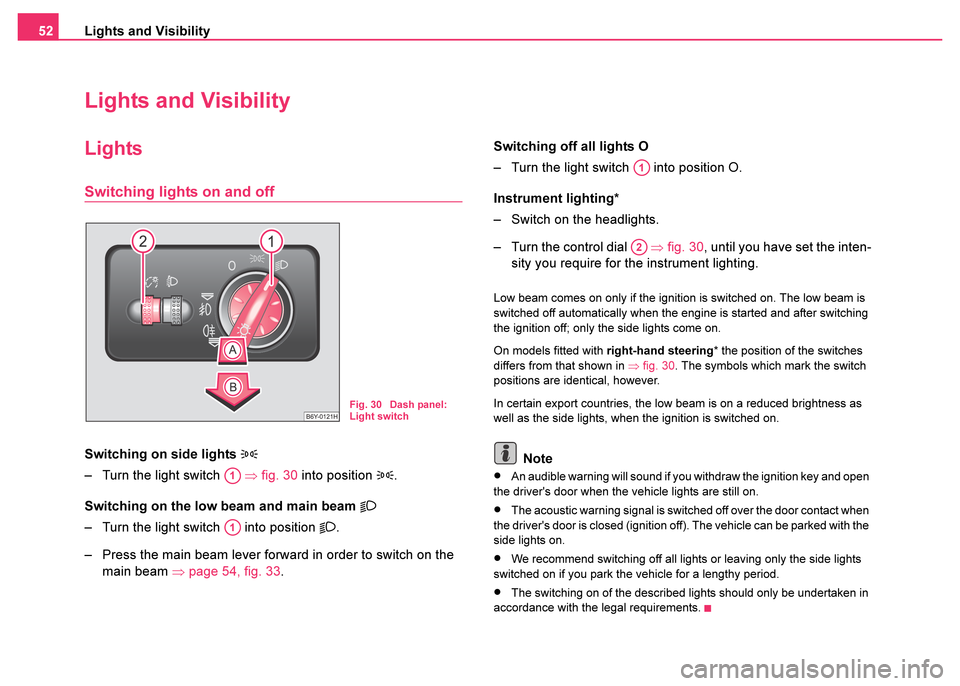
Switching on side lights
– Turn the light switch ⇒fig. 30 into position .
Switching on the low beam and main beam
– Turn the light switch into position .
– Press the main beam lever forward in order to switch on the main beam ⇒page 54, fig. 33 . Switching off all lights O
– Turn the light switch into position O.
Instrument lighting*
– Switch on the headlights.
– Turn the control dial
⇒fig. 30 , until you have set the inten-
sity you require for the instrument lighting.
Low beam comes on only if the ignition is switched on. The low beam is
switched off automatically when the engine is started and after switching
the ignition off; only the side lights come on.
On models fitted with right-hand steering* the position of the switches
differs from that shown in ⇒fig. 30. The symbols which mark the switch
positions are identical, however.
In certain export countries, the low beam is on a reduced brightness as
well as the side lights, when the ignition is switched on.
Note
•An audible warning will sound if you withdraw the ignition key and open
the driver's door when the vehicle lights are still on.
•The acoustic warning signal is switched off over the door contact when
the driver's door is closed (ignition off). The vehicle can be parked with the
side lights on.
•We recommend switching off all lights or leaving only the side lights
switched on if you park the vehicle for a lengthy period.
•The switching on of the described lights should only be undertaken in
accordance with the legal requirements.
Fig. 30 Dash panel:
Light switch
A1
A1
A1
A2
Page 56 of 233

Lights and Visibility55
Using the systemSafetyDriving TipsGeneral MaintenanceBreakdown assist-
anceTechnical DataFabia Praktik
– Turn signal for changing lanes - in order to only flash briefly
move the lever up or down to the pressure point and hold it
there.
Turn signal light (left)
– Push the lever downwards.
– Turn signal for changing lanes - in order to only flash briefly move the lever up or down to the pressure point and hold it
there.
Main beam
– Switch on the low beam.
– Push the lever forwards.
– Pull the lever back into the initial position in order to switch the main beam off again.
Headlight flasher
– Pull on the lever of the steering wheel (sprung position) - the main beam and warning light in the instrument cluster come
on.
Parking light
– Switch off the ignition.
– Push the lever up or down - the right-hand or left-hand parking light is switched on.
Information concerning the function of the lights.
•The turn signal system only operates when the ignition is switched
on. The corresponding indicator light or in the instrument cluster also
flashes.
•The turn signal is automatically cancelled after negotiating a curve.
•The side light and rear light on the appropriate side of the vehicle are
switched on when the parking light is selected. The parking light function
only operates if the ignition is switched off.
•An acoustic warning signal will sound when the driver's door is opened
if the lever is not in the middle position after removing the ignition key. The
acoustic warning signal will stop just as soon as the driver's door is closed.
Caution
•Use main beam or the headlight flasher only if this does not risk
dazzling other road users.
•Use only in accordance with the legal requirements the described
lighting and signal systems.
Page 57 of 233

Lights and Visibility
56
Interior lighting
Front interior lighting and storage compartment on
front passenger side
Door contact switching mechanism (on the front and rear*
door)
– Press the switch ⇒fig. 34 to the right into position
.
Switching the interior light on
– Press the switch to the left into position
.
Switching the interior light off
– Press the switch into the middle position O.Reading lights
\b
– Press on one of the switches in order to switch the right or
left reading light on or off.
Lighting of storage compartment on the front passenger
side
– Open the flap of the storage compartment on the front passenger side.
– The light switches on automatically when the parking light is switched on and goes out when the flap is closed.
The interior light is switched on for about 20 seconds when a vehicle with
a central locking system is unlocked, when a door is opened or when the
ignition key is removed. The requirement for this is that the switch is in the
door contact position. The inner light goes out out immediately after the
ignition is switched on.
A time delay switch* causes the inner lighting on vehicles without a central
locking system stays on for a few seconds after the doors have been
closed. The inner light goes out out immediately after the ignition is
switched on.
The interior lighting is switched off after about 30 minutes when a door has
been left open in order to avoid discharging the battery of the vehicle.
Fig. 34 Detail of the
headliner: front interior
lighting
AA
AA
AA
AB
Page 58 of 233

Lights and Visibility57
Using the systemSafetyDriving TipsGeneral MaintenanceBreakdown assist-
anceTechnical DataFabia Praktik
Interior lighting at the rear* (estate vehicle, sedan)
The lights ⇒fig. 35 are actuated by pressing the glass on the symbol ,
O or by switching to the middle position .
The same principles apply for the interior lighting at the rear as for the for
the interior lighting at the front ⇒page 56.
Note
We recommend having these bulbs replaced by a Škoda dealer.
Front door warning light*
The light is located in the door trim panel below ⇒fig. 36 .
The warning light goes on every time the door is opened.
If a door remains open, the battery will discharge.
There is a reflector installed on some vehicles instead of the warning light.
Luggage compartment light*
The lighting comes on automatically when the boot lid is opened. The
luggage compartment lighting will switch off again automatically if the boot
lid remains open for more than about 30 minutes.
Fig. 35 Roof liner light
at the rearFig. 36 Front door
warning light
Page 59 of 233

Lights and Visibility
58
Visibility
Rear window heater
– Press switch to switch on the rear window heater ⇒fig. 37 .
The rear window heater only operates when the engine is running. An indi-
cator light in the switch is illuminated when the rear window heater is
switched on.
The rear window heater switches off automatically after 20 minutes.
For the sake of the environment
You should switch off the rear window heater as soon as the rear window
is clear. The reduced current consumption will have a favourable effect on
fuel economy ⇒ page 153.
Sun visors
You can pull the sun visors for the driver and front passenger out of their
fixture and swivel them toward the doors in the direction of the arrow
⇒fig. 38. The visor above the interior mirror* can only be folded down.
The vanity mirrors* in the sun visors are provided with covers.Fig. 37 Switch for rear
window heater
Fig. 38 Sun visor:
swivelling out
Page 63 of 233

Lights and Visibility
62
Rear-view mirror
You can adjust the exterior mirrors electrically*.
Adjust the reverse view mirror before commencing to drive so
that there is a clear view to the rear.
Dimming the interior mirror
– Pull the lever on the bottom edge of the mirror toward rear (the
lever on the interior mirror must point forwards in it home posi-
tion).
Heating of the external mirror*
– Turn the rotary knob to position
⇒ fig. 42 . Adjusting left and right exterior mirrors*
– Turn the rotary knob to position
. The movement of the mirror
surface is identical to the movement of the rotary knob. The
right hand exterior mirror is adjusted at the same time on vehi-
cles with electrically operated power windows.
Adjusting the right-hand exterior mirror*
– Turn the rotary knob to position
. The movement of the mirror
surface is identical to the movement of the rotary knob.
The exterior mirror heater only operates when the engine is running.
Note
•Do not touch the surface of the exterior mirrors if the exterior mirror
heater is switched on.
•Contact your Škoda dealer if a fault exists with the power setting of the
exterior mirrors.
•You can set the exterior mirrors by hand, if the power setting function
fails at any time, by pressing on the edge of the mirror surface.
Fig. 42 Inner part of
door: Rotary knob
WARNING
Convex (curved outward) or aspherical exterior mirrors increase
the vision field. They do, however, make objects appear smaller in
the mirror. These mirrors are only of limited use, therefore, for esti-
mating distances to the following vehicles.
Page 77 of 233

Seats and Stowage
76
Removing and installing net partition housing
Removing
– Fold the front seats forwards ⇒page 67.
– Open the right rear door.
– Push the net partition housing ⇒fig. 61 in the direction of
arrow and take it out of the mounts of the rear seat back-
rests in the direction of the arrow .
Installing
– Position the net partition housing into the mounts of the seat backrest.
– Push the net partition housing in the opposite direction of arrow as far as the stop.
– Fold the rear seats back into its original position.
The roof luggage rack system*
Description
Pay attention to the following points if you wish to transport luggage or
other items on the roof of your vehicle:
•A special roof luggage rack system was developed for the vehicle.
That is why you should only use one of the roof luggage rack which has
been released for use by Škoda Auto.
•The base carrier is the basis for a complete roof luggage rack system.
Separate additional holders are required for safety reasons for trans-
porting luggage, bikes, surfboards, skis and boats.
•The basic version of the roof luggage rack system and further compo-
nents are obtainable as accessories from Škoda dealers.
•The base carrier is fixed to the roof of the vehicle using special fixtures
which are located under the roof strip.
Caution
•If you use other roof rack systems or if the roof bars are not properly
fitted, then any damage which may result to your car is not covered by the
warranty agreements. It is therefore essential to pay attention to the fitting
instructions supplied with the roof luggage rack system.
•On models fitted with a power sliding/tilting roof, ensure that the
opened sliding/tilting roof does not strike any items of luggage transported
on the roof.
•Ensure that the opened tailgate does not collide with the roof load.
For the sake of the environment
The increased aerodynamic drag results in a higher fuel consumption.
One should therefore take off the roof bar system after use.
Fig. 61 Rear seats: Net
partition housing
AB
A1
A2
A1
Page 95 of 233

Heating and air conditioning system
94
You can set the air supply to the individual air outlet vents using the control
dial .
Air outlet vents 3 and 4 can also be opened or closed individually:
•Air outlet vent fully open - knurled wheel vertically in position F
•Air outlet vent fully closed - knurled wheel vertically in position F or
G.
Turning the horizontal and vertical knurled wheels on the air outlet vents
3 and 4 allows one to change the direction of the inlet air flow .
Using the air conditioning system economically
The compressor on the air conditioning system uses power from the
engine when in cooling mode which will effect the fuel consumption.
It recommended to open the windows or the doors of a vehicle for which
the interior has been strongly heated through the effect of direct sunlight
in order to allow the heated air to escape.
The air conditioning system should not be switched on while travelling
when the window is open.
The desired interior temperature can also be achieved without switching
in the air conditioning system just by switching to fresh air mode.
For the sake of the environment
When you economize on fuel, you also reduce pollutant emissions.
Operational problems
If the cooling system does not operate at outside temperatures higher
than +5°C, there is a problem in the system. The reasons for this may be:
•The fuse on the air conditioning system has blown. Check the fuse,
replace it if necessary ⇒page 209.
•The cooling system has switched off automatically for a short time
because the coolant temperature of the engine is too hot ⇒page 13.
If you are not able to rectify the operational problem yourself, or if the
cooling capacity decreases, switch the air conditioning system off. Please
contact your Škoda dealer.
AC