2003 SAAB 9-3 tire pressure
[x] Cancel search: tire pressurePage 202 of 256

202 Car careTrunk fuse panel, left-hand sideNo. Amp. Function
1–5 MAXI -
6 30 Control module in left rear door
7 30 Control module in right rear door
820Trailer
9--
10 30 Left-hand brake light; rear right turn signal; right tail
light; right reversing light; high-mounted brake light;
trailer lights
11 - -
12 - -
13 - -
14 - -
15 15 Seat heating, left seat
16 15 Seat heating, right seat
17 7.5 Autodimming rearview mirror; rain sensor; tire
pressure monitoring
18 15 Sunroof
19 7.5 Telematics (OnStar)
20 7.5 DVD player (navigation system)
21 7.5 Saab Parking Assistance (SPA); control module in
rear doors
22 30 Amplifier, sound system III
23 - -
24 10 Movement sensor; CD changer in trunk (accessory)
25 30 Electrically adjustable driver’s seat with memory
26 30 Right-hand stop light; rear left turn signal; left tail
light; rear fog light; left reversing light; license plate
lighting; trunk lighting; trailer lights
27 - -
28 - -
29 - -
ProCarManuals.com
Page 207 of 256

207 Car care
Tire pressure
Note: Low tire pressure also causes prema-
ture tire wear and increased fuel consump-
tion.
Adjust the tire pressure to match the current
load and speed of the car (see page 245).
The stated tire pressures apply to cold tires,
i.e. tires that are the same temperature as
the outside air temperature. Tire pressure
increases as the tires become warm (e.g.
during highway driving) by approximately
0.3 bar (4 psi). When the temperature of the
tires changes by 50°F (10°C), the tire pres-
sure will change 0.1 bar (2 psi).
Never reduce the pressure of a hot tire. If the
tires are hot when you check them, only
increase the pressure, if necessary.
Soft tires will cause faster wear than over-
pressurized tires.
If a valve is leaking, simply unscrew it and fit
a new one.
Note: Remember to adjust the tire pressure
if you change the load in the car or intend to
cruise at a speed that is substantially differ-
ent from normal.
Automatic tire pressure monitoring(option, certain variants only)
The pressure monitoring system consists of
a sensor in each wheel, a detector in each
wheel housing and a receiver. The sensors
are located inside the wheels directly adja-
cent to the air valves.
WARNING
Check the tire pressure at least once a
month and before long journeys. Under-
inflation can result in:
punctures
separation of the tire and tread
damage to the sidewalls
damage to the rims on poor roads
poor handling characteristics.
WARNING
The system is intended to aid the driver.
The driver is always ultimately responsi-
ble for ensuring that the tire pressure is
correct.NOTICEGreat care must be taken when changing
tires so as not to damage the sensors that
are integrated in the valves.
ProCarManuals.com
Page 208 of 256

208 Car careThe receiver is located in the trunk. Tire
pressure information is sent wirelessly to
the receiver.
The system checks the tire pressure when
the car is travelling over 18 mph (30 km/h).
The system is "self-learning", which means
that the position of the wheels can be
changed without requiring adjustments to
the monitoring system. The spare wheel
does not have a sensor.
The sensor batteries have an average life of
10 years. The batteries cannot be changed
but require the sensor units to be replaced.
The system does not warn if a tire is overin-
flated.
If the tire pressure drops
If the tire pressure drops 0.3 bar (4 psi)
below the recommended pressure, the SID
will issue a warning as to which tire is
affected.
Adjust the tire pressure as soon as possible.If the tire pressure continues to drop, the
SID will issue a warning alarm when the
pressure is 0.6 bar (9 psi) below the recom-
mended value.
Reduce speed (avoid heavy braking and
violent steering wheel movements) and
stop the car as soon as it is safe to do so.
Change the wheel. Tire pressure low,
front left.
Check tires.
Flat tire front left.
Make a safe stop.
Valve with sensor Valve without sensor
ProCarManuals.com
Page 209 of 256

209 Car care
Malfunction
The message shown above will be dis-
played on the SID if:
a wheel without pressure sensor is fitted
(e.g. spare wheel)
one, two or three pressure sensors are
broken or missing
two or more detectors are missing or
broken
the receiver malfunctions
a fault arises in the system.
The message shown above is not displayed
if none of the wheels have sensors, such as
if winter wheels without sensors are fitted.
Shifting the wheelsBecause of front wheel drive, the front tires
tend to wear faster than the rear ones. New
tires should always be fitted in pairs, so that
tires on the same axle have the same
amount of tread.
The wheels should be marked, L (left) and
R (right), when changing between summer
and winter (snow) tires. This ensures that
the direction of rotation of the wheels is the
same when they are refitted. Fit the tires in
best condition to the rear wheels.
Store wheels lying flat or hanging – never
standing upright.
Tire markingsAn example of the meaning of the different
markings in a tire size is given below for a
tire size of 195/65 R15 91H: Tire pressure
system failure.
Contact Saab dealer.
WARNING
When fitting just one new pair of tires,
these should be fitted to the rear wheels,
as these are more critical to the direc-
tional stability of the car (e.g. on braking
or in a skid). The existing rear wheels
should therefore be moved to the front.
Always move rear left to front left and rear
right to front right, so that the direction of
rotation remains the same.
195 Tire section width, mm
65 Aspect ratio, i.e. the section height
as a percentage of the section
width
R Radial ply
15 Wheel rim diameter 15 in at bead
seats
91 Tire load index
H Speed rating
Tire load indices
91 Tire approved for max. 1355 lbs.
(615 kg)
93 Max. 1433 lbs. (650 kg)
94 Max. 1477 lbs. (670 kg)
Speed ratings
S Tire approved for speeds up to
110 mph (180 km/h)
T Max. 118 mph (190 km/h)
H Max. 130 mph (210 km/h)
V Max. 149 mph (240 km/h)
W Max. 168 mph (270 km/h)
Y Max. 186 mph (300 km/h)
ProCarManuals.com
Page 212 of 256
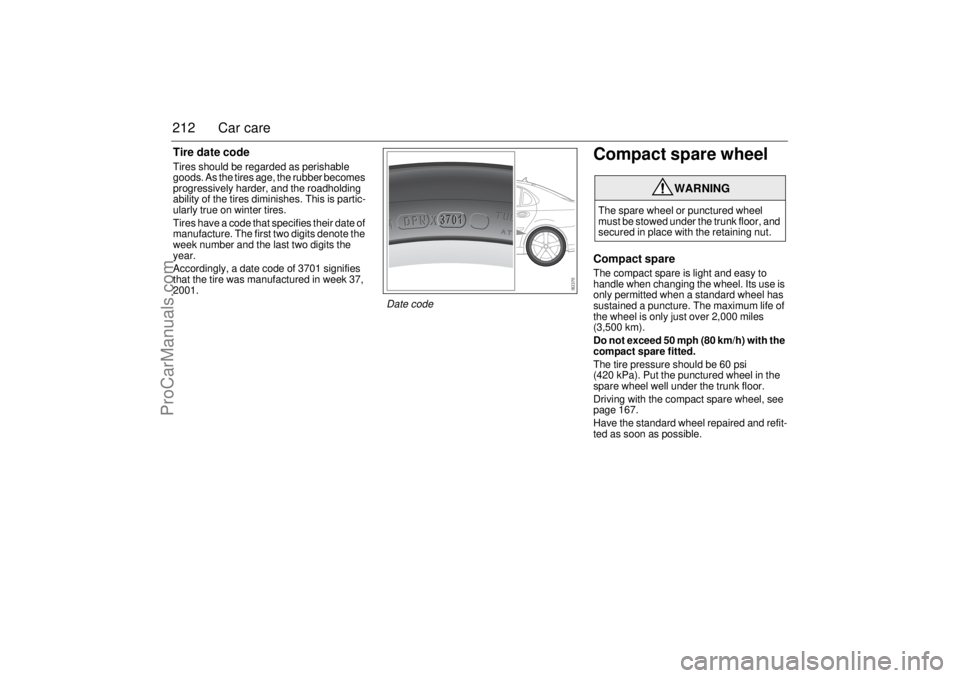
212 Car careTire date codeTires should be regarded as perishable
goods. As the tires age, the rubber becomes
progressively harder, and the roadholding
ability of the tires diminishes. This is partic-
ularly true on winter tires.
Tires have a code that specifies their date of
manufacture. The first two digits denote the
week number and the last two digits the
year.
Accordingly, a date code of 3701 signifies
that the tire was manufactured in week 37,
2001.
Compact spare wheelCompact spareThe compact spare is light and easy to
handle when changing the wheel. Its use is
only permitted when a standard wheel has
sustained a puncture. The maximum life of
the wheel is only just over 2,000 miles
(3,500 km).
Do not exceed 50 mph (80 km/h) with the
compact spare fitted.
The tire pressure should be 60 psi
(420 kPa). Put the punctured wheel in the
spare wheel well under the trunk floor.
Driving with the compact spare wheel, see
page 167.
Have the standard wheel repaired and refit-
ted as soon as possible.
WARNING
The spare wheel or punctured wheel
must be stowed under the trunk floor, and
secured in place with the retaining nut.
Date code
ProCarManuals.com
Page 226 of 256

226 Car careHeadlight aimingThe vehicle has a visual optical headlight
aiming system equipped with vertical
aiming device. The aim has been preset at
the factory and should normally not need
further adjustments.
If your headlights are damaged in a crash,
the headlight aim may be affected. If you
believe your headlights need to be re-
aimed, we recommend that you take it to
your Saab dealer for service. However, it is
possible for you to re-aim your headlights as
described in the following procedure.To check the aim, the vehicle should be
properly prepared as follows:
The vehicle shall be placed so that the
headlights are 25 ft (7.6 m) from a light
colored wall or other flat surface. The
aiming area should be darkened, this will
improve your ability to see the beam of the
low beam headlight being aimed.
An optical headlamp aimer can also be
used and will than replace the wall.
The vehicle must have all four wheels on
a perfectly level surface which is level all
the way to the wall or other flat surface.
The vehicle should be placed so it is per-
pendicular to the wall or other flat surface.
The vehicle should be unloaded and fuel
tank full, and one person or 160 lbs.
(75 kg) on the drivers seat. The vehicle should be fully assembled
and all other work stopped while headlight
aiming is being done.
The vehicle should not have any snow, ice
or mud attached to it.
Tires should be inflated to the prescribed
pressure.
Close all doors.
Rock the vehicle to stabilize the suspen-
sion.
Headlight aiming is done with the vehicle
low beam lamps. The high beam lamps will
be correctly aimed if the low beam lamps
are aimed properly.
WARNING
Before checking/adjusting the headlight
aiming, switch off the engine to avoid
danger of fingers and hands being injured
by moving parts.
The radiator fan can start up even when
the engine is switched off.NOTICETo make sure that your headlights are
aimed properly read all instructions
before beginning. Failure to follow these
instructions could cause damage to
headlight parts or a not correctly aimed
headlight.
ProCarManuals.com
Page 237 of 256

237 Technical data
Curb weight
(i.e. with full fuel tank, full washer fluid res-
ervoir, standard tools and spare wheel) _3174–3461 lbs.
(1440–1570 kg)
Gross vehicle weight (GVW) ___________ 4343–4453 lbs.
(1970–2020 kg)
Maximum axle load:
Front ____________________________ 248 lbs. (1125 kg)
Rear ____________________________ 2226 lbs. (1010 kg)
Weight distribution:
Curb weight + driver (154 lbs. (70 kg)),
front/rear _________________________ approx. 60/40 %
GVW, front/rear ____________________ approx. 50/50 %
Maximum roof load _________________ 220 lbs. (100 kg)
Maximun load in trunk ______________ 175 lbs. (80 kg)
WARNING
The GVW and maximum axle loads must not be exceeded.
Note that if some accessories (e.g. towbar, CD changer) are
fitted, the available load capacity is reduced by the weight of
these.
When carrying a load in the trunk, make sure that it is lashed
down securely, particularly when part or all of the rear seat is
folded down.
Trailer:
Trailer with brakes ___________________ Max. 3500 lbs.
(1588 kg)
Trailer without brakes ________________ Max. 1000 lbs.
(450 kg)
Recommended towball load ___________ 110–165 lbs.
(50–75 kg)
Maximum theoretical towing speed, trailer
with brakes _______________________ 60 mph (100 km/h)
When towing a trailer, increase the pressure
of the rear tires by 0.2 bar (3 psi).
The above speed and weight restrictions are those specified by
Saab Automobile AB.
Note that national restrictions may apply to trailer speeds and
weights (see page 157).
ProCarManuals.com
Page 243 of 256

243 Technical data
Wheels and tires Summer tires
6.5 x 15" _________________________ 215/60R15 94 H
6.5 x 16" _________________________ 215/55R16 93 H
7 x 17"___________________________ 215/50R17 91 W or
225/45R17 91 W
7.5 x 18" (accessory) _______________ 225/45 R18 91 W
Always contact a Saab dealer if you plan to fit other wheels or
tires than those fitted as standard.
Winter (snow) tires:
6.5 x 15" wheel ____________________ 195/65 R15 91 Q
M+S
6.5 x 16" wheel ____________________ 205/55 R16 91 Q
M+S or
215/55 R16 93 Q
M+S
7 x 17" wheel _____________________ 205/50 R17 93 Q RF
M+S
Compact spare:
Wheel ___________________________ 4 x 16"
Tire _____________________________ 125/80 R16 97 M or
125/85 R16 97 M
Pressure _________________________ 4.2 bar (60 psi)
Maximum life______________________ 2200 miles
(3500 km)
Maximum speed ___________________ 50 mph (80 km/h)
NOTICEContact your Saab dealer regarding suitable snow chains.
Max. permissible speed with snow chains fitted is 30 mph
(50 km/h).
Snow chains must not be fitted to wheels larger than 17".
Snow chains must not be used on the rear wheels.NOTICEWheels larger than 18" must not be fitted.
Exercise care when driving on uneven roads or against the curb
if the car is heavily laden. This particularly applies to cars with
18" wheels.
Permitted wheel offset is 41 mm.
ProCarManuals.com