2003 SAAB 9-3 100
[x] Cancel search: 100Page 161 of 256
161 Starting and driving
Driving with a roof rack
loadThe maximum permissible roof load is
220 lbs. (100 kg). Note that the roof load
must be included in the car’s maximum per-
missible payload and axle load.
Strong, sturdy roof carriers designed spe-
cially for your car are available from your
Saab dealer. Always secure roof loads
securely.
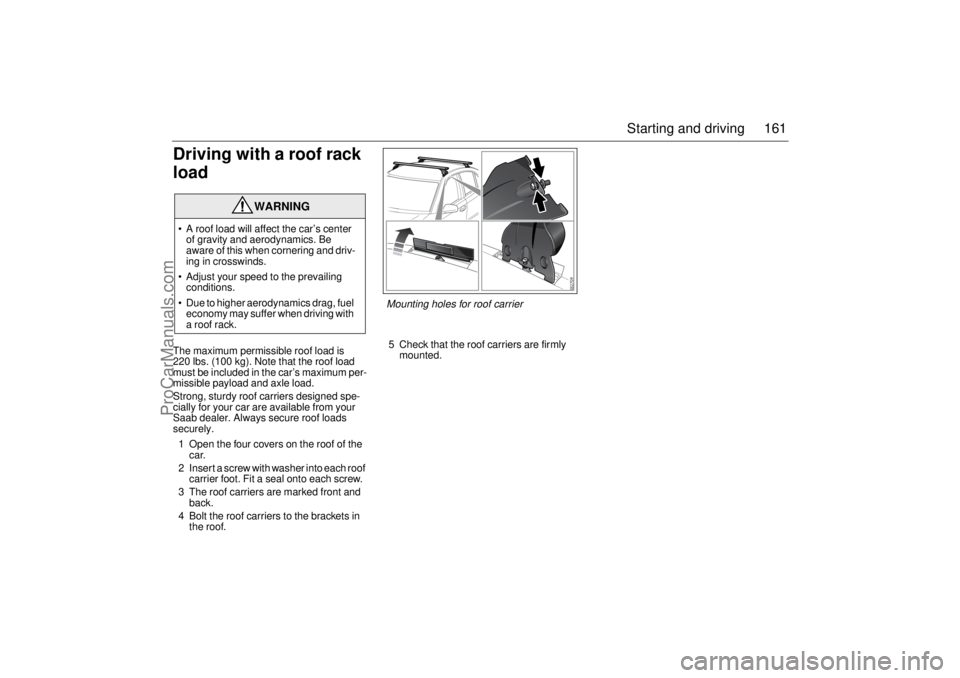
1 Open the four covers on the roof of the
car.
2 Insert a screw with washer into each roof
carrier foot. Fit a seal onto each screw.
3 The roof carriers are marked front and
back.
4 Bolt the roof carriers to the brackets in
the roof.5 Check that the roof carriers are firmly
mounted.
WARNING
A roof load will affect the car’s center
of gravity and aerodynamics. Be
aware of this when cornering and driv-
ing in crosswinds.
Adjust your speed to the prevailing
conditions.
Due to higher aerodynamics drag, fuel
economy may suffer when driving with
a roof rack.
Mounting holes for roof carrier
ProCarManuals.com
Page 210 of 256

210 Car careWinter tiresWinter (snow) tires are recommended for
winter climates where the majority of your
driving will be done on snow and ice. Winter
tires should be fitted to all four wheels to
maintain a proper balance. Your Saab
dealer can advise you of to the correct size
tire for your car (if different from the original
size) and also supply Saab approved winter
tires pre-mounted on steel or alloy rims.Tire quality grading (cars sold in
U.S.)New tires must be graded and labeled in
accordance with new Federal regulations.
Standard tests are conducted to measure
performance in the areas of traction and
temperature resistance. Refer to the tire
sidewall for the specific quality grades of the
tires provided on your new Saab. Compact
spare tires are exempt.
DOT QUALITY GRADES
Treadwear.
Traction AA, A, B, C.
Temperature A, B, C.
All passenger car tires must conform to Fed-
eral safety requirements in addition to these
grades.
Uniform Tire Quality Grading (US)Quality grades can be found where applica-
ble on the tire sidewall between tread shoul-
der and maximum section width. For exam-
ple:
Treadwear 200 Traction AA
Temperature ATreadwearThe treadwear grade is a comparative
rating based on the wear rate of the tire
when tested under controlled conditions on
a specified government test course. For
example, a tire graded 150 would wear one
and one half (1 1/2) times as well on the gov-
ernment course as a tire graded 100. The
relative performance of tires depends upon
the actual conditions of their use, however,
and may depart significantly from the norm
due to variations in driving habits, service
practices and differences in road character-
istics and climate.
TractionThe traction grades, from highest to lowest,
are AA, A, B and C. These grades represent
the tire’s ability to stop on wet pavement as
measured under controlled conditions on
specified government test surfaces of
asphalt and concrete. A tire marked C may
have poor traction performance.
WARNING
The traction grade assigned to a tire is
based on straight-ahead braking, traction
test and does not include acceleration,
cornering, hydroplaning or peak traction
characteristics.
ProCarManuals.com
Page 237 of 256

237 Technical data
Curb weight
(i.e. with full fuel tank, full washer fluid res-
ervoir, standard tools and spare wheel) _3174–3461 lbs.
(1440–1570 kg)
Gross vehicle weight (GVW) ___________ 4343–4453 lbs.
(1970–2020 kg)
Maximum axle load:
Front ____________________________ 248 lbs. (1125 kg)
Rear ____________________________ 2226 lbs. (1010 kg)
Weight distribution:
Curb weight + driver (154 lbs. (70 kg)),
front/rear _________________________ approx. 60/40 %
GVW, front/rear ____________________ approx. 50/50 %
Maximum roof load _________________ 220 lbs. (100 kg)
Maximun load in trunk ______________ 175 lbs. (80 kg)
WARNING
The GVW and maximum axle loads must not be exceeded.
Note that if some accessories (e.g. towbar, CD changer) are
fitted, the available load capacity is reduced by the weight of
these.
When carrying a load in the trunk, make sure that it is lashed
down securely, particularly when part or all of the rear seat is
folded down.
Trailer:
Trailer with brakes ___________________ Max. 3500 lbs.
(1588 kg)
Trailer without brakes ________________ Max. 1000 lbs.
(450 kg)
Recommended towball load ___________ 110–165 lbs.
(50–75 kg)
Maximum theoretical towing speed, trailer
with brakes _______________________ 60 mph (100 km/h)
When towing a trailer, increase the pressure
of the rear tires by 0.2 bar (3 psi).
The above speed and weight restrictions are those specified by
Saab Automobile AB.
Note that national restrictions may apply to trailer speeds and
weights (see page 157).
ProCarManuals.com
Page 239 of 256

239 Technical data
Other grade classifications:API and ACEA designations can also be found on the packag-
ing alongside the GM designations GM-LL-A 025 and
GM-LL-B 025. Oil for gasoline engines classified in accordance
with API standards (American Petroleum Institute) can include
SH (since 1993), SJ (since 1996) and SL (from 2001) classes.
SL class oils fulfil the most stringent requirements. These grade
classes are most often combined with the corresponding class-
es for diesel engines. The class designations for diesel engines
begin with the letter "C" (Commercial). For example, a grade
combination suitable for both types of engine could be API SJ/
CF or SL/CF.
Under ACEA nomenclature, oils are divided into Class A for
petrol engines and Class B for diesel engines. There is a further
class for heavy diesel engines. Each class is divided into
three or four (diesel) grades where grades 2 and 3 (diesel: 4)
normally encompass products comprising semi and fully-
synthetic components.
In the same way as in the API system, gasoline and diesel en-
gine specifications are combined for products that can be used
in both types of engine. For example, a grade designation could
be ACEA A2/B2 or ACEA A3/B3-B4.
Viscosity:
The viscosity of oil is classified according to the SAE standard
(SAE: Society of Automobile Engineers). Nowadays, multigrade
oils are always used in cars. The properties of these oils facili-
tate starting the car in cold weather but mean that the oil is also
sufficiently viscous to coat all moving parts under all operating
conditions.
Multigrade oils are graded with two viscosities, e.g. 0W-30,
where the 0W meets certain viscosity requirements at –22°F (–
30°C), while the 30 fulfils requirements at a temperature of
212°F (100°C).
The approved gasoline engine oil, GM-LL-A 025, has a vis-
cosity of SAE 0W-30.
Oil capacity, including filter (oil change) __ 6.3 qts. (6.0 l)
ProCarManuals.com
Page 241 of 256

241 Technical data
Manual transmission Automatic transmissionType _____________________________ Fully synchronized
with final drive gear
and differential
Oil type (for topping up) _______________ Saab MTF 0063
Oil capacity ________________________ 2.0 qts. (1.9 l)
Speed (mph/km/h) at 1000 rpm in highest
gear (5th gear):
1.8t and 2.0t ______________________ 27–30/43–45Type _____________________________ Electronically-
controlled, 5-speed,
fully-automatic with
hydraulic torque
converter, planetary
gears and integral
final drive.
Lock-up function in
selector positions 3,
4 and 5.
Selector lever positions _______________ P, R, N, D, M
Oil capacity, total ____________________ 7.6 qts. (7.2 litres)
Oil type ___________________________ Saab 3309
Clutch type ________________________ Hydraulic plate
clutches, brake
bands and one-way
couplings
Speed (mph/km/h) at 1000 rpm in top gear:
1.8t, 2.0t and 2.0T _________________ 28–30/46–49
ProCarManuals.com
Page 245 of 256

245 Technical data
Recommended lowest tire pressure, cold tiresTire size Load/speed
mph (km/h)
*)
Front
psi/kPaRear
psi/kPa
Summer tires
215/60 R15 94 H 1–3 pers./0–100 (0–160)
4–5 pers./0–100 (0–160)
1–5 pers./100– (160–)32/220
32/220
38/26032/220
32/220
38/260
215/55 R16 93 H 1–3 pers./0–100 (0–160)
4–5 pers./0–100 (0–160)
1–5 pers./100– (160–)35/240
35/240
41/28032/220
32/220
38/260
215/50 R17 91 W or
225/45 R17 91 W1–3 pers./0–120 (0–190)
4–5 pers./0–120 (0–190)
1–5 pers./120– (190–)35/240
35/240
41/28035/240
35/240
41/280
225/45 R18 91 W 1–3 pers./0–120 (0–190)
4–5 pers./0–120 (0–190)
1–5 pers./120– (190–)35/240
35/240
41/28035/240
35/240
41/280
Winter tires
195/65 R15 91 Q 1–3 pers./0–100 (0–160)
4–5 pers./0–100 (0–160)33/230
41/28033/230
41/280
195/65 R15 95 Q RF 1–3 pers./0–100 (0–160)
4–5 pers./0–100 (0–160)33/230
41/28033/230
41/280
205/55 R16 91 Q 1–3 pers./0–100 (0–160)
4–5 pers./0–100 (0–160)32/220
39/27032/220
39/270
215/55 R16 93 Q 1–3 pers./0–100 (0–160)
4–5 pers./0–100 (0–160)32/220
39/27032/220
39/270
205/50 R17 93 Q RF 1–3 pers./0–100 (0–160)
4–5 pers./0–100 (0–160)33/230
38/26033/230
38/260
Spare wheel
125/80 R16 97 M or
125/85 R16 97 MMax 50 (80) 60/420 60/420
*) Do not exeed posted speed limits.
By cold tires is meant tires that are the same temperature as the sur-
rounding air temperature.
The values for tire pressure in table above are for tires at 68°F
(20°C).
The tire pressure will increase as the tires become warm (e.g. during
highway driving), and decrease as they cool.
When the temperature of the tires increases or decreases by 10
degrees the tire pressure will correspondingly increase or decrease
by 2 psi/10 kPa.
ProCarManuals.com
Page 253 of 256

253 Index
LLATCH (child safety)
_____________ 22
Labels and plates, location
_______ 246
Lashing eyes
__________________ 118
Laying the car up
______________ 150
Leather upholstery, cleaning
______ 218
Limp-home
___________________ 126
Limp-home, automatic transmission
137
Load carriers, roof
______________ 161
Load indices, tyres _____________ 209
Load-through hatch _____________ 117
Locking a car with flat battery
______ 41
Locks
________________________ 38
Long-term parking
______________ 150
Luggage compartment
__________ 116
Luggage compartment lighting
106
, 119
Luggage compartment lighting,
changing
____________________ 197
MMAXI fuses
___________________ 200
Main instrument panel
___________ 54
Main/dipped beam
______________ 72
Maintenance schedule __________ 230
Manual climate control ___________ 79
Manual gear selection ___________ 139
Manual gearbox
_______________ 133
Manual tripping of car alarm
_______ 49
Materials used in the car, reclamation
222Memory, driver’s seat
____________ 19
Milometer
_____________________ 59
Movement sensor, car alarm
______ 48
Mug holder
___________________ 107
NNight driving
__________________ 163
Number plate lighting, changing
___ 196
OORVR
_______________________ 174
Oil capacity, engine
_____________ 239
Opening handles
________________ 38
Opening the fuel filler flap manually
_52
Owner assistance
______________ 232
PPanic function, car alarm
_________ 49
Park Brake Shift Lock
___________ 135
Park Brake Shift Lock,
temporary override
____________ 137
Parking
______________________ 148
Parking aid ___________________ 151
Parking brake _________________ 148
Parking on a hill _______________ 149
Pinch protection, electric windows
_100
Pinch protection, sunroof
________ 104Plates and labels, location
________ 246
Polishing and waxing
____________ 219
Poly-V-belt
____________________ 185
Position lights __________________ 72
Power steering fluid, checking
_____ 181
Power steering fluid, grade
_______ 242
Pressure gauge
_________________ 61
Profiles, customized settings
_______ 64
Puncture, changing wheels _______ 214
QQuick guide, remote control
_______ 39
RRain sensor
____________________ 77
Rear fog light ___________________ 74
Rear seats, folding down
_________ 116
Rear towing eye
_______________ 165
Rear window heating
_____________ 83
Rearview mirrors
_______________ 110
Recirculation
___________________ 82
Recommendations for automatic
transmission, towing a trailer
____ 158
Recommendations for manual
gearbox, towing a trailer
________ 159
Recommended fuel grades _______ 128
Recommended snow chains ______ 243
Refueling
_____________________ 128
ProCarManuals.com