Page 280 of 381
6-35 How To Check Power Steering Fluid
You can check your fluid without taking the cap off.
Just look at the reservoir.
�When the engine compartment is hot, the level
should be between the HOT marks.
�When the engine compartment is cool, the level
should be between the COLD marks.
What to Use
To determine what kind of fluid to use, see
ªRecommended Fluids and Lubricantsº in the Index.
NOTICE:
When adding power steering fluid or making a
complete fluid change, always use the proper
fluid. Failure to use the proper fluid can cause
leaks and damage hoses and seals.
Page 361 of 381
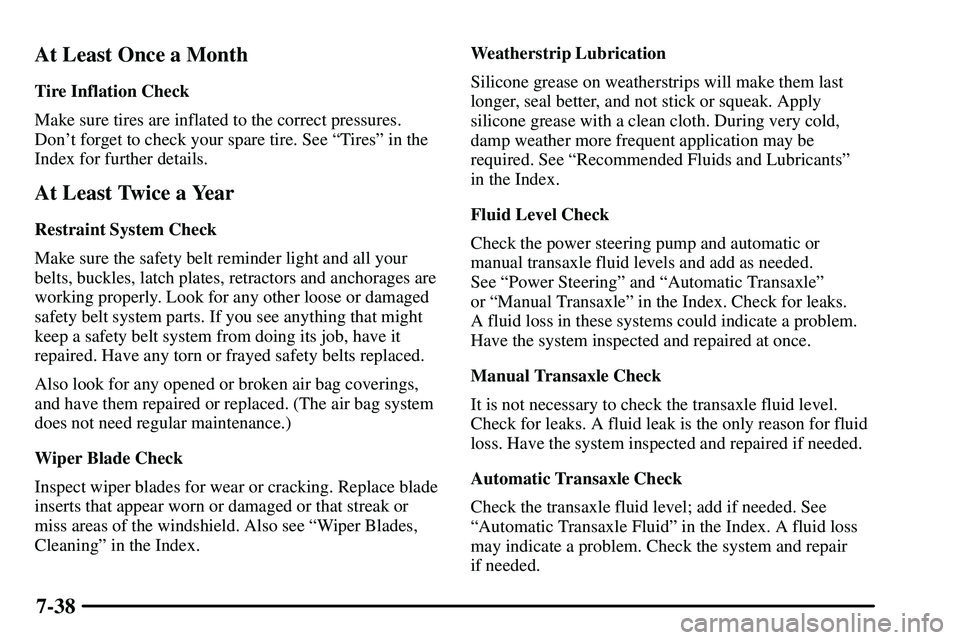
7-38 At Least Once a Month
Tire Inflation Check
Make sure tires are inflated to the correct pressures.
Don't forget to check your spare tire. See ªTiresº in the
Index for further details.
At Least Twice a Year
Restraint System Check
Make sure the safety belt reminder light and all your
belts, buckles, latch plates, retractors and anchorages are
working properly. Look for any other loose or damaged
safety belt system parts. If you see anything that might
keep a safety belt system from doing its job, have it
repaired. Have any torn or frayed safety belts replaced.
Also look for any opened or broken air bag coverings,
and have them repaired or replaced. (The air bag system
does not need regular maintenance.)
Wiper Blade Check
Inspect wiper blades for wear or cracking. Replace blade
inserts that appear worn or damaged or that streak or
miss areas of the windshield. Also see ªWiper Blades,
Cleaningº in the Index.Weatherstrip Lubrication
Silicone grease on weatherstrips will make them last
longer, seal better, and not stick or squeak. Apply
silicone grease with a clean cloth. During very cold,
damp weather more frequent application may be
required. See ªRecommended Fluids and Lubricantsº
in the Index.
Fluid Level Check
Check the power steering pump and automatic or
manual transaxle fluid levels and add as needed.
See ªPower Steeringº and ªAutomatic Transaxleº
or ªManual Transaxleº in the Index. Check for leaks.
A fluid loss in these systems could indicate a problem.
Have the system inspected and repaired at once.
Manual Transaxle Check
It is not necessary to check the transaxle fluid level.
Check for leaks. A fluid leak is the only reason for fluid
loss. Have the system inspected and repaired if needed.
Automatic Transaxle Check
Check the transaxle fluid level; add if needed. See
ªAutomatic Transaxle Fluidº in the Index. A fluid loss
may indicate a problem. Check the system and repair
if needed.
Page 365 of 381
7-42
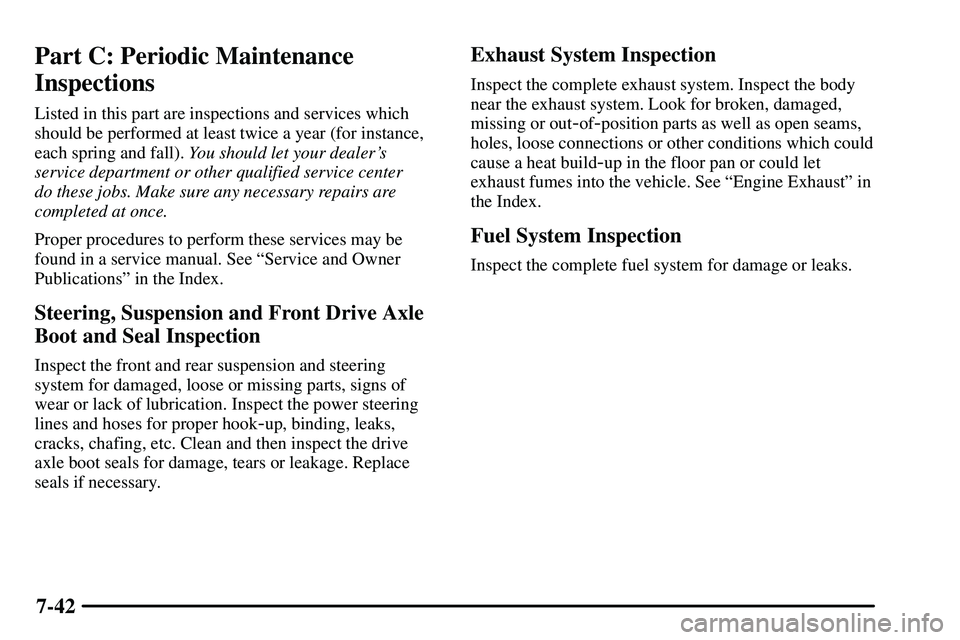
Part C: Periodic Maintenance
Inspections
Listed in this part are inspections and services which
should be performed at least twice a year (for instance,
each spring and fall). You should let your dealer's
service department or other qualified service center
do these jobs. Make sure any necessary repairs are
completed at once.
Proper procedures to perform these services may be
found in a service manual. See ªService and Owner
Publicationsº in the Index.
Steering, Suspension and Front Drive Axle
Boot and Seal Inspection
Inspect the front and rear suspension and steering
system for damaged, loose or missing parts, signs of
wear or lack of lubrication. Inspect the power steering
lines and hoses for proper hook
-up, binding, leaks,
cracks, chafing, etc. Clean and then inspect the drive
axle boot seals for damage, tears or leakage. Replace
seals if necessary.
Exhaust System Inspection
Inspect the complete exhaust system. Inspect the body
near the exhaust system. Look for broken, damaged,
missing or out
-of-position parts as well as open seams,
holes, loose connections or other conditions which could
cause a heat build
-up in the floor pan or could let
exhaust fumes into the vehicle. See ªEngine Exhaustº in
the Index.
Fuel System Inspection
Inspect the complete fuel system for damage or leaks.
Page 367 of 381
7-44
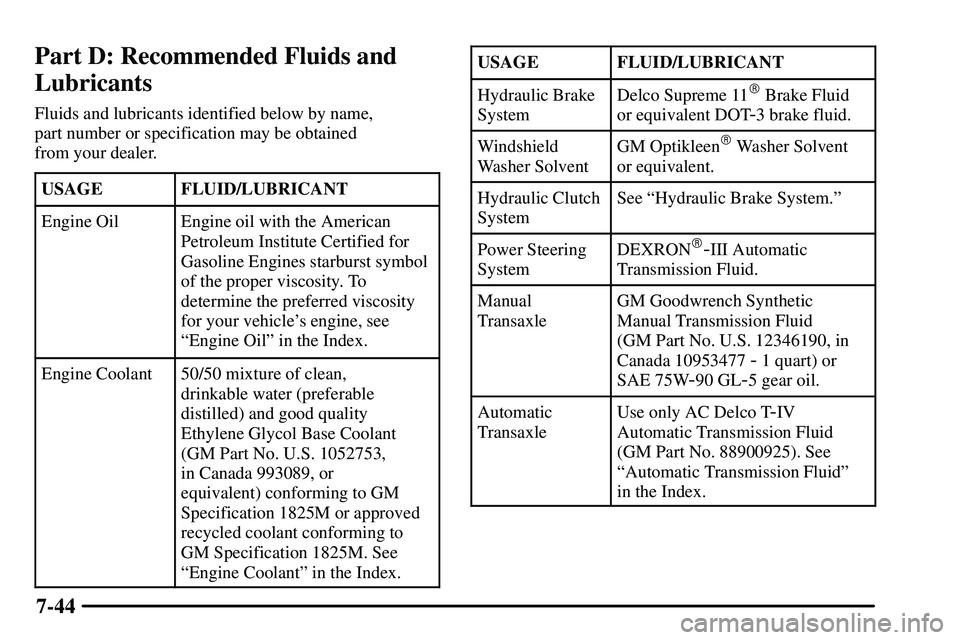
Part D: Recommended Fluids and
Lubricants
Fluids and lubricants identified below by name,
part number or specification may be obtained
from your dealer.
USAGE
FLUID/LUBRICANT
Engine OilEngine oil with the American
Petroleum Institute Certified for
Gasoline Engines starburst symbol
of the proper viscosity. To
determine the preferred viscosity
for your vehicle's engine, see
ªEngine Oilº in the Index.
Engine Coolant50/50 mixture of clean,
drinkable water (preferable
distilled) and good quality
Ethylene Glycol Base Coolant
(GM Part No. U.S. 1052753,
in Canada 993089, or
equivalent) conforming to GM
Specification 1825M or approved
recycled coolant conforming to
GM Specification 1825M. See
ªEngine Coolantº in the Index.
USAGEFLUID/LUBRICANT
Hydraulic Brake
SystemDelco Supreme 11� Brake Fluid
or equivalent DOT
-3 brake fluid.
Windshield
Washer SolventGM Optikleen� Washer Solvent
or equivalent.
Hydraulic Clutch
SystemSee ªHydraulic Brake System.º
Power Steering
SystemDEXRON�-III Automatic
Transmission Fluid.
Manual
TransaxleGM Goodwrench Synthetic
Manual Transmission Fluid
(GM Part No. U.S. 12346190, in
Canada 10953477
- 1 quart) or
SAE 75W
-90 GL-5 gear oil.
Automatic
TransaxleUse only AC Delco T-IV
Automatic Transmission Fluid
(GM Part No. 88900925). See
ªAutomatic Transmission Fluidº
in the Index.
