Page 174 of 183

10-02-2003
Vehicles fitted with two batteries* Certain vehicles, depending on the country where the vehicle is sold, arefitted with two batteries:
Ð a battery for starting, located in theengine compartment,
Ð a service battery*, located in the boot.
The starter battery has a label show- ing that the service battery * is in theboot. These are special batteries.If one of them needs to be replaced,
contact a PEUGEOT dealer.
To charge the starter battery with a battery charger:
� remove the style cover to gain
access to the starter battery,
� disconnect the battery. Follow the instructions for use given by the battery charger
manufacturer,
� reconnect the battery, starting withthe negative (-) terminal,
� check that the terminals and theconnectors are clean. If they arecovered with sulphate (whitish orgreenish deposit), disconnect andclean them,
� refit the style cover. To start the vehicle from another battery: �
remove the style cover to gain
access to the starter battery,
� remove the maxi fuse located
near to the starter battery,
� connect the red cable to the positive (+) terminals of the twobatteries,
� connect one end of the green orblack cable to the negative (-) ter-
minal of the additional battery,
� connect the other end of the greenor black cable to an earth point onthe vehicle which has brokendown, as far as possible from the
battery,
� start the engine and let it run,
� wait for the engine to return to idlethen disconnect the cables,
� drive a few kilometres in order to
recharge the starter battery, thenreplace the maxi fuse near to it,
� refit the style cover.
To recharge the service battery,
contact a PEUGEOT dealer.
* According to country.
PRACTICAL INFORMATION 161
If electrical operations
are carried out, disconnect
the starter battery and remove
the maxi fuse located next to it.
It is advisable to disconnect the
starter battery and remove the maxi fuse located next to it, if the vehicle is not to be used for a period of more than one month.
Page 175 of 183
10-02-2003
PRACTICAL INFORMATION
162
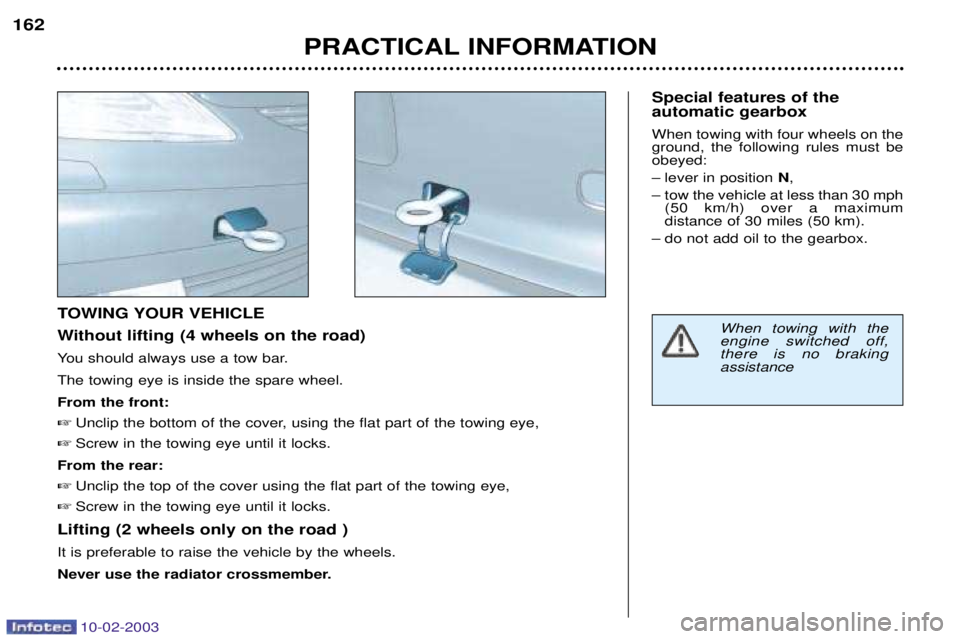
TOWING YOUR VEHICLE
Without lifting (4 wheels on the road)
You should always use a tow bar.The towing eye is inside the spare wheel.From the front:
� Unclip the bottom of the cover, using the flat part of the towing eye,
� Screw in the towing eye until it locks.
From the rear: � Unclip the top of the cover using the flat part of the towing eye,
� Screw in the towing eye until it locks.
Lifting (2 wheels only on the road )It is preferable to raise the vehicle by the wheels.
Never use the radiator crossmember. Special features of the automatic gearbox When towing with four wheels on the ground, the following rules must beobeyed:
Ð lever in position
N,
Ð tow the vehicle at less than 30 mph (50 km/h) over a maximum distance of 30 miles (50 km).
Ð do not add oil to the gearbox.
When towing with theengine switched off,there is no brakingassistance
Page 176 of 183

10-02-2003
TOWING A TRAILER,
CARAVAN, BOAT ETC...
Only use original PEUGEOT tow bars which have been tested andapproved from the design stage ofyour vehicle. The tow bar must be fitted by a
PEUGEOT dealer. Driving advice Distribution of loads: distribute the
load in the trailer so that the heaviest loads are as close as possible to theaxle and the nose weight is close tothe maximum authorised without,
however, exceeding it. Cooling: towing a trailer on a slope
increases the coolant temperature.As the fan is electronically controlled, its cooling capacity is not dependenton the engine speed.
On the contrary, use a high gear to lower the engine speed, and reduceyour speed. In all cases, pay attention to thecoolant temperature. Note:
in certain cases of particularly
arduous use (towing the maximum load up a steep slope in high tem-peratures), the engine automatically
limits its power. In this case, cutting
off the air conditioning allows theengine power to be recovered, andtherefore the towing speed to be sig-nificantly increased (approximately12mph [20 km/h] more). If the coolant temperature warning light comes on, stop the vehicle and
switch off the engine as soon aspossible.
Tyres: check the tyre pressures of
the towing vehicle and of the trailer, observing the recommended pres-sure. Brakes: towing increases the brak-
ing distance. Drive at a moderate speed, change down early and brake
gradually. Side wind: sensitivity to side wind is
increased. Drive smoothly and at a moderate speed. Lighting Manual adjustmentAdjust your headlamps so as not to dazzle other road users (see sectionon ''Manual adjustment of head-lamps''). Check the electrical sig-
nalling of the trailer. Automatic beam correction For vehicles with Xenon bulbs, this system automatically corrects theheight of the beam, whatever the
load of the vehicle. The driver is thenassured of having optimum lightingand not causing a nuisance to otherroad users. In cases of malfunction, the driver is alerted by means of the warning lighton the instrument panel. In this situation the system adjusts your headlamps to the low position.
PRACTICAL INFORMATION
163
Page 178 of 183
TECHNICAL DATA165
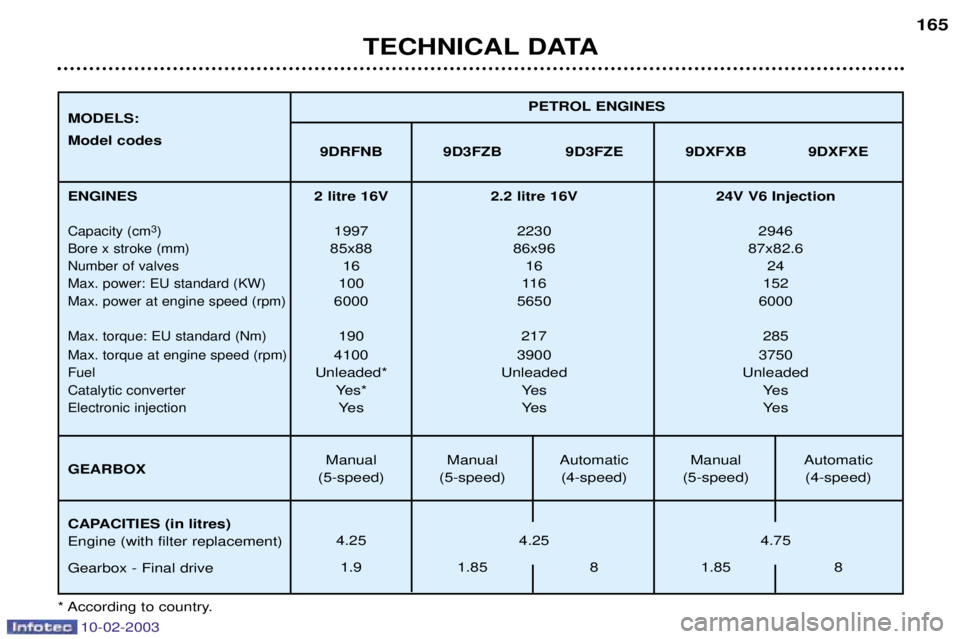
* According to country. MODELS: Model codes
PETROL ENGINES
9DRFNB 9D3FZB 9D3FZE 9DXFXB 9DXFXE
ENGINES
Capacity (cm 3
)
Bore x stroke (mm) Number of valvesMax. power: EU standard (KW)Max. power at engine speed (rpm) Max. torque: EU standard (Nm) Max. torque at engine speed (rpm) FuelCatalytic converterElectronic injection
GEARBOX
CAPACITIES (in litres) Engine (with filter replacement) Gearbox - Final drive 2 litre 16V 2.2 litre 16V 24V V6 Injection
1997 2230 2946
85x88 86x96 87x82.6 16 16 24
100 116 152
6000 5650 6000
190 217 285
4100 3900 3750
Unleaded* Unleaded Unleaded Yes* Yes YesYe s Ye s Ye s
Manual Manual Automatic Manual Automatic
(5-speed) (5-speed) (4-speed) (5-speed) (4-speed)
4.25 4.25 4.751.9 1.85 8 1.85 8
10-02-2003
Page 179 of 183
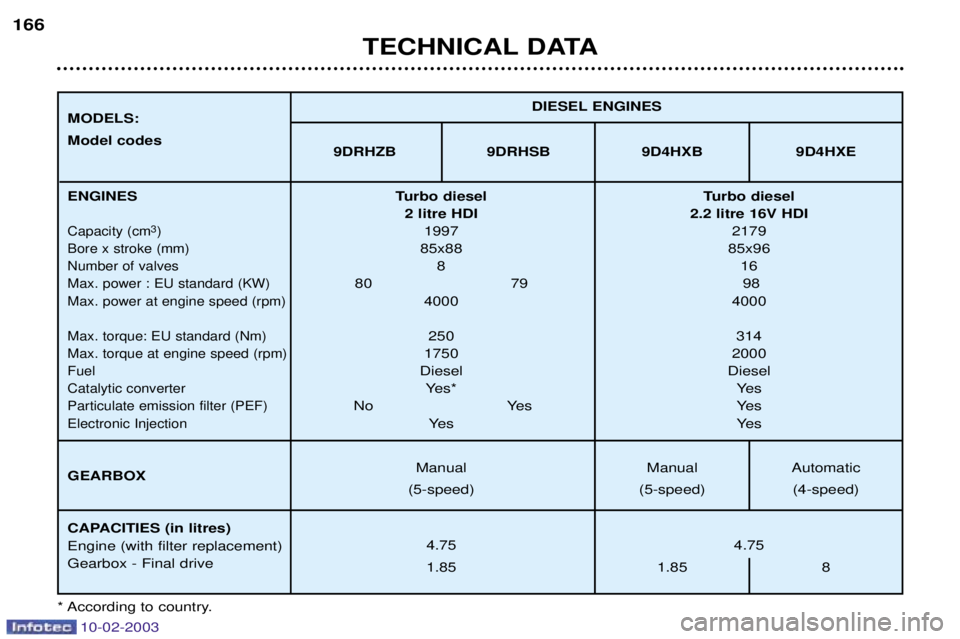
TECHNICAL DATA
166
Turbo diesel Turbo diesel2 litre HDI 2.2 litre 16V HDI 1997 2179
85x88 85x96
81 6
80 79 98 4000 4000
250 314
1750 2000
Diesel Diesel Yes* Yes
No Yes Yes Ye s Ye s
Manual Manual Automatic
(5-speed) (5-speed) (4-speed)
4.75 4.75
1.85 1.85 8
DIESEL ENGINES
MODELS: Model codes 9DRHZB 9DRHSB 9D4HXB 9D4HXE
ENGINES
Capacity (cm 3
)
Bore x stroke (mm) Number of valvesMax. power : EU standard (KW) Max. power at engine speed (rpm) Max. torque: EU standard (Nm) Max. torque at engine speed (rpm)FuelCatalytic converterParticulate emission filter (PEF)Electronic Injection
GEARBOX
CAPACITIES (in litres) Engine (with filter replacement)Gearbox - Final drive
* According to country.
10-02-2003
Page 180 of 183
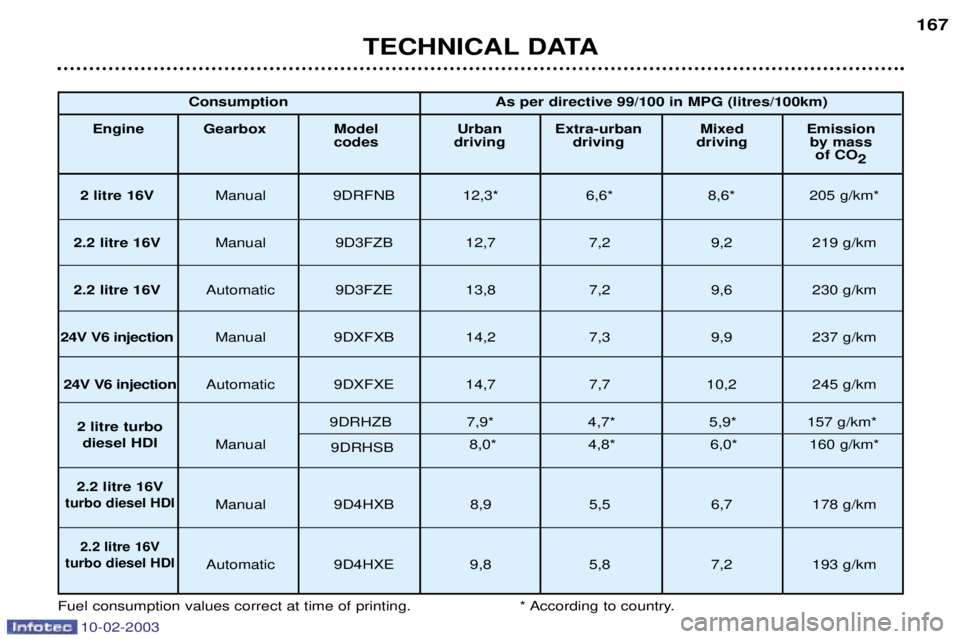
TECHNICAL DATA167
2 litre 16V
Manual 9DRFNB 12,3* 6,6* 8,6* 205 g/km*
2.2 litre 16V Manual 9D3FZB 12,7 7,2 9,2 219 g/km
2.2 litre 16V Automatic 9D3FZE 13,8 7,2 9,6 230 g/km
24V V6 injection Manual 9DXFXB 14,2 7,3 9,9 237 g/km
24V V6 injection Automatic 9DXFXE 14,7 7,7 10,2 245 g/km
2 litre turbo diesel HDI Manual 8,0* 4,8* 6,0* 160 g/km*
2.2 litre 16V
turbo diesel HDIManual 9D4HXB 8,9 5,5 6,7 178 g/km
2.2 litre 16V
turbo diesel HDI
Automatic 9D4HXE 9,8 5,8 7,2 193 g/km
Fuel consumption values correct at time of printing. * According to country. Consumption As per directive 99/100 in MPG (litres/100km)
Engine Gearbox Model Urban Extra-urban Mixed Emission codes driving driving driving by mass of CO2
9DRHZB 7,9* 4,7* 5,9* 157 g/km*
9DRHSB
10-02-2003
Page 181 of 183
TECHNICAL DATA
168
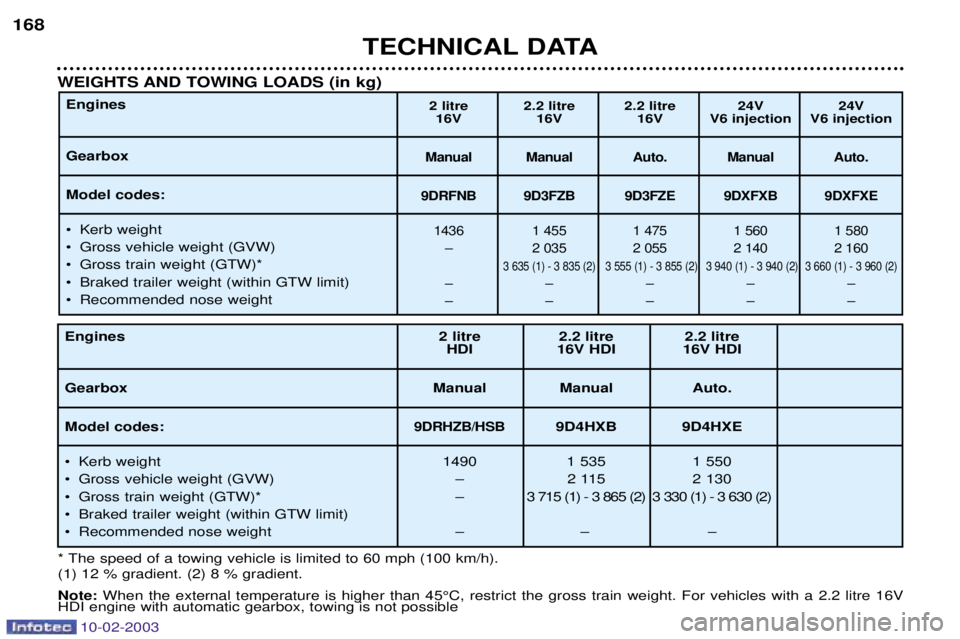
Engines Gearbox Model codes:
¥ Kerb weight
¥ Gross vehicle weight (GVW)
¥ Gross train weight (GTW)*
¥ Braked trailer weight (within GTW limit)
¥ Recommended nose weight 2 litre 2.2 litre 2.2 litre 24V 24V
16V 16V 16V V6 injection V6 injection
Manual Manual Auto. Manual Auto.
9DRFNB 9D3FZB 9D3FZE 9DXFXB 9DXFXE 1436 1 455 1 475 1 560 1 580Ð 2 035 2 055 2 140 2 160
3 635 (1) - 3 835 (2) 3 555 (1) - 3 855 (2) 3 940 (1) - 3 940 (2) 3 660 (1) - 3 960 (2)
ÐÐÐÐÐÐÐÐÐÐ
Engines Gearbox Model codes:
¥ Kerb weight
¥ Gross vehicle weight (GVW)
¥ Gross train weight (GTW)*
¥ Braked trailer weight (within GTW limit)
¥ Recommended nose weight 2 litre 2.2 litre 2.2 litre
HDI 16V HDI 16V HDI
Manual Manual Auto.
9DRHZB/HSB9D4HXB 9D4HXE
1490 1 535 1 550 Ð 2 115 2 130
Ð 3 715 (1) - 3 865 (2) 3 330 (1) - 3 630 (2)
ÐÐ Ð
* The speed of a towing vehicle is limited to 60 mph (100 km/h). (1) 12 % gradient. (2) 8 % gradient. Note: When the external temperature is higher than 45¡C, restrict the gross train weight. For vehicles with a 2.2 litre 16V
HDI engine with automatic gearbox, towing is not possible
WEIGHTS AND TOWING LOADS (in kg)
10-02-2003
Page 183 of 183
TECHNICAL DATA
170
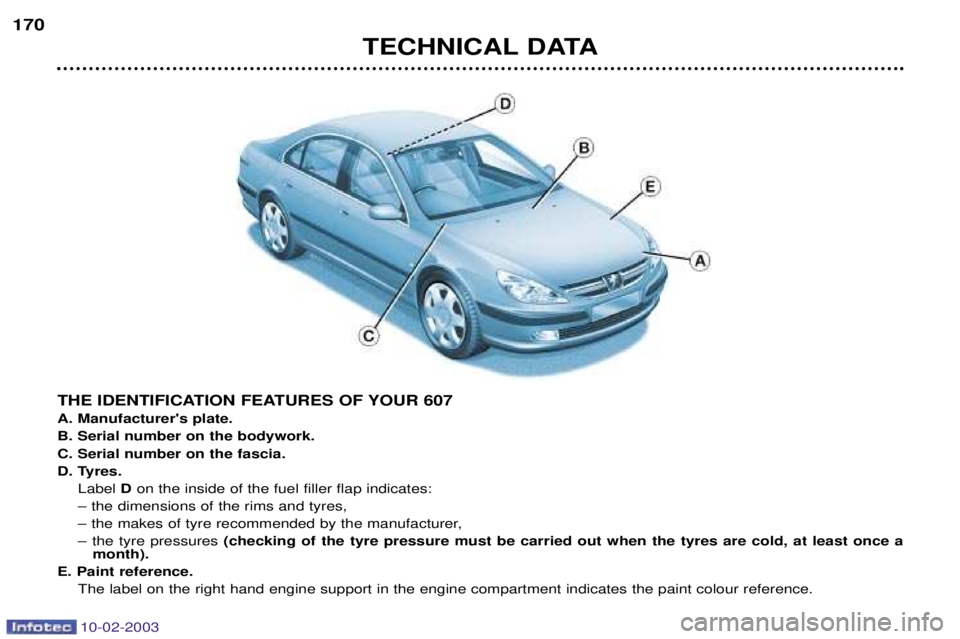
THE IDENTIFICATION FEATURES OF YOUR 607 A. Manufacturer's plate.B. Serial number on the bodywork.C. Serial number on the fascia.
D. Tyres.Label Don the inside of the fuel filler flap indicates:
Ð the dimensions of the rims and tyres,
Ð the makes of tyre recommended by the manufacturer,Ð the tyre pressures (checking of the tyre pressure must be carried out when the tyres are cold, at least once a
month).
E. Paint reference. The label on the right hand engine support in the engine compartment indicates the paint colour reference.
10-02-2003