Page 128 of 177
17-02-2003
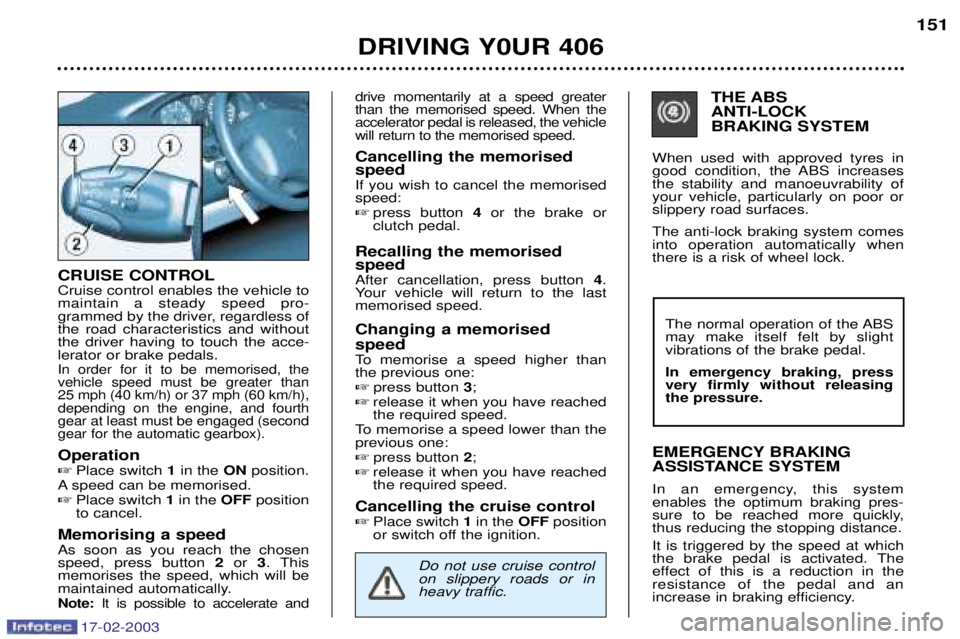
CRUISE CONTROL Cruise control enables the vehicle to maintain a steady speed pro-
grammed by the driver, regardless ofthe road characteristics and withoutthe driver having to touch the acce-lerator or brake pedals.
In order for it to be memorised, thevehicle speed must be greater than
25 mph (40 km/h) or 37 mph (60 km/h),depending on the engine, and fourthgear at least must be engaged (secondgear for the automatic gearbox).
Operation �Place switch 1in the ONposition.
A speed can be memorised.� Place switch 1in the OFFposition
to cancel.
Memorising a speedAs soon as you reach the chosen speed, press button 2or 3. This
memorises the speed, which will be
maintained automatically.
Note: It is possible to accelerate and drive momentarily at a speed greaterthan the memorised speed. When theaccelerator pedal is released, the vehiclewill return to the memorised speed.
Cancelling the memorisedspeed If you wish to cancel the memorised speed: �
press button 4or the brake or
clutch pedal.
Recalling the memorised speed After cancellation, press button 4.
Your vehicle will return to the last memorised speed. Changing a memorised speed
To memorise a speed higher than the previous one: � press button 3;
� release it when you have reached the required speed.
To memorise a speed lower than theprevious one: � press button 2;
� release it when you have reached the required speed.
Cancelling the cruise control � Place switch 1in the OFFposition
or switch off the ignition.
DRIVING Y0UR 406 151
Do not use cruise control on slippery roads or inheavy traffic.
THE ABS ANTI-LOCK BRAKING SYSTEM
When used with approved tyres in
good condition, the ABS increasesthe stability and manoeuvrability ofyour vehicle, particularly on poor orslippery road surfaces. The anti-lock braking system comes into operation automatically whenthere is a risk of wheel lock.
EMERGENCY BRAKING
ASSISTANCE SYSTEM
In an emergency, this system enables the optimum braking pres-
sure to be reached more quickly,thus reducing the stopping distance. It is triggered by the speed at which
the brake pedal is activated. The
effect of this is a reduction in theresistance of the pedal and an
increase in braking efficiency. The normal operation of the ABSmay make itself felt by slightvibrations of the brake pedal. In emergency braking, press very firmly without releasingthe pressure.
Page 146 of 177
17-02-2003
PETROL/LPG TWIN FUEL VERSION169
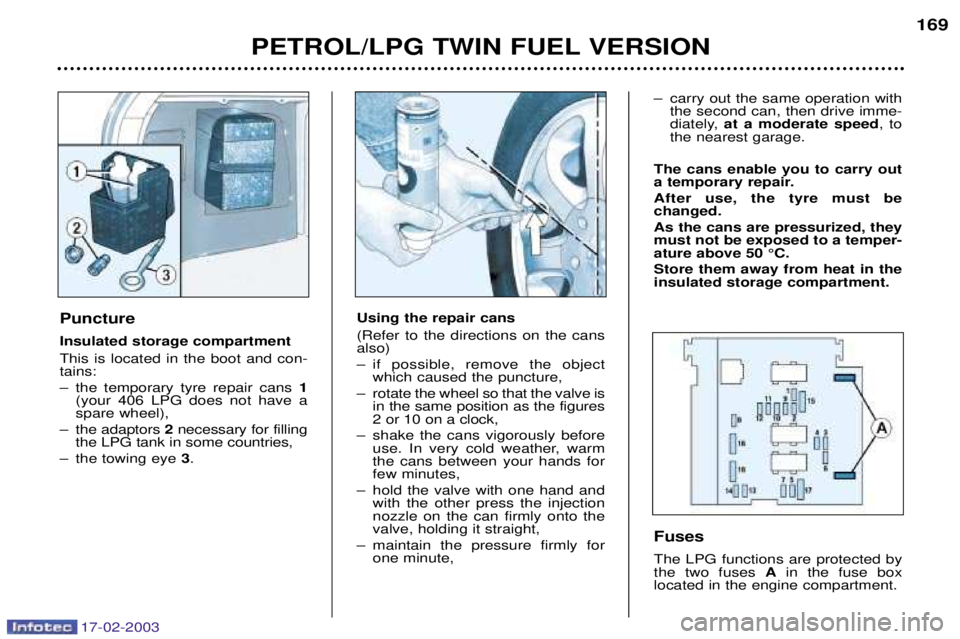
Puncture Insulated storage compartment This is located in the boot and con- tains:
Ð the temporary tyre repair cans 1
(your 406 LPG does not have a spare wheel),
Ð the adaptors 2necessary for filling
the LPG tank in some countries,
Ð the towing eye 3.
Fuses The LPG functions are protected by the two fuses Ain the fuse box
located in the engine compartment.
Using the repair cans (Refer to the directions on the cans also)
Ð if possible, remove the object
which caused the puncture,
Ð rotate the wheel so that the valve is in the same position as the figures 2 or 10 on a clock,
Ð shake the cans vigorously before use. In very cold weather, warmthe cans between your hands forfew minutes,
Ð hold the valve with one hand and with the other press the injectionnozzle on the can firmly onto thevalve, holding it straight,
Ð maintain the pressure firmly for one minute, Ð carry out the same operation with
the second can, then drive imme-
diately, at a moderate speed , to
the nearest garage.
The cans enable you to carry out
a temporary repair. After use, the tyre must be changed. As the cans are pressurized, they must not be exposed to a temper-ature above 50 ¡C. Store them away from heat in the insulated storage compartment.
Page 152 of 177
17-02-2003
CHANGING A FUSE The fuse boxes are under the fascia and in the engine compartment. Fascia fuse box
Turn the three screws a quarter turn with a coin. Pull at Aand tilt the
cover to access the fuses. Removing and changing a fuse Before changing a fuse you must find out the cause of the fault and have it put
right. The fuse numbers are indicated on the fuse box. Use the special pliers
Aattached to the box.
Always change a faulty fuse for one of the same rating.
Correct Incorrect Pliers A
Remove the fascia panel lower trim to access the built-in systems interface.
Fuse n o
. Rating Functions
A 20 A Locking/Unlocking, Deadlock- ing.
B 10 A Rear fog lamps.
C 40 A Demisting the mirrors.
D 15 A Rear screen wiper.
E 30 A Electric windows.
F 15 A Supply to instrument panel -
Display - Audio equipment - Satellite navigation system - Air conditioning.
MAINTENANCE OF YOUR 406 41
Page 155 of 177
17-02-2003
PETROL/LPG TWIN FUEL VERSION169
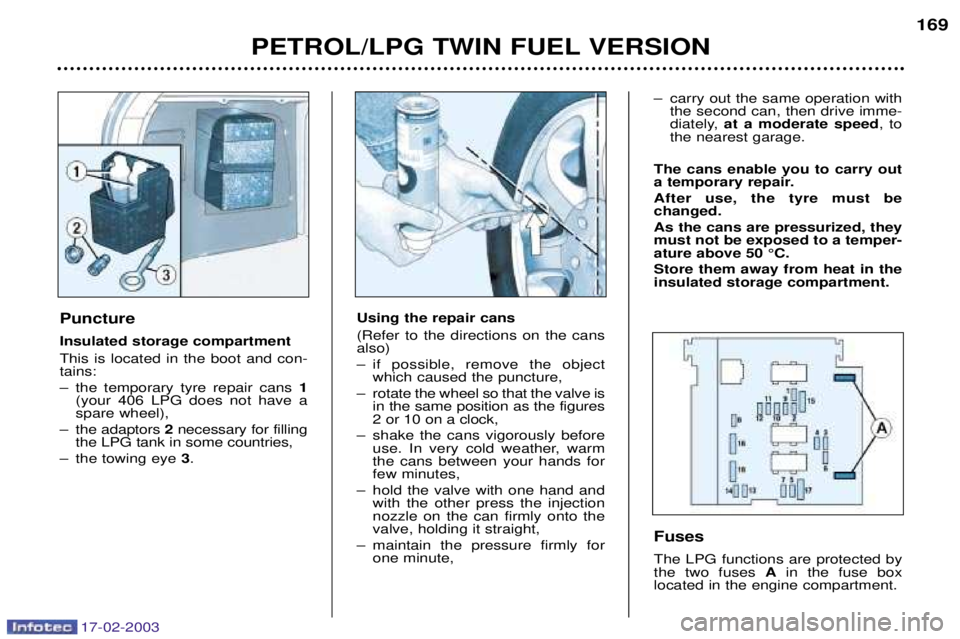
Puncture Insulated storage compartment This is located in the boot and con- tains:
Ð the temporary tyre repair cans 1
(your 406 LPG does not have a spare wheel),
Ð the adaptors 2necessary for filling
the LPG tank in some countries,
Ð the towing eye 3.
Fuses The LPG functions are protected by the two fuses Ain the fuse box
located in the engine compartment.
Using the repair cans (Refer to the directions on the cans also)
Ð if possible, remove the object
which caused the puncture,
Ð rotate the wheel so that the valve is in the same position as the figures 2 or 10 on a clock,
Ð shake the cans vigorously before use. In very cold weather, warmthe cans between your hands forfew minutes,
Ð hold the valve with one hand and with the other press the injectionnozzle on the can firmly onto thevalve, holding it straight,
Ð maintain the pressure firmly for one minute, Ð carry out the same operation with
the second can, then drive imme-
diately, at a moderate speed , to
the nearest garage.
The cans enable you to carry out
a temporary repair. After use, the tyre must be changed. As the cans are pressurized, they must not be exposed to a temper-ature above 50 ¡C. Store them away from heat in the insulated storage compartment.
Page 156 of 177
17-02-2003
CHANGING A FUSE The fuse boxes are under the fascia and in the engine compartment. Fascia fuse box
Turn the three screws a quarter turn with a coin. Pull at Aand tilt the
cover to access the fuses. Removing and changing a fuse Before changing a fuse you must find out the cause of the fault and have it put
right. The fuse numbers are indicated on the fuse box. Use the special pliers
Aattached to the box.
Always change a faulty fuse for one of the same rating.
Correct Incorrect Pliers A
Remove the fascia panel lower trim to access the built-in systems interface.
Fuse n o
. Rating Functions
A 20 A Locking/Unlocking, Deadlock- ing.
B 10 A Rear fog lamps.
C 40 A Demisting the mirrors.
D 15 A Rear screen wiper.
E 30 A Electric windows.
F 15 A Supply to instrument panel -
Display - Audio equipment - Satellite navigation system - Air conditioning.
MAINTENANCE OF YOUR 406 41
Page 161 of 177
17-02-2003
Special features of the automatic gearbox When towing with four wheels on the ground, the following rules must beobeyed:
Ð gear lever in position N,
Ð tow the vehicle at less than 30 m.p.h. (50 km/h) over a maxi- mum distance of 30 miles (50 km).
Ð do not add oil to the gearbox.
MAINTENANCE OF YOUR 406
48
TOWING YOUR VEHICLE
Without lifting (4 wheels on the road)
You should always use a tow bar. The towing eye is inside the spare wheel. From the front:Lift the cover using the flat part of the towing eye.Screw in the towing eye until it locks.From the rear:Unclip the cover by passing your hand behind the bumper and pushing.Screw in the towing eye until it locks. Lifting (2 wheels on the road only) It is preferable to raise the vehicle by the wheels.
Never use the radiator crossmember.


