Page 3 of 131
30-06-2003
3YOUR AT A GLANCE
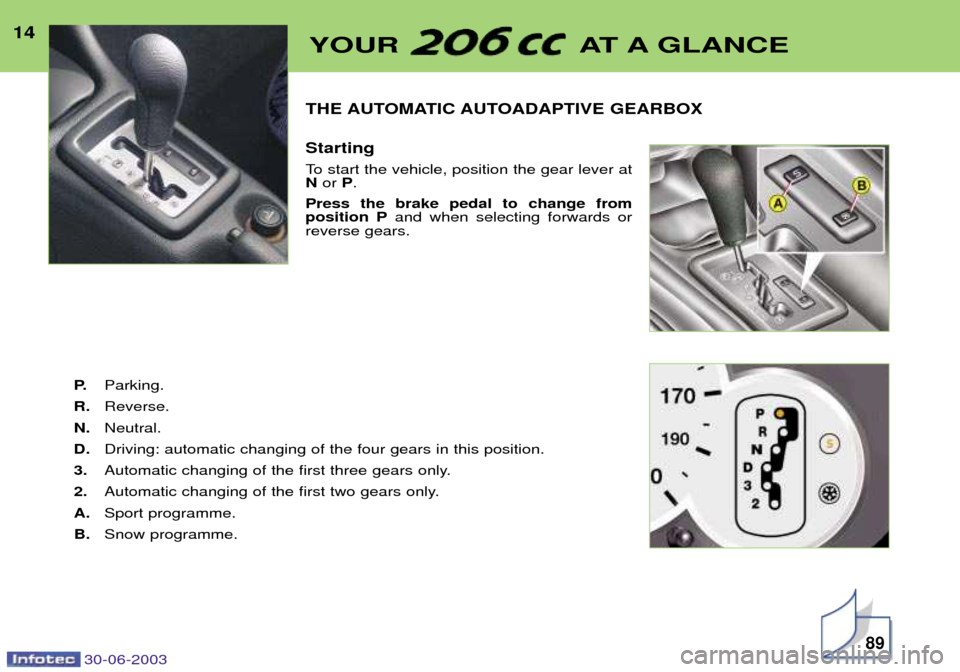
1Driver's air bag Horn
2 Lights and direction indica- tors stalk
3 Passenger air bag disarmingswitch*
4 Heated seats control
5 Dynamic stability control(ESP/ASR) button
6 Instrument panel lightingrheostat
7 Windscreen wipers/wind-screen wash/trip computerstalk
8 Audio equipment steeringcolumn stalk
9 Hazard warning lights switch
10 Multifunction display
11 Windscreen demisting vents 12
Side windows demisting vents
13 Adjustable central vent
14 Passenger air bag
15 Adjustable central vents
16 Glove box
17 RD3 audio equipment
18 Heating/ventilation/airconditioning controls
Rear screen and mirrorsdemisting
19 Front ashtray
20 Gear lever
21 Lighter
22 Electric mirror controls
23 Electric retractable roof control 24
Electric window switches
25 Handbrake
26 Bonnet release control
27 Steering lock
28 Fuse box
29 Storage compartment
30 Steering wheel height adjustment control
31 Headlamp height adjustment
* According to destination.
Page 4 of 131
30-06-200376
YOUR AT A GLANCE4
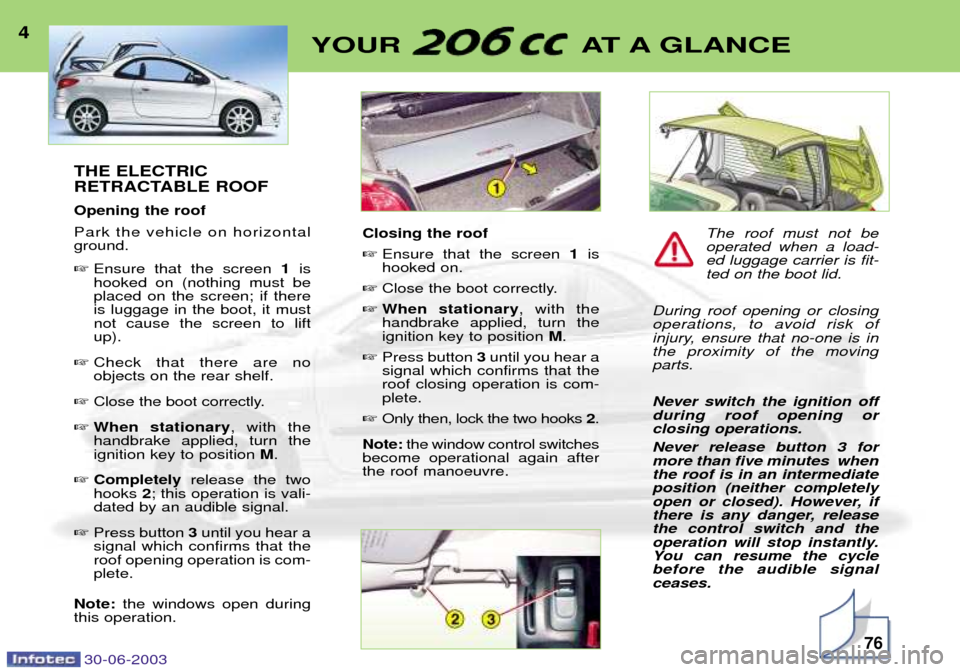
THE ELECTRIC
RETRACTABLE ROOF Opening the roof
Park the vehicle on horizontal ground. �Ensure that the screen 1is
hooked on (nothing must be placed on the screen; if thereis luggage in the boot, it mustnot cause the screen to liftup).
� Check that there are noobjects on the rear shelf.
� Close the boot correctly.
� When stationary , with the
handbrake applied, turn theignition key to position M.
� Completely release the two
hooks 2; this operation is vali-
dated by an audible signal.
� Press button 3until you hear a
signal which confirms that theroof opening operation is com-plete.
Note: the windows open during
this operation. Closing the roof �
Ensure that the screen 1is
hooked on.
� Close the boot correctly.
� When stationary , with the
handbrake applied, turn the ignition key to position M.
� Press button 3until you hear a
signal which confirms that theroof closing operation is com-plete.
� Only then, lock the two hooks 2.
Note: the window control switches
become operational again afterthe roof manoeuvre. The roof must not beoperated when a load-ed luggage carrier is fit-ted on the boot lid.
During roof opening or closingoperations, to avoid risk of
injury, ensure that no-one is inthe proximity of the movingparts.
Never switch the ignition off during roof opening or closing operations. Never release button 3 for more than five minutes whenthe roof is in an intermediateposition (neither completely
open or closed). However, if
there is any danger, releasethe control switch and the
operation will stop instantly.
You can resume the cyclebefore the audible signalceases.
Page 14 of 131
30-06-2003
THE AUTOMATIC AUTOADAPTIVE GEARBOX Starting
To start the vehicle, position the gear lever at Nor P.
Press the brake pedal to change fromposition P and when selecting forwards or
reverse gears.
P. Parking.
R. Reverse.
N. Neutral.
D. Driving: automatic changing of the four gears in this position.
3. Automatic changing of the first three gears only.
2. Automatic changing of the first two gears only.
A. Sport programme.
B. Snow programme.
YOUR AT A GLANCE
89
14
Page 16 of 131
30-06-2003
PEUGEOT SERVICING19
SPECIAL FEATURES Some of your vehicle's vital components have specific servicing schedules. The brake fluid must be replaced every 40,000 miles (60,000 km) or every 2 years.
The passenger compartment filter must be checked at each visitto the PEUGEOT dealer (intermediate visits and
regular services).The timing belt: contact a PEUGEOT dealer.
Note: The engine coolant does not need to be replaced.
Arduous conditions of use If the vehicle is used under certain particularly arduous conditions: - Continuous door-to-door use.
- Town use.- Repeated short journeys, with the engine cold in low temperatures.
Or prolonged stay under the following conditions: - Countries with temperatures often above +30 ¡C.- Countries with temperatures often below minus 15 ¡C.- Countries with a dusty atmosphere.- Countries whose lubricants or fuels do not conform to our recommendations.
It is necessary to follow an "Arduous conditions" service schedule which includes shorter service intervals: - Every 12,000 miles (20,000 km) or every year.
Page 17 of 131
30-06-2003
PEUGEOT SERVICING19
SPECIAL FEATURES Some of your vehicle's vital components have specific servicing schedules. The brake fluid must be replaced every 40,000 miles (60,000 km) or every 2 years.
The passenger compartment filter must be checked at each visitto the PEUGEOT dealer (intermediate visits and
regular services).The timing belt: contact a PEUGEOT dealer.
Note: The engine coolant does not need to be replaced.
Arduous conditions of use If the vehicle is used under certain particularly arduous conditions: - Continuous door-to-door use.
- Town use.- Repeated short journeys, with the engine cold in low temperatures.
Or prolonged stay under the following conditions: - Countries with temperatures often above +30 ¡C.- Countries with temperatures often below minus 15 ¡C.- Countries with a dusty atmosphere.- Countries whose lubricants or fuels do not conform to our recommendations.
It is necessary to follow an "Arduous conditions" service schedule which includes shorter service intervals: - Every 12,000 miles (20,000 km) or every year.
Page 21 of 131
30-06-2003
PEUGEOT SERVICING23
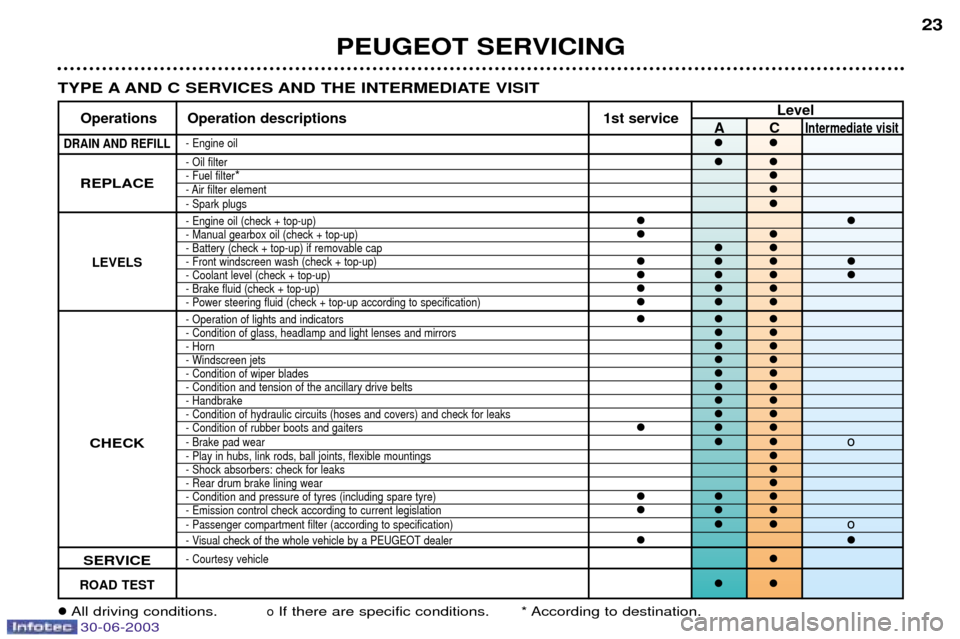
- Engine oil
Level
Operations Operation descriptions 1st service
AC
Intermediate visit
- Oil filter- Fuel filter* - Air filter element- Spark plugs
- Engine oil (check + top-up)- Manual gearbox oil (check + top-up)- Battery (check + top-up) if removable cap- Front windscreen wash (check + top-up)- Coolant level (check + top-up)- Brake fluid (check + top-up)- Power steering fluid (check + top-up according to specification)
- Operation of lights and indicators- Condition of glass, headlamp and light lenses and mirrors- Horn- Windscreen jets- Condition of wiper blades- Condition and tension of the ancillary drive belts- Handbrake- Condition of hydraulic circuits (hoses and covers) and check for leaks- Condition of rubber boots and gaiters- Brake pad wearo- Play in hubs, link rods, ball joints, flexible mountings- Shock absorbers: check for leaks- Rear drum brake lining wear- Condition and pressure of tyres (including spare tyre)- Emission control check according to current legislation- Passenger compartment filter (according to specification)o- Visual check of the whole vehicle by a PEUGEOT dealer
- Courtesy vehicle
All driving conditions.oIf there are specific conditions. * According to destination.
DRAIN AND REFILL
REPLACE
LEVELS
CHECK
SERVICE
ROAD TEST
TYPE A AND C SERVICES AND THE INTERMEDIATE VISIT
Page 23 of 131
30-06-2003
PEUGEOT SERVICING25
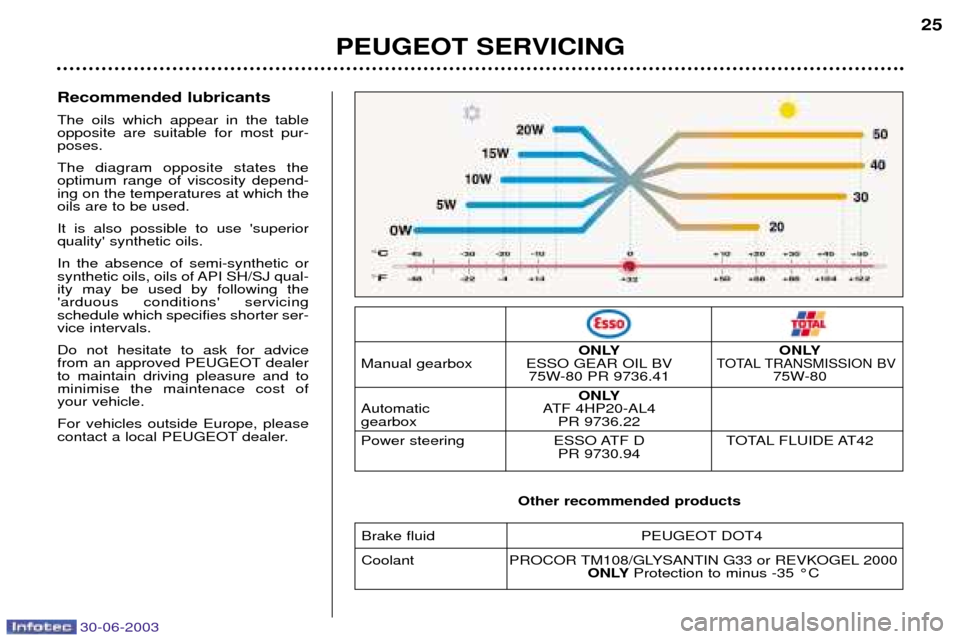
Recommended lubricants The oils which appear in the table opposite are suitable for most pur-poses. The diagram opposite states the optimum range of viscosity depend-ing on the temperatures at which theoils are to be used. It is also possible to use 'superior quality' synthetic oils. In the absence of semi-synthetic or
synthetic oils, oils of API SH/SJ qual-ity may be used by following the'arduous conditions' servicingschedule which specifies shorter ser-vice intervals. Do not hesitate to ask for advice
from an approved PEUGEOT dealerto maintain driving pleasure and tominimise the maintenace cost ofyour vehicle. For vehicles outside Europe, please
contact a local PEUGEOT dealer.
ONLY ONLY
Manual gearbox ESSO GEAR OIL BVTOTAL TRANSMISSION BV75W-80 PR 9736.41 75W-80
ONLY
Automatic ATF 4HP20-AL4
gearbox PR 9736.22
Power steering ESSO ATF D TOTAL FLUIDE AT42 PR 9730.94
Brake fluid PEUGEOT DOT4
Coolant PROCOR TM108/GLYSANTIN G33 or REVKOGEL 2000 ONLYProtection to minus -35 ¡C
Other recommended products
Page 24 of 131
30-06-2003
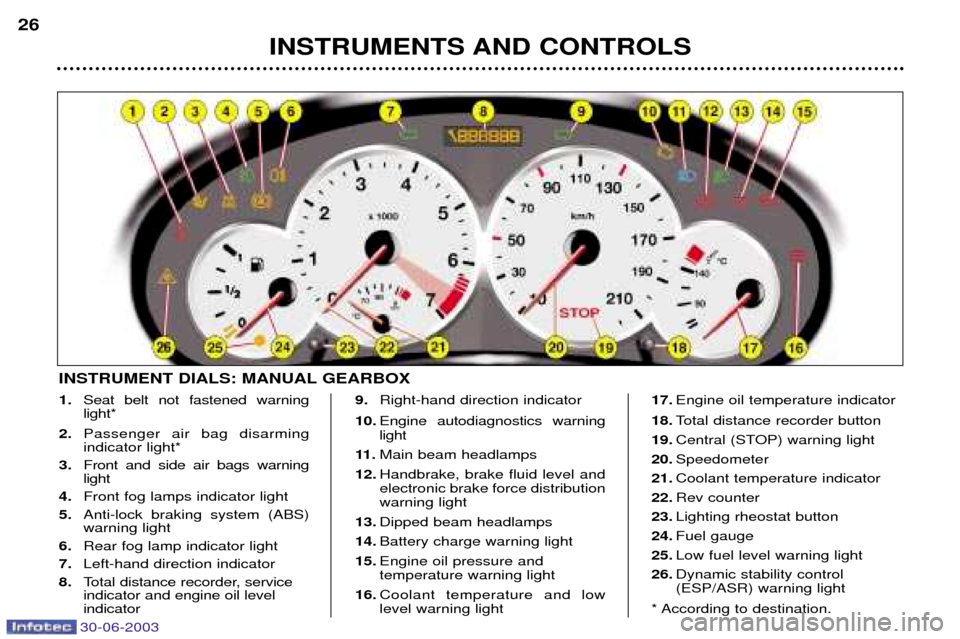
1.Seat belt not fastened warning light*
2. Passenger air bag disarmingindicator light*
3. Front and side air bags warninglight
4. Front fog lamps indicator light
5. Anti-lock braking system (ABS)warning light
6. Rear fog lamp indicator light
7. Left-hand direction indicator
8. Total distance recorder, serviceindicator and engine oil level indicator 9.
Right-hand direction indicator
10. Engine autodiagnostics warning light
11 . Main beam headlamps
12. Handbrake, brake fluid level and electronic brake force distributionwarning light
13. Dipped beam headlamps
14. Battery charge warning light
15. Engine oil pressure and temperature warning light
16. Coolant temperature and lowlevel warning light 17.
Engine oil temperature indicator
18. Total distance recorder button
19. Central (STOP) warning light
20. Speedometer
21. Coolant temperature indicator
22. Rev counter
23. Lighting rheostat button
24. Fuel gauge
25. Low fuel level warning light
26. Dynamic stability control (ESP/ASR) warning light
* According to destination.
INSTRUMENTS AND CONTROLS
26
INSTRUMENT DIALS: MANUAL GEARBOX