Page 300 of 410
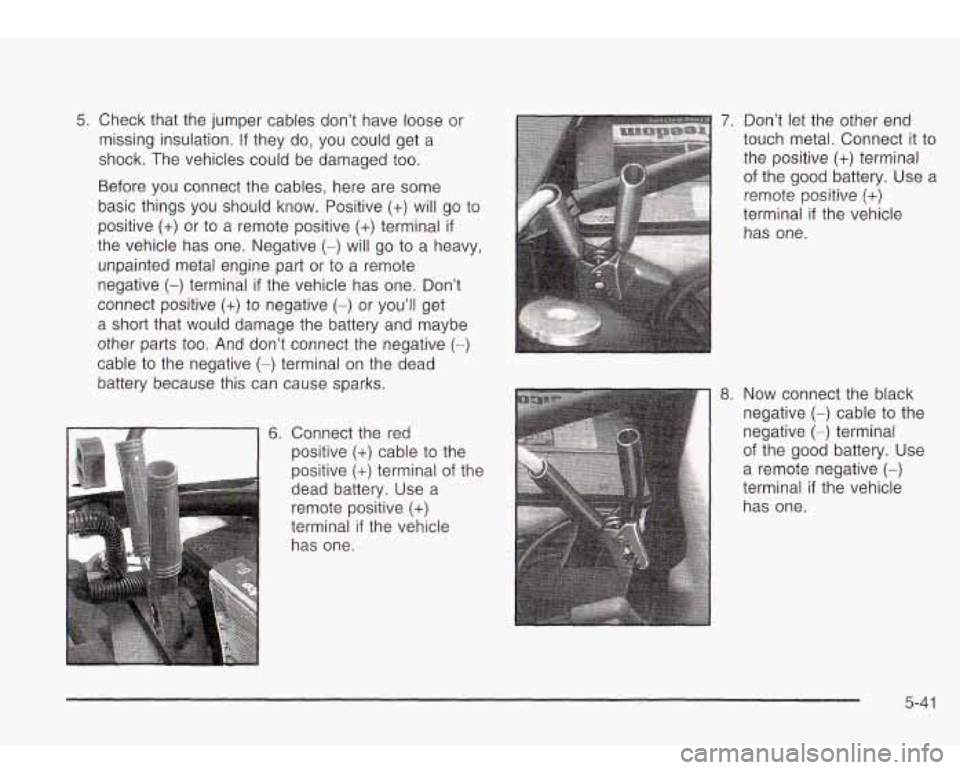
5. Check that the jumper cables don’t have loose or
missing insulation.
If they do, you could get a
shock. The vehicles could be damaged too.
Before you connect the cables, here are some
basic things you should know. Positive
(+) will go to
positive (+) or to a remote positive (+) terminal if
the vehicle has one. Negative (-) will go to a heavy,
unpainted metal engine part or
to a remote
negative
(-) terminal if the vehicle has one. Don’t
connect positive
(+) to negative (-) or you’ll get
a short that would damage the battery and maybe
other parts
too. And don’t connect the negative (-)
cable to the negative (-) terminal on the dead
battery because this can cause sparks.
6. Connect the red
positive
(+) cable to the
positive
(+) terminal of the
dead battery.
Use a
remote positive
(+)
terminal if the vehicle
has one.
7. Don’t let the other end
touch metal. Connect it
to
the positive (+) terminal
of the good battery. Use a
remote positive (+)
terminal if the vehicle
has one.
8. Now connect the black
negative
(-) cable to the
negative
(-) terminal
of the good battery. Use
a remote negative
(-)
terminal if the vehicle
has one.
5-4 1
Page 301 of 410
Don’t let the other end touch anything until the next
step. The other end of the negative
(-) cable
doesn’t go to the dead battery. It goes to a heavy,
unpainted metal engine part or to the remote
negative
(-) terminal on the vehicle with the dead
battery. The remote negative
(-) terminal on
your vehicle is located on the front engine lift
bracket and is marked
“GND.”
9. Connect the other end of
the negative
(-) cable to
1 the remote negative (-)
terminal on the vehicle
with the dead battery.
10. Now start the vehicle with the good battery and run
the engine for a while.
11. Try to start the vehicle that had the dead battery. If
it Won’t start after a few tries, it probably needs
service.
Notice: Damage to your vehicle may result from
electrical shorting
if jumper cables are removed
incorrectly. To prevent electrical shorting, take care
that the cables don’t touch each other or any
other metal. The repairs wouldn’t be covered by
your warranty.
5-42
Page 302 of 410
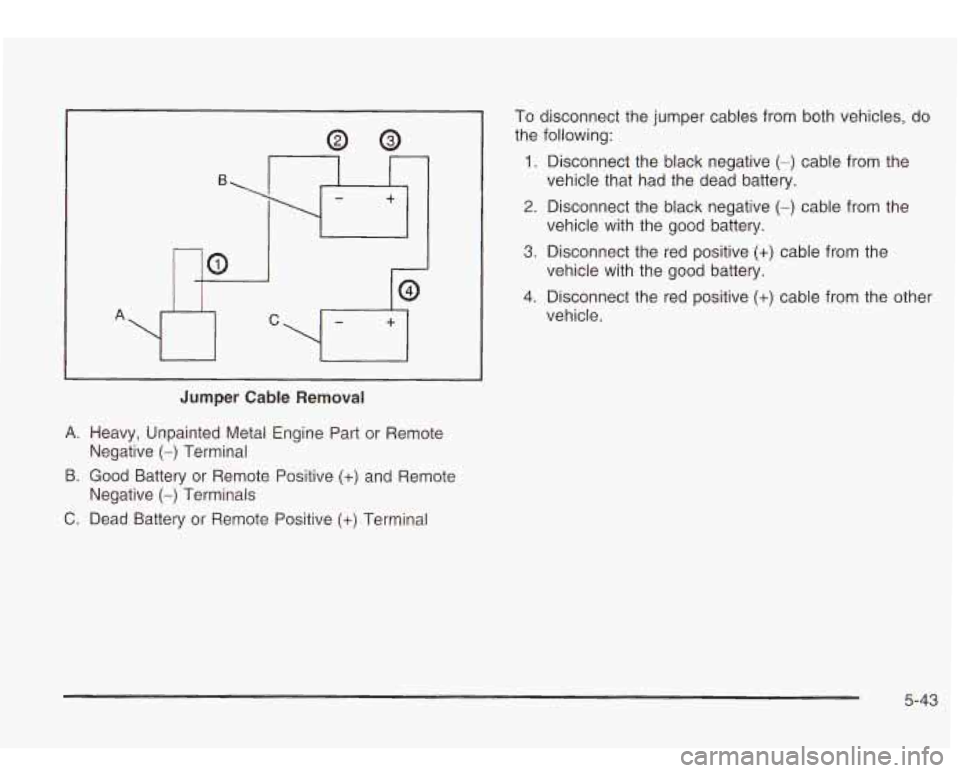
Jumper Cable Removal
A. Heavy, Unpainted Metal Engine Part or Remote
9. Good Battery or Remote Positive (+) and Remote
C. Dead Battery or Remote Positive (+) Terminal
Negative
(-) Terminal
Negative
(-) Terminals
To disconnect the jumper cables from both vehicles, do
the following:
1. Disconnect the black negative (-) cable from the
vehicle that had the dead battery.
2. Disconnect the black negative (-) cable from the
vehicle with the good battery.
3. Disconnect the red positive
(+) cable from the
4. Disconnect the red positive
(+) cable from the other
vehicle with the
good battery.
vehicle.
5-43
Page 321 of 410

A rear blowout, particularly on a curve, acts much like a
skid and may require the same correction you’d use
in a skid. In any rear blowout, remove your foot from the
accelerator pedal. Get the vehicle under control by
steering the way you want the vehicle
to go. It may be
very bumpy and noisy, but you can still steer. Gently
brake
to a stop - well off the road if possible.
If
a tire goes flat, the next part shows how to use your
jacking equipment
to change a flat tire safely.
Changing a Flat Tire
If a tire goes flat, avoid further tire and wheel damage
by driving slowly
to a level place. Turn on your
hazard warning flashers. Cha..,ing
a tire can ca-.-e an injc.
,. The
vehicle can slip
off the jack and roll over you
or other people. You and they could be badly
injured. Find a level place to change your tire.
To help prevent the vehicle from moving:
1. Set the parking brake firmly.
2. Put the shift lever in PARK (P).
3. Turn off the engine.
4. Put the wheel blocks at the front and rear
of the tire farthest away from the one
being changed. That would be the tire on
the other side of the vehicle,
at the
opposite end.
5-62
Page 344 of 410
Vehicle Identification
Vehicle Identification Number (VIN)
This is the legal identifier for your vehicle. It appears on
a plate in the front corner of the instrument panel, on
the driver’s side. You can see it
if you look through the
windshield from outside your vehicle. The VIN also
appears on the Vehicle Certification and Service Parts
labels and the certificates of title and registration.
Engine Identification
The 8th character in your VIN is the engine code. This
code will help you identify your engine, specifications
and replacement parts.
Service Parts Identification Label
You’ll find this label on the inside of the glove box. It’s
very helpful if you ever need to order parts. On this
label is:
your VIN,
the model designation,
paint information and
a list of all production options and special
equipment.
Be sure that this label is not removed from the vehicle.
5-85
Page 346 of 410
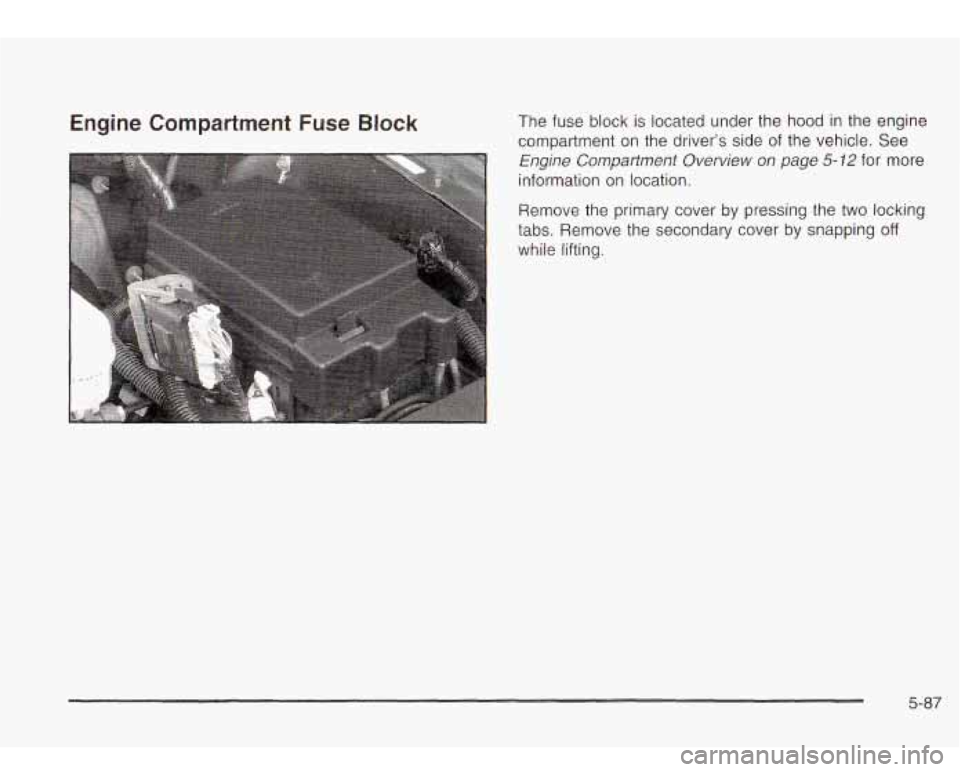
Engine Compartment Fuse Block The fuse block is located under the hood in the engine
compartment on the driver’s side of the vehicle. See
Engine Compartment Overview on page 5-72 for more
information on location.
Remove the primary cover by pressing the
two locking
tabs. Remove the secondary cover by snapping
off
while lifting.
5-87
Page 348 of 410
Fuses
10
11 12
13 14
15 16
17
18
19
20
21 22
23
24
25
26
27
28
29
30
31
Usage
Powertrain Control Module B
Fog Lamps
Stop Lamp
Cigarette Lighter
Ignition Coils
Air Suspension Ride
TBD-Ignition
1
Crank
Air Bag
Electric Brake
Cooling Fan
Horn Ignition
E
Electronic Throttle Control
Instrument Panel Cluster, Driver
Information Center
Automatic Shift Lock Control System
Engine 1
Back-up Powertrain Control Module 1
Oxygen Sensor
Air Conditioning
Truck Body Controller
Fuses
32
33
34
35
36
50
51
52
Relays
37
38
39
40
41
42
43
44
45
46 47
Usage
Trailer
Anti-Lock Brakes (ABS) Ignition A
Blower Motor Ignition B Passenger’s Side Trailer Turn
Driver’s Side Trailer Turn
Hazard Flashers
Usage
Blank Rear Window Washer
Fog Lamps
Horn Fuel Pump
Windshield WipersNasher
High-Beam Headlamp
Air Conditioning
Cooling Fan
Headlamp Driver Module
Starter
Miscellaneous Usage
48 Instrument Panel Battery
49 Fuse Puller
5-89
Page 353 of 410
Normal Maintenance Replacement Parts
Part
GM Part No. 24200796
Automatic Transmission Filter Kit A201 4C*
Engine Air Cleaner P F58*
Engine
Oil Filter Number
~~ ~
Spark Plugs
*ACDelco@ part
number 14.0
inches
(35.6 em) Backglass Wiper Blade
20.0 inches (50.8 cm)
Windshield Wiper Blade
GF831* Fuel Filter 41
-981
*
5-94