2003 OLDSMOBILE AURORA trailer
[x] Cancel search: trailerPage 232 of 387

When You Are Ready to Leave After
Parking on
a Hill
1. Apply your regular brakes and hold the pedal down
while you:
start your engine,
shift into a gear, and
release the parking brake.
2. Let up on the brake pedal.
3. Drive slowly until the trailer is clear of the chocks.
4. Stop and have someone pick up and store the
chocks.
Maintenance When Trailer Towing
Your vehicle will need service more often when you’re
pulling a trailer. See the Maintenance Schedule for more
on this. Things that are especially important in trailer
operation are automatic transaxle fluid (don’t overfill),
engine oil, drive belt, cooling system
and brake system.
Each of these
is covered in this manual, and the
Index will help you find them quickly.
If you’re trailering,
it’s
a good idea to review this information before you
start your trip.
Check periodically to see that all hitch nuts and bolts
are tight.
Engine Cooling When Trailer Towing
Your cooling system may temporarily overheat during
severe operating conditions. See
Engine Overheating on
page
5-28.
4-43
ProCarManuals.com
Page 238 of 387

Fuel
Use of the recommended fuel is an important part of the
proper maintenance of your vehicle.
Gasoline Octane
Use regular unleaded gasoline with a posted octane of
87 or higher. However, for best performance and for
trailer towing, you may wish to use middle grade
or premium unleaded gasoline.
If the octane is less than
87, you may get a heavy knocking noise when you
drive.
If this occurs, use a gasoline rated at 87 octane
or higher as soon as possible. Otherwise, you might
damage your engine.
Gasoline Specifications
It is recommended that gasoline meet specifications
which were developed by the American Automobile
Manufacturers Association and endorsed by the
Canadian Vehicle Manufacturers Association for better
vehicle performance and engine protection. Gasoline
meeting these specifications could provide improved
driveability and emission control system performance
compared to other gasoline.
In Canada, look for the
“Auto Makers’ Choice”
label on the pump.
Canada Only
5-5
ProCarManuals.com
Page 255 of 387

Automatic Transaxle Fluid
When to Check and Change
A good time to check your automatic transaxle fluid
level is when the engine oil is changed.
Change both the fluid and filter every
50,000 miles
(83
000 km) if the vehicle is mainly driven under one or
more
of these conditions:
In heavy city traffic where the outside temperature
In hilly or mountainous terrain.
regularly reaches
90°F (32°C) or
higher.
When doing frequent trailer towing.
Uses such as found in taxi, police or delivery
If you do not use your vehicle under any of these
conditions, change the fluid and filter at
100,000 miles
(1 66 000 km).
service.
See
Part A: Scheduled Maintenance Services on
page
6-4 for automatic transaxle fluid change intervals.
How to Check
Because this operation can be a little difficult, you may
choose to have this done at the dealership service
department.
If you do it yourself, be sure to follow all the instructions
here, or you could get a false reading
on the dipstick.
Notice: Too much or too little fluid can damage
your transaxle.
Too much can mean that some of the
fluid could come out and fall on hot engine or
exhaust system parts, starting a fire.
Too little fluid
could cause the transaxle to overheat.
Be sure
to get an accurate reading
if you check your
transaxle fluid.
Wait at least 30 minutes before checking the transaxle
fluid level
if you have been driving:
When outside temperatures are above 90°F (32°C).
At high speed for quite a while.
In heavy traffic - especially in hot weather.
While pulling a trailer.
To get the right reading, the fluid should be at normal
operating temperature, which is
180°F to 200°F
(82°C to 93°C).
Get the vehicle warmed up by driving about
15 miles
(24 km) when outside temperatures are above
50°F
(10°C). If it's colder than 50°F (lO"C), you may have to
drive longer.
5-22
ProCarManuals.com
Page 261 of 387

Coolant Surge Tank Pressure Cap
The cooling system pressure cap is located on the
surge tank.
Notice: Your cooling system pressure cap is a
pressure-type cap and must be tightly installed to
prevent coolant
loss and possible engine damage
from overheating.
Engine Overheating
You will find a coolant temperature gage on your
vehicle’s instrument panel. Your Driver Information
Center (DIC) will also display messages about engine
overheating. See
Engine Coolant Temperature Gage on
page 3-38.
Overheated Engine Protection
Operating Mode
If an overheated engine condition exists and the
message HOT STOP
ENGINE is displayed, an overheat
protection mode which alternates firing groups of
cylinders helps prevent engine damage. In this mode,
you will notice a
loss in power and engine performance.
This operating mode allows your vehicle to be driven
to a safe place in an emergency. Driving extended miles
(km) and/or towing a trailer in the overheat protection
mode should be avoided.
Notice: After driving in the overheated engine
protection operating mode, to avoid engine damage,
allow the engine to cool before attempting any
repair. The engine oil will be severely degraded. Repair the cause of coolant
loss, change the oil and
reset the oil life system. See “Engine
Oil” in the
Index.
5-28
ProCarManuals.com
Page 263 of 387

If No Steam Is Coming From Your
Engine
An overheat warning, along with a low coolant message,
can indicate a serious problem. See “Low Coolant
Message” under
DIC Warnings and Messages
on page 3-50.
If you get an engine overheat warning with no low
coolant message, but see or hear no steam, the problem
may not be too serious. Sometimes the engine can
get a little too hot when you:
Climb a long hill on a hot day.
Stop after high-speed driving.
Idle for long periods in traffic.
Tow a trailer.
If you get the overheat warning with no sign of steam,
try this for a minute or
so:
1. In heavy traffic, let the engine idle in NEUTRAL (N)
while stopped. If it is safe to do
so, pull off the road,
shift to PARK (P) or NEUTRAL (N) and let the
engine idle.
If you no longer have the overheat warning, you can
drive. Just to be safe, drive slower for about
10 minutes.
If the warning doesn’t come back on, you can drive
normally.
If the warning continues and you have not stopped, pull
over, stop, and park your vehicle right away.
If there’s still no sign of steam, you can idle the engine
for three minutes while you’re parked. If you still
have the warning,
turn off the engine and get everyone
out
of the vehicle until it cools down. Also, see
“Overheated Engine Protection Operating Mode” listed
previously in this section.
You may decide not to lift the hood but to get service
help right away.
2. Turn on your heater to full hot at the highest fan
speed and open the window as necessary.
5-30
ProCarManuals.com
Page 342 of 387

50,000 Miles (83 000 km)
0 Change automatic transaxle fluid and bottom screens
if the vehicle is mainly driven under one or more of
these conditions:
- In heavy city traffic where the outside
temperature regularly reaches
90°F (32°C) or
higher.
- In hilly or mountainous terrain.
- When doing frequent trailer towing.
- Uses such as found in taxi, police or delivery
service.
If you do not use your vehicle under any of these
conditions, change the fluid and filter at
100,000 miles
(166 000 km).
52,500 Miles (87 500 km)
0 Rotate tires. See Tire Inspection and Rotation on
page 5-63
for proper rotation pattern and additional
information.
(See footnote @.) (See footnote +.)
60,000 Miles (100 000 km)
0 Inspect throttle body bore and valve plates for
deposits, open the throttle valve and inspect all
surfaces. Clean as required.
An Emission Control
Service. (See footnote
t.)
0 Rotate tires. See Tire Inspection and Rotation on
page 5-63
for proper rotation pattern and additional
information.
(See footnote @.) (See footnote +.)
0 Replace engine air cleaner filter. An Emission Control
Service.
67,500 Milles (112 500 km)
0 Rotate tires. See Tire Inspection and Rotation on
page 5-63
for proper rotation pattern and additional
information.
(See footnote @.) (See footnote +.)
75,000 Miles (125 000 km)
0 Inspect engine air cleaner filter if you are driving in
dusty conditions. Replace filter if necessary.
An
Emission Control Service. (See footnote
t.)
0 Rotate tires. See Tire Inspection and Rotation on
page 5-63
for proper rotation pattern and additional
information.
(See footnote @.) (See footnote +.)
82,500 Miles (137 500 km)
0 Rotate tires. See Tire Inspection and Rotation on
page 5-63
for proper rotation pattern and additional
information.
(See footnote @.) (See footnote +.)
6-7
ProCarManuals.com
Page 343 of 387

90,000 Miles (150 000 km)
0 Inspect throttle body bore and valve plates for
deposits, open the throttle valve and inspect all
surfaces. Clean as required.
An Emission Control
Service. (See footnote
t.)
Control Service.
page
5-63 for proper rotation pattern and additional
information.
(See footnote @.) (See footnote +.)
0 Replace engine air cleaner filter. An Emission
0 Rotate tires. See Tire Inspection and Rotation on
97,500 Miles (162 500 km)
U Rotate tires. See Tire Inspection and Rotation on
page 5-63 for proper rotation pattern and additional
information.
(See footnote @.) (See footnote +.)
100,000 Miles (1 66 000 km)
0 Replace spark plugs. An Emission Control Service.
0 Change automatic transaxle fluid and bottom screens
if the vehicle is mainly driven under one or more of
these conditions:
- In heavy city traffic where the outside
temperature regularly reaches
90°F (32°C) or
higher.
- In hilly or mountainous terrain.
- When doing frequent trailer towing.
0 If you haven’t used your vehicle under severe service
conditions listed previously and therefore, haven’t
changed your automatic transaxle fluid, change both
the fluid and filter.
150,000 Miles (240 000 km)
0 Drain, flush and refill cooling system (or every
60 months since last service, whichever occurs first).
See
Engine Coolant on page 5-24 for what to use.
Inspect hoses. Clean radiator, condenser, pressure
cap and neck. Pressure test the cooling system and pressure cap.
An Emission Control Service.
U Inspect engine accessory drive belt. An Emission
Control Service.
- Uses such as found in taxi, police or delivery
service.
6-8
ProCarManuals.com
Page 368 of 387
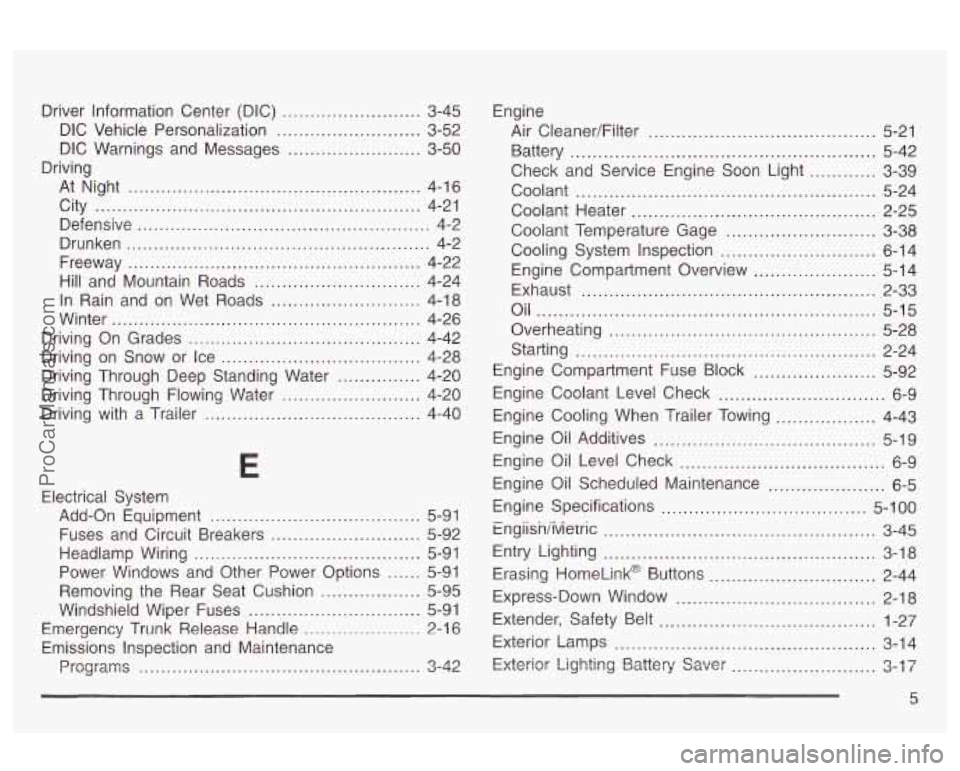
Driver Information Center (DIC) ___ ....... 3-45
DIC Vehicle Personalization .......................... 3-52
DIC Warnings and Messages .......... ....... 3-50
At Night ..................................................... 4-16
City ........................................................... 4-21
Defensive ..................................................... 4-2
Drunken ....................................................... 4-2
Freeway ..................................................... 4-22
Hill and Mountain Roads .............................. 4-24
In Rain and on Wet Roads ........................... 4-18
Winter ........................................................ 4-26
Driving On Grades .......................................... 4-42
Driving Through Deep Standing Water ............... 4-20
Driving Through Flowing Water ...................... 4-20
Driving with a Trailer .................................... 4-40
Driving
Driving on Snow or Ice
.................................... 4-28
E
Electrical System
Add-on Equipment
............................... 5-91
Fuses and Circuit Breakers ........................... 5-92
Headlamp Wiring ......................................... 5-91
Power Windows and Other Power Options ...... 5-91
Removing the Rear Seat Cushion .................. 5-95
Windshield Wiper Fuses ............................... 5-91
Emergency Trunk Release Handle ..................... 2-1 6
Emissions Inspection and Maintenance
Programs
................................................... 3-42
Engine
Air Cleaner/Filter
......................................... 5-21
Battery ....................................................... 5-42
Check and Service Engine Soon Light ............ 3-39
Coolant ...................................................... 5-24
Coolant Heater ............................................ 2-25
Coolant Temperature Gage ........................... 3-38
Cooling System Inspection ............................ 6-14
Engine Compartment Overview ...................... 5-14
Exhaust ..................................................... 2-33
Oil ............................................................. 5-15
Overheating ................................................ 5-28
Starting ...................................................... 2-24
Engine Compartment Fuse Block ...................... 5-92
Engine Coolant Level Check .............................. 6-9
Engine Cooling When Trailer Towing .................. 4-43
Engine Oil Additives ........................................ 5-19
Engine Oil Level Check ..................................... 6-9
Engine Oil Scheduled Maintenance ..................... 6-5
Engine Specifications ..................................... 5-1 00
Engiishiivietric ................................................. 3-45
Entry Lighting ................................................. 3-18
Erasing HomeLink@ Buttons .............................. 2-44
Express-Down Window .................................... 2-18
Extender, Safety Belt ....................................... 1-27
Exterior Lamps ............................................... 3-14
Exterior Lighting Battery Saver .......................... 3-17
5
ProCarManuals.com