2003 NISSAN X-TRAIL engine
[x] Cancel search: enginePage 36 of 3066
AT-30
OVERALL SYSTEM
At Low Fluid Temperature
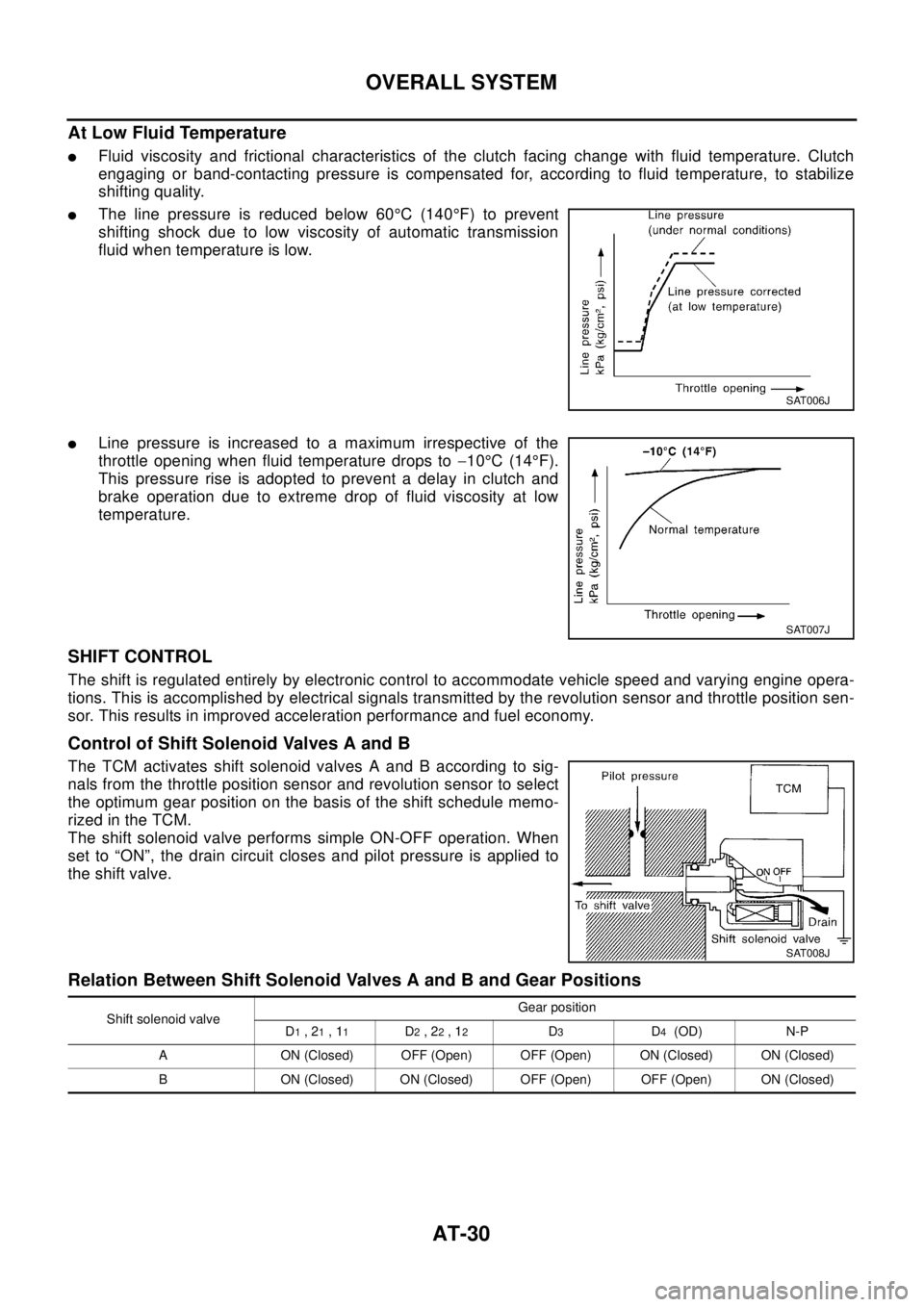
lFluid viscosity and frictional characteristics of the clutch facing change with fluid temperature. Clutch
engaging or band-contacting pressure is compensated for, according to fluid temperature, to stabilize
shifting quality.
lThe line pressure is reduced below 60°C(140°F) to prevent
shifting shock due to low viscosity of automatic transmission
fluid when temperature is low.
lLine pressure is increased to a maximum irrespective of the
throttle opening when fluid temperature drops to-10°C(14°F).
This pressure rise is adopted to prevent a delay in clutch and
brake operation due to extreme drop of fluid viscosity at low
temperature.
SHIFT CONTROL
The shift is regulated entirely by electronic control to accommodate vehicle speed and varying engine opera-
tions. This is accomplished by electrical signals transmitted by the revolution sensor and throttle position sen-
sor. This results in improved acceleration performance and fuel economy.
Control of Shift Solenoid Valves A and B
The TCM activates shift solenoid valves A and B according to sig-
nals from the throttle position sensor and revolution sensor to select
the optimum gear position on the basis of the shift schedule memo-
rizedintheTCM.
The shift solenoid valve performs simple ON-OFF operation. When
set to “ON”, the drain circuit closes and pilot pressure is applied to
the shift valve.
Relation Between Shift Solenoid Valves A and B and Gear Positions
SAT006J
SAT007J
SAT008J
Shift solenoid valveGear position
D1,21,11D2,22,12D3D4(OD) N-P
A ON (Closed) OFF (Open) OFF (Open) ON (Closed) ON (Closed)
B ON (Closed) ON (Closed) OFF (Open) OFF (Open) ON (Closed)
Page 38 of 3066
AT-32
OVERALL SYSTEM
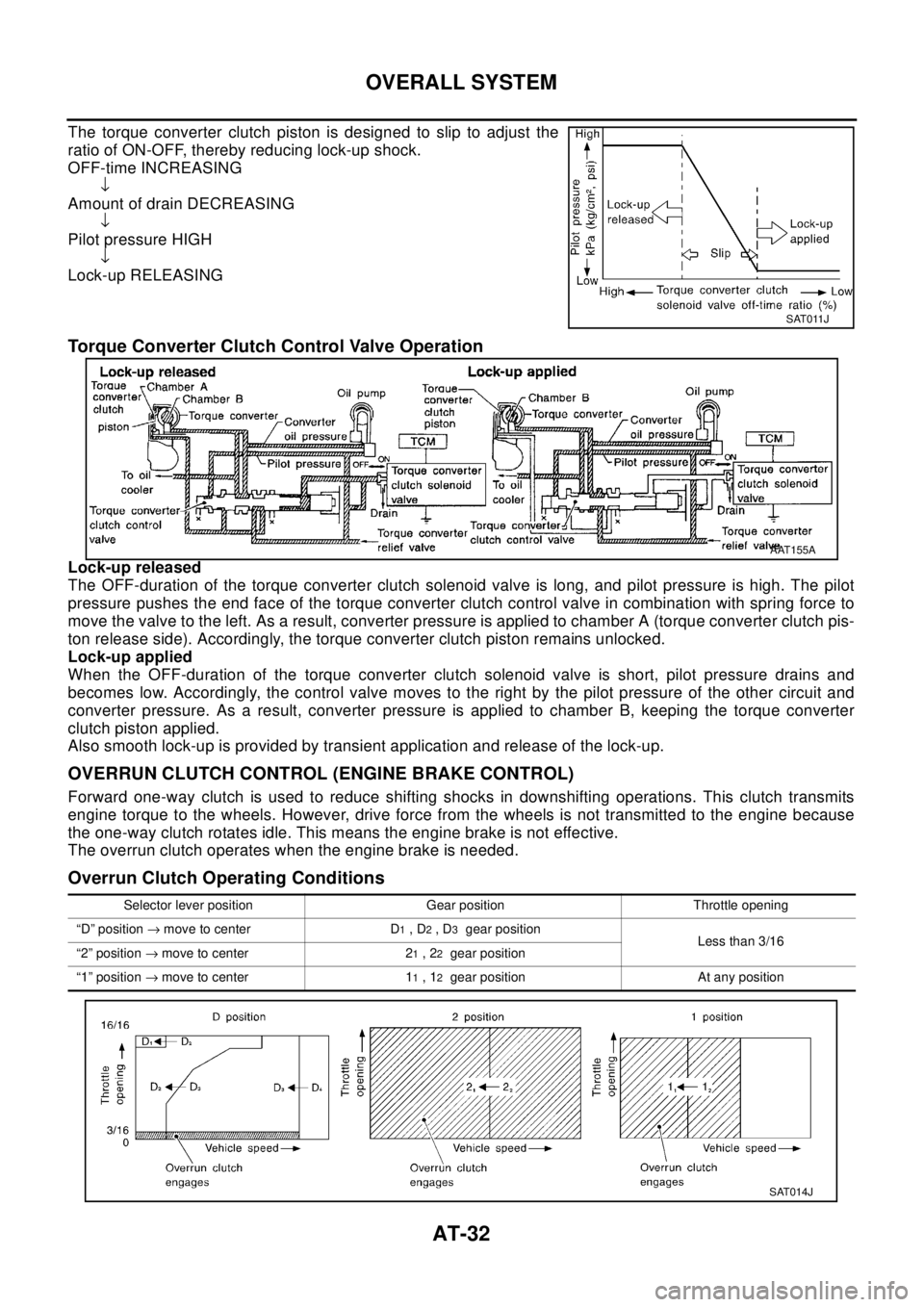
The torque converter clutch piston is designed to slip to adjust the
ratio of ON-OFF, thereby reducing lock-up shock.
OFF-time INCREASING
¯
Amount of drain DECREASING
¯
Pilot pressure HIGH
¯
Lock-up RELEASING
Torque Converter Clutch Control Valve Operation
Lock-up released
The OFF-duration of the torque converter clutch solenoid valve is long, and pilot pressure is high. The pilot
pressure pushes the end face of the torque converter clutch control valve in combination with spring force to
move the valve to the left. As a result, converter pressure is applied to chamber A (torque converter clutch pis-
ton release side). Accordingly, the torque converter clutch piston remains unlocked.
Lock-up applied
When the OFF-duration of the torque converter clutch solenoid valve is short, pilot pressure drains and
becomes low. Accordingly, the control valve moves to the right by the pilot pressure of the other circuit and
converter pressure. As a result, converter pressure is applied to chamber B, keeping the torque converter
clutch piston applied.
Also smooth lock-up is provided by transient application and release of the lock-up.
OVERRUN CLUTCH CONTROL (ENGINE BRAKE CONTROL)
Forward one-way clutch is used to reduce shifting shocks in downshifting operations. This clutch transmits
engine torque to the wheels. However, drive force from the wheels is not transmitted to the engine because
the one-way clutch rotates idle. This means the engine brake is not effective.
The overrun clutch operates when the engine brake is needed.
Overrun Clutch Operating Conditions
SAT011J
AAT155A
Selector lever position Gear position Throttle opening
“D” position®move to center D
1,D2,D3gear position
Less than 3/16
“2” position®move to center 2
1,22gear position
“1” position®move to center 1
1,12gear position At any position
SAT014J
Page 39 of 3066
OVERALL SYSTEM
AT-33
D
E
F
G
H
I
J
K
L
MA
B
AT
Overrun Clutch Solenoid Valve Control
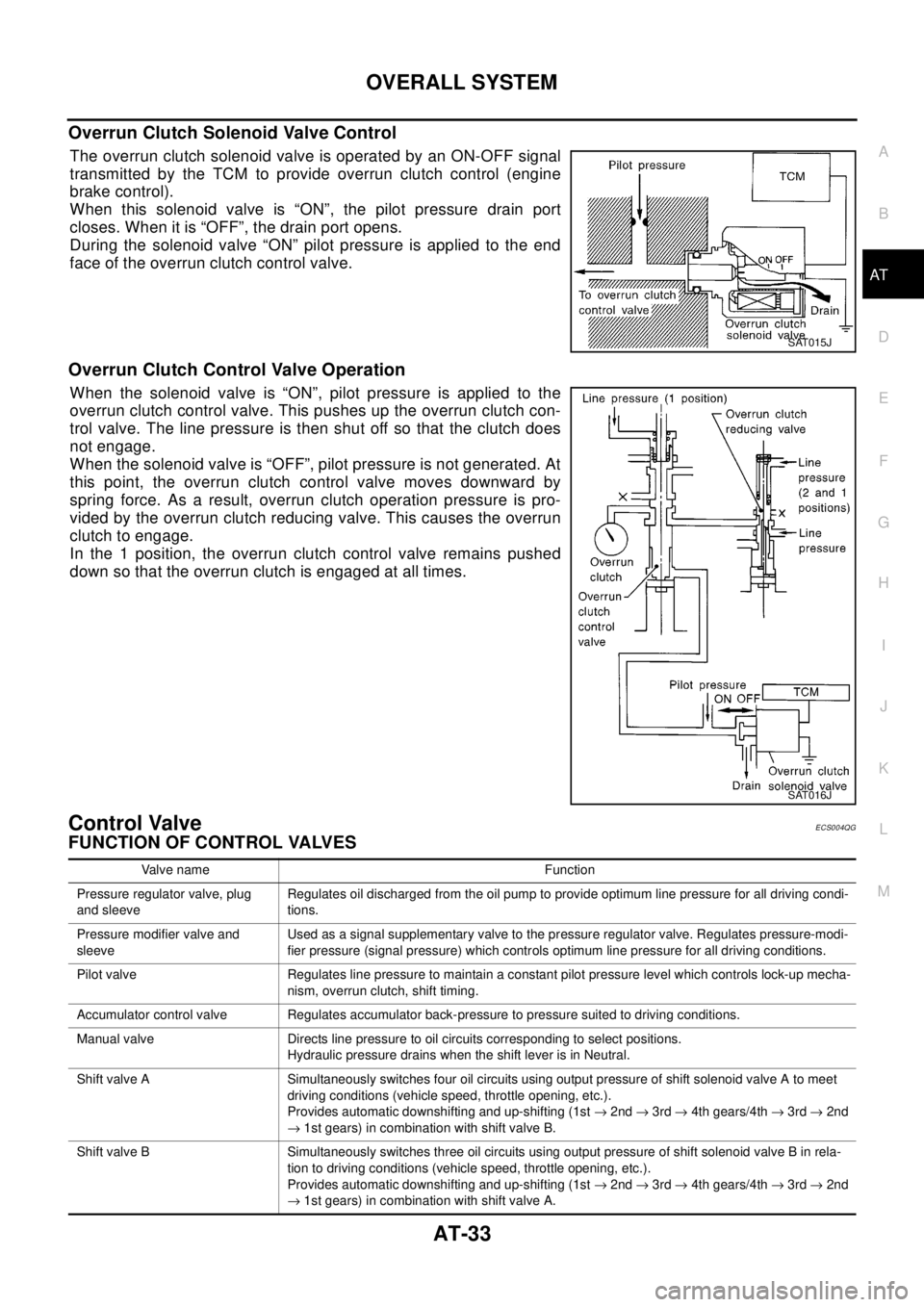
TheoverrunclutchsolenoidvalveisoperatedbyanON-OFFsignal
transmitted by the TCM to provide overrun clutch control (engine
brake control).
When this solenoid valve is “ON”, the pilot pressure drain port
closes. When it is “OFF”, the drain port opens.
During the solenoid valve “ON” pilot pressure is applied to the end
face of the overrun clutch control valve.
Overrun Clutch Control Valve Operation
When the solenoid valve is “ON”, pilot pressure is applied to the
overrun clutch control valve. This pushes up the overrun clutch con-
trol valve. The line pressure is then shut off so that the clutch does
not engage.
When the solenoid valve is “OFF”, pilot pressure is not generated. At
this point, the overrun clutch control valve moves downward by
spring force. As a result, overrun clutch operation pressure is pro-
vided by the overrun clutch reducing valve. This causes the overrun
clutch to engage.
In the 1 position, the overrun clutch control valve remains pushed
down so that the overrun clutch is engaged at all times.
Control ValveECS004QG
FUNCTION OF CONTROL VALVES
SAT015J
SAT016J
Valve name Function
Pressure regulator valve, plug
and sleeveRegulates oil discharged from the oil pump to provide optimum line pressure for all driving condi-
tions.
Pressure modifier valve and
sleeveUsed as a signal supplementary valve to the pressure regulator valve. Regulates pressure-modi-
fier pressure (signal pressure) which controls optimum line pressure for all driving conditions.
Pilot valve Regulates line pressure to maintain a constant pilot pressure level which controls lock-up mecha-
nism, overrun clutch, shift timing.
Accumulator control valve Regulates accumulator back-pressure to pressure suited to driving conditions.
Manual valve Directs line pressure to oil circuits corresponding to select positions.
Hydraulic pressure drains when the shift lever is in Neutral.
Shift valve A Simultaneously switches four oil circuits using output pressure of shift solenoid valve A to meet
driving conditions (vehicle speed, throttle opening, etc.).
Provides automatic downshifting and up-shifting (1st®2nd®3rd®4th gears/4th®3rd®2nd
®1st gears) in combination with shift valve B.
Shift valve B Simultaneously switches three oil circuits using output pressure of shift solenoid valve B in rela-
tion to driving conditions (vehicle speed, throttle opening, etc.).
Provides automatic downshifting and up-shifting (1st®2nd®3rd®4th gears/4th®3rd®2nd
®1st gears) in combination with shift valve A.
Page 40 of 3066

AT-34
OVERALL SYSTEM
Overrun clutch control valve Switches hydraulic circuits to prevent engagement of the overrun clutch simultaneously with appli-
cation of the brake band in D
4. (Interlocking occurs if the overrun clutch engages during D4.)
1st reducing valve Reduces low & reverse brake pressure to dampen engine-brake shock when down-shifting from
the “1” position 1
2to 11.
Overrun clutch reducing valve Reduces oil pressure directed to the overrun clutch and prevents engine-brake shock.
In “1” and “2” positions, line pressure acts on the overrun clutch reducing valve to increase the
pressure-regulating point, with resultant engine brake capability.
Torque converter relief valve Prevents an excessive rise in torque converter pressure.
Torque converter clutch control
valve, plug and sleeveActivates or inactivates the lock-up function.
Also provides smooth lock-up through transient application and release of the lock-up system.
1-2 accumulator valve and piston Dampens the shock encountered when 2nd gear band servo contracts, and provides smooth
shifting.
3-2 timing valve Switches oil pressure with 3-2 timing valve according to throttle opening.
Shuttle control valve Reduces shock when down-shifting from 3rd to 2nd and regulates overrun clutch.
Cooler check valve Regulates oil pressure which causes lock-up when driving at low speeds.Valve name Function
Page 41 of 3066
![NISSAN X-TRAIL 2003 Electronic Repair Manual TROUBLE DIAGNOSIS — INDEX
AT-35
[EURO-OBD]
D
E
F
G
H
I
J
K
L
MA
B
AT
[EURO-OBD]TROUBLE DIAGNOSIS — INDEXPFP:00000
Alphabetical & P No. Index for DTCECS003VK
ALPHABETICAL INDEX FOR DTC
Check if the](/manual-img/5/57402/w960_57402-40.png "NISSAN X-TRAIL 2003 Electronic Repair Manual TROUBLE DIAGNOSIS — INDEX
AT-35
[EURO-OBD]
D
E
F
G
H
I
J
K
L
MA
B
AT
[EURO-OBD]TROUBLE DIAGNOSIS — INDEXPFP:00000
Alphabetical & P No. Index for DTCECS003VK
ALPHABETICAL INDEX FOR DTC
Check if the")
TROUBLE DIAGNOSIS — INDEX
AT-35
[EURO-OBD]
D
E
F
G
H
I
J
K
L
MA
B
AT
[EURO-OBD]TROUBLE DIAGNOSIS — INDEXPFP:00000
Alphabetical & P No. Index for DTCECS003VK
ALPHABETICAL INDEX FOR DTC
Check if the vehicle is a model with Euro-OBD system or not by the “Type approval number” on the identifica-
tion plate. Refer toGI-45, "
IDENTIFICATION PLATE".
l*1: These numbers are prescribed by SAE J2012.
l*2: When the fail-safe operation occurs, the MIL illuminates.
l*3: The MIL illuminates when both the “Revolution sensor signal” and the “Vehicle speed sensor signal” meet the fail-safe condition at
thesametime.Type approval number Model
Available With Euro-OBD system
Not available (blank) Without Euro-OBD system
Items
(CONSULT-II screen terms)DTC
Reference page
CONSULT-II
GST*1
A/T 1ST GR FNCTN P0731AT- 1 5 1 , "
DTC P0731 A/T 1ST
GEAR FUNCTION"
A/T 2ND GR FNCTN P0732AT- 1 5 8 , "DTC P0732 A/T 2ND
GEAR FUNCTION"
A/T 3RD GR FNCTN P0733AT- 1 6 5 , "DTC P0733 A/T 3RD
GEAR FUNCTION"
A/T 4TH GR FNCTN P0734AT- 1 7 2 , "DTC P0734 A/T 4TH
GEAR FUNCTION"
ATF TEMP SEN/CIRC P0710AT- 1 3 6 , "
DTC P0710 A/T FLUID
TEMPERATURE SENSOR
CIRCUIT"
ENGINE SPEED SIG P0725AT- 1 4 7 , "DTC P0725 ENGINE
SPEED SIGNAL"
L/PRESS SOL/CIRC P0745AT-186, "
DTC P0745 LINE
PRESSURE SOLENOID
VA LV E"
O/R CLTCH SOL/CIRC P1760AT- 2 0 8 , "
DTC P1760 OVER-
RUN CLUTCH SOLENOID
VA LV E"
PNP SW/CIRC P0705AT-1 3 0 , "
DTC P0705 PARK/
NEUTRAL POSITION (PNP)
SWITCH"
SFT SOL A/CIRC*2 P0750AT- 1 9 3 , "DTC P0750 SHIFT
SOLENOID VALVE A"
SFT SOL B/CIRC*2 P0755AT- 1 9 8 , "DTC P0755 SHIFT
SOLENOID VALVE B"
TCC SOLENOID/CIRC P0740AT-181, "
DTC P0740 TORQUE
CONVERTER CLUTCH SOLE-
NOID VALVE"
TP SEN/CIRC A/T*2 P1705AT- 2 0 3 , "
DTC P1705 ACCEL-
ERATOR PEDAL POSITION
(APP) SENSOR"
VEH SPD SEN/CIR AT*3 P0720AT-142, "
DTC P0720 VEHICLE
SPEED SENSOR·A/T (REVO-
LUTION SENSOR)"
CAN COMM CIRCUIT U1000EC-114, "DTC U1000 CAN
COMMUNICATION LINE"
Page 42 of 3066
![NISSAN X-TRAIL 2003 Electronic Repair Manual AT-36
[EURO-OBD]
TROUBLE DIAGNOSIS — INDEX
PNO.INDEXFORDTC
Check if the vehicle is a model with Euro-OBD system or not by the “Type approval number” on the identifica-
tion plate. Refer toGI-45,](/manual-img/5/57402/w960_57402-41.png "NISSAN X-TRAIL 2003 Electronic Repair Manual AT-36
[EURO-OBD]
TROUBLE DIAGNOSIS — INDEX
PNO.INDEXFORDTC
Check if the vehicle is a model with Euro-OBD system or not by the “Type approval number” on the identifica-
tion plate. Refer toGI-45,")
AT-36
[EURO-OBD]
TROUBLE DIAGNOSIS — INDEX
PNO.INDEXFORDTC
Check if the vehicle is a model with Euro-OBD system or not by the “Type approval number” on the identifica-
tion plate. Refer toGI-45, "
IDENTIFICATION PLATE".
l*1: These numbers are prescribed by SAE J2012.
l*2: When the fail-safe operation occurs, the MIL illuminates.
l*3: The MIL illuminates when both the “Revolution sensor signal” and the “Vehicle speed sensor signal” meet the fail-safe condition at
thesametime.Type approval number Model
Available With Euro-OBD system
Not available (blank) Without Euro-OBD system
DTC
Items
(CONSULT-II screen terms)Reference page
CONSULT-II
GST*1
P0705 PNP SW/CIRCAT- 1 3 0 , "
DTC P0705 PARK/
NEUTRAL POSITION (PNP)
SWITCH"
P0710 ATF TEMP SEN/CIRCAT-136, "
DTC P0710 A/T FLUID
TEMPERATURE SENSOR
CIRCUIT"
P0720 VEH SPD SEN/CIR AT*3AT- 1 4 2 , "
DTC P0720 VEHICLE
SPEED SENSOR·A/T (REVO-
LUTION SENSOR)"
P0725 ENGINE SPEED SIGAT- 1 4 7 , "DTC P0725 ENGINE
SPEED SIGNAL"
P0731 A/T 1ST GR FNCTNAT- 1 5 1 , "DTC P0731 A/T 1ST
GEAR FUNCTION"
P0732 A/T 2ND GR FNCTNAT- 1 5 8 , "DTC P0732 A/T 2ND
GEAR FUNCTION"
P0733 A/T 3RD GR FNCTNAT- 1 6 5 , "DTC P0733 A/T 3RD
GEAR FUNCTION"
P0734 A/T 4TH GR FNCTNAT- 1 7 2 , "DTC P0734 A/T 4TH
GEAR FUNCTION"
P0740 TCC SOLENOID/CIRCAT- 1 8 1 , "
DTC P0740 TORQUE
CONVERTER CLUTCH SOLE-
NOID VALVE"
P0745 L/PRESS SOL/CIRCAT-186, "
DTC P0745 LINE
PRESSURE SOLENOID
VA LV E"
P0750 SFT SOL A/CIRC*2AT-193, "DTC P0750 SHIFT
SOLENOID VALVE A"
P0755 SFT SOL B/CIRC*2AT-198, "DTC P0755 SHIFT
SOLENOID VALVE B"
P1705 TP SEN/CIRC A/T*2AT- 2 0 3 , "
DTC P1705 ACCEL-
ERATOR PEDAL POSITION
(APP) SENSOR"
P1760 O/R CLTCH SOL/CIRCAT-208, "
DTC P1760 OVER-
RUNCLUTCHSOLENOID
VA LV E"
U1000 CAN COMM CIRCUITEC-114, "DTC U1000 CAN
COMMUNICATION LINE"
Page 44 of 3066
![NISSAN X-TRAIL 2003 Electronic Repair Manual AT-38
[EURO-OBD]
ON BOARD DIAGNOSTIC SYSTEM DESCRIPTION
A sample of CONSULT-II display for DTC is shown in the following
page. DTC or 1st trip DTC of a malfunction is displayed in SELF
DIAGNOSIS mode](/manual-img/5/57402/w960_57402-43.png "NISSAN X-TRAIL 2003 Electronic Repair Manual AT-38
[EURO-OBD]
ON BOARD DIAGNOSTIC SYSTEM DESCRIPTION
A sample of CONSULT-II display for DTC is shown in the following
page. DTC or 1st trip DTC of a malfunction is displayed in SELF
DIAGNOSIS mode")
AT-38
[EURO-OBD]
ON BOARD DIAGNOSTIC SYSTEM DESCRIPTION
A sample of CONSULT-II display for DTC is shown in the following
page. DTC or 1st trip DTC of a malfunction is displayed in SELF
DIAGNOSIS mode for “ENGINE” with CONSULT-II. Time data indi-
cates how many times the vehicle was driven after the last detection
of a DTC.
If the DTC is being detected currently, the time data will be “0”.
If a 1st trip DTC is stored in the ECM, the time data will be “1t”.
Freeze Frame Data and 1st Trip Freeze Frame Data
The ECM has a memory function, which stores the driving condition such as fuel system status, calculated
load value, engine coolant temperature, short term fuel trim, long term fuel trim, engine speed and vehicle
speed at the moment the ECM detects a malfunction.
Data which are stored in the ECM memory, along with the 1st trip DTC, are called 1st trip freeze frame data,
and the data, stored together with the DTC data, are called freeze frame data and displayed on CONSULT-II
or GST. The 1st trip freeze frame data can only be displayed on the CONSULT-II screen, not on the GST. For
detail, refer to " ", “CONSULT-II”.
Only one set of freeze frame data (either 1st trip freeze frame data of freeze frame data) can be stored in the
ECM. 1st trip freeze frame data is stored in the ECM memory along with the 1st trip DTC. There is no priority
for 1st trip freeze frame data and it is updated each time a different 1st trip DTC is detected. However, once
freeze frame data (2nd trip detection/MIL on) is stored in the ECM memory, 1st trip freeze frame data is no
longer stored. Remember, only one set of freeze frame data can be stored in the ECM.
The ECM has the following priorities to update the data.
Both 1st trip freeze frame data and freeze frame data (along with the DTCs) are cleared when the ECM mem-
oryiserased.
SAT014K
SAT015K
SAT016K
Priority Items
1 Freeze frame data Misfire — DTC: P0300 - P0306
Fuel Injection System Function — DTC: P0171, P0172, P0174, P0175
2 Except the above items (Includes A/T related items)
3 1st trip freeze frame data
Page 45 of 3066
![NISSAN X-TRAIL 2003 Electronic Repair Manual ON BOARD DIAGNOSTIC SYSTEM DESCRIPTION
AT-39
[EURO-OBD]
D
E
F
G
H
I
J
K
L
MA
B
AT
HOW TO ERASE DTC
The diagnostic trouble code can be erased by CONSULT-II, GST or ECM DIAGNOSTIC TEST MODE as
described](/manual-img/5/57402/w960_57402-44.png "NISSAN X-TRAIL 2003 Electronic Repair Manual ON BOARD DIAGNOSTIC SYSTEM DESCRIPTION
AT-39
[EURO-OBD]
D
E
F
G
H
I
J
K
L
MA
B
AT
HOW TO ERASE DTC
The diagnostic trouble code can be erased by CONSULT-II, GST or ECM DIAGNOSTIC TEST MODE as
described")
ON BOARD DIAGNOSTIC SYSTEM DESCRIPTION
AT-39
[EURO-OBD]
D
E
F
G
H
I
J
K
L
MA
B
AT
HOW TO ERASE DTC
The diagnostic trouble code can be erased by CONSULT-II, GST or ECM DIAGNOSTIC TEST MODE as
described following.
lIf the battery terminal is disconnected, the diagnostic trouble code will be lost within 24 hours.
lWhen you erase the DTC, using CONSULT-II or GST is easier and quicker than switching the mode
selector on the ECM.
The following emission-related diagnostic information is cleared from the ECM memory when erasing DTC
related to EURO-OBD. For details, refer toEC-46, "
HOW TO ERASE EMISSION-RELATED DIAGNOSTIC
INFORMATION".
lDiagnostic trouble codes (DTC)
l1st trip diagnostic trouble codes (1st trip DTC)
lFreeze frame data
l1st trip freeze frame data
lSystem readiness test (SRT) codes
lTest values
HOW TO ERASE DTC (WITH CONSULT-II)
lIf a DTC is displayed for both ECM and TCM, it needs to be erased for both ECM and TCM.
1. If the ignition switch stays “ON” after repair work, be sure to turn ignition switch “OFF” once. Wait at least
5 seconds and then turn it “ON” (engine stopped) again.
2. Turn CONSULT-II “ON” and touch “A/T”.
3. Touch “SELF DIAGNOSIS”.
4. Touch “ERASE”. (The DTC in the TCM will be erased.) Then touch “BACK” twice.
5. Touch “ENGINE”.
6. Touch “SELF DIAGNOSIS”.