Page 205 of 299
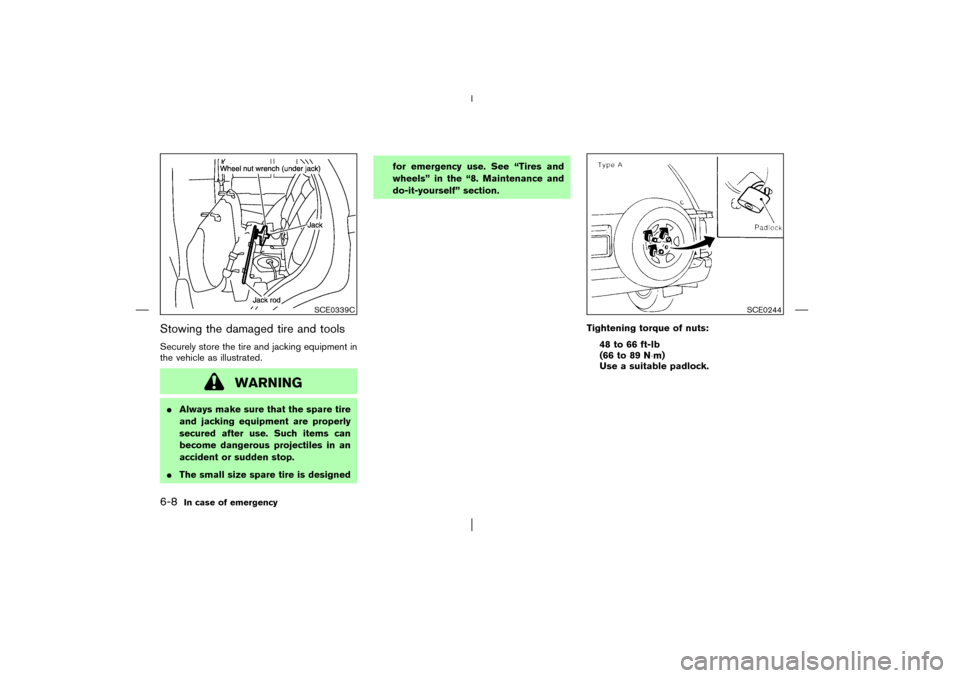
Stowing the damaged tire and toolsSecurely store the tire and jacking equipment in
the vehicle as illustrated.
WARNING
�Always make sure that the spare tire
and jacking equipment are properly
secured after use. Such items can
become dangerous projectiles in an
accident or sudden stop.
�The small size spare tire is designedfor emergency use. See “Tires and
wheels” in the “8. Maintenance and
do-it-yourself” section.
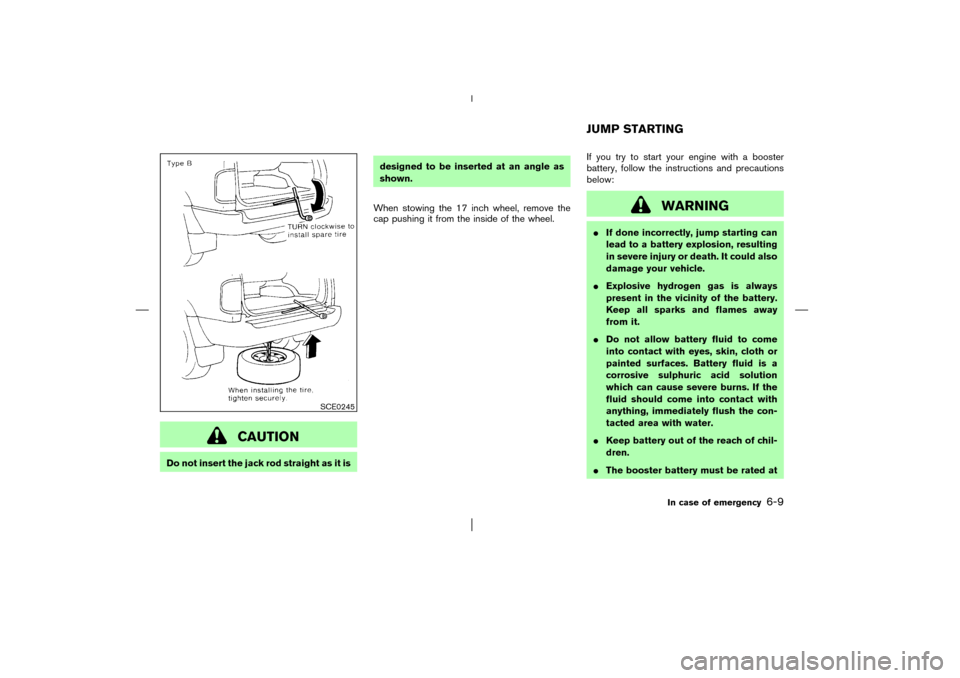
Tightening torque of nuts:
48 to 66 ft-lb
(66 to 89 N⋅m)
Use a suitable padlock.
SCE0339C
SCE0244
6-8
In case of emergency
�
03.1.28/R50-D/V5
�
Page 206 of 299
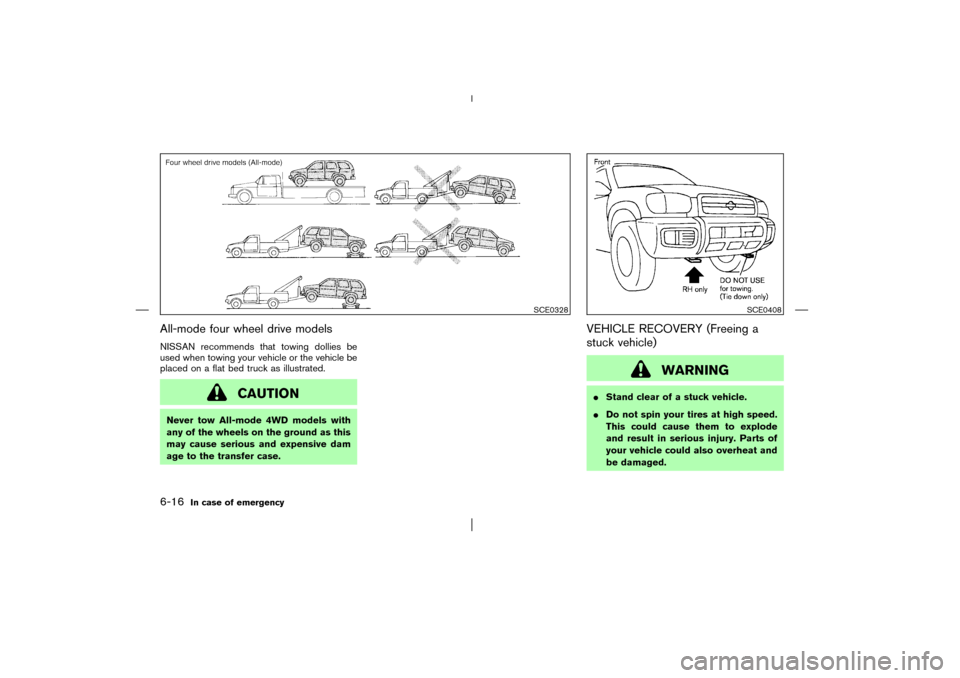
CAUTION
Do not insert the jack rod straight as it isdesigned to be inserted at an angle as
shown.
When stowing the 17 inch wheel, remove the
cap pushing it from the inside of the wheel.If you try to start your engine with a booster
battery, follow the instructions and precautions
below:
WARNING
�If done incorrectly, jump starting can
lead to a battery explosion, resulting
in severe injury or death. It could also
damage your vehicle.
�Explosive hydrogen gas is always
present in the vicinity of the battery.
Keep all sparks and flames away
from it.
�Do not allow battery fluid to come
into contact with eyes, skin, cloth or
painted surfaces. Battery fluid is a
corrosive sulphuric acid solution
which can cause severe burns. If the
fluid should come into contact with
anything, immediately flush the con-
tacted area with water.
�Keep battery out of the reach of chil-
dren.
�The booster battery must be rated at
SCE0245
JUMP STARTING
In case of emergency
6-9
�
03.1.28/R50-D/V5
�
Page 211 of 299
TOWING RECOMMENDED BY
NISSAN
Two wheel drive modelsNISSAN recommends that your vehicle be
towed with the driving (rear) wheels off the
ground or place the vehicle on a flat bed truck as
illustrated.
CAUTION
�Never tow automatic transmission
models with the rear wheels on the
ground or four wheels on the ground
(forward or backward), as this may
cause serious and expensive damage
to the transmission. If it is necessary
to tow the vehicle with the front
wheels raised, always use towing
dollies under the rear wheels.
�When towing automatic or manual
transmission models with the front
wheels on the ground or on towing
dollies:
�Turn the ignition key to the OFF
position, and secure the steeringwheel in a straightahead position
with a rope or similar device. Never
secure the steering wheel by turn-
ing the ignition key to the LOCK
position. This may damage the
steering lock mechanism.
�If you have to tow manual transmis-
sion models with the rear wheels on
the ground or four wheels on the
ground (if you do not use towing
dollies):
�Always release the parking brake.
�Move the transmission shift lever
to the N(Neutral) position.
�Observe the following restricted tow-
ing speeds and distances for manual
transmission models only:
�Speed: Below 60 MPH (95 km/h)
�Distance: Less than 500 miles (800
km)
If the speed or distance must necessarily be
greater, remove the propeller shaft before tow-
ing to prevent damage to the transmission.
Part time four wheel drive modelsNISSAN recommends that towing dollies be
used when towing your vehicle or the vehicle be
placed on a flat bed truck as illustrated.
SCE0198
6-14
In case of emergency
�
03.1.28/R50-D/V5
�
Page 212 of 299
CAUTION
�Never tow automatic transmission
models with the rear wheels on the
ground or four wheels on the ground,
as this may cause serious and expen-
sive damage to the transmission. If it
is necessary to tow the vehicle with
the front wheels raised, always use
towing dollies under the rear wheels.
�When towing automatic or manual
transmission models with the front
wheels on the ground or on towing
dollies:
�Move the transfer case shift lever
to the 2H position.
�Turn the ignition key to the OFF
position, and secure the steering
wheel in a straight ahead position
with a rope or similar device. Never
secure the steering wheel by turn-
ing the ignition key to the LOCK
position. This may damage the
steering lock mechanism.�If you have to tow manual transmis-
sion models with the rear wheels on
the ground (if you do not use towing
dollies) or four wheels on the ground:
�Move the transfer case shift lever
to the 2H position.
�Move the transmission shift lever
to the N(Neutral) position.
�Always release the parking brake.
�Observe the following restricted tow-
ing speeds and distances manual
transmission models only:
�Speed: Below 60 MPH (95 km/h)
�Distance: Less than 500 miles (800
km)
If the speed or distance must necessarily be
greater, remove the front and rear propeller
shafts before towing to prevent damage to the
transmission.
In case of emergency
6-15
�
03.1.28/R50-D/V5
�
Page 213 of 299
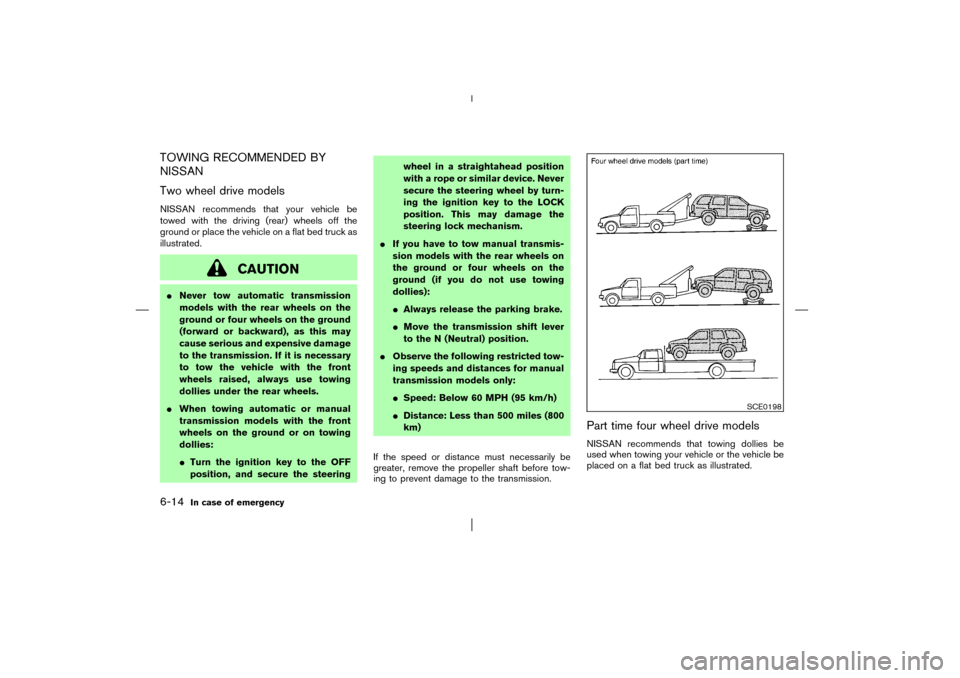
All-mode four wheel drive modelsNISSAN recommends that towing dollies be
used when towing your vehicle or the vehicle be
placed on a flat bed truck as illustrated.
CAUTION
Never tow All-mode 4WD models with
any of the wheels on the ground as this
may cause serious and expensive dam
age to the transfer case.
VEHICLE RECOVERY (Freeing a
stuck vehicle)
WARNING
�Stand clear of a stuck vehicle.
�Do not spin your tires at high speed.
This could cause them to explode
and result in serious injury. Parts of
your vehicle could also overheat and
be damaged.
SCE0328
SCE0408
6-16
In case of emergency
�
03.1.28/R50-D/V5
�
Page 216 of 299

7 Appearance and careCleaning exterior .................................................................... 7-2
Washing ............................................................................. 7-2
Waxing ................................................................................ 7-2
Removing spots ................................................................ 7-3
Underbody ......................................................................... 7-3
Glass ................................................................................... 7-3
Aluminum alloy wheels.................................................... 7-3
Chrome parts .................................................................... 7-3Cleaning interior ..................................................................... 7-3
Floor mats .......................................................................... 7-4
Seat belts ........................................................................... 7-4
Corrosion protection ............................................................. 7-4
Most common factors contributing to vehicle
corrosion............................................................................. 7-4
To protect your vehicle from corrosion ...................... 7-5
�
03.1.28/R50-D/V5
�
Page 217 of 299
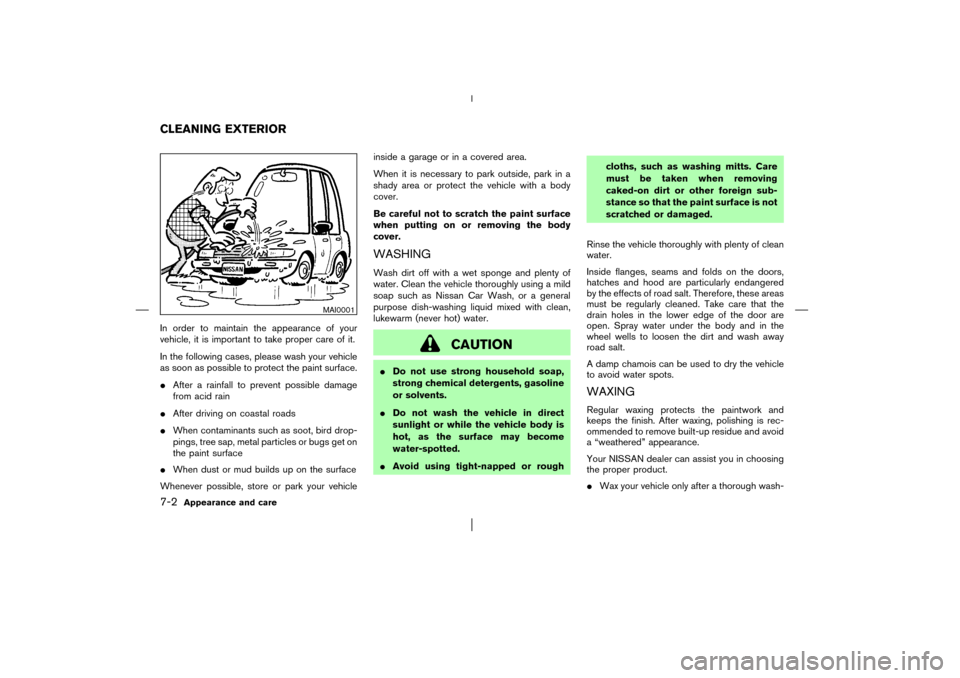
In order to maintain the appearance of your
vehicle, it is important to take proper care of it.
In the following cases, please wash your vehicle
as soon as possible to protect the paint surface.
�After a rainfall to prevent possible damage
from acid rain
�After driving on coastal roads
�When contaminants such as soot, bird drop-
pings, tree sap, metal particles or bugs get on
the paint surface
�When dust or mud builds up on the surface
Whenever possible, store or park your vehicleinside a garage or in a covered area.
When it is necessary to park outside, park in a
shady area or protect the vehicle with a body
cover.
Be careful not to scratch the paint surface
when putting on or removing the body
cover.
WASHINGWash dirt off with a wet sponge and plenty of
water. Clean the vehicle thoroughly using a mild
soap such as Nissan Car Wash, or a general
purpose dish-washing liquid mixed with clean,
lukewarm (never hot) water.
CAUTION
�Do not use strong household soap,
strong chemical detergents, gasoline
or solvents.
�Do not wash the vehicle in direct
sunlight or while the vehicle body is
hot, as the surface may become
water-spotted.
�Avoid using tight-napped or roughcloths, such as washing mitts. Care
must be taken when removing
caked-on dirt or other foreign sub-
stance so that the paint surface is not
scratched or damaged.
Rinse the vehicle thoroughly with plenty of clean
water.
Inside flanges, seams and folds on the doors,
hatches and hood are particularly endangered
by the effects of road salt. Therefore, these areas
must be regularly cleaned. Take care that the
drain holes in the lower edge of the door are
open. Spray water under the body and in the
wheel wells to loosen the dirt and wash away
road salt.
A damp chamois can be used to dry the vehicle
to avoid water spots.
WAXINGRegular waxing protects the paintwork and
keeps the finish. After waxing, polishing is rec-
ommended to remove built-up residue and avoid
a “weathered” appearance.
Your NISSAN dealer can assist you in choosing
the proper product.
�Wax your vehicle only after a thorough wash-
MAI0001
CLEANING EXTERIOR7-2
Appearance and care
�
03.1.28/R50-D/V5
�
Page 218 of 299
ing. Follow the instructions supplied with the
wax.
�Do not use a wax containing any abrasives,
cutting compounds or cleaners that may
damage the vehicle finish.
�If the surface does not polish easily, use a
road tar remover and wax again.
Machine compounding or aggressive pol-
ishing on a base coat/clear coat paint
finish may dull the finish or leave swirl
marks.
Only apply black wax or black shoe polish to the
black urethane or polypropylene bumper.
REMOVING SPOTSRemove tar and oil spots, industrial dust, insects
and tree sap as quickly as possible from the
surface of the paint to avoid lasting damage or
staining. Special cleaning products are available
at your NISSAN dealer or any automotive acces-
sories store.UNDERBODYIn areas where road salt is used in winter, it is
necessary to clean the underbody regularly in
order to prevent dirt and salt from building up
and causing corrosion on the underbody and
suspension. Before the winter period and againin the spring, the underseal must be checked
and, if necessary, re-treated.
GLASSUse glass cleaner to remove smoke and dust film
from the glass surfaces. It is normal for glass to
be coated with a film after the vehicle is parked
in the hot sun. Glass cleaner and a soft cloth will
easily remove this film.
CAUTION
When cleaning the inside of the win-
dow, do not use sharp-edged tools,
abrasive cleaners or chlorine based dis-
infectant cleaners. They could damage
the electrical conductors, radio antenna
elements or rear window defogger ele-
ments.ALUMINUM ALLOY WHEELSWash regularly, especially during winter months
in areas where road salt is used. Salt could
discolor the wheel if not removed.CHROME PARTSClean all chrome parts regularly with a non-
abrasive chrome polish to maintain the finish.Occasionally remove loose dust from the interior
trim, plastic parts and seats using a vacuum
cleaner or soft brush. Wipe the vinyl and leather
surfaces with a clean, soft cloth dampened in
mild soap solution, then wipe clean with a dry
soft cloth. Before using any fabric protector,
read the manufacturer’s recommendations.
Some fabric protectors contains chemicals that
stain or bleach the seat material. Use a cloth
dampened only with water, to clean the meter
and gauge lens.
CAUTION
�Never use gasoline, thinner or any
similar material.
�The leather seats should be regularly
coated with a leather wax like saddle
soap. Never use car wax.
�Never use fabric protectors unless
recommended by the manufacturer.
�Do not use glass or plastic cleaner on
meter or gauge lens covers. It may
damage the lens cover.CLEANING INTERIOR
Appearance and care
7-3
�
03.1.28/R50-D/V5
�