Page 227 of 299
multiport fuel injection (MFI) system,
the fuel filter or fuel lines should be
serviced by a NISSAN dealer because
the fuel lines are under high pressure
even when the engine is off.
CAUTION
�Do not work under the engine hood
while it is hot. Turn off the engine and
wait until it cools down.
�Never connect or disconnect either
the battery or any transistorized
component connector while the igni-
tion key is on.
�Never leave the engine or the auto-
matic transmission related compo-
nent harness connector discon-
nected while the ignition key is on.
�Avoid direct contact with used engine
oil and coolant. Improperly disposed
engine oil, engine coolant, and/or
other vehicle fluids can hurt the envi-ronment. Always conform to local
regulations for disposal of vehicle
fluid.
This section gives instructions regarding only
those items which are relatively easy for an
owner to perform. More involved service should
be done by your NISSAN dealer.
A genuine NISSAN Service Manual is also avail-
able. See “Owner’s Manual/Service Manual or-
der information” in the “9. Technical and con-
sumer information” section.
You should be aware that incomplete or im-
proper servicing may result in operating difficul-
ties or excessive emissions, and could affect
your warranty coverage.If in doubt about any
servicing, have it done by your NISSAN
dealer.8-6
Maintenance and do-it-yourself
�
03.1.28/R50-D/V5
�
Page 234 of 299
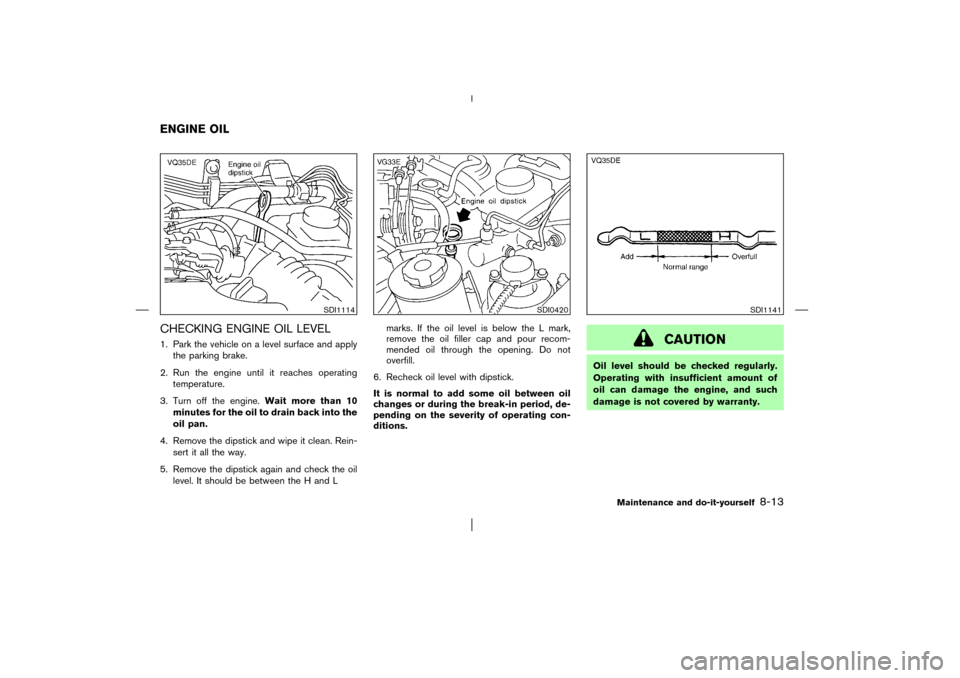
CHECKING ENGINE OIL LEVEL1. Park the vehicle on a level surface and apply
the parking brake.
2. Run the engine until it reaches operating
temperature.
3. Turn off the engine.Wait more than 10
minutes for the oil to drain back into the
oil pan.
4. Remove the dipstick and wipe it clean. Rein-
sert it all the way.
5. Remove the dipstick again and check the oil
level. It should be between the H and Lmarks. If the oil level is below the L mark,
remove the oil filler cap and pour recom-
mended oil through the opening. Do not
overfill.
6. Recheck oil level with dipstick.
It is normal to add some oil between oil
changes or during the break-in period, de-
pending on the severity of operating con-
ditions.
CAUTION
Oil level should be checked regularly.
Operating with insufficient amount of
oil can damage the engine, and such
damage is not covered by warranty.
SDI1114
SDI0420
SDI1141
ENGINE OIL
Maintenance and do-it-yourself
8-13
�
03.1.28/R50-D/V5
�
Page 235 of 299
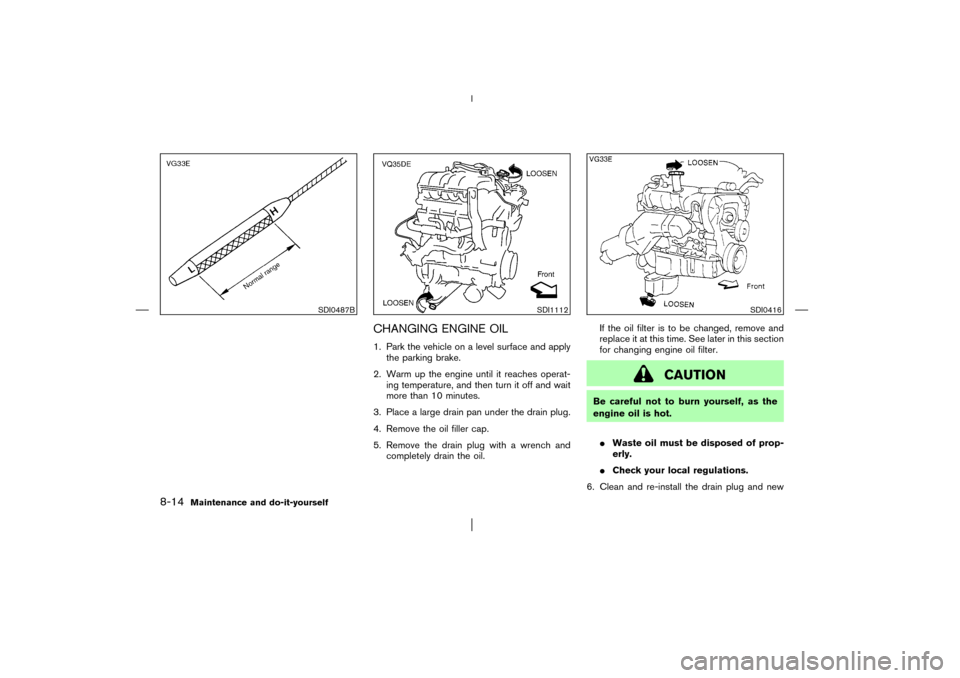
CHANGING ENGINE OIL1. Park the vehicle on a level surface and apply
the parking brake.
2. Warm up the engine until it reaches operat-
ing temperature, and then turn it off and wait
more than 10 minutes.
3. Place a large drain pan under the drain plug.
4. Remove the oil filler cap.
5. Remove the drain plug with a wrench and
completely drain the oil.If the oil filter is to be changed, remove and
replace it at this time. See later in this section
for changing engine oil filter.
CAUTION
Be careful not to burn yourself, as the
engine oil is hot.
�Waste oil must be disposed of prop-
erly.
�Check your local regulations.
6. Clean and re-install the drain plug and new
SDI0487B
SDI1112
SDI0416
8-14
Maintenance and do-it-yourself
�
03.1.28/R50-D/V5
�
Page 236 of 299
washer. Securely tighten the drain plug with a
wrench. Do not use excessive force.
Drain plug tightening torque:
22 to 29 ft-lb (29 to 39 N⋅m)
7. Refill engine with recommended oil through
the oil filler opening, then install the oil filler
cap securely.
See “Capacities and recommended
fuel/lubricants” in the “9. Technical and con-
sumer information” section for drain and refill
capacity.
The drain and refill capacity depends on the
oil temperature and drain time. Use these
specifications for reference only. Always use
the dipstick to determine when the proper
amount of oil is in the engine.
8. Start the engine.
Check for leakage around the drain plug.
Correct as required.
9. Turn the engine off and wait more than 10
minutes. Check the oil level with the dipstick.
Add engine oil if necessary.
WARNING
�Prolonged and repeated contact withused engine oil may cause skin can-
cer.
�Try to avoid direct skin contact with
used oil. If skin contact is made,
wash thoroughly with soap or hand
cleaner as soon as possible.
�Keep used engine oil out of reach of
children.
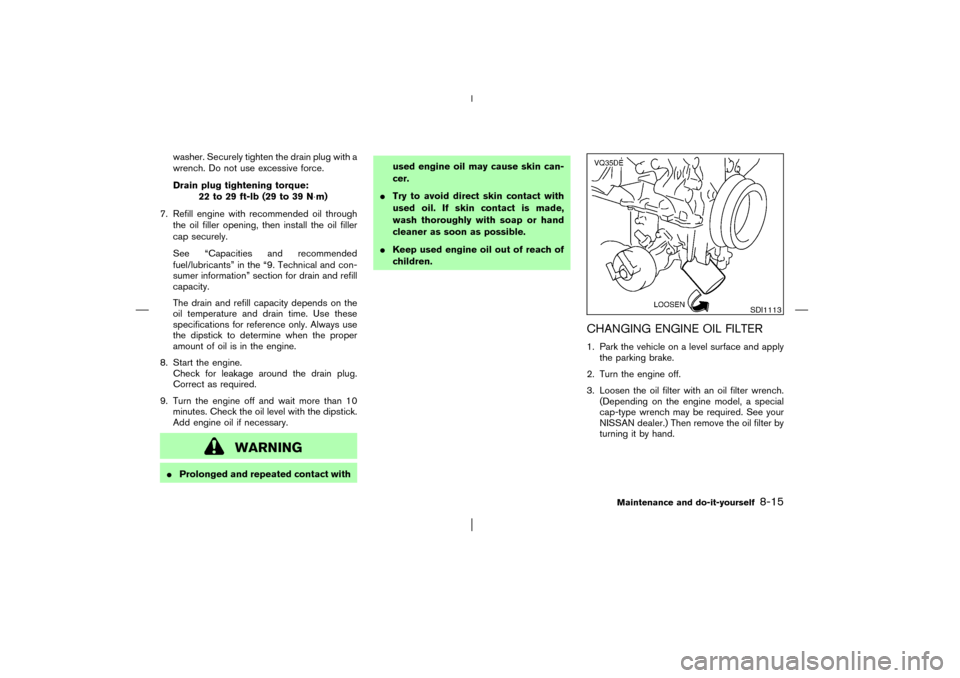
CHANGING ENGINE OIL FILTER1. Park the vehicle on a level surface and apply
the parking brake.
2. Turn the engine off.
3. Loosen the oil filter with an oil filter wrench.
(Depending on the engine model, a special
cap-type wrench may be required. See your
NISSAN dealer.) Then remove the oil filter by
turning it by hand.
SDI1113
Maintenance and do-it-yourself
8-15
�
03.1.28/R50-D/V5
�
Page 237 of 299
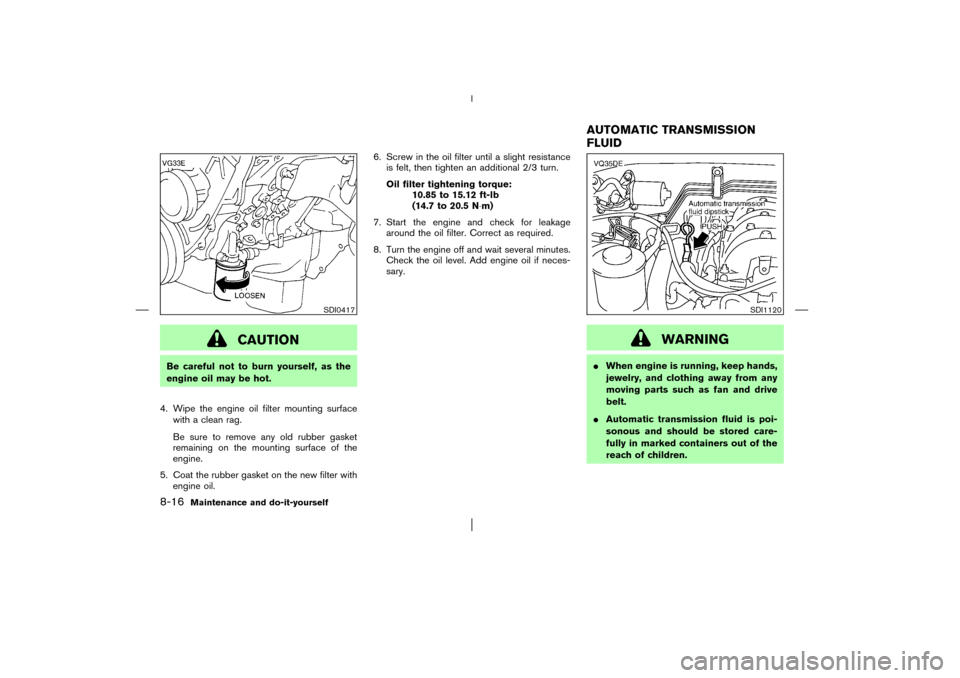
CAUTION
Be careful not to burn yourself, as the
engine oil may be hot.
4. Wipe the engine oil filter mounting surface
with a clean rag.
Be sure to remove any old rubber gasket
remaining on the mounting surface of the
engine.
5. Coat the rubber gasket on the new filter with
engine oil.6. Screw in the oil filter until a slight resistance
is felt, then tighten an additional 2/3 turn.
Oil filter tightening torque:
10.85 to 15.12 ft-lb
(14.7 to 20.5 N⋅m)
7. Start the engine and check for leakage
around the oil filter. Correct as required.
8. Turn the engine off and wait several minutes.
Check the oil level. Add engine oil if neces-
sary.
WARNING
�When engine is running, keep hands,
jewelry, and clothing away from any
moving parts such as fan and drive
belt.
�Automatic transmission fluid is poi-
sonous and should be stored care-
fully in marked containers out of the
reach of children.
SDI0417
SDI1120
AUTOMATIC TRANSMISSION
FLUID
8-16
Maintenance and do-it-yourself
�
03.1.28/R50-D/V5
�
Page 243 of 299
under severe conditions require frequent
checks of the battery fluid level.
WARNING
Be sure the ignition key is in the OFF or
LOCK position. The engine could rotate
unexpectedly.
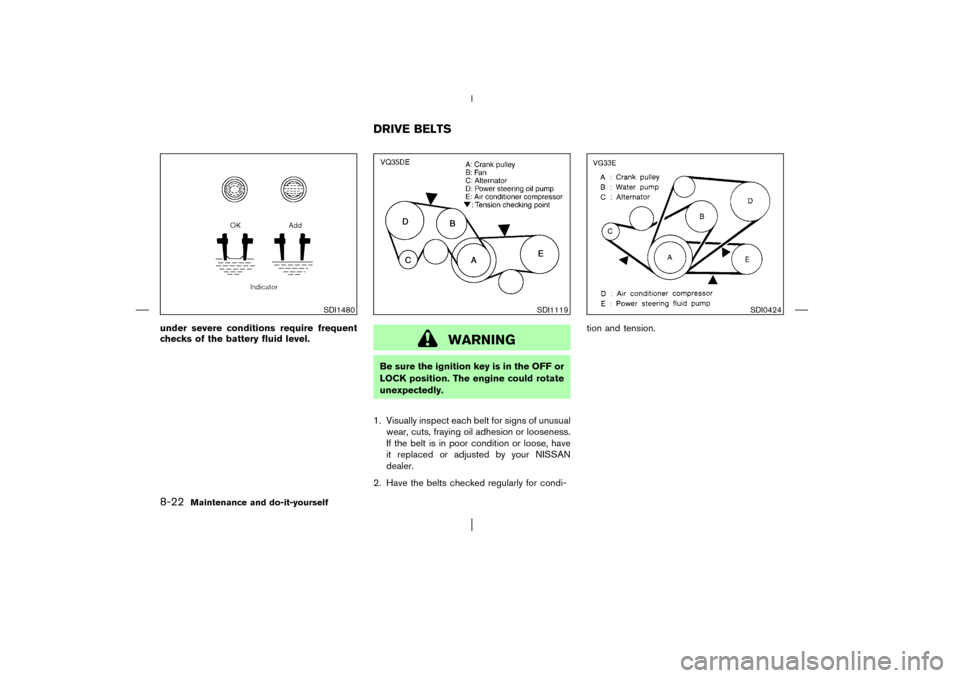
1. Visually inspect each belt for signs of unusual
wear, cuts, fraying oil adhesion or looseness.
If the belt is in poor condition or loose, have
it replaced or adjusted by your NISSAN
dealer.
2. Have the belts checked regularly for condi-tion and tension.
SDI1480
SDI1119
SDI0424
DRIVE BELTS
8-22
Maintenance and do-it-yourself
�
03.1.28/R50-D/V5
�
Page 264 of 299

9 Technical and consumer informationCapacities and recommended fuel/lubricants ................ 9-2
Fuel recommendation ...................................................... 9-4
Engine oil and oil filter recommendation.................... 9-6
Recommended SAE oil viscosity number.................. 9-7
Air conditioning system refrigerant and lubricant
recommendations ............................................................. 9-8
Specifications.......................................................................... 9-9
Engine ................................................................................. 9-9
Wheels and tires ................................................................. 9-11
Dimensions and weights.............................................. 9-11
When traveling or registering your vehicle in another
country.................................................................................... 9-12
Vehicle identification ........................................................... 9-12
Vehicle identification number (VIN) plate ................ 9-12
Vehicle identification number (Chassis
number) ............................................................................ 9-12
Engine serial number .................................................... 9-13
F.M.V.S.S. certification label ....................................... 9-13
Emission control information label ............................ 9-14
Tire placard ..................................................................... 9-14Air conditioner specification label ............................. 9-14
Vehicle loading information ............................................... 9-15
Terms ................................................................................ 9-15
Determining vehicle payload capacity ...................... 9-15
Securing the load .......................................................... 9-16
Loading tips .................................................................... 9-16
Payload weight capacity .............................................. 9-17
Measurement of weights ............................................. 9-17
Towing a trailer .................................................................... 9-17
Maximum load limits ...................................................... 9-17
Towing load/specification chart ................................. 9-19
Towing safety.................................................................. 9-19
Uniform tire quality grading ......................................... 9-21
Emission control system warranty ................................... 9-22
Reporting safety defects (US only) ................................ 9-22
Readiness for inspection/maintenance (I/M) test
(US only) ................................................................................ 9-23
Owner’s Manual/Service Manual order information ... 9-25
In the event of a collision ............................................ 9-25
�
03.1.28/R50-D/V5
�
Page 265 of 299

The following values are approximate capacities. The actual refill capacities may be a little different from them. When refilling, follow
the procedure instructed in the “8. Maintenance and do-it-yourself” section to determine the proper refill capacity.
Capacity (Approximate)
Recommended specifications
US
measureImp
measureLiter
Fuel 20-7/8 gal 17-3/8 gal 79Unleaded gasoline with an octane rating of
at least 91 AKI (RON 96) (VQ35DE) or
87AKI (RON 91) (VG33E)*1
Engine oil*4
Drain and refill
with oil filter
change5-1/4 qt 4-3/8 qt 5.0�API Certification Mark*2 *3
�API grade SG/SH, Energy Conserving I &
II or API grade SJ, SL, Energy Conserv-
ing*2 *3
�ILSAC grade GF-I, GF-II & GF-III*2 *3 without oil filter
change5-1/8 qt 4-1/4 qt 4.8
Cooling system (with
heater and reservoir
tank)9-3/4 qt 8-1/8 qt 9.2Genuine Nissan Anti-Freeze Coolant or
equivalent
*1: See later in this section for fuel recommendation.
*2: See later in this section for recommended SAE viscosity number.
*3: See later in this section for engine oil and oil filter recommendation.
*4: See “Changing engine oil” in the “8. Maintenance and do-it-yourself” section for further details.CAPACITIES AND
RECOMMENDED
FUEL/LUBRICANTS9-2
Technical and consumer information
�
03.1.28/R50-D/V5
�