Page 247 of 299
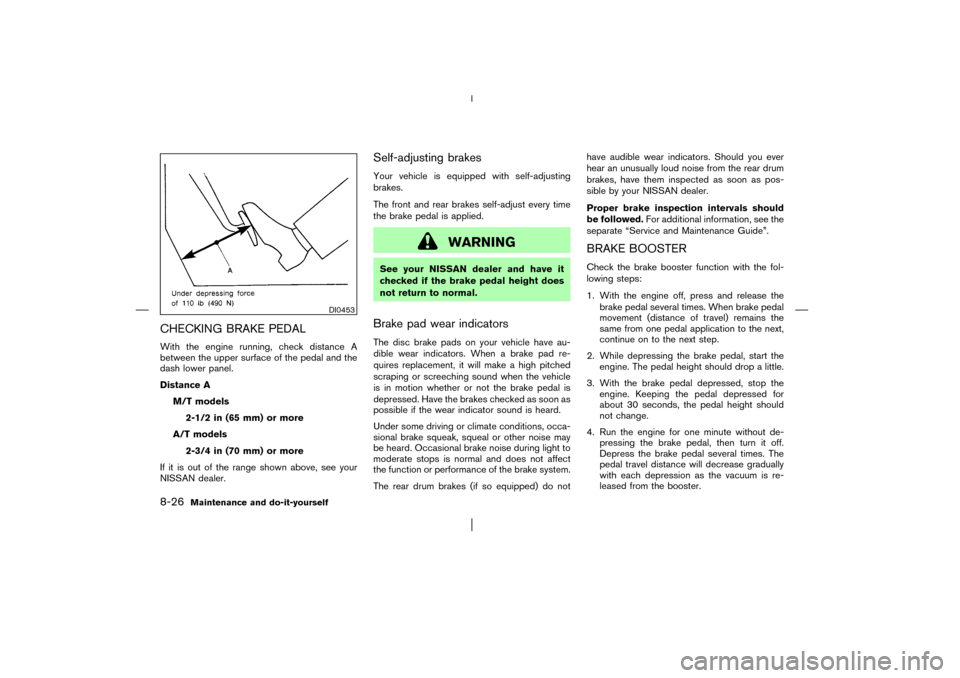
CHECKING BRAKE PEDALWith the engine running, check distance A
between the upper surface of the pedal and the
dash lower panel.
Distance A
M/T models
2-1/2 in (65 mm) or more
A/T models
2-3/4 in (70 mm) or more
If it is out of the range shown above, see your
NISSAN dealer.
Self-adjusting brakesYour vehicle is equipped with self-adjusting
brakes.
The front and rear brakes self-adjust every time
the brake pedal is applied.
WARNING
See your NISSAN dealer and have it
checked if the brake pedal height does
not return to normal.Brake pad wear indicatorsThe disc brake pads on your vehicle have au-
dible wear indicators. When a brake pad re-
quires replacement, it will make a high pitched
scraping or screeching sound when the vehicle
is in motion whether or not the brake pedal is
depressed. Have the brakes checked as soon as
possible if the wear indicator sound is heard.
Under some driving or climate conditions, occa-
sional brake squeak, squeal or other noise may
be heard. Occasional brake noise during light to
moderate stops is normal and does not affect
the function or performance of the brake system.
The rear drum brakes (if so equipped) do nothave audible wear indicators. Should you ever
hear an unusually loud noise from the rear drum
brakes, have them inspected as soon as pos-
sible by your NISSAN dealer.
Proper brake inspection intervals should
be followed.For additional information, see the
separate “Service and Maintenance Guide”.
BRAKE BOOSTERCheck the brake booster function with the fol-
lowing steps:
1. With the engine off, press and release the
brake pedal several times. When brake pedal
movement (distance of travel) remains the
same from one pedal application to the next,
continue on to the next step.
2. While depressing the brake pedal, start the
engine. The pedal height should drop a little.
3. With the brake pedal depressed, stop the
engine. Keeping the pedal depressed for
about 30 seconds, the pedal height should
not change.
4. Run the engine for one minute without de-
pressing the brake pedal, then turn it off.
Depress the brake pedal several times. The
pedal travel distance will decrease gradually
with each depression as the vacuum is re-
leased from the booster.
DI0453
8-26
Maintenance and do-it-yourself
�
03.1.28/R50-D/V5
�
Page 248 of 299
If the brakes do not operate properly, have the
brake checked by your NISSAN dealer.
ENGINE COMPARTMENT
CAUTION
Never use a fuse of higher amperage
rating than that specified on the fuse
box cover. This could damage the elec-
trical system or cause a fire.
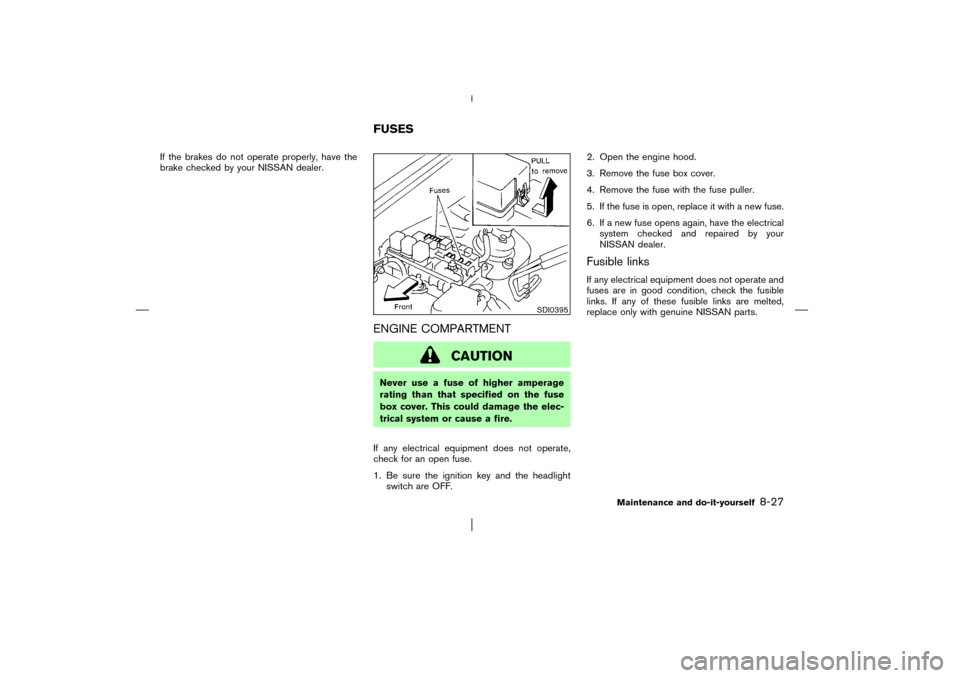
If any electrical equipment does not operate,
check for an open fuse.
1. Be sure the ignition key and the headlight
switch are OFF.2. Open the engine hood.
3. Remove the fuse box cover.
4. Remove the fuse with the fuse puller.
5. If the fuse is open, replace it with a new fuse.
6. If a new fuse opens again, have the electrical
system checked and repaired by your
NISSAN dealer.
Fusible linksIf any electrical equipment does not operate and
fuses are in good condition, check the fusible
links. If any of these fusible links are melted,
replace only with genuine NISSAN parts.
SDI0395
FUSES
Maintenance and do-it-yourself
8-27
�
03.1.28/R50-D/V5
�
Page 282 of 299
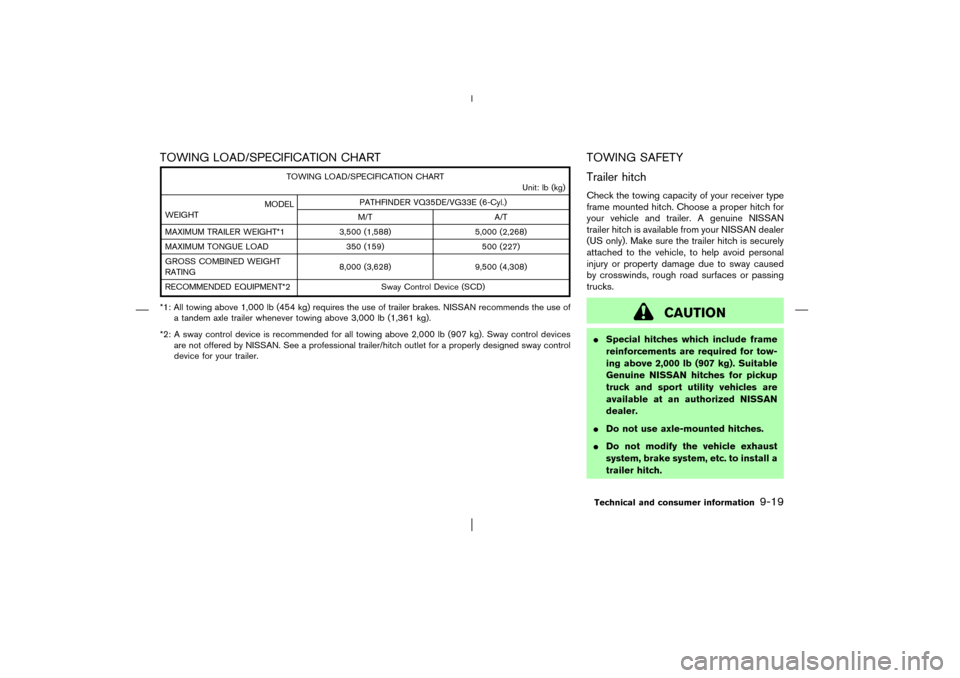
TOWING LOAD/SPECIFICATION CHART
TOWING LOAD/SPECIFICATION CHART
Unit: lb(kg)
MODEL
WEIGHTPATHFINDER VQ35DE/VG33E (6-Cyl.)
M/T A/T
MAXIMUM TRAILER WEIGHT*1 3,500 (1,588) 5,000 (2,268)
MAXIMUM TONGUE LOAD 350 (159) 500 (227)
GROSS COMBINED WEIGHT
RATING8,000 (3,628) 9,500 (4,308)
RECOMMENDED EQUIPMENT*2 Sway Control Device (SCD)
*1: All towing above 1,000 lb (454 kg) requires the use of trailer brakes. NISSAN recommends the use of
a tandem axle trailer whenever towing above 3,000 lb (1,361 kg).
*2: A sway control device is recommended for all towing above 2,000 lb (907 kg). Sway control devices
are not offered by NISSAN. See a professional trailer/hitch outlet for a properly designed sway control
device for your trailer.
TOWING SAFETY
Trailer hitchCheck the towing capacity of your receiver type
frame mounted hitch. Choose a proper hitch for
your vehicle and trailer. A genuine NISSAN
trailer hitch is available from your NISSAN dealer
(US only). Make sure the trailer hitch is securely
attached to the vehicle, to help avoid personal
injury or property damage due to sway caused
by crosswinds, rough road surfaces or passing
trucks.
CAUTION
�Special hitches which include frame
reinforcements are required for tow-
ing above 2,000 lb (907 kg). Suitable
Genuine NISSAN hitches for pickup
truck and sport utility vehicles are
available at an authorized NISSAN
dealer.
�Do not use axle-mounted hitches.
�Do not modify the vehicle exhaust
system, brake system, etc. to install a
trailer hitch.Technical and consumer information
9-19
�
03.1.28/R50-D/V5
�
Page 283 of 299
�After the hitch is removed, seal the
bolt holes to prevent exhaust fumes,
water or dust from entering the pas-
senger compartment.
�Regularly check all hitch mounting
bolts are securely mounted.
�To reduce the possibility of addi-
tional damage if your vehicle is
struck from the rear, where practical,
remove the hitch and/or receiver
when not in use.
�Never connect a trailer brake system
directly to the vehicle brake system.Tire pressures�When towing a trailer, inflate the vehicle tires
to the recommended cold tire pressure indi-
cated on the tire placard (affixed to the glove
box lid).
�Trailer tire condition, size, load rating and
proper inflation pressure should be in accor-
dance with the trailer and tire manufacturers’
specifications.Safety chains
Always use a suitable chain between your ve-
hicle and the trailer. The chain should be
crossed and should be attached to the hitch, not
to the vehicle bumper or axle. Be sure to leave
enough slack in the chain to permit turning
corners.Trailer lightsTrailer lights should comply with Federal and/or
local regulations.
When wiring vehicle for towing connection,
connect stop and tail light pickup into the
vehicle electrical circuit at point between
the sensor and stop light switch or light
switch.Trailer brakesIf your trailer is equipped with a braking system,
make sure it conforms to Federal and/or local
regulations and that it is properly installed.
WARNING
Never connect a trailer brake system
directly to the vehicle brake system.Trailer towing tipsIn order to gain skill and an understanding of thevehicle’s behavior, you should practice turning,
stopping and backing up in an area which is free
from traffic. Steering stability and braking perfor-
mance will be somewhat different than under
normal driving conditions.
�Always secure items in the trailer to prevent
load shift while driving.
�Avoid abrupt starts, acceleration or stops.
�Avoid sharp turns or lane changes.
�Always drive your vehicle at a moderate
speed.
�Always block the wheels on both vehicle and
trailer when parking. Parking on a slope is not
recommended; however, if you must do so,
and if your vehicle is equipped with automatic
transmission, first block the wheels and apply
the parking brake, and then move the trans-
mission selector lever into the P position. If
you move the selector lever to the P position
before blocking the wheels and applying the
parking brake, transmission damage could
occur.
�When going down a hill, shift into a lower
gear and use the engine braking effect.
When ascending a long grade, downshift the
transmission to a lower gear and reduce
speed to reduce chances of engine overload-
ing and/or overheating.
9-20
Technical and consumer information
�
03.1.28/R50-D/V5
�