2003 NISSAN FRONTIER differential
[x] Cancel search: differentialPage 157 of 272

cAccelerating quickly from a stop after
shifting from two-wheel drive to four-
wheel drive may not allow engagement
of the auto-locking free-running hubs
and may cause a clattering noise. If this
occurs, release the accelerator pedal to
reduce the engine speed or stop the
vehicle. Continued use of the vehicle
with this noise may damage the hub
lock.
cIf the auto-locking hubs make a clatter-
ing noise after shifting from four-wheel
drive to two-wheel drive, stop and move
the vehicle in reverse gear, in a straight
line, about 7 to 10 feet (2 to 3 m) .
cUnder extremely cold conditions [below
5°F (-15°C)], the front axle shafts may
rotate even with the transfer lever in the
2H position. If this occurs, the auto-
locking hubs may make a clattering
noise. To avoid this, drive first in four-
wheel drive to warm up the vehicle and
differential gear oil. Then, shift to two-
wheel drive.
cIn cold weather, it may be necessary to
reduce speed or stop the vehicle in or-
der to shift from two-wheel drive to
four-wheel drive.cWhen shifting into or out of four-wheel
drive while driving, do not stop shift
lever movement midway. An incomplete
shift may cause a clattering noise from
the auto-locking hubs. Continued use
of the vehicle with this noise may dam-
age the hub lock. Drive in four-wheel
drive to stop the noise. Shift to two-
wheel drive as described.
For Automatic transmission models:
When moving the transfer lever from 4H or 4L to
4L or 4H, you must always move it quickly
through the N position. If you are slow to shift, the
engine idle speed will allow the transfer gears to
speed up and gear clashing will occur.
Do not move the transfer lever from 4H or 4L to
4L or 4H, from 2H to 4L and from 4L to 2H with
the engine turned off. Otherwise, you may have
difficulty in moving the transfer lever to the de-
sired position.
Do not leave the transfer lever in the N position
with the engine running. Stopping with the trans-
fer case in the N position may cause gear grind-
ing when selecting another gear. Changing the
transfer case gear quickly and smoothly will elimi-
nate this.
Starting and driving5-23
ZREVIEW COPY:Ð2003 Truck/Frontier(d22)
Owners Manual(owners)ÐUSA English(nna)
01/15/03Ðarosenma
X
Page 172 of 272
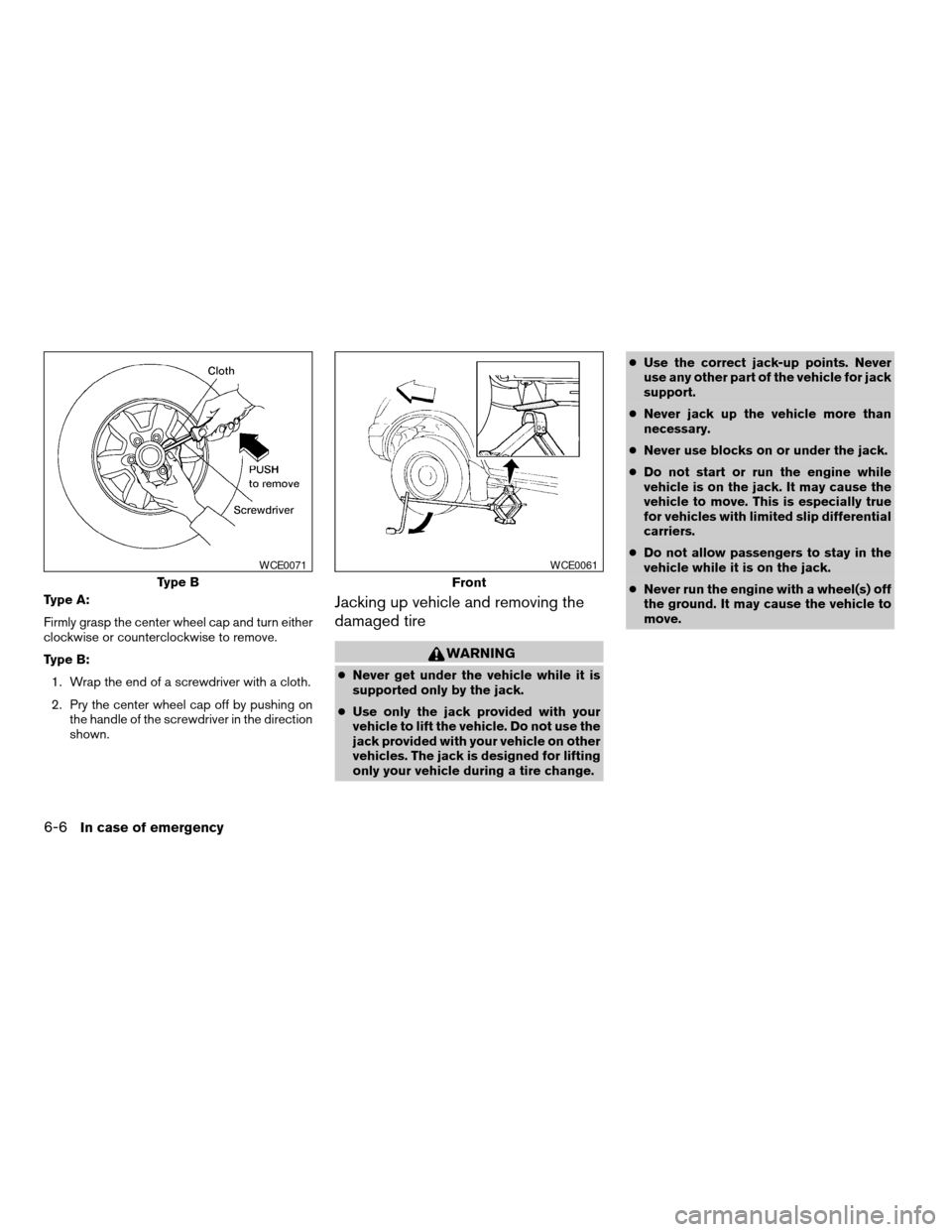
Type A:
Firmly grasp the center wheel cap and turn either
clockwise or counterclockwise to remove.
Type B:
1. Wrap the end of a screwdriver with a cloth.
2. Pry the center wheel cap off by pushing on
the handle of the screwdriver in the direction
shown.Jacking up vehicle and removing the
damaged tire
WARNING
cNever get under the vehicle while it is
supported only by the jack.
cUse only the jack provided with your
vehicle to lift the vehicle. Do not use the
jack provided with your vehicle on other
vehicles. The jack is designed for lifting
only your vehicle during a tire change.cUse the correct jack-up points. Never
use any other part of the vehicle for jack
support.
cNever jack up the vehicle more than
necessary.
cNever use blocks on or under the jack.
cDo not start or run the engine while
vehicle is on the jack. It may cause the
vehicle to move. This is especially true
for vehicles with limited slip differential
carriers.
cDo not allow passengers to stay in the
vehicle while it is on the jack.
cNever run the engine with a wheel(s) off
the ground. It may cause the vehicle to
move.
Type B
WCE0071
Front
WCE0061
6-6In case of emergency
ZREVIEW COPY:Ð2003 Truck/Frontier(d22)
Owners Manual(owners)ÐUSA English(nna)
01/17/03Ðtmchalpi
X
Page 229 of 272
Four-wheel drive models
CAUTION
Always use tires of the same type, size,
brand, construction (bias, bias-belted or
radial) , and tread pattern on all four
wheels. Failure to do so may result in a
circumference difference between tires
on the front and rear axles which will
cause excessive tire wear and may dam-
age the transmission, transfer case and
differential gears.
If excessive tire wear is found, it is recommended
that all four tires be replaced with tires of the
same size, brand, construction and tread pattern.
The tire pressure and wheel alignment should
also be checked and corrected as necessary.
Contact a NISSAN dealer.
Wheel balance
Unbalanced wheels may affect vehicle handling
and tire life. Even with regular use, wheels can get
out of balance. Therefore, they should be bal-
anced as required.
Wheel balance service should be per-
formed with the wheels off the vehicle.
Spin balancing the wheels on the vehicle
could lead to mechanical damage.cFor additional information regarding
tires, refer to “Important Tire Safety In-
formation” (US) or “Tire Safety Informa-
tion” (Canada) in the Warranty Informa-
tion Booklet .
Care of wheels
cWash the wheels when washing the vehicle to
maintain their appearance.
cClean the inner side of the wheels when the
wheel is changed or the underside of the ve-
hicle is washed.
cDo not use abrasive cleaners when washing
the wheels.
cInspect wheel rims regularly for dents or cor-
rosion. Such damage may cause loss of pres-
sure or poor seal at the tire bead.
cNISSAN recommends waxing the road wheels
to protect against road salt in areas where it is
used during winter.
Spare tire (TEMPORARY USE ONLY
spare tire)
Your vehicle may be equipped with a TEMPO-
RARY SPARE USE ONLY spare tire.Observe the following precautions if the TEM-
PORARY USE ONLY spare tire must be used,
Otherwise, your vehicle could be damaged or
involved in an accident:
WARNING
cThe spare tire should be used for emer-
gency use only. It should be replaced
with the standard tire at the first oppor-
tunity to avoid possible tire or differen-
tial damage.
cDrive carefully while the TEMPORARY
USE ONLY spare tire is installed. Avoid
sharp turns and abrupt braking while
driving.
cPeriodically check spare tire inflation
pressure. Always keep the pressure of
the TEMPORARY USE ONLY spare tire
at 60 psi (420 kPa, 4.2 bar) .
cWith the TEMPORARY USE ONLY spare
tire installed do not drive the vehicle at
speeds faster than 50 MPH (80 km/h) .
Maintenance and do-it-yourself8-41
ZREVIEW COPY:Ð2003 Truck/Frontier(d22)
Owners Manual(owners)ÐUSA English(nna)
01/15/03Ðarosenma
X
Page 230 of 272
cWhen driving on roads covered with
snow or ice, the TEMPORARY USE
ONLY spare tire should be used on the
front wheels and the original tire used
on the rear wheels (drive wheels) . Use
tire chains only on the two rear original
tires.
cTire tread of the TEMPORARY USE
ONLY spare tire will wear at a faster rate
than the standard tire. Replace the
spare tire as soon as the tread wear
indicators appear.
cDo not use the spare tire on other
vehicles.
cDo not use more than one spare tire at
the same time.
cDo not tow a trailer when the TEMPO-
RARY USE ONLY spare tire is installed.
CAUTION
cWith the spare tire installed the
transfer control lever must be in the 2H
position to prevent the transfer case
and differential gears from being
damaged.cDo not use tire chains on a TEMPO-
RARY USE ONLY spare tire. Tire chains
will not fit properly and may cause dam-
age to the vehicle.
cBecause the TEMPORARY USE ONLY
spare tire is smaller than the original
tire, ground clearance is reduced. To
avoid damage to the vehicle, do not
drive over obstacles. Also, do not drive
the vehicle through an automatic car
wash since it may get caught.
8-42Maintenance and do-it-yourself
ZREVIEW COPY:Ð2003 Truck/Frontier(d22)
Owners Manual(owners)ÐUSA English(nna)
01/15/03Ðarosenma
X
Page 232 of 272
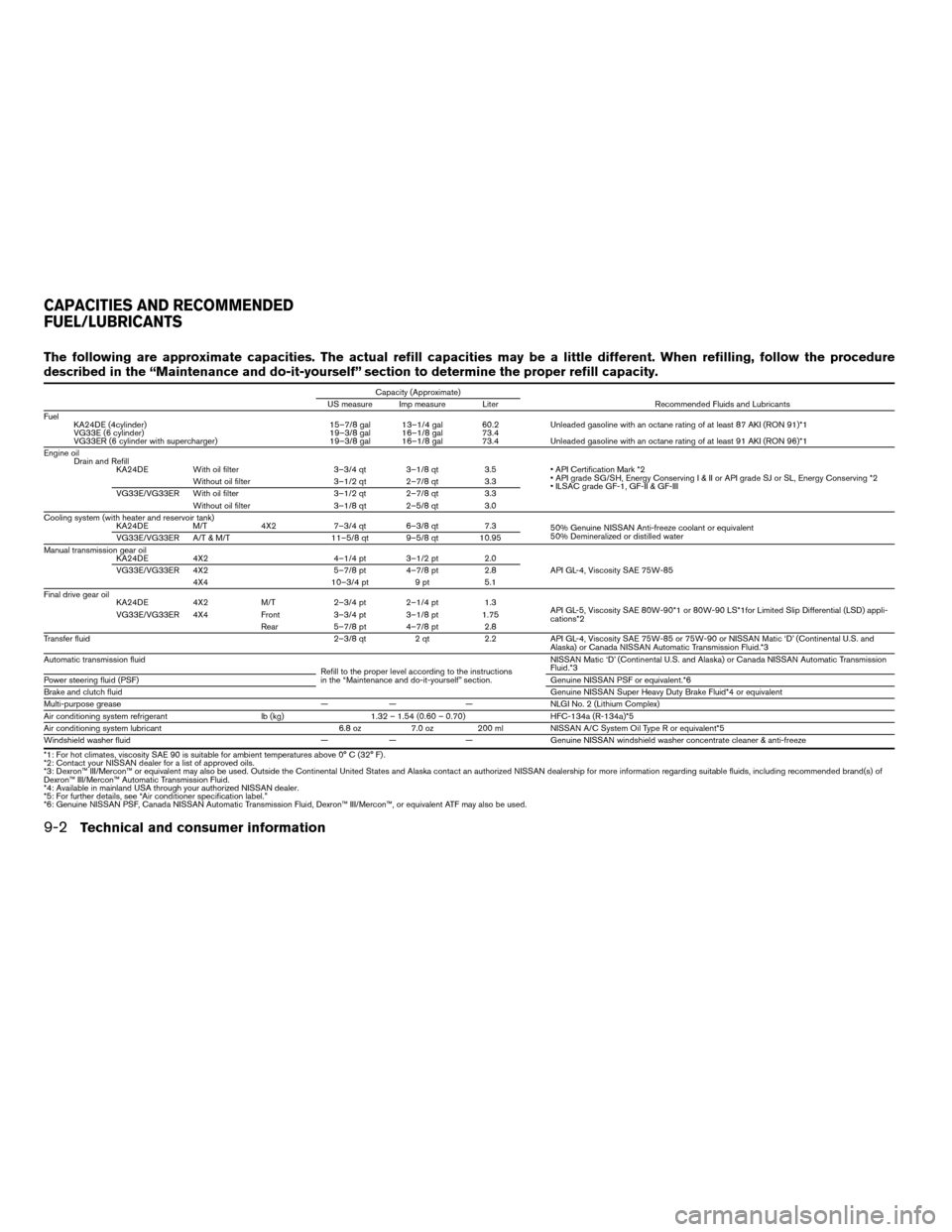
The following are approximate capacities. The actual refill capacities may be a little different. When refilling, follow the procedure
described in the “Maintenance and do-it-yourself” section to determine the proper refill capacity.
Capacity (Approximate)
US measure Imp measure Liter Recommended Fluids and Lubricants
Fuel
KA24DE (4cylinder) 15–7/8 gal 13–1/4 gal 60.2 Unleaded gasoline with an octane rating of at least 87 AKI (RON 91)*1
VG33E (6 cylinder) 19–3/8 gal 16–1/8 gal 73.4
VG33ER (6 cylinder with supercharger) 19–3/8 gal 16–1/8 gal 73.4 Unleaded gasoline with an octane rating of at least 91 AKI (RON 96)*1
Engine oil
Drain and Refill
KA24DE With oil filter 3–3/4 qt 3–1/8 qt 3.5 • API Certification Mark *2
• API grade SG/SH, Energy ConservingI&IIorAPIgrade SJ or SL, Energy Conserving *2
• ILSAC grade GF-1, GF-II & GF-III Without oil filter 3–1/2 qt 2–7/8 qt 3.3
VG33E/VG33ER With oil filter 3–1/2 qt 2–7/8 qt 3.3
Without oil filter 3–1/8 qt 2–5/8 qt 3.0
Cooling system (with heater and reservoir tank)
KA24DE M/T 4X2 7–3/4 qt 6–3/8 qt 7.3
50% Genuine NISSAN Anti-freeze coolant or equivalent
50% Demineralized or distilled water
VG33E/VG33ER A/T & M/T 11–5/8 qt 9–5/8 qt 10.95
Manual transmission gear oil
KA24DE 4X2 4–1/4 pt 3–1/2 pt 2.0
API GL-4, Viscosity SAE 75W-85 VG33E/VG33ER 4X2 5–7/8 pt 4–7/8 pt 2.8
4X4 10–3/4 pt 9 pt 5.1
Final drive gear oil
KA24DE 4X2 M/T 2–3/4 pt 2–1/4 pt 1.3
API GL-5, Viscosity SAE 80W-90*1 or 80W-90 LS*1for Limited Slip Differential (LSD) appli-
cations*2 VG33E/VG33ER 4X4 Front 3–3/4 pt 3–1/8 pt 1.75
Rear 5–7/8 pt 4–7/8 pt 2.8
Transfer fluid 2–3/8 qt 2 qt 2.2 API GL-4, Viscosity SAE 75W-85 or 75W-90 or NISSAN Matic ‘D’ (Continental U.S. and
Alaska) or Canada NISSAN Automatic Transmission Fluid.*3
Automatic transmission fluid
Refill to the proper level according to the instructions
in the “Maintenance and do-it-yourself” section.NISSAN Matic ‘D’ (Continental U.S. and Alaska) or Canada NISSAN Automatic Transmission
Fluid.*3
Power steering fluid (PSF)Genuine NISSAN PSF or equivalent.*6
Brake and clutch fluidGenuine NISSAN Super Heavy Duty Brake Fluid*4 or equivalent
Multi-purpose grease — — — NLGI No. 2 (Lithium Complex)
Air conditioning system refrigerant lb (kg) 1.32 – 1.54 (0.60 – 0.70) HFC-134a (R-134a)*5
Air conditioning system lubricant 6.8 oz 7.0 oz 200 ml NISSAN A/C System Oil Type R or equivalent*5
Windshield washer fluid — — — Genuine NISSAN windshield washer concentrate cleaner & anti-freeze
*1: For hot climates, viscosity SAE 90 is suitable for ambient temperatures above 0° C (32° F) .
*2: Contact your NISSAN dealer for a list of approved oils.
*3: Dexron™ III/Mercon™ or equivalent may also be used. Outside the Continental United States and Alaska contact an authorized NISSAN dealership formore information regarding suitable fluids, including recommended brand(s) of
Dexron™ III/Mercon™ Automatic Transmission Fluid.
*4: Available in mainland USA through your authorized NISSAN dealer.
*5: For further details, see “Air conditioner specification label.”
*6: Genuine NISSAN PSF, Canada NISSAN Automatic Transmission Fluid, Dexron™ III/Mercon™, or equivalent ATF may also be used.
CAPACITIES AND RECOMMENDED
FUEL/LUBRICANTS
9-2Technical and consumer information
ZREVIEW COPY:Ð2003 Truck/Frontier(d22)
Owners Manual(owners)ÐUSA English(nna)
01/17/03Ðtmchalpi
X