2003 NISSAN ALTIMA seats
[x] Cancel search: seatsPage 179 of 256
When driving in areas using road salt or other
corrosive materials, check lubrication frequently.
Lights*Clean the headlights on a regular basis.
Make sure that the headlights, stop lights, tail
lights, turn signal lights, and other lights are all
operating properly and installed securely. Also
check headlight aim.
Road wheel nuts (lug nuts)*When checking
the tires, make sure no wheel nuts are missing,
and check for any loose wheel nuts. Tighten if
necessary.
Tire rotation*Tires should be rotated every
7,500 miles (12,000 km) .
Tire, wheel alignment and balanceIf the
vehicle should pull to either side while driving on
a straight and level road, or if you detect uneven
or abnormal tire wear, there may be a need for
wheel alignment.
If the steering wheel or seat vibrates at normal
highway speeds, wheel balancing may be
needed.
cFor additional information regarding tires,
refer to “Important Tire Safety Information”
(US) or “Tire Safety Information” (Canada) in
the Warranty Information Booklet .
Tires*Check the pressure with a gauge at least
once a month and always prior to long distancetrips. If necessary, adjust the pressure in all tires,
including the spare, to the pressure specified.
Check carefully for damage, cuts or excessive
wear.
WindshieldClean the windshield on a regular
basis. Check the windshield at least every six
months for cracks or other damage. Have a dam-
aged windshield repaired by a qualified repair
facility.
Windshield wiper blades*Check for cracks or
wear if they do not wipe properly.
Inside the vehicle
The maintenance items listed here should be
checked on a regular basis, such as when per-
forming periodic maintenance, cleaning the ve-
hicle, etc.
Additional information on the following
items with an “*” is found later in this sec-
tion.
Accelerator pedalCheck the pedal for smooth
operation and make sure the pedal does not bind
or require uneven effort. Keep the floor mat away
from the pedal.
Automatic transmission P (Park) position
mechanismOn a fairly steep hill check that your
vehicle is held securely with the selector lever in
the P position without applying any brakes.Brake pedal and booster*Check the pedal for
smooth operation and make sure it has the proper
distance under it when depressed fully. Check
the brake booster function. Be certain to keep the
floor mat away from the pedal.
BrakesCheck that the brakes do not pull the
vehicle to one side when applied.
Clutch pedal*Make sure the pedal operates
smoothly and check that it has the proper free
travel.
Parking brake*Check that the lever has the
proper travel and confirm that your vehicle is held
securely on a fairly steep hill with only the parking
brake applied.
SeatsCheck seat position controls such as seat
adjusters, seatback recliner, etc. to ensure they
operate smoothly and all latches lock securely in
every position. Check that the head restraints
move up and down smoothly and the locks (if so
equipped) hold securely in all latched positions.
Seat beltsCheck that all parts of the seat belt
system (for example, buckles, anchors, adjusters
and retractors) operate properly and smoothly,
and are installed securely. Check the belt web-
bing for cuts, fraying, wear or damage.
Steering wheelCheck for changes in the steer-
ing system, such as excessive freeplay, hard
steering or strange noises.
Maintenance and do-it-yourself8-3
ZREVIEW COPY:Ð2003 Altima(l30)
Owners Manual(owners)ÐUSA English(nna)
04/21/03Ðdebbie
X
Page 234 of 256
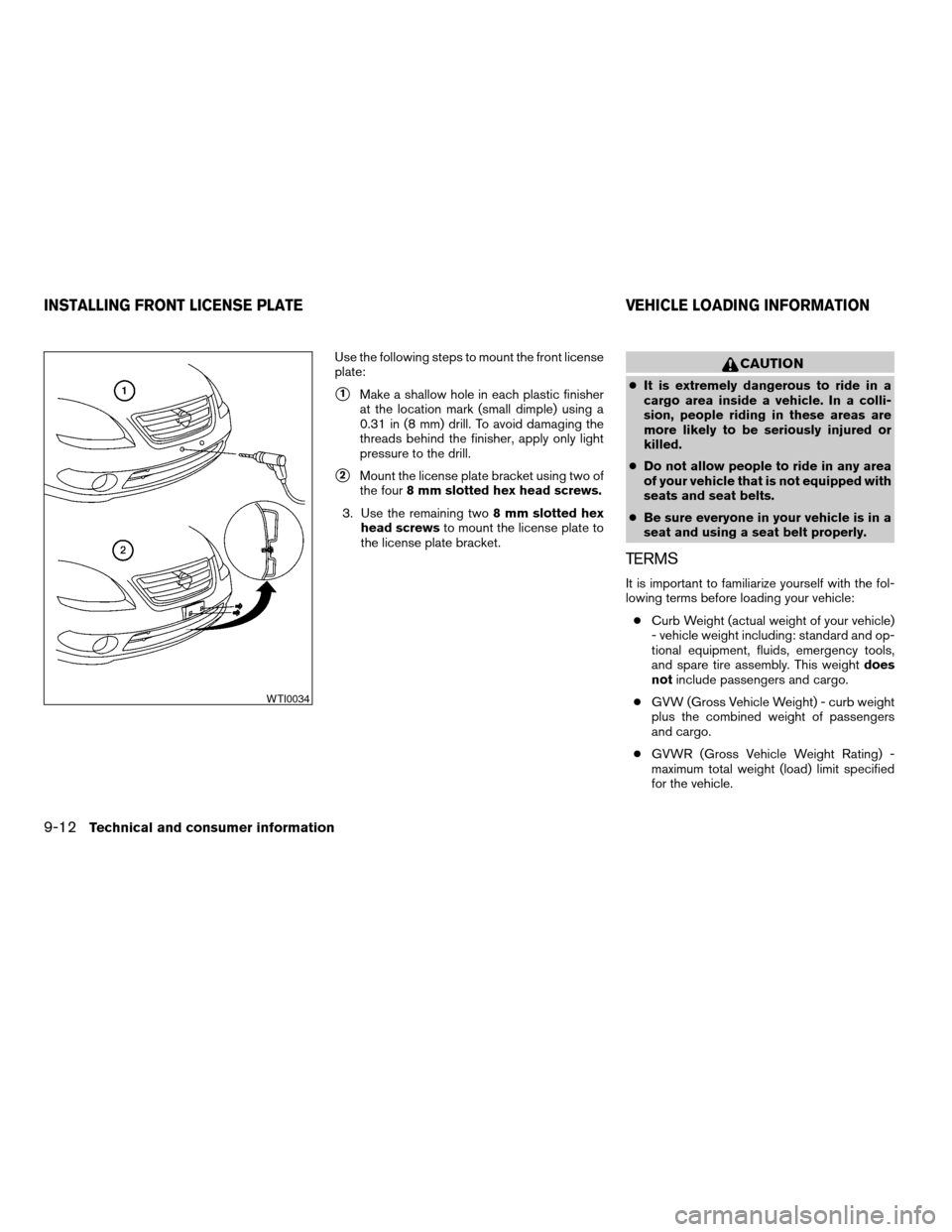
Use the following steps to mount the front license
plate:
s1Make a shallow hole in each plastic finisher
at the location mark (small dimple) using a
0.31 in (8 mm) drill. To avoid damaging the
threads behind the finisher, apply only light
pressure to the drill.
s2Mount the license plate bracket using two of
the four8 mm slotted hex head screws.
3. Use the remaining two8 mm slotted hex
head screwsto mount the license plate to
the license plate bracket.
CAUTION
cIt is extremely dangerous to ride in a
cargo area inside a vehicle. In a colli-
sion, people riding in these areas are
more likely to be seriously injured or
killed.
cDo not allow people to ride in any area
of your vehicle that is not equipped with
seats and seat belts.
cBe sure everyone in your vehicle is in a
seat and using a seat belt properly.
TERMS
It is important to familiarize yourself with the fol-
lowing terms before loading your vehicle:
cCurb Weight (actual weight of your vehicle)
- vehicle weight including: standard and op-
tional equipment, fluids, emergency tools,
and spare tire assembly. This weightdoes
notinclude passengers and cargo.
cGVW (Gross Vehicle Weight) - curb weight
plus the combined weight of passengers
and cargo.
cGVWR (Gross Vehicle Weight Rating) -
maximum total weight (load) limit specified
for the vehicle.
WTI0034
INSTALLING FRONT LICENSE PLATE VEHICLE LOADING INFORMATION
9-12Technical and consumer information
ZREVIEW COPY:Ð2003 Altima(l30)
Owners Manual(owners)ÐUSA English(nna)
04/21/03Ðdebbie
X
Page 246 of 256
D
Daytime running light system
(Canada only)..................2-21
Defogger switch
Rear window defogger switch.......2-17
Dimensions and weights.............9-8
Door locks....................3-3
Door open warning light.............2-9
Drive belts....................8-20
Driving
Cold weather driving............5-20
Driving with automatic transmission.....5-7
Driving with manual transmission.....5-10
Precautions when starting and driving . . .5-2
E
Economy - fuel.................5-15
Emission control information label.......9-11
Emission control system warranty.......9-18
Engine
Before starting the engine..........5-6
Capacities and recommended
fuel/lubricants.................9-2
Changing engine coolant..........8-10
Changing engine oil............8-11
Changing engine oil filter..........8-13
Checking engine coolant level........8-9
Checking engine oil level..........8-10
Engine compartment check locations. . . .8-9
Engine coolant temperature gauge.....2-6
Engine cooling system............8-9
Engine oil..................8-10Engine oil and oil filter recommendation . .9-5
Engine oil pressure warning light......2-9
Engine oil viscosity..............9-5
Engine serial number............9-10
Engine specifications.............9-7
Starting the engine..............5-6
Exhaust gas (Carbon monoxide)........5-2
Eyeglass case..................2-28
F
Flashers
(See hazard warning flasher switch)......2-24
Flat tire......................6-2
Floor mat positioning aid.............7-4
Fluid
Automatic transmission fluid (ATF). . . .8-14
Brake fluid..................8-16
Capacities and recommended
fuel/lubricants.................9-2
Clutch fluid.................8-17
Engine coolant................8-9
Engine oil..................8-10
Power steering fluid.............8-15
Window washer fluid............8-17
F.M.V.S.S. certification label..........9-10
Fog light switch.................2-22
Front seats....................1-2
Fuel
Capacities and recommended
fuel/lubricants.................9-2
Fuel economy................5-15
Fuel filler cap................3-13
Fuel filler lid.................3-13
Fuel filler lid and cap............3-13Fuel filler lid lock opener lever.......3-13
Fuel gauge..................2-7
Fuel octane rating..............9-4
Fuel recommendation............9-3
Fuses......................8-27
Fusible links...................8-28
G
Garage door opener, HomeLinkTUniversal
Transceiver...................2-38
Gascap.....................3-13
Gauge
Engine coolant temperature gauge.....2-6
Fuel gauge..................2-7
Odometer...................2-3
Speedometer.................2-3
Tachometer..................2-5
Trip odometer.................2-3
General maintenance..............8-2
Glove box....................2-29
Glove box lock.................2-29
H
Hazard warning flasher switch.........2-24
Head restraints..................1-7
Headlight and turn signal switch........2-18
Heated seats..................2-25
Heater
Heater and air conditioner
controls.................4-3, 4-11
Heater operation............4-4, 4-11
HomeLinkTUniversal Transceiver.......2-38
10-2
ZREVIEW COPY:Ð2003 Altima(l30)
Owners Manual(owners)ÐUSA English(nna)
04/21/03Ðdebbie
X
Page 248 of 256
O
Octane rating (See fuel octane rating).....9-4
Odometer.....................2-3
Oil
Capacities and recommended
fuel/lubricants.................9-2
Changing engine oil............8-11
Changing engine oil filter..........8-13
Checking engine oil level..........8-10
Engine oil..................8-10
Engine oil and oil filter recommendation . .9-5
Engine oil viscosity..............9-5
Outside mirror control.............3-17
Overheat
If your vehicle overheats...........6-9
Owner’s manual order form..........9-20
Owner’s manual/service manual order
information....................9-20
P
Parking
Parking brake check............8-26
Parking brake operation..........5-12
Parking/parking on hills...........5-16
Power
Power door locks...............3-4
Power outlet.................2-26
Power steering fluid.............8-15
Power steering system...........5-17
Power windows...............2-33
Rear power windows............2-34
PrecautionsMaintenance precautions..........8-5
Precautions on child restraints.......1-30
Precautions on seat belt usage......1-22
Precautions on supplemental restraint
system.....................1-8
Precautions when starting and driving . . .5-2
Push starting...................6-8
R
Radio
Car phone or CB radio...........4-28
FM-AM radio with compact disc (CD)
changer...................4-20
FM-AM radio with compact disc (CD)
player....................4-15
Readiness for inspection maintenance (I/M)
test........................9-19
Rear power windows..............2-34
Rear seat.....................1-6
Rear window defogger switch.........2-17
Refrigerant recommendation..........9-6
Registering your vehicle in another country. . .9-9
Remote keyless entry system..........3-5
Reporting safety defects (US only)......9-18
S
Safety
Child safety rear door lock..........3-5
Child seat belts...............1-30
Reporting safety defects (US only). . . .9-18
Seat adjustment
Front manual seat adjustment........1-2Front power seat adjustment........1-4
Rear seat adjustment.............1-6
Seat belt
Child safety.................1-24
Infants and small children.........1-25
Injured Person................1-25
Larger children...............1-25
Precautions on seat belt usage......1-22
Pregnant women..............1-25
Seat belt extenders.............1-29
Seat belt maintenance...........1-29
Seat belts..................1-22
Shoulder belt height adjustment......1-28
Three-point type with retractor.......1-26
Seat belt warning light.............2-10
Seatback pockets................2-27
Seatback side pockets.............2-27
Seats
Adjustment..................1-2
Front seats..................1-2
Heated seats................2-25
Manual front seat adjustment........1-2
Rear seat...................1-6
Security system (Nissan vehicle immobilizer
system) , engine start.........2-12, 3-2, 5-5
Self-adjusting brakes..............8-27
Service manual order form...........9-20
Servicing air conditioner............4-12
Shift lock release.................5-9
Shifting
Automatic transmission...........5-8
Manual transmission............5-10
Shoulder belt height adjustment........1-28
Spark plug replacement............8-21
Speedometer...................2-3
Spotlights (See map light)...........2-37
10-4
ZREVIEW COPY:Ð2003 Altima(l30)
Owners Manual(owners)ÐUSA English(nna)
04/21/03Ðdebbie
X
Page 255 of 256
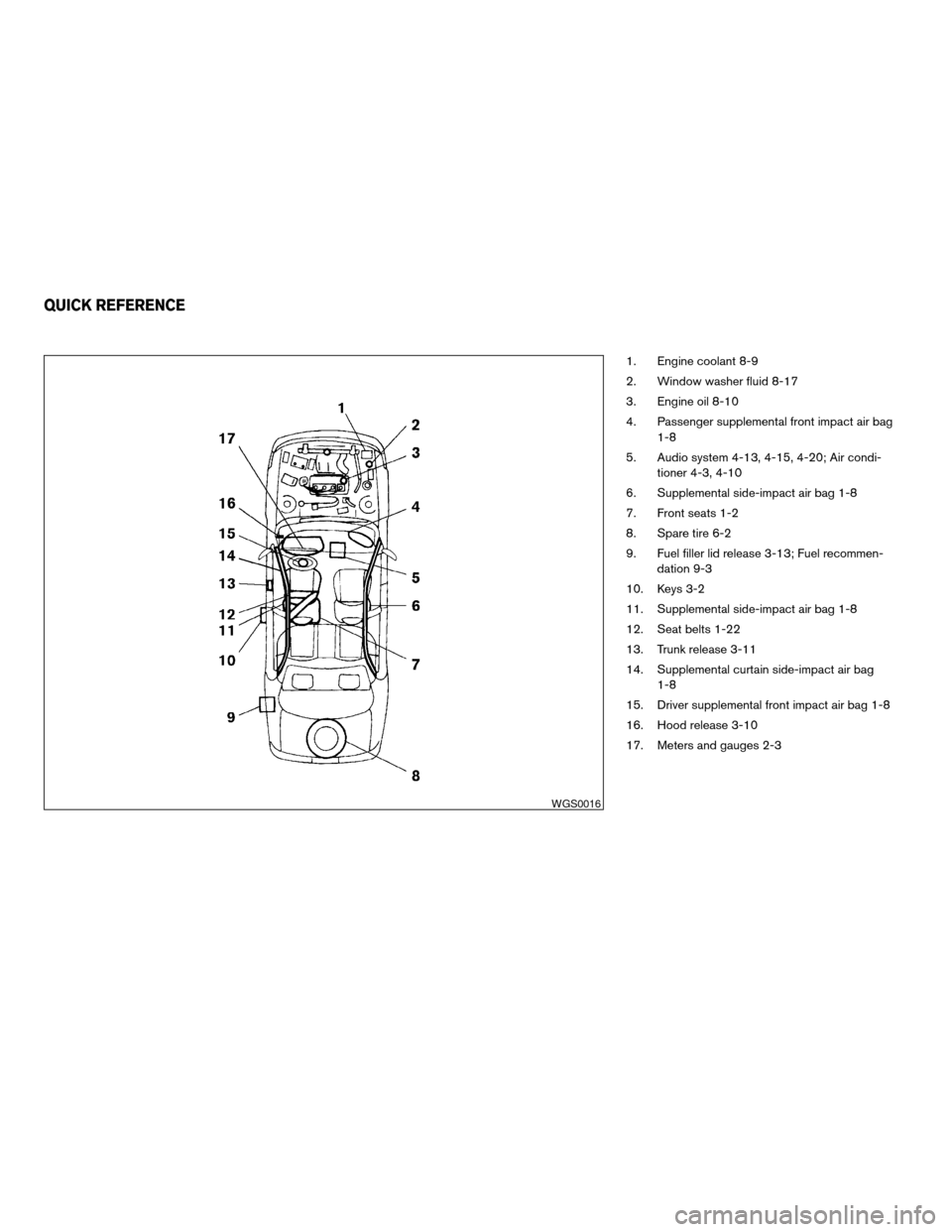
1. Engine coolant 8-9
2. Window washer fluid 8-17
3. Engine oil 8-10
4. Passenger supplemental front impact air bag
1-8
5. Audio system 4-13, 4-15, 4-20; Air condi-
tioner 4-3, 4-10
6. Supplemental side-impact air bag 1-8
7. Front seats 1-2
8. Spare tire 6-2
9. Fuel filler lid release 3-13; Fuel recommen-
dation 9-3
10. Keys 3-2
11. Supplemental side-impact air bag 1-8
12. Seat belts 1-22
13. Trunk release 3-11
14. Supplemental curtain side-impact air bag
1-8
15. Driver supplemental front impact air bag 1-8
16. Hood release 3-10
17. Meters and gauges 2-3
WGS0016
QUICK REFERENCE
ZREVIEW COPY:Ð2003 Altima(l30)
Owners Manual(owners)ÐUSA English(nna)
04/21/03Ðdebbie
X