2003 NISSAN 350Z wiring
[x] Cancel search: wiringPage 17 of 227
may inflate if the forces in another type of
collision are similar to those of a higher severity
frontal impact. They may not inflate in certain
frontal collisions. Vehicle damage (or lack of it) is
not always an indication of proper supplemental
air bag operation.
The supplemental air bag system has dual stage
inflators for both the driver and passenger air
bags. The system monitors information from the
crash zone sensor, the diagnosis sensor unit and
seat belt buckle sensors that detect if the seat
belts are fastened, inflator operation is based on
the severity of a collision and whether the seat
belts are being used. Only one front air bag may
inflate in a crash, depending on the crash sever-
ity and whether the front occupants are belted or
unbelted. This does not indicate improper per-
formance of the system. If you have any ques-
tions about the performance of your air bag
system, please contact your NISSAN dealer.
When the supplemental front air bag inflates, a
fairly loud noise may be heard, followed by
release of smoke. This smoke is not harmful and
does not indicate a fire. Care should be taken
not to inhale it, as it may cause irritation and
choking. Those with a history of a breathing
condition should get fresh air promptly.
Supplemental front air bags, along with the use
of seat belts, help to cushion the impact force onthe face and chest of the front occupants. They
can help save lives and reduce serious injuries.
However, an inflating front air bag may cause
facial abrasions or other injuries. Front air bags
do not provide restraint to the lower body.
The seat belts should be correctly worn and the
driver and passenger seated upright as far as
practical away from the steering wheel or instru-
ment panel. The supplemental front air bags
inflates quickly in order to help protect the front
occupants. Because of this, the force of the front
air bag inflating can increase the risk of injury if
the occupant is too close to, or is against, the air
bag module during inflation. The air bag will
deflate quickly after the collision is over.
After turning the ignition key to the ON
position, the supplemental air bag warning
light illuminates. The supplemental air bag
warning light will turn off after about 7
seconds if the system is operational.
WARNING
IDo not place any objects on the
steering wheel pad or on the instru-
ment panel. Also, do not place any
objects between any occupant andthe steering wheel or instrument
panel. Such objects may become
dangerous projectiles and cause in-
jury if the supplemental front air bag
inflates.
IRight after inflation, several air bag
system components will be hot. Do
not touch them; you may severely
burn yourself.
INo unauthorized changes should be
made to any components or wiring of
the supplemental front air bag sys-
tem. This is to prevent accidental in-
flation of the air bag or damage to
the air bag system.
IDo not make unauthorized changes
to your vehicle's electrical system,
suspension system or front end
structure. This could affect proper
operation of the supplemental air
bag system.
ITampering with the supplemental
front air bag system may result in
serious personal injury. Tampering
1-12
Seats, restraints and supplemental air bag systems
Z
02.9.13/Z33-D/V5.0
X
Page 18 of 227
includes changes to the steering
wheel and the instrument panel as-
sembly by placing material over the
steering wheel pad, above the dash-
board, or by installing additional trim
material around the air bag system.
IWork around and on the supplemen-
tal front air bag system should be
done by a NISSAN dealer. Installa-
tion of electrical equipment should
also be done by a NISSAN dealer.
The yellow and orange Supplemental
Restrain System (SRS) wiring and
connectors should not be modified or
disconnected. Unauthorized electri-
cal test equipment and probing de-
vices should not be used on the air
bag system.
IA cracked windshield should be re-
placed immediately by a qualified re-
pair facility. A cracked windshield
could affect inflation of the supple-
mental air bag system.
IThe SRS wiring harness connectors
are yellow and orange for easyidentification.
When selling your vehicle, we request that you
inform the buyer about the supplemental front air
bag system and guide the buyer to the appro-
priate sections in this Owner's Manual.
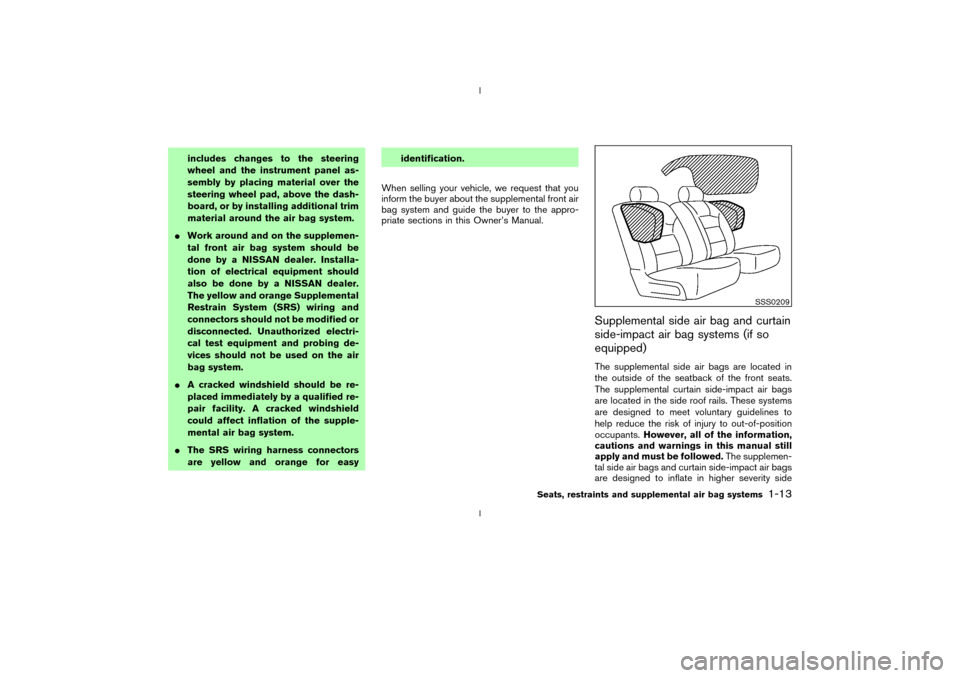
Supplemental side air bag and curtain
side-impact air bag systems (if so
equipped)The supplemental side air bags are located in
the outside of the seatback of the front seats.
The supplemental curtain side-impact air bags
are located in the side roof rails. These systems
are designed to meet voluntary guidelines to
help reduce the risk of injury to out-of-position
occupants.However, all of the information,
cautions and warnings in this manual still
apply and must be followed.The supplemen-
tal side air bags and curtain side-impact air bags
are designed to inflate in higher severity side
SSS0209
Seats, restraints and supplemental air bag systems
1-13
Z
02.9.13/Z33-D/V5.0
X
Page 19 of 227
collisions, although they may inflate if the forces
in another type of collision are similar to those of
a higher severity side impact. They are designed
to inflate on the side where the vehicle is
impacted. They may not inflate in certain side
collisions. Vehicle damage (or lack of it) is not
always an indication of proper supplemental side
air bag and curtain side-impact air bag opera-
tion.
When the supplemental side air bag and curtain
side-impact air bag inflate, a fairly loud noise
may be heard, followed by release of smoke.
This smoke is not harmful and does not indicate
a fire. Care should be taken not to inhale it, as it
may cause irritation and choking. Those with a
history of a breathing condition should get fresh
air promptly.
Supplemental side air bags, along with the use
of seat belts, help to cushion the impact force on
the chest of the front occupants. Curtain side-
impact air bags help to cushion the impact force
to the head of occupants. They can help save
lives and reduce serious injuries. However, an
inflating side air bag and curtain side-impact air
bag may cause abrasions or other injuries.
Supplemental side air bags and curtain side-
impact air bags do not provide restraint to the
lower body.
The seat belts should be correctly worn and the
driver and passenger seated upright as far aspractical away from the side air bag, and seated
as far away as practical from the door finishers
and side roof rails. The side air bags and curtain
side-impact air bag inflate quickly in order to
help protect the front occupants. Because of
this, the force of the side air bag and curtain
side-impact air bag inflating can increase the risk
of injury if the occupant is too close to, or is
against, these air bag modules during inflation.
The side air bag and curtain side-impact air bag
will deflate quickly after the collision is over.
After turning the ignition key to the ON
position, the supplemental air bag warning
light illuminates. The air bag warning light
will turn off after about 7 seconds if the
systems are operational.
WARNING
IDo not place any objects near the
seatback of the front seats. Also, do
not place any objects (an umbrella,
bag, etc.) between the front door fin-
isher and the front seat. Such objects
may become dangerous projectiles
and cause injury if the side air bag
inflates.
IRight after inflation, several side airbag and curtain air bag system com-
ponents will be hot. Do not touch
them; you may severely burn your-
self.
INo unauthorized changes should be
made to any components or wiring of
this side air bag and curtain side-
impact air bag system. This is to pre-
vent accidental inflation of the side
air bag and curtain side-impact air
bag or damage to the side air bag
and curtain side-impact air bag sys-
tem.
IDo not make unauthorized changes
to your vehicle's electrical system,
suspension system or side panel.
This could affect proper operation of
the supplemental side air bag and
curtain side-impact air bag system.
ITampering with the supplemental
system may result in serious per-
sonal injury. For example, do not
change the front seat by placing ma-
terial near the seatback or by install-
ing additional trim material, such as
1-14
Seats, restraints and supplemental air bag systems
Z
02.9.13/Z33-D/V5.0
X
Page 20 of 227
seat covers, around the side air bag.
IWork around and on the side air bag
and curtain side-impact air bag sys-
tem should be done by a NISSAN
dealer. Installation of electrical
equipment should also be done by a
NISSAN dealer. The SRS wiring har-
nesses* should not be modified or
disconnected. Unauthorized electri-
cal test equipment and probing de-
vices should not be used on the side
air bag system.
* The SRS wiring harnesses are cov-
ered with yellow insulation either just
before the harness connectors or
over the complete harness for easy
identification.
When selling your vehicle, we request that you
inform the buyer about the side air bag and
curtain side-impact air bag system and guide the
buyer to the appropriate sections in this Owner's
Manual.
Pre-tensioner seat belt system
WARNING
IThe pre-tensioner seat belt cannot be
reused after activation. It must be
replaced together with the retractor
as a unit.
IIf the vehicle becomes involved in a
frontal collision but the pre-tensioner
is not activated, be sure to have the
pre-tensioner system checked and, if
necessary, replaced by your NISSAN
dealer.
INo unauthorized changes should be
made to any components or wiring of
the pre-tensioner seat belt system.
This is to prevent accidental activa-
tion of the pre-tensioner seat belt or
damage to the pre-tensioner seat
belt operation. Tampering with the
pre-tensioner seat belt system may
result in serious personal injury.
IWork around and on the pre-
tensioner seat belt system should bedone by a NISSAN dealer. Installa-
tion of electrical equipment should
also be done by a NISSAN dealer.
Unauthorized electrical test equip-
ment and probing devices should not
be used on the pre-tensioner seat
belt system.
IIf you need to dispose of the pre-
tensioner or scrap the vehicle, con-
tact a NISSAN dealer. Correct pre-
tensioner disposal procedures are
set forth in the appropriate NISSAN
Service Manual. Incorrect disposal
procedures could cause personal
injury.
The front seat pre-tensioner seat belt system
activates in conjunction with the supplemental
front air bag. Working with the seat belt retrac-
tor, it helps tighten the seat belt the instant the
vehicle becomes involved in certain types of
collisions, thereby restraining seat occupants.
The pre-tensioner is encased with the seat belt's
retractor. These seat belts are used the same as
conventional seat belts.
When the pre-tensioner seat belt activates,
smoke is released and a loud noise may be
Seats, restraints and supplemental air bag systems
1-15
Z
02.9.13/Z33-D/V5.0
X
Page 22 of 227
SUPPLEMENTAL AIR BAG
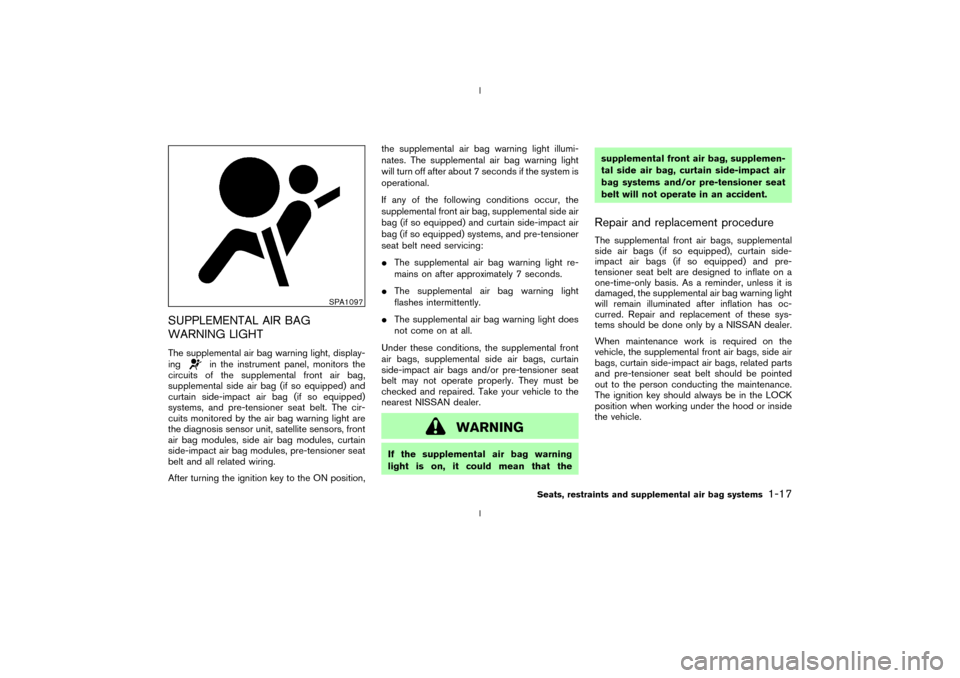
WARNING LIGHTThe supplemental air bag warning light, display-
ing
in the instrument panel, monitors the
circuits of the supplemental front air bag,
supplemental side air bag (if so equipped) and
curtain side-impact air bag (if so equipped)
systems, and pre-tensioner seat belt. The cir-
cuits monitored by the air bag warning light are
the diagnosis sensor unit, satellite sensors, front
air bag modules, side air bag modules, curtain
side-impact air bag modules, pre-tensioner seat
belt and all related wiring.
After turning the ignition key to the ON position,the supplemental air bag warning light illumi-
nates. The supplemental air bag warning light
will turn off after about 7 seconds if the system is
operational.
If any of the following conditions occur, the
supplemental front air bag, supplemental side air
bag (if so equipped) and curtain side-impact air
bag (if so equipped) systems, and pre-tensioner
seat belt need servicing:
IThe supplemental air bag warning light re-
mains on after approximately 7 seconds.
IThe supplemental air bag warning light
flashes intermittently.
IThe supplemental air bag warning light does
not come on at all.
Under these conditions, the supplemental front
air bags, supplemental side air bags, curtain
side-impact air bags and/or pre-tensioner seat
belt may not operate properly. They must be
checked and repaired. Take your vehicle to the
nearest NISSAN dealer.
WARNING
If the supplemental air bag warning
light is on, it could mean that thesupplemental front air bag, supplemen-
tal side air bag, curtain side-impact air
bag systems and/or pre-tensioner seat
belt will not operate in an accident.
Repair and replacement procedureThe supplemental front air bags, supplemental
side air bags (if so equipped), curtain side-
impact air bags (if so equipped) and pre-
tensioner seat belt are designed to inflate on a
one-time-only basis. As a reminder, unless it is
damaged, the supplemental air bag warning light
will remain illuminated after inflation has oc-
curred. Repair and replacement of these sys-
tems should be done only by a NISSAN dealer.
When maintenance work is required on the
vehicle, the supplemental front air bags, side air
bags, curtain side-impact air bags, related parts
and pre-tensioner seat belt should be pointed
out to the person conducting the maintenance.
The ignition key should always be in the LOCK
position when working under the hood or inside
the vehicle.
SPA1097
Seats, restraints and supplemental air bag systems
1-17
Z
02.9.13/Z33-D/V5.0
X
Page 119 of 227
WARNING
IDo not leave children, impaired
adults, or pets alone in your vehicle.
They could accidentally injure them-
selves or others through inadvertent
operation of the vehicle. Also, on hot,
sunny days, temperatures in a closed
vehicle could quickly become high
enough to cause severe or possibly
fatal injuries to people or animals.
IProperly secure all cargo to help pre-
vent it from sliding or shifting. Do not
place cargo higher than the seat-
backs. In a sudden stop or collision,
unsecured cargo could cause per-
sonal injury.EXHAUST GAS (Carbon monoxide)
WARNING
Do not breathe exhaust gases; they con-
tain colorless and odorless carbonmonoxide. Carbon monoxide is dan-
gerous. It can cause unconscious-
ness or death.
IIf you suspect that exhaust fumes are
entering the vehicle, drive with all
windows fully open, and have the
vehicle inspected immediately.
IDo not run the engine in closed
spaces such as a garage.
IDo not park the vehicle with the en-
gine running for any extended length
of time.
IKeep the rear hatch closed while
driving, otherwise exhaust gases
could be drawn into the passenger
compartment. If you must drive with
the rear hatch open, follow these
precautions:
1. Open all the windows.
2. Set the air recirculation mode OFF
and the fan control at the maxi-
mum position to circulate the air.
IIf electrical wiring or other cable con-nections must pass to a trailer
through the seal on the rear hatch or
the body, follow the manufacturer's
recommendation to prevent carbon
monoxide entry into the vehicle.
IIf a special body or other equipment
is added for recreational or other
usage, follow the manufacturer's rec-
ommendation to prevent carbon
monoxide entry into the vehicle.
(Some recreational vehicle appli-
ances such as stoves, refrigerator,
heaters, etc. may also generate car-
bon monoxide.)
IThe exhaust system and body should
be inspected by a qualified mechanic
whenever:
a. The vehicle is raised for service.
b. You suspect that exhaust fumes
are entering into the passenger
compartment.
c. You notice a change in the sound
of the exhaust system.PRECAUTIONS WHEN STARTING
AND DRIVING5-2
Starting and driving
Z
02.9.13/Z33-D/V5.0
X
Page 212 of 227
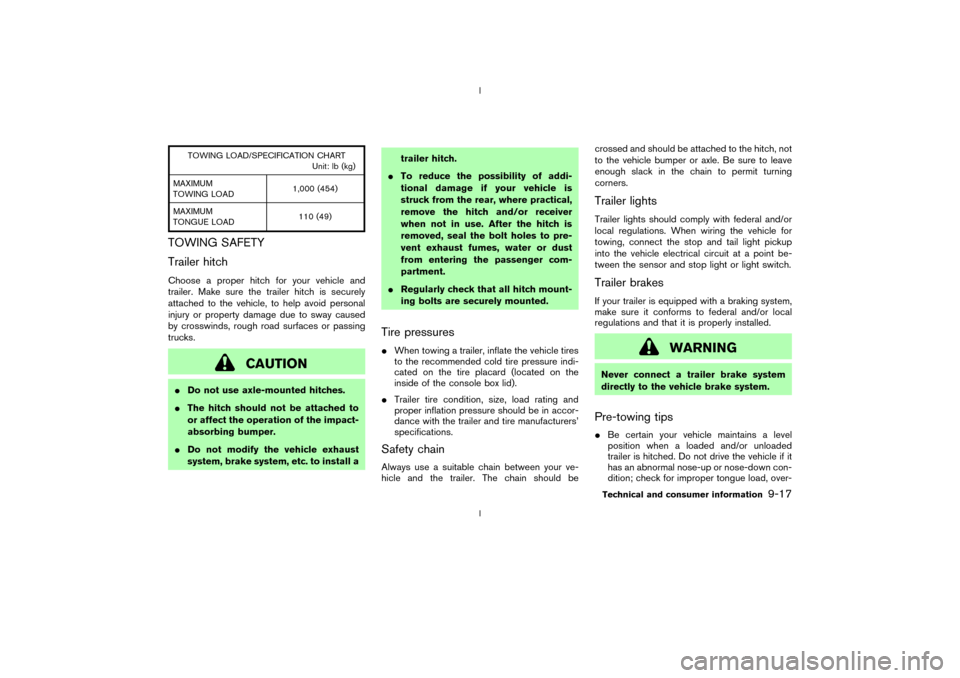
TOWING LOAD/SPECIFICATION CHART
Unit: lb (kg)
MAXIMUM
TOWING LOAD1,000 (454)
MAXIMUM
TONGUE LOAD110 (49)
TOWING SAFETY
Trailer hitchChoose a proper hitch for your vehicle and
trailer. Make sure the trailer hitch is securely
attached to the vehicle, to help avoid personal
injury or property damage due to sway caused
by crosswinds, rough road surfaces or passing
trucks.
CAUTION
IDo not use axle-mounted hitches.
IThe hitch should not be attached to
or affect the operation of the impact-
absorbing bumper.
IDo not modify the vehicle exhaust
system, brake system, etc. to install atrailer hitch.
ITo reduce the possibility of addi-
tional damage if your vehicle is
struck from the rear, where practical,
remove the hitch and/or receiver
when not in use. After the hitch is
removed, seal the bolt holes to pre-
vent exhaust fumes, water or dust
from entering the passenger com-
partment.
IRegularly check that all hitch mount-
ing bolts are securely mounted.
Tire pressuresIWhen towing a trailer, inflate the vehicle tires
to the recommended cold tire pressure indi-
cated on the tire placard (located on the
inside of the console box lid).
ITrailer tire condition, size, load rating and
proper inflation pressure should be in accor-
dance with the trailer and tire manufacturers'
specifications.Safety chainAlways use a suitable chain between your ve-
hicle and the trailer. The chain should becrossed and should be attached to the hitch, not
to the vehicle bumper or axle. Be sure to leave
enough slack in the chain to permit turning
corners.
Trailer lightsTrailer lights should comply with federal and/or
local regulations. When wiring the vehicle for
towing, connect the stop and tail light pickup
into the vehicle electrical circuit at a point be-
tween the sensor and stop light or light switch.Trailer brakesIf your trailer is equipped with a braking system,
make sure it conforms to federal and/or local
regulations and that it is properly installed.
WARNING
Never connect a trailer brake system
directly to the vehicle brake system.Pre-towing tipsIBe certain your vehicle maintains a level
position when a loaded and/or unloaded
trailer is hitched. Do not drive the vehicle if it
has an abnormal nose-up or nose-down con-
dition; check for improper tongue load, over-Technical and consumer information
9-17
Z
02.9.13/Z33-D/V5.0
X
Page 217 of 227

A genuine NISSAN Service Manual is the best
source of service and repair information for your
vehicle. Filled with wiring diagrams, illustrations
and step-by-step diagnostic and adjustment
procedures, this manual is the same one used by
the factory trained technicians working at autho-
rized NISSAN dealerships. Also available are
genuine NISSAN Owner's Manuals, and genu-
ine NISSAN Service and Owner's Manuals for
older NISSAN models.In the USA:
For current pricing and availability of genuine
NISSAN Service Manualsfor the 2000 model
year and later, contact:
Tweddle Litho Company
1-800-639-8841
www.nissan-techinfo.com
For current pricing and availability of genuine
NISSAN Service Manualsfor the 1999 model
year and prior, see a NISSAN dealer, or contact:
DDS Distribution Services, Ltd.
20770 Westwood Dr.
Strongsville OH 44136
1-800-247-5321For current pricing and availability of genuine
NISSAN Owner's Manualsfor the 2003
model year and prior, see a NISSAN dealer, or
contact:
DDS Distribution Services, Ltd.
20770 Westwood Dr.
Strongsville OH 44136
1-800-247-5321
In Canada:
To purchase a copy of a genuine NISSAN
Service Manual or Owner's Manual please con-
tact your nearest NISSAN dealer. For the phone
number and location of a NISSAN Dealer in your
area call the NISSAN Satisfaction Center at
1-800-387-0122 and a bilingual
NISSAN representative will assist you.
Also available are Genuine NISSAN Service and
Owner's Manuals for older NISSAN models.
IN THE EVENT OF A COLLISIONUnfortunately, accidents do occur. In this unlikely
event, there is some important information you
should know. Many insurance companies rou-
tinely authorize the use of non-genuine collision
parts in order to cut costs, among other reasons.
OWNER'S MANUAL/SERVICE
MANUAL ORDER INFORMATION9-22
Technical and consumer information
Z
02.9.13/Z33-D/V5.0
X