2003 NISSAN 350Z oil temperature
[x] Cancel search: oil temperaturePage 39 of 227
2 Instruments and controlsInstrument panel ..................................................................... 2-2
Meters and gauges ............................................................... 2-3
Speedometer and odometer ......................................... 2-4
Tachometer ........................................................................ 2-5
Engine coolant temperature gauge ............................. 2-5
Fuel gauge ......................................................................... 2-6
Engine oil pressure gauge ............................................. 2-6
Volt meter ......................................................................... 2-7
Trip computer .................................................................. 2-8
Warning/indicator lights and audible reminders ......... 2-11
Checking bulbs .............................................................. 2-11
Warning lights ................................................................ 2-11
Indicator lights ................................................................ 2-14
Audible reminders.......................................................... 2-16
Security systems.................................................................. 2-16
Vehicle security system................................................ 2-17
Nissan Vehicle Immobilizer System (NVIS) ............ 2-18
Windshield wiper and washer switch ............................ 2-19
Rear window wiper and washer switch ........................ 2-20
Rear window and outside mirror (if so equipped)
defroster switch ................................................................... 2-21
Headlight and turn signal switch..................................... 2-21
Xenon headlights (if so equipped) ............................ 2-21
Headlight switch ............................................................ 2-22Turn signal switch ......................................................... 2-23
Instrument brightness control ..................................... 2-23
Daytime running light system (Canada only) .......... 2-23
Hazard warning flasher switch ......................................... 2-24
Horn ........................................................................................ 2-24
Heated seats (if so equipped) ......................................... 2-25
Vehicle dynamic control (VDC) off switch
(if so equipped).................................................................... 2-26
Traction control system (TCS) off switch
(if so equipped).................................................................... 2-26
Clock ...................................................................................... 2-27
Adjusting the time ......................................................... 2-27
Power outlet.......................................................................... 2-27
Cigarette lighter and ashtray (accessory) .................... 2-28
Storage ................................................................................. 2-29
Instrument pocket (Except for Navigation system
equipped models) ........................................................ 2-29
Sunglasses holder ......................................................... 2-29
Tray.................................................................................... 2-30
Cup holders .................................................................... 2-30
Console box .................................................................... 2-31
Rear floor box ................................................................. 2-32
Rear parcel box .............................................................. 2-32
Windows................................................................................ 2-33
Z
02.9.13/Z33-D/V5.0
X
Page 165 of 227
Automatic transmission P (Park) position
mechanism:On a fairly steep hill check that the
vehicle is held securely with the selector lever in
the P (Park) position without applying any
brakes.Under the hood and the vehicleThe maintenance items listed here should be
checked periodically (for example, each time you
check the engine oil or refuel).
Windshield washer fluid*:Check that there is
adequate fluid in the tank.
Engine coolant level*:Check the coolant level
when the engine is cold.
Radiator and hoses:Check the front of the
radiator and clean off any dirt, insects, leaves,
etc., that may have accumulated. Make sure the
hoses have no cracks, deformation, deterioration
or loose connections.
Brake and clutch fluid levels*:Make sure that
the brake and clutch fluid levels are between the
MAX and MIN lines on the reservoir.
Battery*:Check the fluid level in each cell. It
should be between the MAX and MIN lines.
Vehicles operated in high temperatures or under
severe conditions require frequent checks of the
battery fluid level.
Engine drive belts*:Make sure that no belt isfrayed, worn, cracked or oily.
Engine oil level*:Check the level on the
dipstick after parking the vehicle on a level spot,
turning off the engine and waiting 10 minutes.
Power steering fluid level* and lines:Check
the level in the reservoir tank with the engine off.
Check the lines for proper attachment, leaks,
cracks, etc.
Exhaust system:Make sure there are no loose
supports, cracks or holes. If the sound of the
exhaust seems unusual or there is a smell of
exhaust fumes, immediately locate the trouble
and correct it. (See ªPrecautions when starting
and drivingº in the ª5. Starting and drivingº
section for exhaust gas (carbon monoxide).)
Underbody:The underbody is frequently ex-
posed to corrosive substances such as those
used on icy roads or to control dust. It is very
important to remove these substances, other-
wise rust will form on the floor pan, frame, fuel
lines and around the exhaust system. At the end
of winter, the underbody should be thoroughly
flushed with plain water, being careful to clean
those areas where mud and dirt may accumu-
late. For additional information, see ªCleaning
exteriorº in the ª7. Appearance and careº sec-
tion.
Fluid leaks:Check under the vehicle for fuel,oil, water or other fluid leaks after the vehicle has
been parked for a while. Water dripping from the
air conditioner after use is normal. If you should
notice any leaks or if gasoline fumes are evident,
check for the cause and have it corrected imme-
diately.8-4
Maintenance and do-it-yourself
Z
02.9.13/Z33-D/V5.0
X
Page 171 of 227
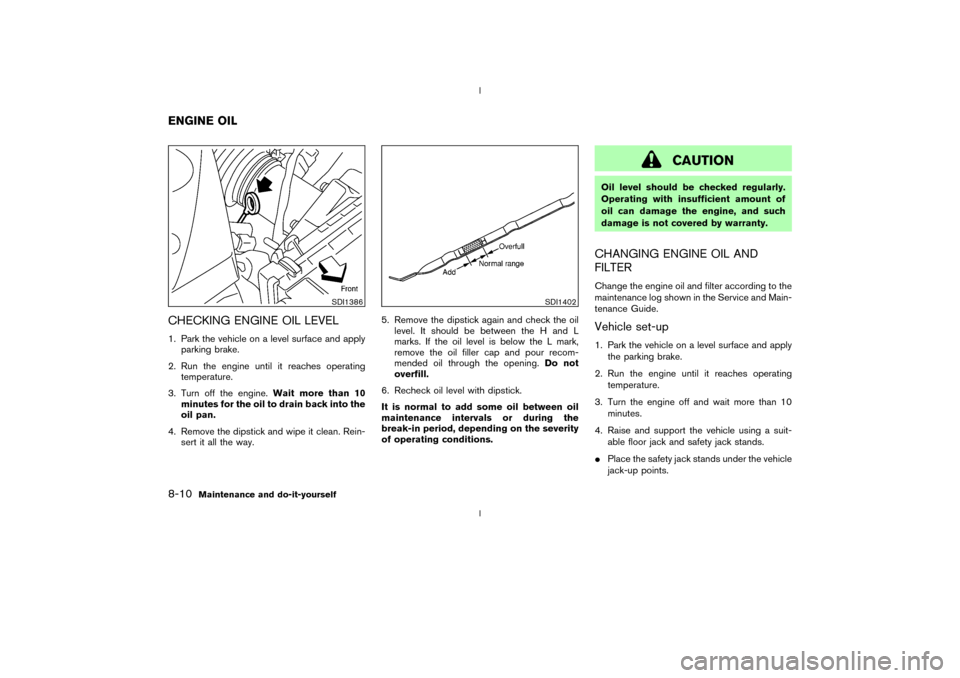
CHECKING ENGINE OIL LEVEL1. Park the vehicle on a level surface and apply
parking brake.
2. Run the engine until it reaches operating
temperature.
3. Turn off the engine.Wait more than 10
minutes for the oil to drain back into the
oil pan.
4. Remove the dipstick and wipe it clean. Rein-
sert it all the way.5. Remove the dipstick again and check the oil
level. It should be between the H and L
marks. If the oil level is below the L mark,
remove the oil filler cap and pour recom-
mended oil through the opening.Do not
overfill.
6. Recheck oil level with dipstick.
It is normal to add some oil between oil
maintenance intervals or during the
break-in period, depending on the severity
of operating conditions.
CAUTION
Oil level should be checked regularly.
Operating with insufficient amount of
oil can damage the engine, and such
damage is not covered by warranty.CHANGING ENGINE OIL AND
FILTERChange the engine oil and filter according to the
maintenance log shown in the Service and Main-
tenance Guide.Vehicle set-up1. Park the vehicle on a level surface and apply
the parking brake.
2. Run the engine until it reaches operating
temperature.
3. Turn the engine off and wait more than 10
minutes.
4. Raise and support the vehicle using a suit-
able floor jack and safety jack stands.
IPlace the safety jack stands under the vehicle
jack-up points.
SDI1386
SDI1402
ENGINE OIL8-10
Maintenance and do-it-yourself
Z
02.9.13/Z33-D/V5.0
X
Page 173 of 227
CAUTION
The dipstick must be inserted in place to
prevent oil spillage from the dipstick
hole while filling the engine with oil.
See ªCapacities and recommended fuel/
lubricantsº in the ª9. Technical and consumer
informationº section for drain and refill capac-
ity. The drain and refill capacity depends on
the oil temperature and drain time. Use these
specifications for reference only. Always use
the dipstick to determine the proper amount
of oil in the engine.
10.Start the engine and check for leakage
around the drain plug and the oil filter. Cor-
rect as required.
11.Turn the engine off and wait more than 10
minutes. Check the oil level with the dipstick.
Add engine oil if necessary.After the operation1. Install the engine undercover into position as
the following steps.
a. Pull the center of the small plastic clip out.
b. Hold the engine undercover into position.
c. Insert the clip through the undercover into thehole in the frame, then push the center of the
clip in to lock the clip in place.
d. Install the other bolts that hold the under-
cover in place. Be careful not to strip the
bolts or over-tighten them.
2. Lower the vehicle carefully to the ground.
3. Dispose of waste oil and filter properly.
WARNING
IProlonged and repeated contact with
used engine oil may cause skin can-
cer.
ITry to avoid direct skin contact with
used oil. If skin contact is made,
wash thoroughly with soap or hand
cleaner as soon as possible.
IKeep used engine oil out of reach of
children.When checking or replacement is required, we
recommend your NISSAN dealer for servicing.
CAUTION
IUse only Genuine Nissan ATF Matic
Fluid J. Do not mix with other fluids.
IUsing automatic transmission fluid
other than Genuine Nissan ATF Matic
Fluid J will cause deterioration in
driveability and automatic transmis-
sion durability, and may damage the
automatic transmission, which is not
covered by the NISSAN new vehicle
limited warranty.
The specified automatic transmission fluid is
also described on caution labels located in the
engine compartment.AUTOMATIC TRANSMISSION
FLUID
8-12
Maintenance and do-it-yourself
Z
02.9.13/Z33-D/V5.0
X
Page 197 of 227
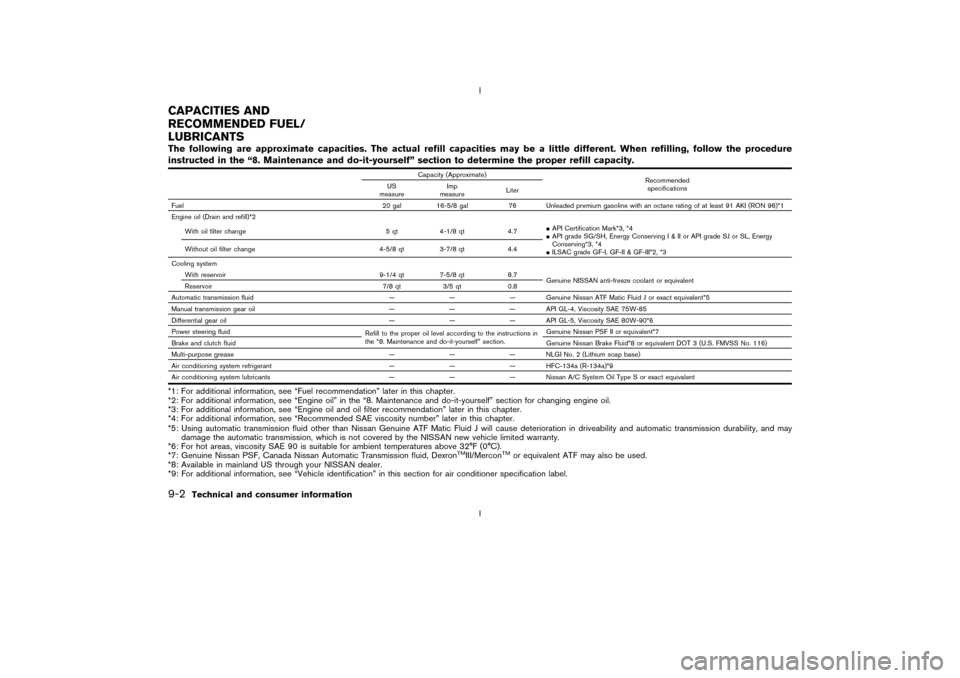
The following are approximate capacities. The actual refill capacities may be a little different. When refilling, follow the procedure
instructed in the ª8. Maintenance and do-it-yourselfº section to determine the proper refill capacity.
Capacity (Approximate)
Recommended
specifications US
measureImp
measureLiter
Fuel 20 gal 16-5/8 gal 76 Unleaded premium gasoline with an octane rating of at least 91 AKI (RON 96)*1
Engine oil (Drain and refill)*2
With oil filter change 5 qt 4-1/8 qt 4.7IAPI Certification Mark*3, *4
IAPI grade SG/SH, Energy ConservingI&IIorAPIgrade SJ or SL, Energy
Conserving*3, *4
IILSAC grade GF-I, GF-II & GF-III*2, *3 Without oil filter change 4-5/8 qt 3-7/8 qt 4.4
Cooling system
With reservoir 9-1/4 qt 7-5/8 qt 8.7
Genuine NISSAN anti-freeze coolant or equivalent
Reservoir 7/8 qt 3/5 qt 0.8
Automatic transmission fluid Ð Ð Ð Genuine Nissan ATF Matic Fluid J or exact equivalent*5
Manual transmission gear oil Ð Ð Ð API GL-4, Viscosity SAE 75W-85
Differential gear oil Ð Ð Ð API GL-5, Viscosity SAE 80W-90*6
Power steering fluid
Refill to the proper oil level according to the instructions in
the ª8. Maintenance and do-it-yourselfº section.Genuine Nissan PSF II or equivalent*7
Brake and clutch fluidGenuine Nissan Brake Fluid*8 or equivalent DOT 3 (U.S. FMVSS No. 116)
Multi-purpose grease Ð Ð Ð NLGI No. 2 (Lithium soap base)
Air conditioning system refrigerant Ð Ð Ð HFC-134a (R-134a)*9
Air conditioning system lubricants Ð Ð Ð Nissan A/C System Oil Type S or exact equivalent
*1: For additional information, see ªFuel recommendationº later in this chapter.
*2: For additional information, see ªEngine oilº in the ª8. Maintenance and do-it-yourselfº section for changing engine oil.
*3: For additional information, see ªEngine oil and oil filter recommendationº later in this chapter.
*4: For additional information, see ªRecommended SAE viscosity numberº later in this chapter.
*5: Using automatic transmission fluid other than Nissan Genuine ATF Matic Fluid J will cause deterioration in driveability and automatic transmission durability, and may
damage the automatic transmission, which is not covered by the NISSAN new vehicle limited warranty.
*6: For hot areas, viscosity SAE 90 is suitable for ambient temperatures above 32ÉF (0ÉC).
*7: Genuine Nissan PSF, Canada Nissan Automatic Transmission fluid, Dexron
TMIII/Mercon
TMor equivalent ATF may also be used.
*8: Available in mainland US through your NISSAN dealer.
*9: For additional information, see ªVehicle identificationº in this section for air conditioner specification label.
CAPACITIES AND
RECOMMENDED FUEL/
LUBRICANTS9-2
Technical and consumer information
Z
02.9.13/Z33-D/V5.0
X
Page 200 of 227
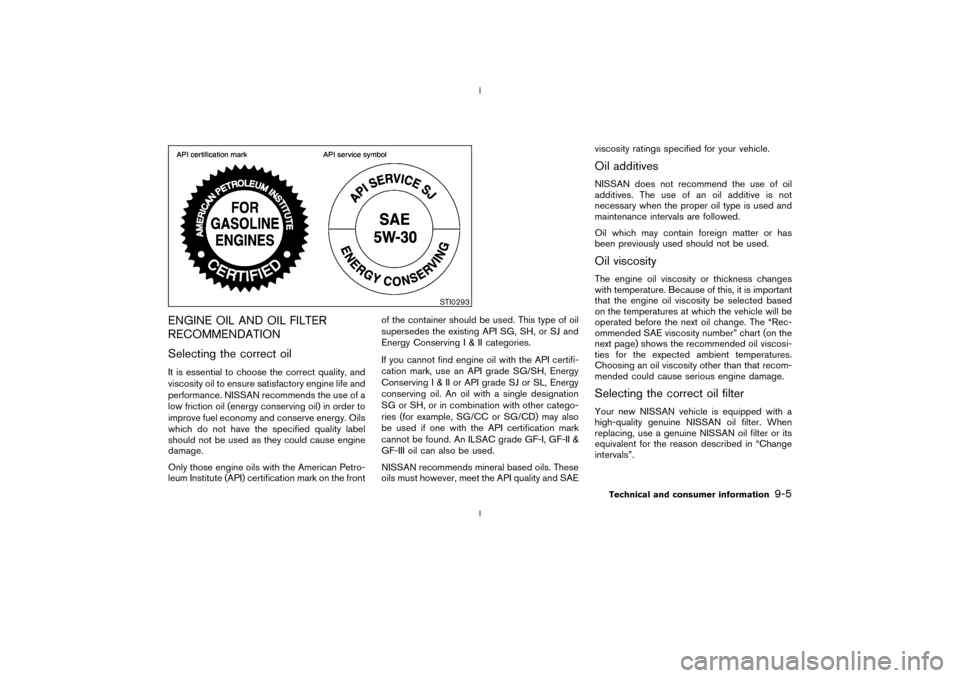
ENGINE OIL AND OIL FILTER
RECOMMENDATION
Selecting the correct oilIt is essential to choose the correct quality, and
viscosity oil to ensure satisfactory engine life and
performance. NISSAN recommends the use of a
low friction oil (energy conserving oil) in order to
improve fuel economy and conserve energy. Oils
which do not have the specified quality label
should not be used as they could cause engine
damage.
Only those engine oils with the American Petro-
leum Institute (API) certification mark on the frontof the container should be used. This type of oil
supersedes the existing API SG, SH, or SJ and
Energy ConservingI&IIcategories.
If you cannot find engine oil with the API certifi-
cation mark, use an API grade SG/SH, Energy
ConservingI&IIorAPIgrade SJ or SL, Energy
conserving oil. An oil with a single designation
SG or SH, or in combination with other catego-
ries (for example, SG/CC or SG/CD) may also
be used if one with the API certification mark
cannot be found. An ILSAC grade GF-I, GF-II &
GF-III oil can also be used.
NISSAN recommends mineral based oils. These
oils must however, meet the API quality and SAEviscosity ratings specified for your vehicle.
Oil additivesNISSAN does not recommend the use of oil
additives. The use of an oil additive is not
necessary when the proper oil type is used and
maintenance intervals are followed.
Oil which may contain foreign matter or has
been previously used should not be used.Oil viscosityThe engine oil viscosity or thickness changes
with temperature. Because of this, it is important
that the engine oil viscosity be selected based
on the temperatures at which the vehicle will be
operated before the next oil change. The ªRec-
ommended SAE viscosity numberº chart (on the
next page) shows the recommended oil viscosi-
ties for the expected ambient temperatures.
Choosing an oil viscosity other than that recom-
mended could cause serious engine damage.Selecting the correct oil filterYour new NISSAN vehicle is equipped with a
high-quality genuine NISSAN oil filter. When
replacing, use a genuine NISSAN oil filter or its
equivalent for the reason described in ªChange
intervalsº.
STI0293
Technical and consumer information
9-5
Z
02.9.13/Z33-D/V5.0
X
Page 201 of 227
Change intervalsThe oil and oil filter change intervals for your
engine are based on the use of the specified
quality oils and filters. Oil and filter other than the
specified quality, or oil and filter change intervals
longer than recommended could reduce engine
life. Damage to engines caused by improper
maintenance or use of incorrect oil and filter
quality and/or viscosity is not covered by the
new NISSAN vehicle warranties.
Your engine was filled with a high quality engine
oil when it was built. You do not have to change
the oil before the first recommended change
interval. Oil and filter change intervals depend
upon how you use your vehicle. Operation under
the following conditions may require more fre-
quent oil and filter changes.
Irepeated short distance driving at cold out-
side temperatures,
Idriving in dusty conditions,
Iextensive idling,
Itowing a trailer,
Istop and go ªrush hourº traffic.
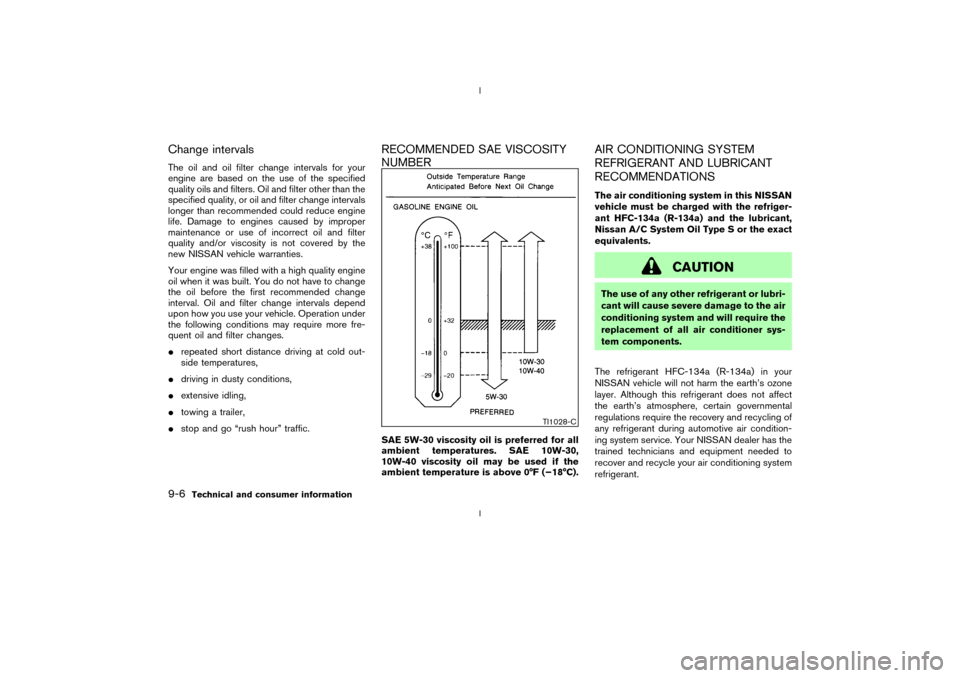
RECOMMENDED SAE VISCOSITY
NUMBERSAE 5W-30 viscosity oil is preferred for all
ambient temperatures. SAE 10W-30,
10W-40 viscosity oil may be used if the
ambient temperature is above 0ÉF (þ18ÉC).
AIR CONDITIONING SYSTEM
REFRIGERANT AND LUBRICANT
RECOMMENDATIONSThe air conditioning system in this NISSAN
vehicle must be charged with the refriger-
ant HFC-134a (R-134a) and the lubricant,
Nissan A/C System Oil Type S or the exact
equivalents.
CAUTION
The use of any other refrigerant or lubri-
cant will cause severe damage to the air
conditioning system and will require the
replacement of all air conditioner sys-
tem components.
The refrigerant HFC-134a (R-134a) in your
NISSAN vehicle will not harm the earth's ozone
layer. Although this refrigerant does not affect
the earth's atmosphere, certain governmental
regulations require the recovery and recycling of
any refrigerant during automotive air condition-
ing system service. Your NISSAN dealer has the
trained technicians and equipment needed to
recover and recycle your air conditioning system
refrigerant.
TI1028-C
9-6
Technical and consumer information
Z
02.9.13/Z33-D/V5.0
X
Page 214 of 227
sion oil more frequently. See the Service
and Maintenance Guide.DOT (Department Of Transportation) Quality
Grades: All passenger car tires must conform to
federal safety requirements in addition to these
grades.
Quality grades can be found where applicable
on the tire sidewall between tread shoulder and
maximum section width. For example:
Treadwear 200 Traction AA Temperature A
TreadwearTreadwear grade is a comparative rating based
on tire wear rate when tested under controlled
conditions on specified government test
courses. For example, a tire graded 150 would
wear one and a half (1-1/2) times as well on the
government course as a tire graded 100. How-
ever, relative tire performance depends on actual
driving conditions, and may vary significantly
from the norm due to variations in driving habits,
service practices and differences in road char-
acteristics and climate.Traction AA, A, B and CThe traction grades, from highest to lowest, are
AA, A, B, and C. Those grades represent the
tire's ability to stop on wet pavement as mea-
sured under controlled conditions on specified
government test surfaces of asphalt and con-crete. A tire marked C may have poor traction
performance.
WARNING
The traction grade assigned to your ve-
hicle tires is based on straight-ahead
braking traction tests, and does not in-
clude acceleration, cornering, hydro-
planing, or peak traction characteristics.Temperature A, B and CTemperature grades are A (the highest), B, and
C. They represent a tire's resistance to heat
build-up, and its ability to dissipate heat when
tested under controlled conditions on a speci-
fied indoor laboratory test wheel. Sustained high
temperature can cause tire material to degener-
ate, reducing tire life. Excessive temperatures
can lead to sudden tire failure. Grade C corre-
sponds to a performance level which all passen-
ger car tires must meet under the Federal Motor
Vehicle Safety Standard No. 109. Grades A and
B represent higher levels of performance on
laboratory test wheels than the minimum re-
quired by law.
UNIFORM TIRE QUALITY
GRADING
Technical and consumer information
9-19
Z
02.9.13/Z33-D/V5.0
X