Page 35 of 376
35 Getting started
Adjusting
Steering column, height�
Move the stalk up or down in the direc-
tion of arrow2. Make sure that your
legs can move freely and that all the
displays (including malfunction and in-
dicator lamps) on the instrument clus-
ter are clearly visible.
Mirrors
Adjust the inside and exterior rear view
mirrors before driving so that you have a
good view of the road and traffic condi-
tions.
Inside rear view mirror�
Manually adjust the inside rear view
mirror.Exterior rear view mirror
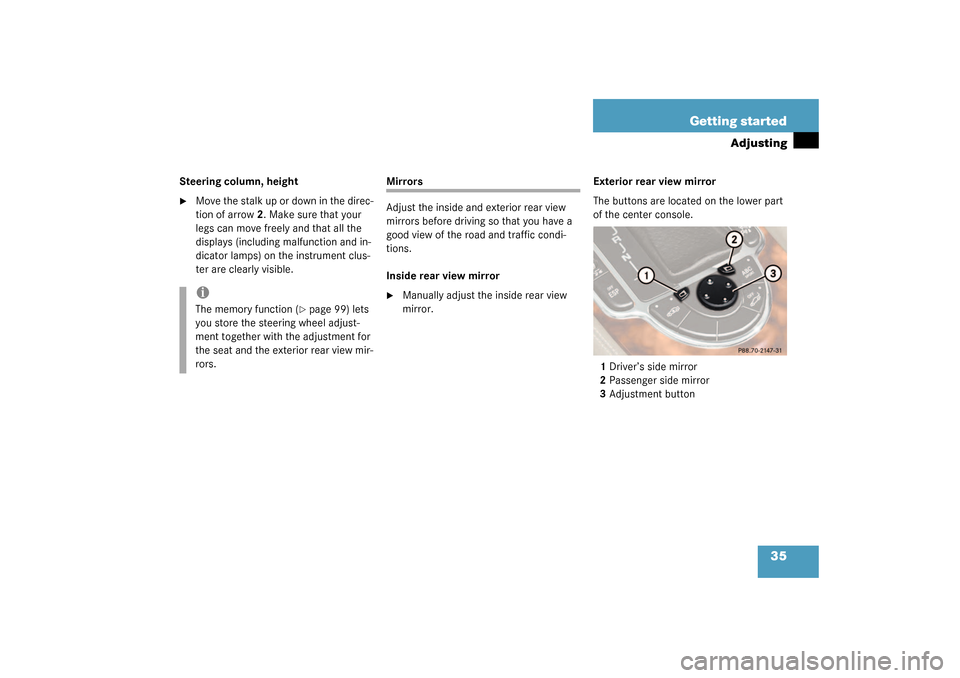
The buttons are located on the lower part
of the center console.
1Driver’s side mirror
2Passenger side mirror
3Adjustment button
iThe memory function (
�page 99) lets
you store the steering wheel adjust-
ment together with the adjustment for
the seat and the exterior rear view mir-
rors.
Page 36 of 376

36 Getting startedAdjusting
�
Make sure that the ignition is switched
on.
All the lights in the instrument cluster
light up.
�
Press button1 for the left mirror or
button2 for the right mirror.
�
Push adjustment button3 up, down,
left or right according to the setting de-
sired.More information can be found in the
“Controls in detail” section (
�page 145).
Warning!
G
Exercise care when using the passenger
side exterior rear view mirror. The mirror
surface is convex (outwardly curved surface
for a wider field of view). Objects in mirror
are closer than they appear. Check your in-
side rear view mirror or glance over your
shoulder before changing lanes. Warning!
G
In case of an accident, liquid electrolyte may
escape the mirror housing if the mirror glass
breaks.
Electrolyte has an irritating effect. Do not al-
low the liquid to come into contact with
eyes, skin, clothing, or respiratory system.
In case it does, immediately flush the affect-
ed area with water, and seek medical help if
necessary.
!Electrolyte drops coming into contact
with the vehicle paint finish can only be
completely removed while in their liq-
uid state and by applying plenty of wa-
ter.iThe memory function (
�page 99) lets
you store the steering wheel adjust-
ment together with the adjustment for
the seat and the exterior rear view mir-
rors.
!If an exterior rear view mirror housing
is forcibly pushed forward or rearward,
reposition it by applying firm pressure
until it snaps into place. The mirror
housing is now properly positioned and
you can adjust the mirror normally.
Page 38 of 376
38 Getting startedDriving
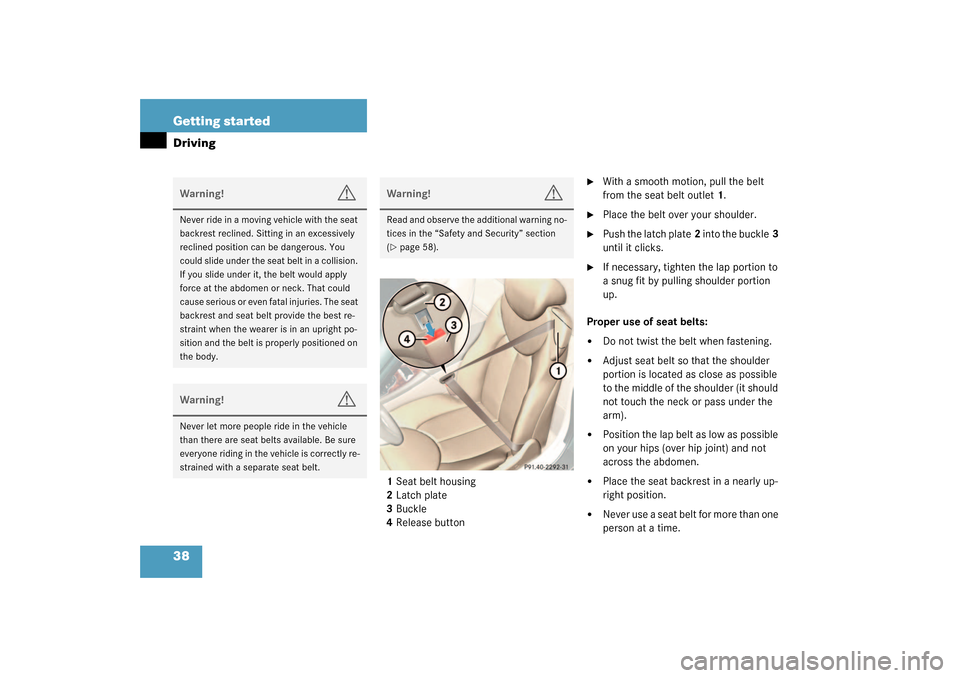
1Seat belt housing
2Latch plate
3Buckle
4Release button
�
With a smooth motion, pull the belt
from the seat belt outlet1.
�
Place the belt over your shoulder.
�
Push the latch plate2 into the buckle3
until it clicks.
�
If necessary, tighten the lap portion to
a snug fit by pulling shoulder portion
up.
Proper use of seat belts:
�
Do not twist the belt when fastening.
�
Adjust seat belt so that the shoulder
portion is located as close as possible
to the middle of the shoulder (it should
not touch the neck or pass under the
arm).
�
Position the lap belt as low as possible
on your hips (over hip joint) and not
across the abdomen.
�
Place the seat backrest in a nearly up-
right position.
�
Never use a seat belt for more than one
person at a time.
Warning!
G
Never ride in a moving vehicle with the seat
backrest reclined. Sitting in an excessively
reclined position can be dangerous. You
could slide under the seat belt in a collision.
If you slide under it, the belt would apply
force at the abdomen or neck. That could
cause serious or even fatal injuries. The seat
backrest and seat belt provide the best re-
straint when the wearer is in an upright po-
sition and the belt is properly positioned on
the body.Warning!
G
Never let more people ride in the vehicle
than there are seat belts available. Be sure
everyone riding in the vehicle is correctly re-
strained with a separate seat belt.
Warning!
G
Read and observe the additional warning no-
tices in the “Safety and Security” section
(�page 58).
Page 40 of 376
40 Getting startedDrivingStarting with the SmartKey�
Turn the key in the starter switch to
position3 and hold until the engine
starts (
�page 29).
�
Depress the brake pedal.
The selector lever lock is released.
For information on turning off the engine
with the key, see “Turning off engine with
the key” (
�page 48).Starting with KEYLESS-GO*
You can start your vehicle without a key
using the KEYLESS-GO start/stop button
on the gear selector lever.
1KEYLESS-GO start/stop button
�
Depress the brake pedal during the
starting procedure. Do not depress ac-
celerator.
The selector lever lock is released.
�
Press the KEYLESS-GO start/stop
button1 once.
The engine starts automatically.
For information on turning off the engine
with KEYLESS-GO, see “Turning off engine
with KEYLESS-GO*” (
�page 49).
iYou can also use the “touch-start”
function. Turn the key to position3 and
release it again immediately. The en-
gine then starts automatically.
Page 47 of 376
47 Getting started
Parking and locking
Parking and locking
You have now completed your first drive.
You have properly stopped and parked
your vehicle. End your drive as follows:
Parking brake
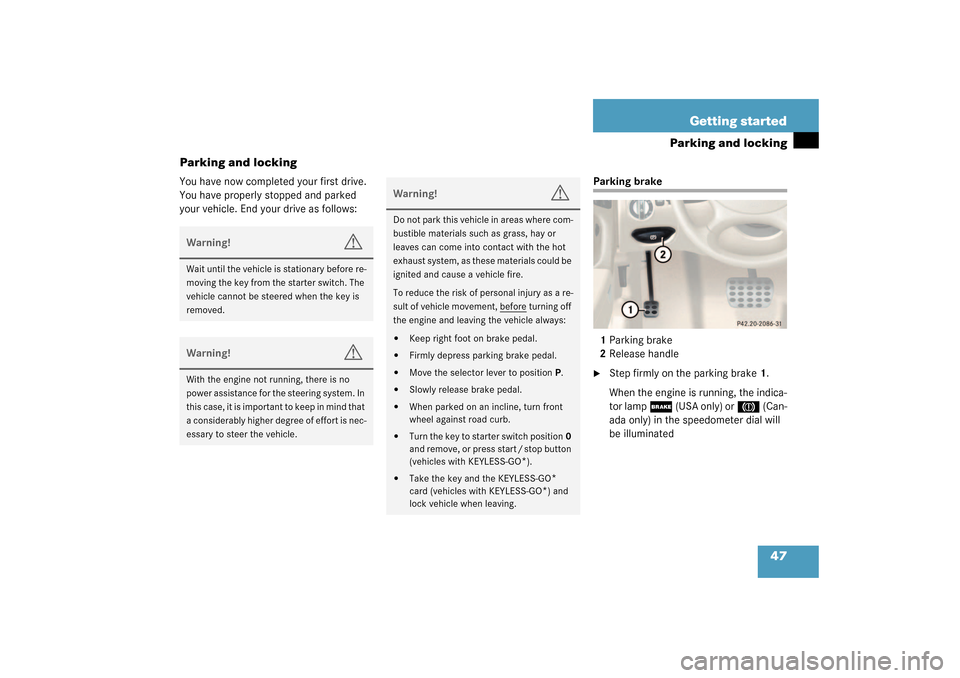
1Parking brake
2Release handle�
Step firmly on the parking brake1.
When the engine is running, the indica-
tor lamp
;
(USA only) or
3
(Can-
ada only) in the speedometer dial will
be illuminated
Warning!
G
Wait until the vehicle is stationary before re-
moving the key from the starter switch. The
vehicle cannot be steered when the key is
removed.Warning!
G
With the engine not running, there is no
power assistance for the steering system. In
this case, it is important to keep in mind that
a considerably higher degree of effort is nec-
essary to steer the vehicle.
Warning!
G
Do not park this vehicle in areas where com-
bustible materials such as grass, hay or
leaves can come into contact with the hot
exhaust system, as these materials could be
ignited and cause a vehicle fire.
To reduce the risk of personal injury as a re-
sult of vehicle movement, before
turning off
the engine and leaving the vehicle always:
�
Keep right foot on brake pedal.
�
Firmly depress parking brake pedal.
�
Move the selector lever to positionP.
�
Slowly release brake pedal.
�
When parked on an incline, turn front
wheel against road curb.
�
Turn the key to starter switch position0
and remove, or press start / stop button
(vehicles with KEYLESS-GO
*).
�
Take the key and the KEYLESS-GO
*
card (vehicles with KEYLESS-GO
*) and
lock vehicle when leaving.
Page 48 of 376
48 Getting startedParking and locking
Switching off headlamps�
Turn the switch to
M
(�page 43).
More information can be found in the
“Controls in detail” section (
�page 102).
Turning off engine with the key�
Place the gear selector lever inP.
�
Turn the key in the starter switch
(�page 29) to position0 and remove
it.
The immobilizer is activated.
�
Press the seat belt release button
(�page 37).
Warning!
G
When leaving the vehicle, always remove the
key from the starter switch, take the KEY-
LESS-GO
* card (if so equipped) with you
and lock the vehicle. Do not leave children
unattended in the vehicle, or with access to
an unlocked vehicle. Children could release
the parking brake and/or move the gear se-
lector lever from positionP, either of which
could result in an accident and/or serious
injury.
Warning!
G
Getting out of your vehicle with the selector
lever not fully engaged in positionP is dan-
gerous. Also, when parked on an incline,
positionP alone may not prevent your vehi-
cle from moving, possibly hitting people or
objects.
Always set the parking brake in addition to
shifting to positionP (
�page 140).
When parked on an incline, also turn front
wheel against road curb.
iAlways set the parking brake in addi-
tion to shifting to positionP.
On steep slopes, turn the front wheels
towards the road curb.
Page 49 of 376

49 Getting started
Parking and locking
�
After exiting the vehicle, press the lock
button
‹
on the remote control
(
�page 28).
The locking knobs on the doors move
down.
More information can be found in the
“Controls in detail” section (
�page 80).
Turning off engine with KEYLESS-GO* �
Place the gear selector lever inP.
�
Press the KEYLESS-GO start/stop but-
ton until the engine shuts off.
With the driver's door closed, the start-
er switch is now in the position1. With
the driver's door opened, the starter
switch is set to position0, same as key
removed from starter switch
(�page 29).
�
Press the seat belt release button
(�page 37).
!If you hear a warning signal you have ei-
ther�
forgotten to turn off the lights, or
�
not put the gear selector lever inP
before opening the driver’s door.
Turn off the lights or place the gear se-
lector lever inP.
Warning!
G
To prevent possible personal injury, always
keep hands and fingers away from the door
openings when closing the doors. Be espe-
cially careful when small children are
around.
Before closing doors, make sure that there
is no possibility of someone getting caught
in a door during closing.
!If you hear a warning signal you have ei-
ther�
forgotten to turn off the lights, or
�
not put the gear selector lever inP
before opening the driver’s door.
Turn off the lights or place the gear se-
lector lever inP.
Warning!
G
To prevent possible personal injury, always
keep hands and fingers away from the door
openings when closing the doors. Be espe-
cially careful when small children are
around.
Before closing doors, make sure that there
is no possibility of someone getting caught
in a door during closing.
Page 50 of 376
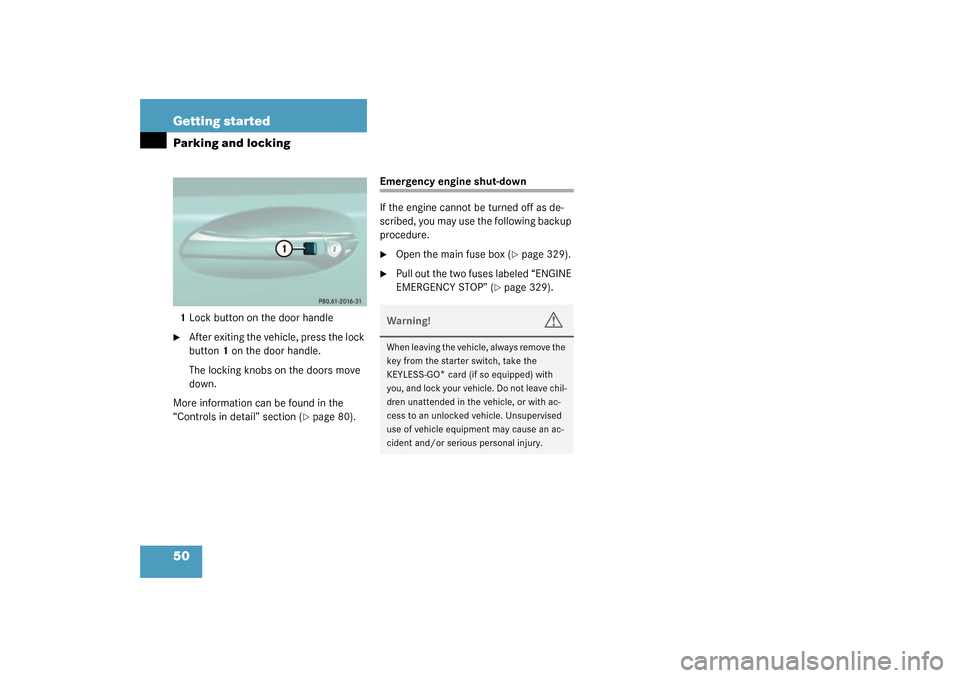
50 Getting startedParking and locking1Lock button on the door handle�
After exiting the vehicle, press the lock
button1 on the door handle.
The locking knobs on the doors move
down.
More information can be found in the
“Controls in detail” section (
�page 80).
Emergency engine shut-down
If the engine cannot be turned off as de-
scribed, you may use the following backup
procedure.�
Open the main fuse box (
�page 329).
�
Pull out the two fuses labeled “ENGINE
EMERGENCY STOP” (
�page 329).
Warning!
G
When leaving the vehicle, always remove the
key from the starter switch, take the
KEYLESS-GO
* card (if so equipped) with
you, and lock your vehicle. Do not leave chil-
dren unattended in the vehicle, or with ac-
cess to an unlocked vehicle. Unsupervised
use of vehicle equipment may cause an ac-
cident and/or serious personal injury.