2003 MERCEDES-BENZ E320 WAGON lock
[x] Cancel search: lockPage 280 of 354
277 Spare wheel
Te ch n i c a l
data Instruments
and controlsOperation DrivingInstrument
cluster displayPractical hintsCar care Index Spare wheel, vehicle tools
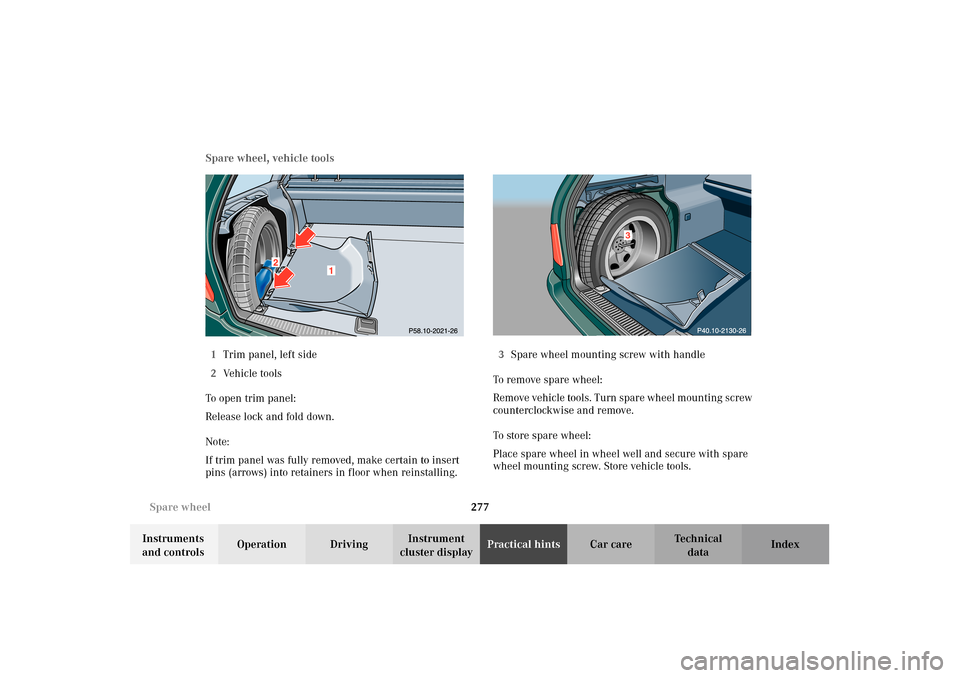
1Trim panel, left side
2Vehicle tools
To o pen tr im p an el :
Release lock and fold down.
Note:
If trim panel was fully removed, make certain to insert
pins (arrows) into retainers in floor when reinstalling.3Spare wheel mounting screw with handle
To remove spare wheel:
Remove vehicle tools. Turn spare wheel mounting screw
counterclockwise and remove.
To store spare wheel:
Place spare wheel in wheel well and secure with spare
wheel mounting screw. Store vehicle tools.
3
Page 281 of 354
278 Vehicle jack
Te ch n i c a l
data Instruments
and controlsOperation DrivingInstrument
cluster displayPractical hintsCar care Index
Ve h i c l e j a c k
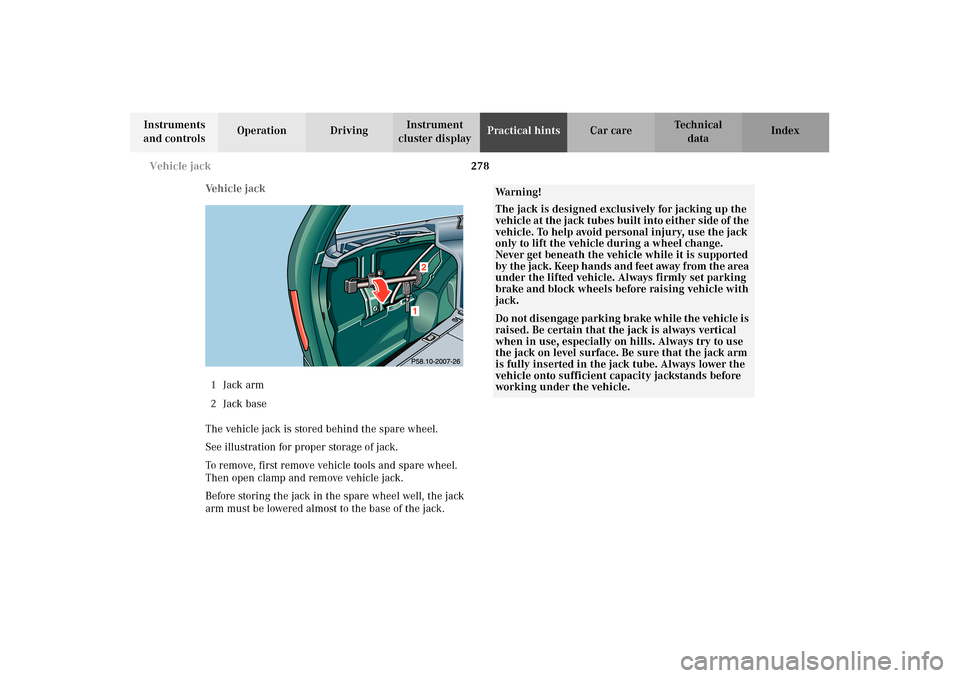
1Jack arm
2Jack base
The vehicle jack is stored behind the spare wheel.
See illustration for proper storage of jack.
To remove, first remove vehicle tools and spare wheel.
Then open clamp and remove vehicle jack.
Before storing the jack in the spare wheel well, the jack
arm must be lowered almost to the base of the jack.
Wa r n i n g !
The jack is designed exclusively for jacking up the
vehicle at the jack tubes built into either side of the
vehicle. To help avoid personal injury, use the jack
only to lift the vehicle during a wheel change.
Never get beneath the vehicle while it is supported
by the jack. Keep hands and feet away from the area
under the lifted vehicle. Always firmly set parking
brake and block wheels before raising vehicle with
jack.Do not disengage parking brake while the vehicle is
raised. Be certain that the jack is always vertical
when in use, especially on hills. Always try to use
the jack on level surface. Be sure that the jack arm
is fully inserted in the jack tube. Always lower the
vehicle onto sufficient capacity jackstands before
working under the vehicle.
Page 285 of 354
282 Tires, Wheels
Te ch n i c a l
data Instruments
and controlsOperation DrivingInstrument
cluster displayPractical hintsCar care Index
Changing wheelsMove vehicle to a level area which is a safe distance
from the roadway.
1. Set parking brake and turn on hazard warning
flasher.
2. Move selector lever to position “P” and turn off
engine.
3. Prevent vehicle from rolling away by blocking
wheels with wheel chocks (not supplied with
vehicle) or sizable wood block or stone. When
changing a wheel on a hill, place chocks on the
downhill side blocking both wheels of the other
axle. On a level road, place one chock in front of and
one behind the wheel that is diagonally opposite to
the wheel being changed.
Wa r n i n g !
The jack is designed exclusively for jacking up the
vehicle at the jack tubes built into either side of the
vehicle. To help avoid personal injury, use the jack
only to lift the vehicle during a wheel change.
Never get beneath the vehicle while it is supported
by the jack. Keep hands and feet away from the area
under the lifted vehicle. Always firmly set parking
brake and block wheels before raising vehicle with
jack.Do not disengage parking brake while the vehicle is
raised. Be certain that the jack is always vertical
when in use, especially on hills. Always try to use
the jack on level surface. Be sure that the jack arm
is fully inserted in the jack tube. Always lower the
vehicle onto sufficient capacity jackstands before
working under the vehicle.
Page 292 of 354
289 Battery
Te ch n i c a l
data Instruments
and controlsOperation DrivingInstrument
cluster displayPractical hintsCar care Index Battery
Important!
Battery replacement information:
The battery is located under the rear seat cushion. To
minimize the chance for acid leakage which could cause
severe burns during a crash or rollover, a special acid
leakage resistant battery was factory installed. A
replacement battery for the vehicle must not leak acid when upside down for at least 15 minutes. Your
authorized Mercedes-Benz Center can provide such a
special battery.
The service life of the battery is dependent on its
condition of charge. The battery should always be kept
sufficiently charged, in order to last an optimum length
of time.
Therefore, we strongly recommend that you have the
battery charge checked frequently, and corrected if
necessary, especially if you use the vehicle less than
approximately 200 miles (300 km) per month,
mostly for short distance trips, or if it is not used for
long periods of time.
Only charge a battery with a battery charger after the
battery has been disconnected from the vehicle’s
electrical circuit.
Always disconnect the battery negative lead first and
connect last.
When removing and connecting the battery, always
make sure that all electrical consumers are off and the
electronic key is in steering lock position 0. The battery,
its filler caps, the vent tube and the opposite plug must
always be securely installed when the vehicle in
operation.
Wa r n i n g !
Failure to follow these instructions can result in
severe injury or death.Never lean over batteries while connecting, you
might get injured.Battery fluid contains sulfuric acid. Do not allow
this fluid to come in contact with eyes, skin or
clothing. In case it does, immediately flush affected
area with water and seek medical help if necessary.A battery will also produce hydrogen gas, which is
flammable and explosive. Keep flames or sparks
away from battery, avoid improper connection of
jumper cables, smoking etc..
Page 293 of 354
290 Battery
Te ch n i c a l
data Instruments
and controlsOperation DrivingInstrument
cluster displayPractical hintsCar care Index
During removal and installation always protect the
disconnected battery positive (+) terminal with the
cover attached to the battery.
While the engine is running the battery terminal clamps
must not be loosened or detached, otherwise the
generator and other electronic components would be
damaged.
Note:
The selector lever will remain locked in position “P” and
the electronic key cannot be turned in the steering lock,
if the vehicle battery is disconnected or discharged.
After reconnecting the battery also resynchronize the
front seat head restraints, the express feature of the
power windows, and the electronic stability program
(ESP), see page 44, 156 and 231.Battery recycling
Batteries contain material that can harm the
environment with improper disposal.
Large 12 Volt storage batteries contain lead.
Recycling of batteries is the preferred method of
disposal.
Many states require sellers of batteries to accept old
batteries for recycling.
Page 297 of 354
294 Towing the vehicle
Te ch n i c a l
data Instruments
and controlsOperation DrivingInstrument
cluster displayPractical hintsCar care Index
Tow i n g t h e ve h i c l e
Mercedes-Benz recommends that the vehicle be
transported with all wheels off the ground using flatbed
or appropriate wheel lift/ dolly equipment. This method
is preferable to other types of towing.
Caution!
Use flatbed or wheel lift/ dolly equipment with key in
steering lock turned to position 0.
Do not tow with sling- type equipment. Towing with
sling- type equipment over bumpy roads will damage
radiator and supports.
To prevent damage during transport, do not tie down
vehicle by its chassis or suspension parts.
Switch off the tow-away alarm (see page 41) as well as
the ESP (see page 232).
When circumstances do not permit the recommended
towing methods, the vehicle may be towed with all
wheels on the ground or front wheels raised only so far
as necessary to have the vehicle moved to a safe location
where the recommended towing methods can be
employed.Caution!
Ve h i c l e s w i t h 4 M AT I C :
Do not tow with one axle raised. Doing so could damage
the transfer case, which is not covered by the Mercedes-
Benz Limited Warranty.
Caution!
If the vehicle is towed with the front axle raised (not
permissible for vehicles with 4MATIC), the engine must
be shut off (electronic key in steering lock in position 0
or 1). Otherwise, the EPS will immediately be engaged
and will apply the rear wheel brakes.
When towing the vehicle with all wheels on the ground,
the selector lever must be in position “N” and the key
must be in steering lock po sition 2.
When towing the vehicle with all wheels on the ground
or the front axle raised, the vehicle may be towed only
for distances up to 30 miles (50 km) and at a speed not
to exceed 30 mph (50 km/h).
To be certain to avoid a possibility of damage to the
drivetrain, however, we recommend the drive shaft be
disconnected at the rear axle drive flange (vehicles with
Page 298 of 354
295 Towing the vehicle
Te ch n i c a l
data Instruments
and controlsOperation DrivingInstrument
cluster displayPractical hintsCar care Index 4MATIC: disconnected at the front and rear axle drive
flanges) for any towing beyond a short tow to a nearby
garage.
Important!
When towing the vehicle with all wheels on the ground,
please note the following:
With the automatic central locking activated and the
electronic key in steering lock position 2, the vehicle
doors lock if the left front wheel as well as the right rear
wheel are turning at vehicle speeds of approx. 9 mph
(15 km/h) or more. To prevent the vehicle doors from
locking, deactivate the automatic central locking, see
page 35.
Note:
To signal turns while being towed with hazard warning
flasher in use, turn electronic key in steering lock to
position 2 and activate combination switch for left or
right turn signal in usual manner – only the selected
turn signal will operate.
Upon canceling the turn signal, the hazard warning
flasher will operate again.
Wa r n i n g !
If circumstances require towing the vehicle with
all wheels on the ground, always tow with a tow bar
if:
• the engine will not run
• there is malfunction in the power supply or in
the vehicle’s electrical system
as that will be necessary to adequately control the
towed vehicle.
Prior to towing the vehicle with all wheels on the
ground, make certain that the electronic key is in
steering lock position 2.If the key is left in the steering lock position 0 for
an extended period of time, it can no longer be
turned in the lock. In this case, the steering is
locked. To unlock, remove electronic key from
steering lock and reinsert.Wa r n i n g !
With the engine not running, there is no power
assistance for the braking and steering systems. In
this case, it is important to keep in mind that a
considerably higher degree of effort is necessary to
brake and steer the vehicle.
Page 299 of 354
296 Towing the vehicle
Te ch n i c a l
data Instruments
and controlsOperation DrivingInstrument
cluster displayPractical hintsCar care Index
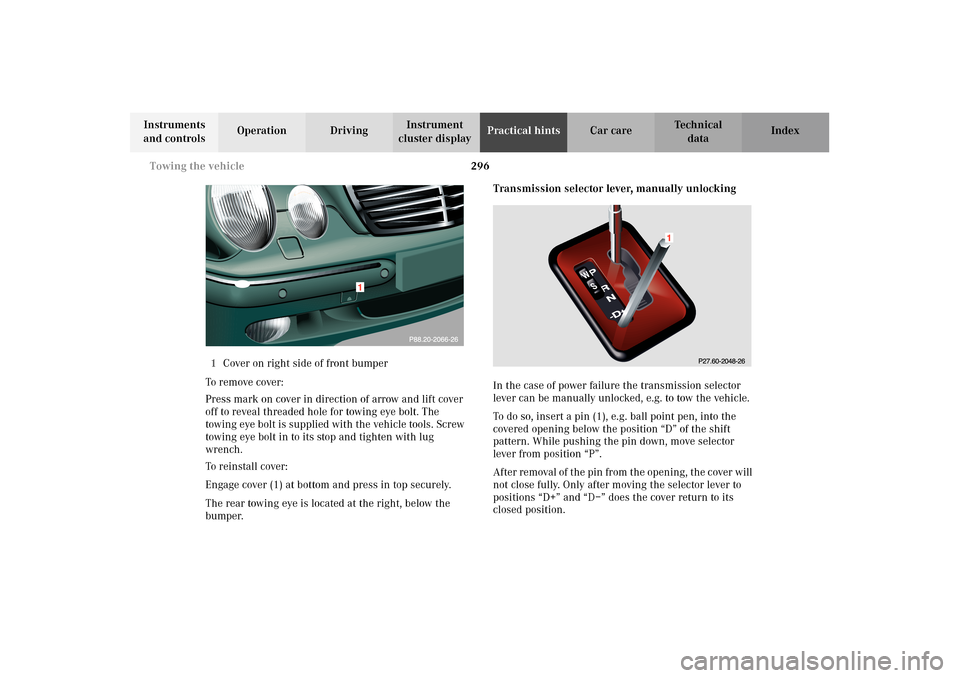
1Cover on right side of front bumper
To remove cover:
Press mark on cover in direction of arrow and lift cover
off to reveal threaded hole for towing eye bolt. The
towing eye bolt is supplied with the vehicle tools. Screw
towing eye bolt in to its stop and tighten with lug
wrench.
To reinstall cover:
Engage cover (1) at bottom and press in top securely.
The rear towing eye is located at the right, below the
bumper.Transmission selector lever, manually unlocking
In the case of power failure the transmission selector
lever can be manually unlocked, e.g. to tow the vehicle.
To do so, insert a pin (1), e.g. ball point pen, into the
covered opening below the position “D” of the shift
pattern. While pushing the pin down, move selector
lever from position “P”.
After removal of the pin from the opening, the cover will
not close fully. Only after moving the selector lever to
positions “D+” and “D–” does the cover return to its
closed position.