Page 306 of 399
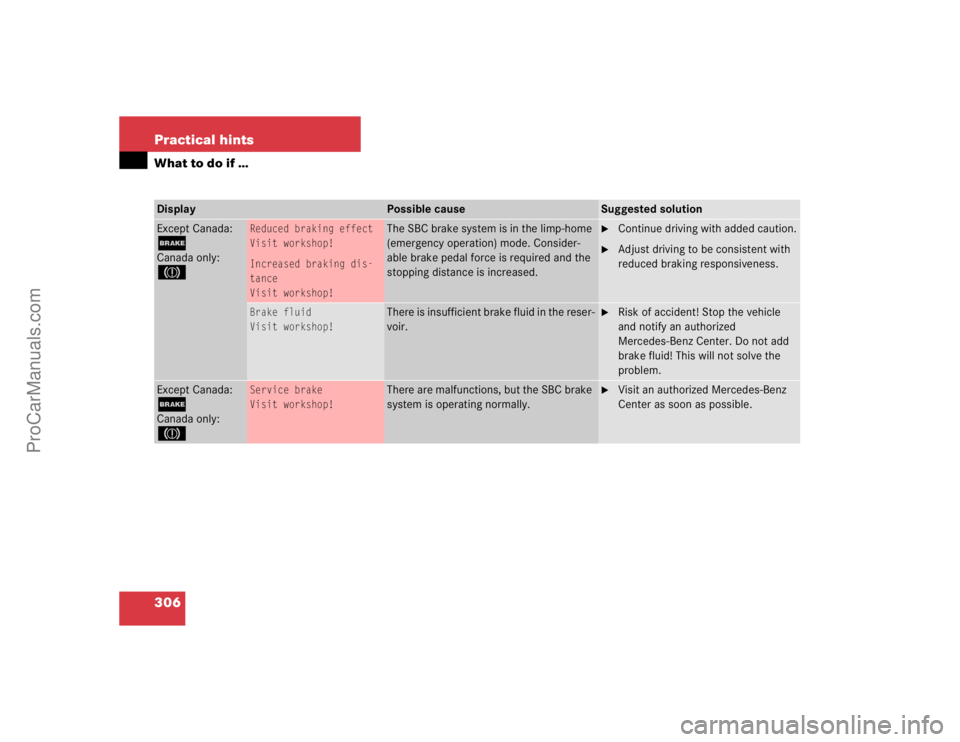
306 Practical hintsWhat to do if …Except Canada:;Canada only:3
Reduced braking effect
Visit workshop!
Increased braking dis-
tance
Visit workshop!
The SBC brake system is in the limp-home
(emergency operation) mode. Consider-
able brake pedal force is required and the
stopping distance is increased.
�
Continue driving with added caution.
�
Adjust driving to be consistent with
reduced braking responsiveness.
Brake fluid
Visit workshop!
There is insufficient brake fluid in the reser-
voir.
�
Risk of accident! Stop the vehicle
and notify an authorized
Mercedes-Benz Center. Do not add
brake fluid! This will not solve the
problem.
Except Canada:;Canada only:3
Service brake
Visit workshop!
There are malfunctions, but the SBC brake
system is operating normally.
�
Visit an authorized Mercedes-Benz
Center as soon as possible.
Display
Possible cause
Suggested solution
ProCarManuals.com
Page 339 of 399
339 Practical hints
Flat tire
�
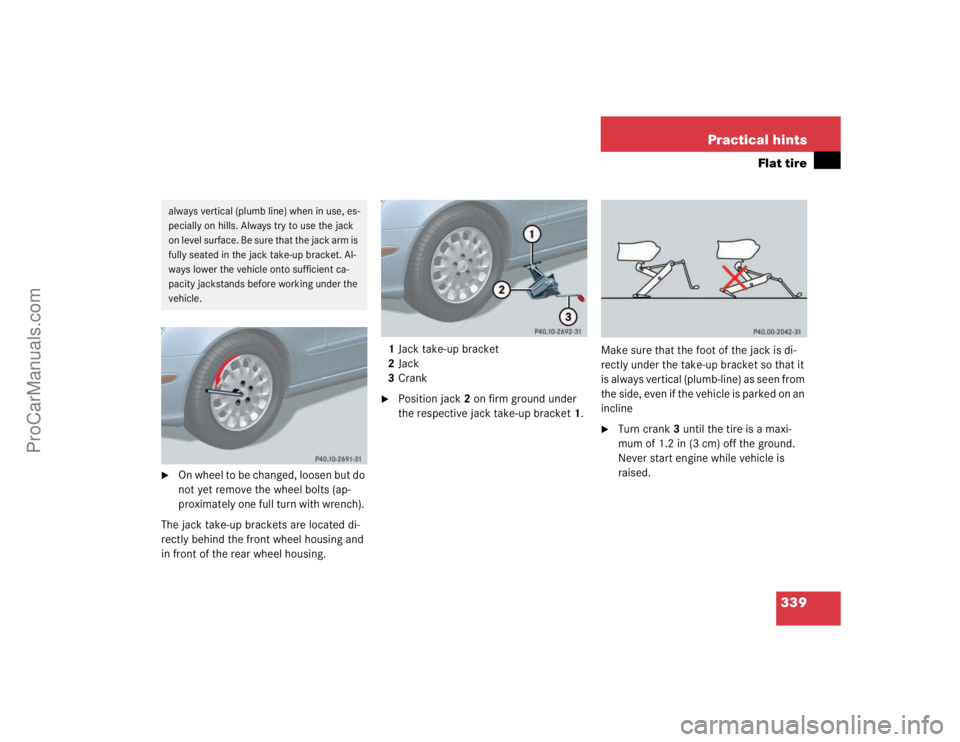
On whee l to b e c hang ed, l oose n but d o
not yet remove the wheel bolts (ap-
proximately one full turn with wrench).
The jack take-up brackets are located di-
rectly behind the front wheel housing and
in front of the rear wheel housing. 1Jack take-up bracket
2Jack
3Crank
�
Position jack2 on firm ground under
the respective jack take-up bracket1.Make sure that the foot of the jack is di-
rectly under the take-up bracket so that it
is always vertical (plumb-line) as seen from
the side, even if the vehicle is parked on an
incline
�
Turn crank3 until the tire is a maxi-
mum of 1.2 in (3 cm) off the ground.
Never start engine while vehicle is
raised.
always vertical (plumb line) when in use, es-
pecially on hills. Always try to use the jack
on level surface. Be sure that the jack arm is
fully seated in the jack take-up bracket. Al-
ways lower the vehicle onto sufficient ca-
pacity jackstands before working under the
vehicle.
ProCarManuals.com
Page 345 of 399
345 Practical hints
Batteries
Reconnecting the batteries�
Turn off all electrical consumers.
�
Connect the positive lead and fasten its
cover.
�
Connect the negative lead.Batteries contain materials that can harm
the environment if disposed of improperly.
Large 12-volt storage batteries contain
lead. Recycling of batteries is the preferred
method of disposal. Many states require
sellers of batteries to accept old batteries
for recycling.Warning!
G
Never charge a battery while still installed in
the vehicle. Gases may escape during charg-
ing and cause explosions that may result in
paint damage, corrosion or personal injury.!NEVER invert the terminal connections!
The battery, its filler caps and the vent
tube must always be securely installed
when the vehicle is in operation.
iThe following procedures must be car-
ried out following any interruption of
battery power (e.g. due to reconnec-
tion):�
Set the clock (
�page 136) (vehi-
cles with COMAND*: see COMAND
operator’s manual).
�
Resynchronize the front seat head
restraints (
�page 104).
�
Resynchronize the ESP
(�page 75).
�
Re-enter the radio code (see radio
operating instructions).
�
Resynchronize the side windows
(�page 186).
�
Resynchronize the sliding/pop-up
roof* (
�page 189).
ProCarManuals.com
Page 348 of 399
348 Practical hintsTowing the vehicle
Towing the vehicleTowing the vehicle
Mercedes-Benz recommends that the vehi-
cle be transported with all wheels off the
ground using flatbed or appropriate wheel
lift/dolly equipment.
When circumstances do not permit the
recommended towing methods, the vehi-
cle may be towed with all wheels on the
ground or front wheels raised only so far as to have the vehicle moved to a safe loca-
tion where the recommended towing
methods can be employed.
!Use flatbed or wheel lift/dolly equip-
ment with key in starter switch turned
to position0.
Do not tow with sling-type equipment.
Towing with sling-type equipment over
bumpy roads will damage radiator and
supports.
To prevent damage during transport,
do not tie down vehicle by its chassis or
suspension parts.
Switch off the tow-away alarm and the
automatic central locking
!If the vehicle is towed with the front
axle raised, the engine must be shut off
(key in starter switch position0 or1).
Otherwise, the ESP will immediately be
engaged and will apply the rear wheel
brakes.
When towing the vehicle with all wheels
on the ground, the selector lever must
be in positionN and the key must be in
starter switch position2. When towing
the vehicle with all wheels on the
ground, the vehicle may be towed only
for distances up to 30 miles (50 km)
and at a speed not to exceed 30 mph
(50 km/h).
!To be certain to avoid a possibility of
damage to the transmission, however,
we recommend the drive shaft be dis-
connected at the rear axle drive flange
for any towing beyond a short tow to a
nearby garage.
ProCarManuals.com
Page 360 of 399
360 Technical dataEngine
EngineModel
E 320 (211.065
1)
1The quoted data apply only to the standard vehicle. See an authorized Mercedes-Benz Center for the corresponding data of all special bodies and special equipment.
E 500 (211.070
1)
Engine
112
113
Mode of operation
4-stroke engine, gasoline injection
4-stroke engine, gasoline injection
No. of cylinders
6
8
Bore
3.54 in (89.90 mm)
3.82 in (97.00 mm)
Stroke
3.31 in (84.00 mm)
3.31 in (84.00 mm)
Total piston displacement
195.2 cu.in. (3199 cm
3)
302.9 cu.in. (4966 cm
3)
Compression ratio
10:1
10:1
Output acc. to SAE J 1349
221 hp / 5700 rpm
(165 kW / 5700 rpm)
302 hp / 5600 rpm
(225 kW / 5600 rpm)
Maximum torque acc. to SAE J 1349
232ft.lb/3000rpm
(315 Nm / 3000 rpm)
339ft.lb/2700rpm
(460 Nm / 2700 rpm)
Maximum engine speed
6000 rpm
6000 rpm
Firing order
1-4-3-6-2-5
1-5-4-2-6-3-7-8
Poly-V-belt
7ft 10in (2390mm)
7ft 10in (2390mm)
ProCarManuals.com
Page 366 of 399

366 Technical dataFuels, coolants, lubricants etc.
Fuels, coolants, lubricants etc.CapacitiesVehicle components and their respective
lubricants must match. Therefore use only
brands tested and recommended by us.Please refer to the Factory Approved Ser-
vice Products Pamphlet, or inquire at your
authorized Mercedes-Benz Center.
Model
Capacity
Fuels, coolants, lubricants etc.
Engine with oil filter
E320
E500
8.5 US qt (8.0 l)
8.0 US qt (7.5 l)
Recommended engine oils
Automatic transmission
8.0 US qt (7.5 l)
MB Automatic Transmission Oil
1
1MB part no. 001 989 21 03 10Rear axle
E320
E500
1.06 US qt (1 l)
1.37 US qt (1.3 l)
Hypoid gear oil SAE 85 W 90
Power steering
approx. 1.1 US qt (1.0 l)
MB Power Steering Fluid (Pentosin
CHF 11S)
Front wheel hubs
approx. 3.0 oz (85 g) each
High temperature roller bearing grease
Brake system
0.64 US qt (0.6 l)
MB Brake Fluid (DOT 4+)
Cooling system
E320
E500
approx. 10.7 US qt (10 l)
approx. 11.9 US qt (11.3 l)
MB 325.0 Anticorrosion / Antifreeze
Fuel tank including a reserve of
21.12 US gal (80.0 l)
2.38 US gal (9.0 l)
Premium unleaded gasoline:
Posted Octane 91 (Avg. of 96
RON / 86 MON)
Air conditioner system
R-134a refrigerant and special PAG lu-
bricant oil (never R-12)
ProCarManuals.com
Page 369 of 399

369 Technical data
Fuels, coolants, lubricants etc.
Premium unleaded gasoline
Fuel requirements
Use only premium unleaded gasoline
meeting ASTM standard D 439:�
The octane number (posted at the
p um p) m us t be 91 mi n. It i s an a vera ge
of both the Research (R) Octane Num-
ber and the Motor (M) Octane Number:
(R+M) / 2). This is also known as the
ANTI-KNOCK INDEX.
Unleaded gasoline containing oxygenates
such as ethanol, IPA, IBA and TBA can be
used provided the ratio of any one of these
oxygenates to gasoline does not exceed
10%; MTBE is not to exceed 15%.
The ratio of methanol to gasoline must not
exceed 3% plus additional cosolvents.
Using mixtures of ethanol and methanol is
not allowed. Gasohol, which contains 10%
ethanol and 90% unleaded gasoline, can be
used.
These blends must also meet all other fuel
requirements, such as resistance to spark
knock, boiling range, vapor pressure, etc.
Gasoline additives
A major concern among engine manufac-
turers is carbon build-up caused by gaso-
line. Mercedes-Benz recommends only the
use of quality gasoline containing additives
that prevent the build-up of carbon depos-
its.
After an extended period of using fuels
without such additives, carbon deposits
can build up especially on the intake valves
and in the combustion area, leading to en-
gine performance problems such as:�
Warm-up hesitation
�
Unstable idle
�
Knocking/pinging
�
Misfire
�
Power loss
Do not blend any specific fuel additives
with fuel. This only results in unnecessary
costs and may be harmful to the engine op-
eration.
!To maintain the engine’s durability and
performance, premium unleaded gaso-
line must be used. If premium unleaded
gasoline is not available and low octane
fuel is used, follow these precautions:�
Have the fuel tank only partially
filled with unleaded regular and fill
up with premium unleaded as soon
as possible
�
Avoid full throttle driving and abrupt
acceleration
�
Do not exceed an engine speed of
3000 rpm if the vehicle is loaded
with a light load such as two per-
sons and no luggage
�
Do not exceed 2/3 of maximum ac-
celerator pedal position if the vehi-
cle is fully loaded or operating in
mountainous terrain
ProCarManuals.com
Page 374 of 399

374 Technical dataConsumer informationTemperature
The temperature grades are A (the high-
est), B, and C, representing the tire’s resis-
tance to the generation of heat and its
ability to dissipate heat when tested under
controlled conditions on a specified indoor
laboratory test wheel. Sustained high tem-
perature can cause the material of the tire
to degenerate and reduce tire life, and ex-
cessive temperature can lead to sudden
tire failure. Grade C corresponds to a level
of performance which all passenger car
tires must meet under the Federal Motor
Vehicle Safety Standard No. 109. Grades B
and A represent higher levels of perfor-
mance on the laboratory test wheel than
the minimum required by law.
Warning
G
The temperature grade for this tire is estab-
lished for a tire that is properly inflated and
not overloaded. Excessive speed, underin-
flation, or excessive loading, either sepa-
rately or in combination, can cause
excessive heat build-up and possible tire
failure.
ProCarManuals.com