2003 MAZDA MODEL B4000 brakes
[x] Cancel search: brakesPage 128 of 250

Driving on snow and ice
A 4WD vehicle has advantages over 2WD vehicles in snow and ice but
can skid like any other vehicle.
Avoid sudden applications of power and quick changes of direction on
snow and ice. Apply the accelerator slowly and steadily when starting
from a full stop.
When braking, apply the brakes as you normally would. In order to allow
the anti-lock brake system (ABS) to operate properly, keep steady
pressure on the brake pedal.
Make sure you allow sufficient distance between you and other vehicles
for stopping. Drive slower than usual and consider using one of the lower
gears.
DRIVING THROUGH WATER
If driving through deep or standing water is unavoidable, proceed very
slowly especially if the depth is not known. Never drive through water
that is higher than the bottom of the hubs (for trucks) or the bottom of
the wheel rims (for cars). Traction or brake capability may be limited
and your vehicle may stall. Water may also enter your engine’s air intake
and severely damage your engine.
Once through the water, always dry the brakes by moving your vehicle
slowly while applying light pressure on the brake pedal. Wet brakes do
not stop the vehicle as quickly as dry brakes.Driving through deep
water where the transmission vent tube is submerged may allow
water into the transmission and cause internal transmission
damage.
SPECIAL LOADING INSTRUCTIONS FOR OWNERS OF PICKUP
TRUCKS AND UTILITY-TYPE VEHICLES
WARNING: For important information regarding safe operation
of this type of vehicle, see the Preparing to drive your vehicle
section in this chapter.
WARNING: Loaded vehicles may handle differently than
unloaded vehicles. Extra precautions, such as slower speeds and
increased stopping distance, should be taken when driving a
heavily loaded vehicle.
Your vehicle can haul more cargo and people than most passenger cars.
Depending upon the type and placement of the load, hauling cargo and
people may raise the center of gravity of the vehicle.
Driving
128
Page 131 of 250

TRAILER TOWING
Your vehicle may tow a class I, II or III trailer provided the maximum
trailer weight is less than or equal to the maximum trailer weight listed
for your engine and rear axle ratio on the following charts.
Your vehicle’s load capacity is designated by weight, not by volume, so
you cannot necessarily use all available space when loading a vehicle.
Towing a trailer places an additional load on your vehicle’s engine,
transmission, axle, brakes, tires and suspension. Inspect these
components carefully after any towing operation.
4x2 w/manual transmission
Engine Maximum GCWR - kg
(lbs.)Maximum
trailer weight -
kg (lbs.)Maximum
frontal area of
trailer - m
2
(ft2)
Regular Cab
2.3L 2,177 (4,800) 744 (1,640) Equal to frontal area of vehicle
3.0L Dual Sport 2,722 (6,000) 1,161 (2,560) 4.64 (50) Cab Plus/Cab Plus 4
3.0L Dual Sport 2,722 (6,000) 1,070 (2,360) 4.64 (50)
4.0L Dual Sport 3,175 (7,000) 1,488 (3,380) 4.64 (50)
For high altitude operation, reduce GCW by 2% per 300 meters (1,000
ft.) elevation.
For definition of terms used in this table see Vehicle Loadingearlier
in this chapter.
To determine maximum trailer weight designed for your particular
vehicle, see Calculating the load earlier in this chapter.
Maximum trailer weight is shown. The combined weight of the
completed towing vehicle (including hitch, passengers and cargo) and
the loaded trailer must not exceed the Gross Combined Weight Rating
(GCWR).
Driving
131
Page 134 of 250
WARNING: Towing trailers beyond the maximum recommended
gross trailer weight exceeds the limit of the vehicle and could
result in engine damage, transmission damage, structural
damage, loss of vehicle control, vehicle rollover and personal
injury.
Preparing to tow
Use the proper equipment for towing a trailer and make sure it is
properly attached to your vehicle. See your dealer or a reliable trailer
dealer if you require assistance.
Hitches
For towing trailers up to 907 kg (2,000 lb), use a weight carrying hitch
and ball which uniformly distributes the trailer tongue loads through the
underbody structure. Use a frame-mounted weight distributing hitch for
trailers over 907 kg (2,000 lb).
Do not install a single or multi-clamp type bumper hitch, or a hitch
which attaches to the axle. Underbody mounted hitches are acceptable if
they are installed properly. Follow the towing instructions of a reputable
rental agency.
Whenever a trailer hitch and hardware are removed, make sure all
mounting holes in the underbody are properly sealed to prevent noxious
gases or water from entering.
Safety chains
Always connect the trailer’s safety chains to the frame or hook retainers
of the vehicle hitch. To connect the trailer’s safety chains, cross the
chains under the trailer tongue and allow slack for turning corners.
If you use a rental trailer, follow the instructions that the rental agency
gives to you.
Do not attach safety chains to the bumper.
Trailer brakes
Electric brakes and manual, automatic or surge-type trailer brakes are
safe if installed properly and adjusted to the manufacturer’s
specifications. The trailer brakes must meet local and Federal
regulations.
Driving
134
Page 176 of 250
WASHING YOUR VEHICLE
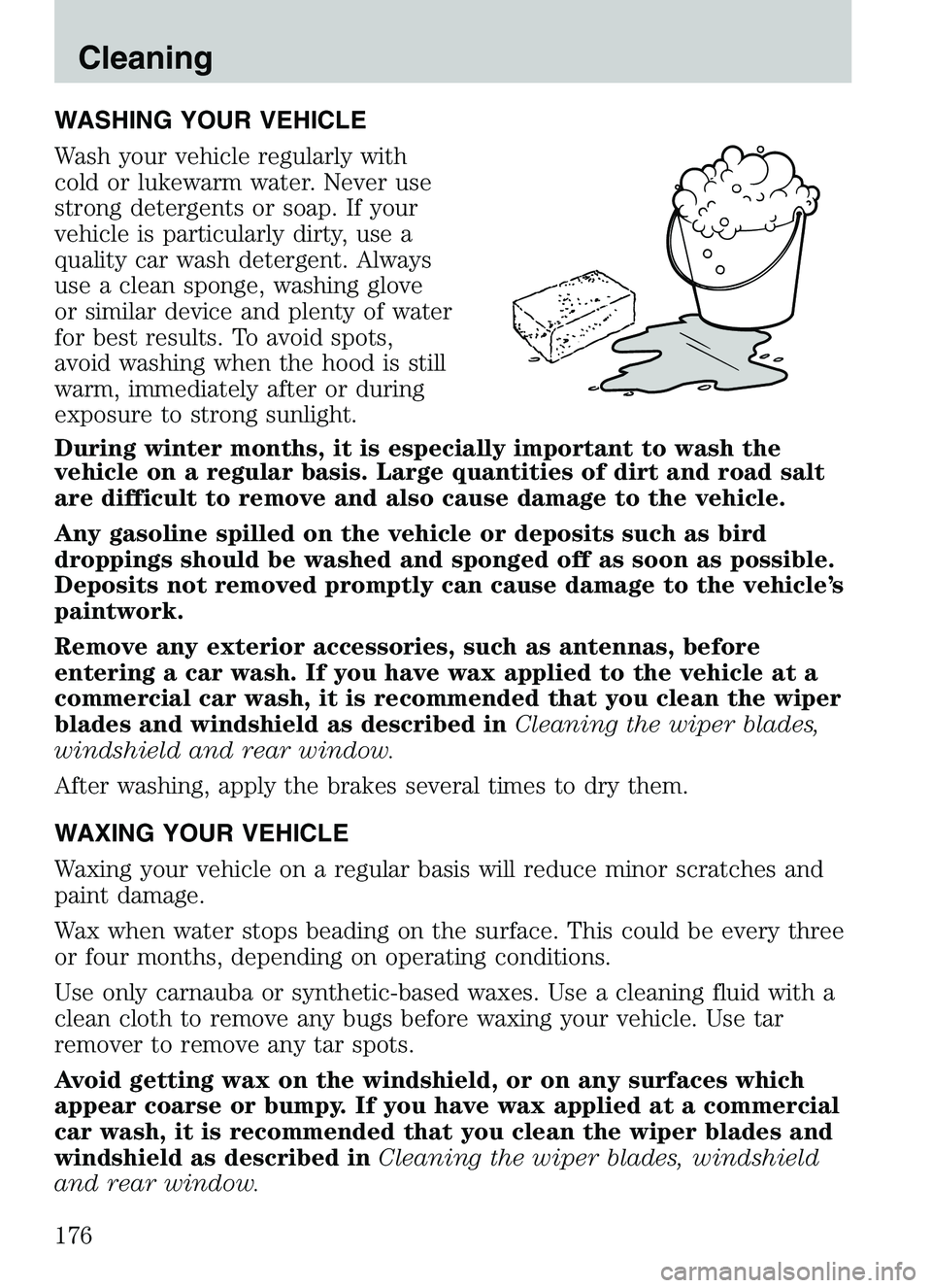
Wash your vehicle regularly with
cold or lukewarm water. Never use
strong detergents or soap. If your
vehicle is particularly dirty, use a
quality car wash detergent. Always
use a clean sponge, washing glove
or similar device and plenty of water
for best results. To avoid spots,
avoid washing when the hood is still
warm, immediately after or during
exposure to strong sunlight.
During winter months, it is especially important to wash the
vehicle on a regular basis. Large quantities of dirt and road salt
are difficult to remove and also cause damage to the vehicle.
Any gasoline spilled on the vehicle or deposits such as bird
droppings should be washed and sponged off as soon as possible.
Deposits not removed promptly can cause damage to the vehicle’s
paintwork.
Remove any exterior accessories, such as antennas, before
entering a car wash. If you have wax applied to the vehicle at a
commercial car wash, it is recommended that you clean the wiper
blades and windshield as described inCleaning the wiper blades,
windshield and rear window.
After washing, apply the brakes several times to dry them.
WAXING YOUR VEHICLE
Waxing your vehicle on a regular basis will reduce minor scratches and
paint damage.
Wax when water stops beading on the surface. This could be every three
or four months, depending on operating conditions.
Use only carnauba or synthetic-based waxes. Use a cleaning fluid with a
clean cloth to remove any bugs before waxing your vehicle. Use tar
remover to remove any tar spots.
Avoid getting wax on the windshield, or on any surfaces which
appear coarse or bumpy. If you have wax applied at a commercial
car wash, it is recommended that you clean the wiper blades and
windshield as described in Cleaning the wiper blades, windshield
and rear window.
Cleaning
176
Page 222 of 250

2. Visually inspect the fluid level.
3. If necessary, add brake fluidfrom a clean un-opened
container until the level reaches
MAX. Do not fill above this line.
4. Use only a DOT 3 brake fluid certified to meet Mazda specification . Refer to Lubricant
specifications in this chapter.
WARNING: Brake fluid is toxic. If brake fluid contacts the
eyes, flush eyes with running water for 15 minutes. Seek
medical attention if irritation persists. If taken internally, drink
water and induce vomiting. Seek medical attention immediately.
WARNING: If you use a brake fluid that is not DOT 3, you will
cause permanent damage to your brakes.
WARNING: Do not let the reservoir for the master cylinder run
dry. This may cause the brakes to fail.
CLUTCH FLUID (IF EQUIPPED)
Check the fluid level. Refer to the service maintenance section for the
service interval schedules.
During normal operation, the fluid level in the clutch reservoir should
remain constant. If the fluid level drops, refill the fluid level to the step
in the reservoir.
Use only a DOT 3 brake fluid designed to meet Mazda specification.
Refer to Lubricant Specifications in this chapter.
WARNING: Brake fluid is toxic. If brake fluid contacts the
eyes, flush eyes with running water for 15 minutes. Seek
medical attention if irritation persists. If taken internally, drink
water and induce vomiting. Seek medical attention immediately.
MAX
Maintenance and Specifications
222
Page 240 of 250
A
ABS (see Brakes) .....................115
Air bag supplemental
restraint system ..........................81and child safety seats ..............84
description ................................81
disposal ......................................87
driver air bag ............................85
indicator light ...........................87
operation ...................................85
passenger air bag .....................85
passenger deactivation switch...88
Ambulance packages ....................7
Antifreeze
(see Engine coolant) ................204
Anti-lock brake system
(see Brakes) ......................115–116
Audio system 6-CD in dash .............................24
AM/FM .......................................19
MACH MP3 ...............................27
Single CD ..................................21
Audio system
(see Radio) ................19, 21, 24, 27
Automatic dimming rear
view mirror ..................................50
Automatic transmission ............119 driving an automatic
overdrive .................................120
fluid, adding ............................223
fluid, checking ........................223
fluid, refill capacities ..............231
fluid, specification ..................236
Auxiliary power point .................49
Axle lubricant specifications ..235–236
refill capacities ........................231
traction lok ..............................118 B
Battery .......................................202
acid, treating emergencies .....202
jumping a disabled battery ....159
maintenance-free ....................202
servicing ..................................202
Bed extender ..............................57
BeltMinder ...................................76
Brakes ........................................115 anti-lock ...........................115–116
anti-lock brake system
(ABS) warning light ...............116
fluid, checking and adding ....221
fluid, refill capacities ..............231
fluid, specifications .........235–236
lubricant specifications ..235–236
parking ....................................116
shift interlock ..........................119
Break-in period .............................5
Bulbs ............................................40
C
Calculating load ........................130
Capacities for refilling fluids ....231
Cassette tape player .............21, 24
CD-single premium ...............19, 27
Cell phone warning ...................239
Certification Label ....................238
Changing a tire .........................151
Child safety restraints ................94 child safety belts ......................94
Child safety seats ........................97 attaching with tether straps ..102
in front seat ..............................99
in rear seat ................................99
LATCH .....................................106
2003 Mazda B Series (mbs)
New Owners Guide own2002 (own2002)
USA English (fus)
Index
240
Page 243 of 250

Instrument panelcleaning ...................................180
cluster ................................12, 180
lighting up panel and interior...39
location of components ............12
J
Jack ............................................151 positioning ...............................151
storage .............................151–154
Jump-starting your vehicle ......159
K
Keyless remote entry system -
see Remote entry system ...........59
Keys positions of the ignition .........110
L
Lamps bulb replacement
specifications chart ..................40
cargo lamps ...............................39
courtesy .....................................40
daytime running light ...............38
fog lamps ...................................38
headlamps .................................38
headlamps, flash to pass ..........39
instrument panel, dimming .....39
interior lamps .....................40–41
replacing bulbs . 40–41, 43, 45–46
Lane change indicator
(see Turn signal) ........................40
LATCH anchors .........................106
Lights, warning and indicator ....12 anti-lock brakes (ABS) ..........116 Limited slip axle
(see Traction-Lok) ....................118
Load limits .................................129
GAWR ......................................129
GVWR ......................................129
trailer towing ..........................129
Loading instructions .................128
Lubricant specifications ...235–236
Lumbar support, seats ...............68
M
Manual transmission .................122 fluid capacities ........................231
lubricant specifications ..........236
reverse .....................................123
Mirrors automatic dimming rearview
mirror ........................................50
cleaning ...................................179
side view mirrors (power) .......53
Motorcraft parts ........................214
O
Octane rating ............................213
Oil (see Engine oil) ..................195
Overdrive .....................................56
Overheating ...............................150
P
Parking brake ............................116
Passive anti-theft system
(PATS) .........................................64
Power distribution box
(see Fuses) ...............................144
Power door locks ........................59
2003 Mazda B Series (mbs)
New Owners Guide own2002 (own2002)
USA English (fus)
Index
243