2003 LINCOLN TOWN CAR back up sensor
[x] Cancel search: back up sensorPage 98 of 272
MIRRORS
Automatic dimming inside rear view mirror (if equipped)
Your vehicle is equipped with an inside rear view mirror which has an
auto-dimming function (available as an option on the outside driver’s side
mirror). The electronic day/night mirror will change from the normal
state to the non-glare state when bright lights (glare) reach the mirror.
When the mirror detects bright light from front or behind, it will
automatically adjust (darken) to minimize glare.
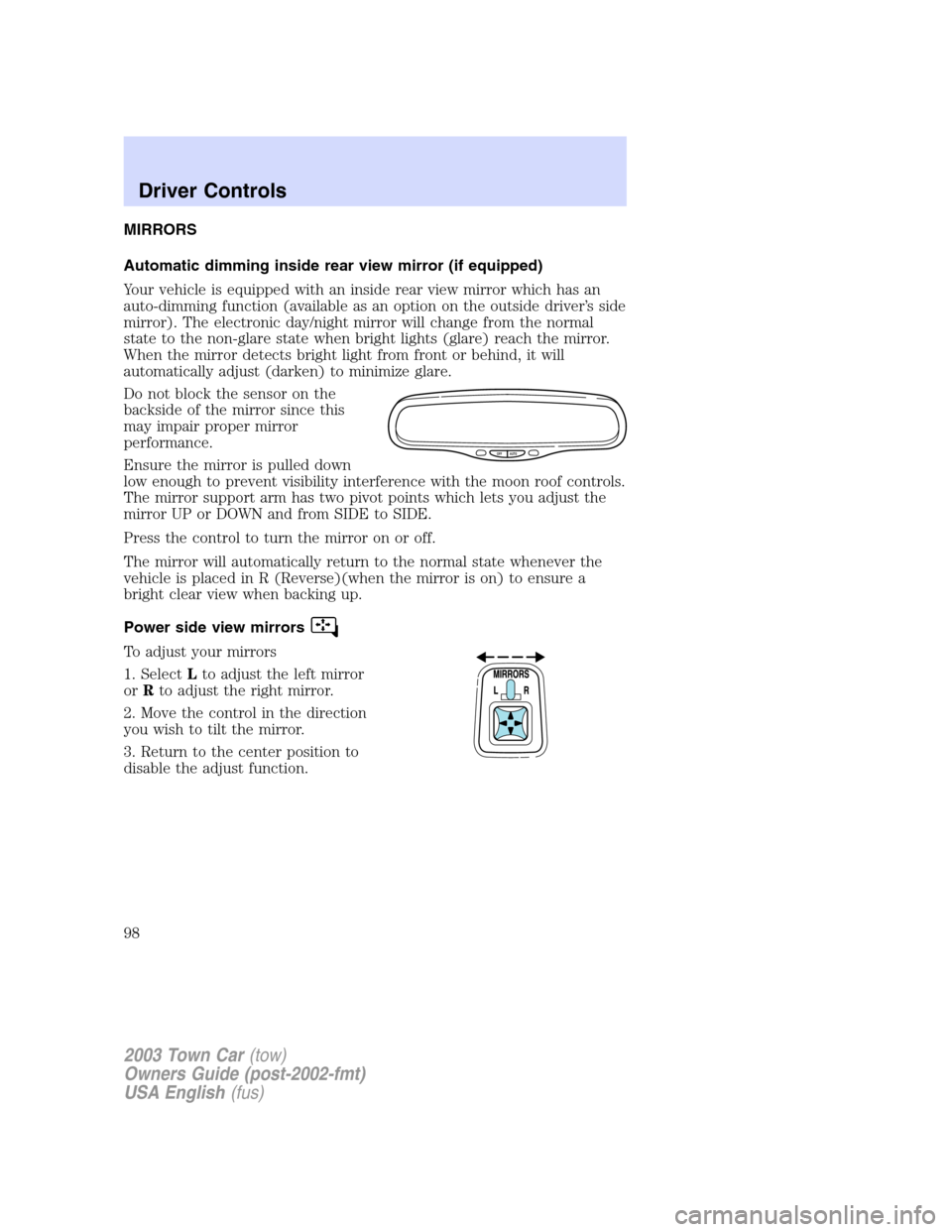
Do not block the sensor on the
backside of the mirror since this
may impair proper mirror
performance.
Ensure the mirror is pulled down
low enough to prevent visibility interference with the moon roof controls.
The mirror support arm has two pivot points which lets you adjust the
mirror UP or DOWN and from SIDE to SIDE.
Press the control to turn the mirror on or off.
The mirror will automatically return to the normal state whenever the
vehicle is placed in R (Reverse)(when the mirror is on) to ensure a
bright clear view when backing up.
Power side view mirrors
To adjust your mirrors
1. SelectLto adjust the left mirror
orRto adjust the right mirror.
2. Move the control in the direction
you wish to tilt the mirror.
3. Return to the center position to
disable the adjust function.
OFF AUTO
2003 Town Car(tow)
Owners Guide (post-2002-fmt)
USA English(fus)
Driver Controls
98
Page 133 of 272
SAFETY RESTRAINTS
Personal Safety System
The Personal Safety System provides an improved overall level of frontal
crash protection to front seat occupants and is designed to help further
reduce the risk of air bag-related injuries. The system is able to analyze
different occupant conditions and crash severity before activating the
appropriate safety devices to help better protect a range of occupants in
a variety of frontal crash situations.
Your vehicle’s Personal Safety System consists of the following items:
•Driver and passenger dual-stage air bag supplemental restraints
•Driver and front passenger side air bags
•Front safety belts with pretensioners, energy management retractors,
and safety belt usage sensors
•Driver’s seat position sensor
•Passenger occupant classification sensor
•Front crash severity sensor
•Restraints Control Module (RCM) with impact and safing sensors
•Restraint system warning light and back-up tone
•The electrical wiring for the air bags, crash sensor(s), safety belt
pretensioners, front safety belt usage sensors, driver seat position
sensor, passenger occupant classification sensor, and indicator lights
How does the personal safety system work?
The Personal safety system can adapt the deployment strategy of your
vehicle’s safety devices according to crash severity and occupant
conditions. A collection of crash and occupant sensors provides
information to the Restraints control module (RCM). During a crash, the
RCM activates the safety belt pretensioners and/or either one or both
stages of the dual-stage air bag supplemental restraints based on crash
severity and occupant conditions.
The fact that the pretensioners or air bags did not activate for both front
seat occupants in a collision does not mean that something is wrong with
the system. Rather, it means the Personal safety system determined the
accident conditions (crash severity, belt usage, etc.) were not
appropriate to activate these safety devices. Front air bags and
pretensioners are designed to activate only in frontal and near-frontal
collisions, not rollovers, side-impacts, or rear-impacts unless the collision
causes sufficient longitudinal deceleration.
2003 Town Car(tow)
Owners Guide (post-2002-fmt)
USA English(fus)
Seating and Safety Restraints
133
Page 134 of 272
Driver and passenger dual-stage air bag supplemental restraints
The dual-stage air bags offer the capability to tailor the level of air bag
inflation energy. A lower, less forceful energy level is provided for more
common, moderate-severity impacts. A higher energy level is used for
the most severe impacts. Refer toAir bag supplemental restraints
section in this chapter.
Front crash severity sensor
The front crash severity sensor enhances the ability to detect the
severity of an impact. Positioned up front, it provides valuable
information early in the crash event on the severity of the impact. This
allows your Personal safety system to distinguish between different levels
of crash severity and modify the deployment strategy of the dual-stage
air bags and safety belt pretensioners.
Driver’s seat position sensor
The driver’s seat position sensor allows your Personal safety system to
tailor the deployment level of the driver dual-stage air bag based on seat
position. The system is designed to help protect smaller drivers sitting
close to the driver air bag by providing a lower air bag output level.
Passenger occupant classification sensor (OCS)
For air bags to do their job they must inflate with great force, and this
force can pose a potentially deadly risk to occupants that are very close
to the air bag when it begins to inflate. For some occupants, this occurs
because they are initially sitting very close to the air bag. For other
occupants, this occurs when the occupant is not properly restrained by
seat belts or child safety seats and they move forward during pre-crash
braking. The most effective way to reduce the risk of unnecessary
injuries is to make sure all occupants are properly restrained. Accident
statistics suggest that children are much safer when properly restrained
in the rear seating positions than in the front.
Air bags can kill or injure a child in a child seat.NEVERplace a
rear-facing child seat in front of an active air bag. If you must
use a forward-facing child seat in the front seat, move the seat all the
way back.
Always transport children 12 years old and under in the back
seat and always properly use appropriate child restraints.
The passenger occupant classification sensor can automatically turn off
the passenger front air bag and side air bag (if equipped). The system is
2003 Town Car(tow)
Owners Guide (post-2002-fmt)
USA English(fus)
Seating and Safety Restraints
134
Page 135 of 272
designed to help protect small (child size) occupants from air bag
deployments when they are improperly seated or restrained in the front
passenger seat contrary to proper child-seating or restraint usage
recommendations. Even with this technology, parents areSTRONGLY
encouraged to always properly restrain children in the rear seat. The
sensor also turns off the air bag(s) when the passenger seat is empty to
prevent unnecessary replacement of the air bag(s) after a collision.
Front safety belt usage sensors
The front safety belt usage sensors detect whether or not the driver and
front outboard passenger safety belts are fastened. This information
allows your Personal safety system to tailor the air bag deployment and
safety belt pretensioner activation depending upon safety belt usage.
Refer toSafety beltsection in this chapter.
Front safety belt pretensioners
The safety belt pretensioners at the front outboard seating positions are
designed to tighten the safety belts firmly against the occupant’s body
during a frontal or near-frontal collision. This maximizes the effectiveness
of the safety belts and helps properly position the occupant relative to
the air bag to improve protection. The safety belt pretensioners can be
either activated alone or, if the collision is of sufficient severity, together
with the air bags.
Front safety belt energy management retractors
The front safety belt energy management retractors allow webbing to be
pulled out of the retractor in a gradual and controlled manner in
response to the occupant’s forward momentum. This helps reduce the
risk of force-related injuries to the occupant’s chest by limiting the load
on the occupant. Refer toEnergy management featuresection in this
chapter.
Determining if the Personal safety system is operational
The Personal safety system uses a warning light in the instrument cluster
or a back-up tone to indicate the condition of the system. Refer to the
Warning lightsection in theInstrument clusterchapter. Routine
maintenance of the Personal safety system is not required.
The Restraints control module (RCM) monitors its own internal circuits
and the circuits for the air bag supplemental restraints, crash sensor(s),
safety belt pretensioners, front safety belt buckle sensors, driver seat
position sensor, and passenger occupant classification sensor. In addition,
the RCM also monitors the restraints warning light in the instrument
cluster. A difficulty with the system is indicated by one or more of the
following.
2003 Town Car(tow)
Owners Guide (post-2002-fmt)
USA English(fus)
Seating and Safety Restraints
135
Page 151 of 272
The SRS consists of the following items:
•Driver and passenger air bag modules (which include the inflators and
air bags)
•Driver and passenger side air bags
•One or more impact and safing sensors
•A readiness light and tone
•A diagnostic module
•The electrical wiring which connects the components
The diagnostic module monitors its own internal circuits as well as the
supplemental air bag electrical system warning (including the impact
sensors), the system wiring, the air bag system readiness light, the air
bag back up power and the air bag ignitors.
Several air bag system components get hot after inflation. Do not
touch them after inflation.
If the air bag has deployed,the air bag will not function
again and must be replaced immediately.If the air bag is not
replaced, the unrepaired area will increase the risk of injury in a
collision.
If the safety belt pretensioners deploy in an accident, they will
not function again ( belt will not extract or retract) and must be
replaced immediately. Failure to replace the retractor assemblies will
increase the risk of injury.
Determining if the system is operational
The SRS uses a readiness light in the instrument cluster or a tone to
indicate the condition of the system. Refer toAir bag readinesssection
in theInstrument clusterchapter. Routine maintenance of the air bag is
not required.
A difficulty with the system is indicated by one or more of the following:
•The readiness light will either
flash or stay lit.
•The readiness light will not
illuminate immediately after
ignition is turned on.
AIR
BAG
2003 Town Car(tow)
Owners Guide (post-2002-fmt)
USA English(fus)
Seating and Safety Restraints
151
Page 153 of 272
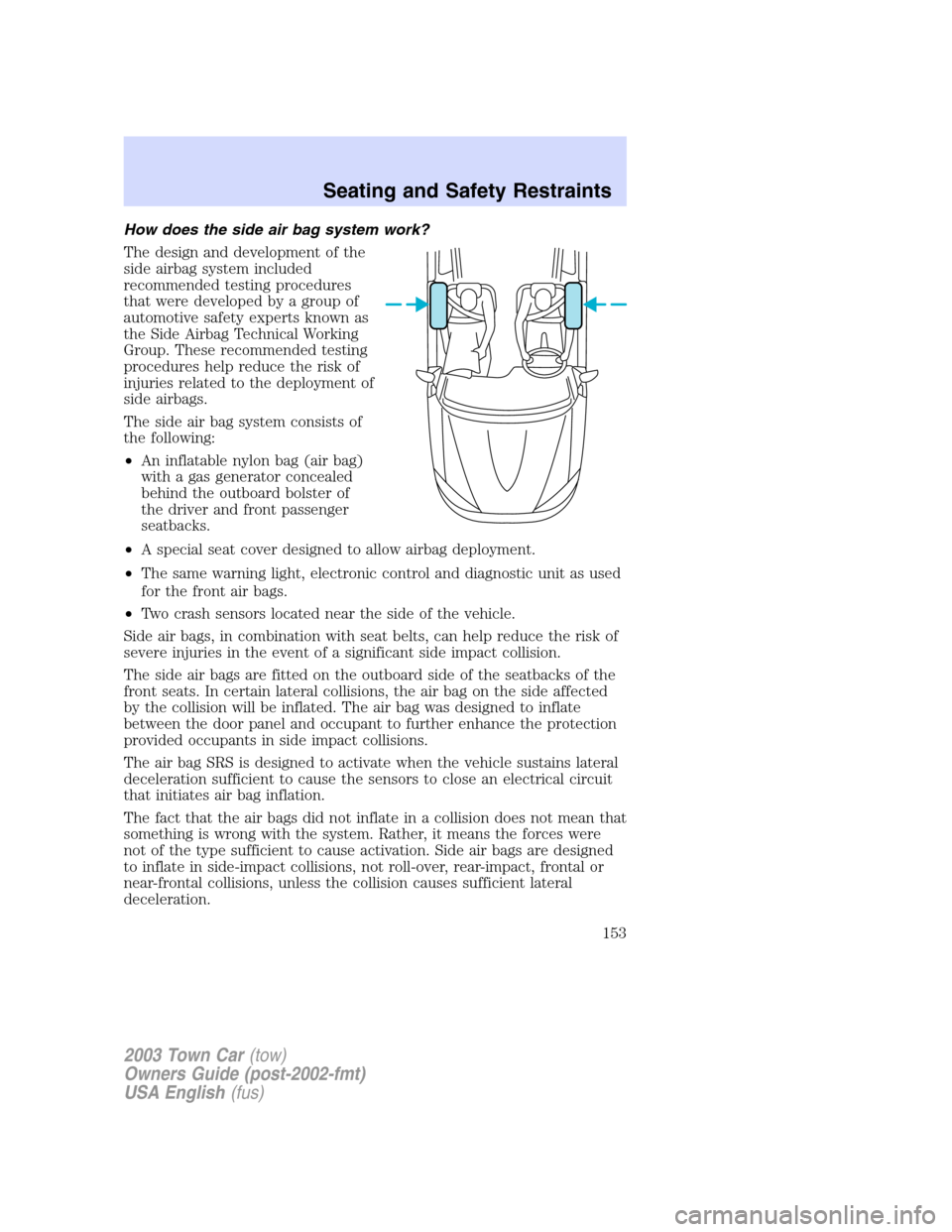
How does the side air bag system work?
The design and development of the
side airbag system included
recommended testing procedures
that were developed by a group of
automotive safety experts known as
the Side Airbag Technical Working
Group. These recommended testing
procedures help reduce the risk of
injuries related to the deployment of
side airbags.
The side air bag system consists of
the following:
•An inflatable nylon bag (air bag)
with a gas generator concealed
behind the outboard bolster of
the driver and front passenger
seatbacks.
•A special seat cover designed to allow airbag deployment.
•The same warning light, electronic control and diagnostic unit as used
for the front air bags.
•Two crash sensors located near the side of the vehicle.
Side air bags, in combination with seat belts, can help reduce the risk of
severe injuries in the event of a significant side impact collision.
The side air bags are fitted on the outboard side of the seatbacks of the
front seats. In certain lateral collisions, the air bag on the side affected
by the collision will be inflated. The air bag was designed to inflate
between the door panel and occupant to further enhance the protection
provided occupants in side impact collisions.
The air bag SRS is designed to activate when the vehicle sustains lateral
deceleration sufficient to cause the sensors to close an electrical circuit
that initiates air bag inflation.
The fact that the air bags did not inflate in a collision does not mean that
something is wrong with the system. Rather, it means the forces were
not of the type sufficient to cause activation. Side air bags are designed
to inflate in side-impact collisions, not roll-over, rear-impact, frontal or
near-frontal collisions, unless the collision causes sufficient lateral
deceleration.
2003 Town Car(tow)
Owners Guide (post-2002-fmt)
USA English(fus)
Seating and Safety Restraints
153
Page 190 of 272
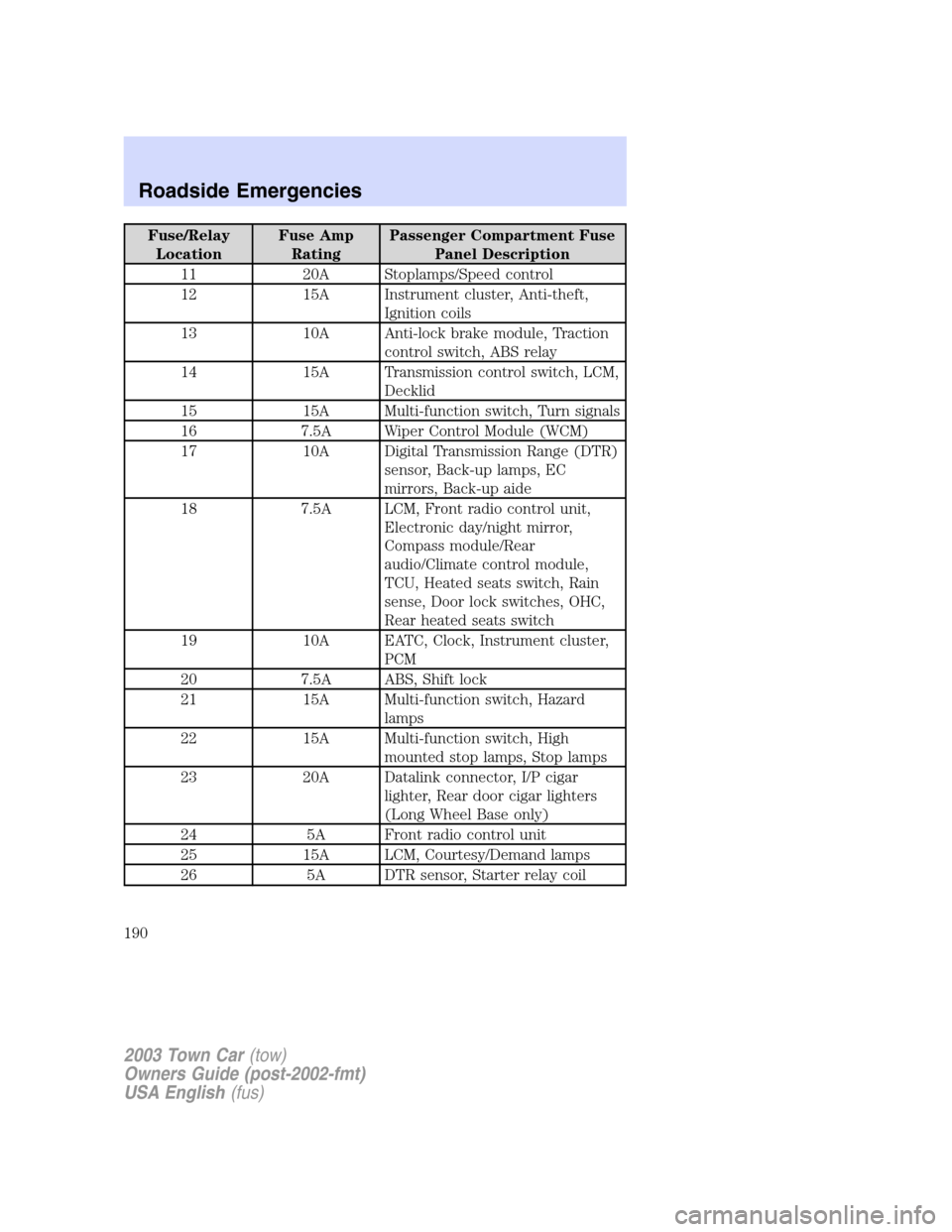
Fuse/Relay
LocationFuse Amp
RatingPassenger Compartment Fuse
Panel Description
11 20A Stoplamps/Speed control
12 15A Instrument cluster, Anti-theft,
Ignition coils
13 10A Anti-lock brake module, Traction
control switch, ABS relay
14 15A Transmission control switch, LCM,
Decklid
15 15A Multi-function switch, Turn signals
16 7.5A Wiper Control Module (WCM)
17 10A Digital Transmission Range (DTR)
sensor, Back-up lamps, EC
mirrors, Back-up aide
18 7.5A LCM, Front radio control unit,
Electronic day/night mirror,
Compass module/Rear
audio/Climate control module,
TCU, Heated seats switch, Rain
sense, Door lock switches, OHC,
Rear heated seats switch
19 10A EATC, Clock, Instrument cluster,
PCM
20 7.5A ABS, Shift lock
21 15A Multi-function switch, Hazard
lamps
22 15A Multi-function switch, High
mounted stop lamps, Stop lamps
23 20A Datalink connector, I/P cigar
lighter, Rear door cigar lighters
(Long Wheel Base only)
24 5A Front radio control unit
25 15A LCM, Courtesy/Demand lamps
26 5A DTR sensor, Starter relay coil
2003 Town Car(tow)
Owners Guide (post-2002-fmt)
USA English(fus)
Roadside Emergencies
190
Page 193 of 272
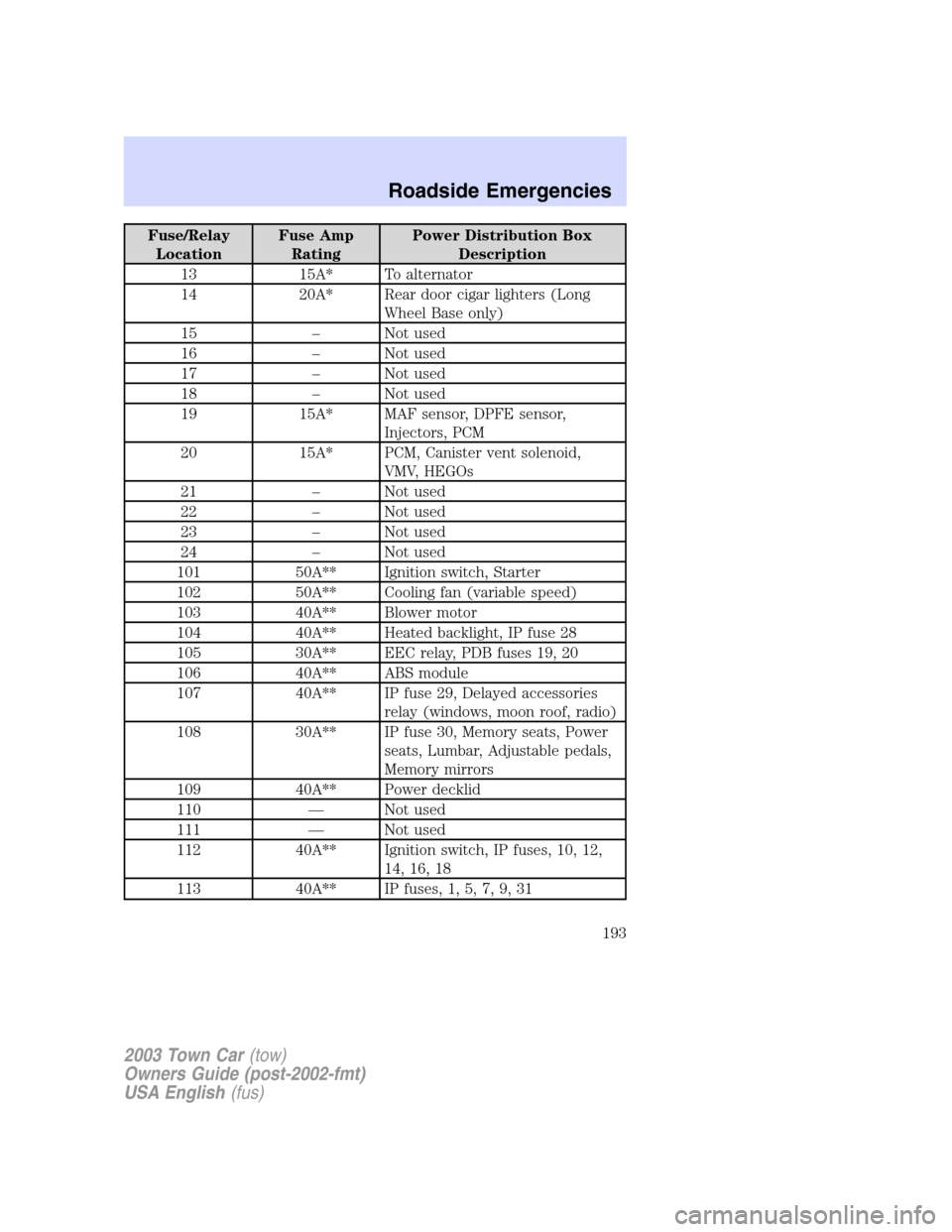
Fuse/Relay
LocationFuse Amp
RatingPower Distribution Box
Description
13 15A* To alternator
14 20A* Rear door cigar lighters (Long
Wheel Base only)
15–Not used
16–Not used
17–Not used
18–Not used
19 15A* MAF sensor, DPFE sensor,
Injectors, PCM
20 15A* PCM, Canister vent solenoid,
VMV, HEGOs
21–Not used
22–Not used
23–Not used
24–Not used
101 50A** Ignition switch, Starter
102 50A** Cooling fan (variable speed)
103 40A** Blower motor
104 40A** Heated backlight, IP fuse 28
105 30A** EEC relay, PDB fuses 19, 20
106 40A** ABS module
107 40A** IP fuse 29, Delayed accessories
relay (windows, moon roof, radio)
108 30A** IP fuse 30, Memory seats, Power
seats, Lumbar, Adjustable pedals,
Memory mirrors
109 40A** Power decklid
110—Not used
111—Not used
112 40A** Ignition switch, IP fuses, 10, 12,
14, 16, 18
113 40A** IP fuses, 1, 5, 7, 9, 31
2003 Town Car(tow)
Owners Guide (post-2002-fmt)
USA English(fus)
Roadside Emergencies
193