Page 172 of 288
Follow all instructions provided by the manufacturer of the
booster seat.
Never put the shoulder belt under a child’s arm or behind the
back because it eliminates the protection for the upper part of
the body and may increase the risk of injury or death in a collision.
Never use pillows, books, or towels to boost a child. They can
slide around and increase the likelihood of injury or death in a
collision.
SAFETY SEATS FOR CHILDREN
Child and infant or child safety seats
Use a safety seat that is recommended for the size and weight of the
child. Carefully follow all of the manufacturer’s instructions with the
safety seat you put in your vehicle. If you do not install and use the
safety seat properly, the child may be injured in a sudden stop or
collision.
Seating and Safety Restraints
172
Page 173 of 288
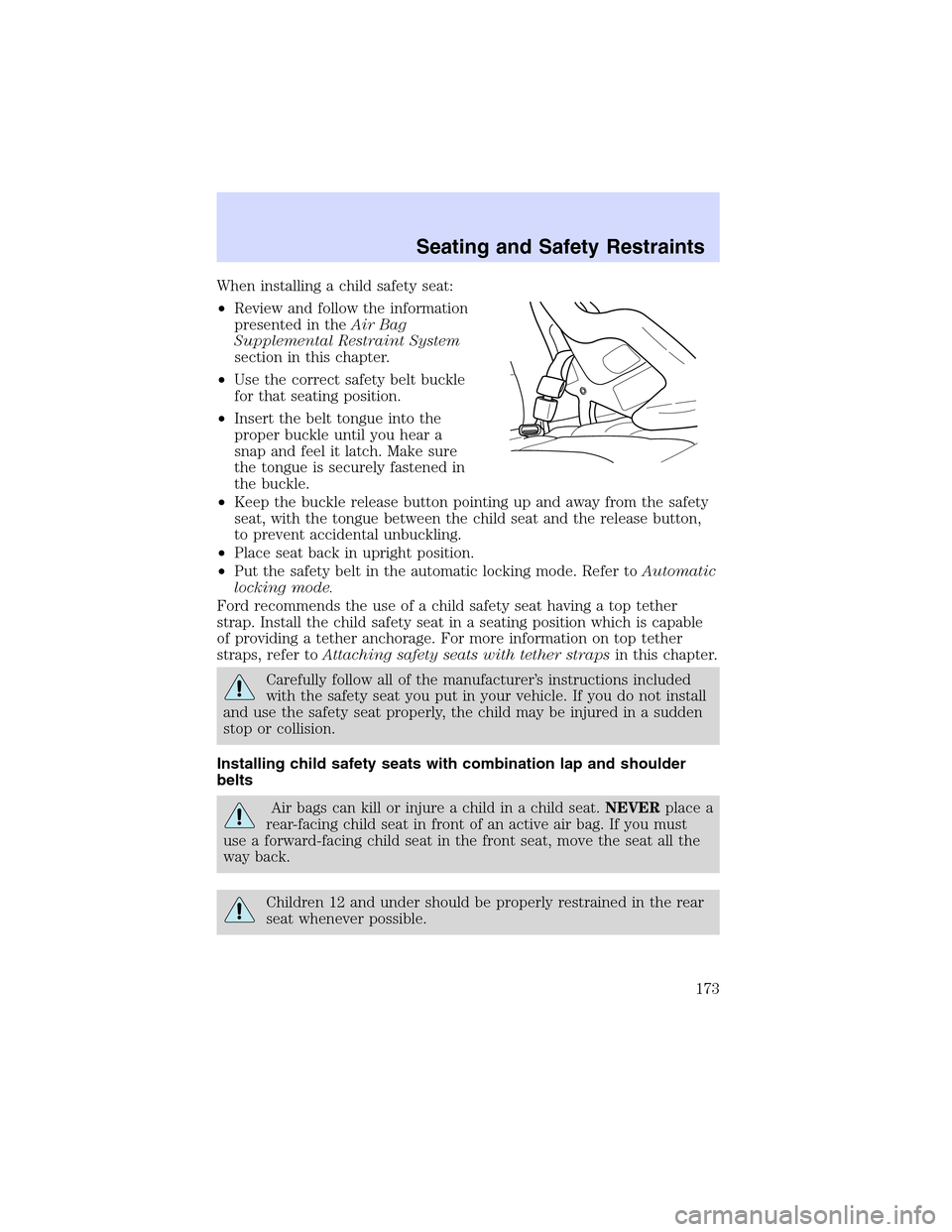
When installing a child safety seat:
•Review and follow the information
presented in theAir Bag
Supplemental Restraint System
section in this chapter.
•Use the correct safety belt buckle
for that seating position.
•Insert the belt tongue into the
proper buckle until you hear a
snap and feel it latch. Make sure
the tongue is securely fastened in
the buckle.
•Keep the buckle release button pointing up and away from the safety
seat, with the tongue between the child seat and the release button,
to prevent accidental unbuckling.
•Place seat back in upright position.
•Put the safety belt in the automatic locking mode. Refer toAutomatic
locking mode.
Ford recommends the use of a child safety seat having a top tether
strap. Install the child safety seat in a seating position which is capable
of providing a tether anchorage. For more information on top tether
straps, refer toAttaching safety seats with tether strapsin this chapter.
Carefully follow all of the manufacturer’s instructions included
with the safety seat you put in your vehicle. If you do not install
and use the safety seat properly, the child may be injured in a sudden
stop or collision.
Installing child safety seats with combination lap and shoulder
belts
Air bags can kill or injure a child in a child seat.NEVERplace a
rear-facing child seat in front of an active air bag. If you must
use a forward-facing child seat in the front seat, move the seat all the
way back.
Children 12 and under should be properly restrained in the rear
seat whenever possible.
Seating and Safety Restraints
173
Page 176 of 288
8.Allowthesafetybelttoretract to
remove any slack in the belt.
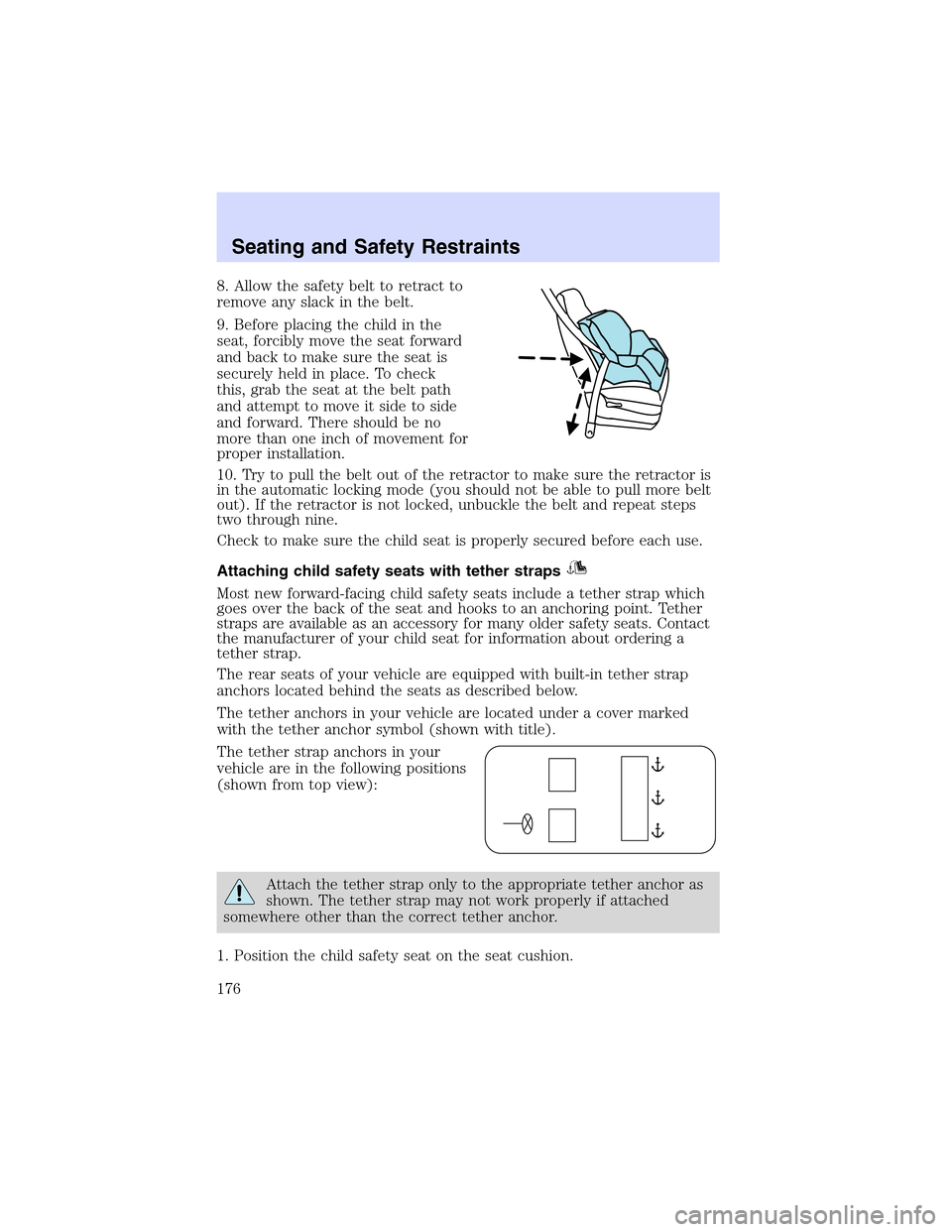
9. Before placing the child in the
seat, forcibly move the seat forward
and back to make sure the seat is
securely held in place. To check
this, grab the seat at the belt path
and attempt to move it side to side
and forward. There should be no
more than one inch of movement for
proper installation.
10. Try to pull the belt out of the retractor to make sure the retractor is
in the automatic locking mode (you should not be able to pull more belt
out). If the retractor is not locked, unbuckle the belt and repeat steps
two through nine.
Check to make sure the child seat is properly secured before each use.
Attaching child safety seats with tether straps
Most new forward-facing child safety seats include a tether strap which
goes over the back of the seat and hooks to an anchoring point. Tether
straps are available as an accessory for many older safety seats. Contact
the manufacturer of your child seat for information about ordering a
tether strap.
The rear seats of your vehicle are equipped with built-in tether strap
anchors located behind the seats as described below.
The tether anchors in your vehicle are located under a cover marked
with the tether anchor symbol (shown with title).
The tether strap anchors in your
vehicle are in the following positions
(shown from top view):
Attach the tether strap only to the appropriate tether anchor as
shown. The tether strap may not work properly if attached
somewhere other than the correct tether anchor.
1. Position the child safety seat on the seat cushion.
Seating and Safety Restraints
176
Page 177 of 288
2. Route the child safety seat tether strap over the back of the seat.
For vehicles with adjustable head restraints, route the tether strap under
the head restraint and between the head restraint posts, otherwise route
the tether strap over the top of the seatback.
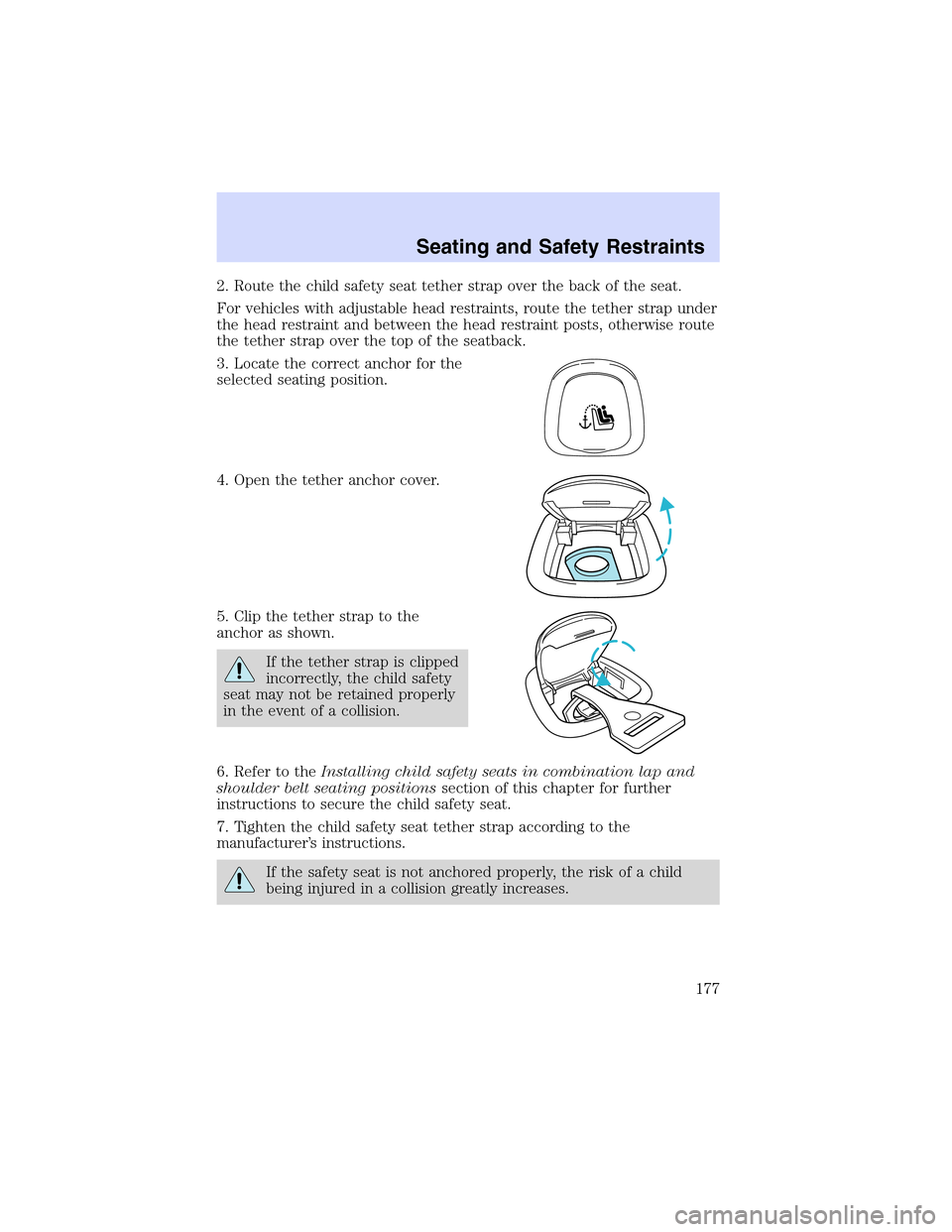
3. Locate the correct anchor for the
selected seating position.
4. Open the tether anchor cover.
5. Clip the tether strap to the
anchor as shown.
If the tether strap is clipped
incorrectly, the child safety
seat may not be retained properly
in the event of a collision.
6. Refer to theInstalling child safety seats in combination lap and
shoulder belt seating positionssection of this chapter for further
instructions to secure the child safety seat.
7. Tighten the child safety seat tether strap according to the
manufacturer’s instructions.
If the safety seat is not anchored properly, the risk of a child
being injured in a collision greatly increases.
Seating and Safety Restraints
177
Page 178 of 288
Attaching safety seats with LATCH (Lower Anchors and Tethers for
Children) attachments for child seat anchors
Some child safety seats have two rigid or webbing mounted attachments
that connect to two anchors at certain seating positions in your vehicle.
This type of child seat eliminates the need to use seat belts to attach the
child seat. For forward-facing child seats, the tether strap must also be
attached to the proper tether anchor. SeeAttaching safety seats with
tether strapsin this chapter.
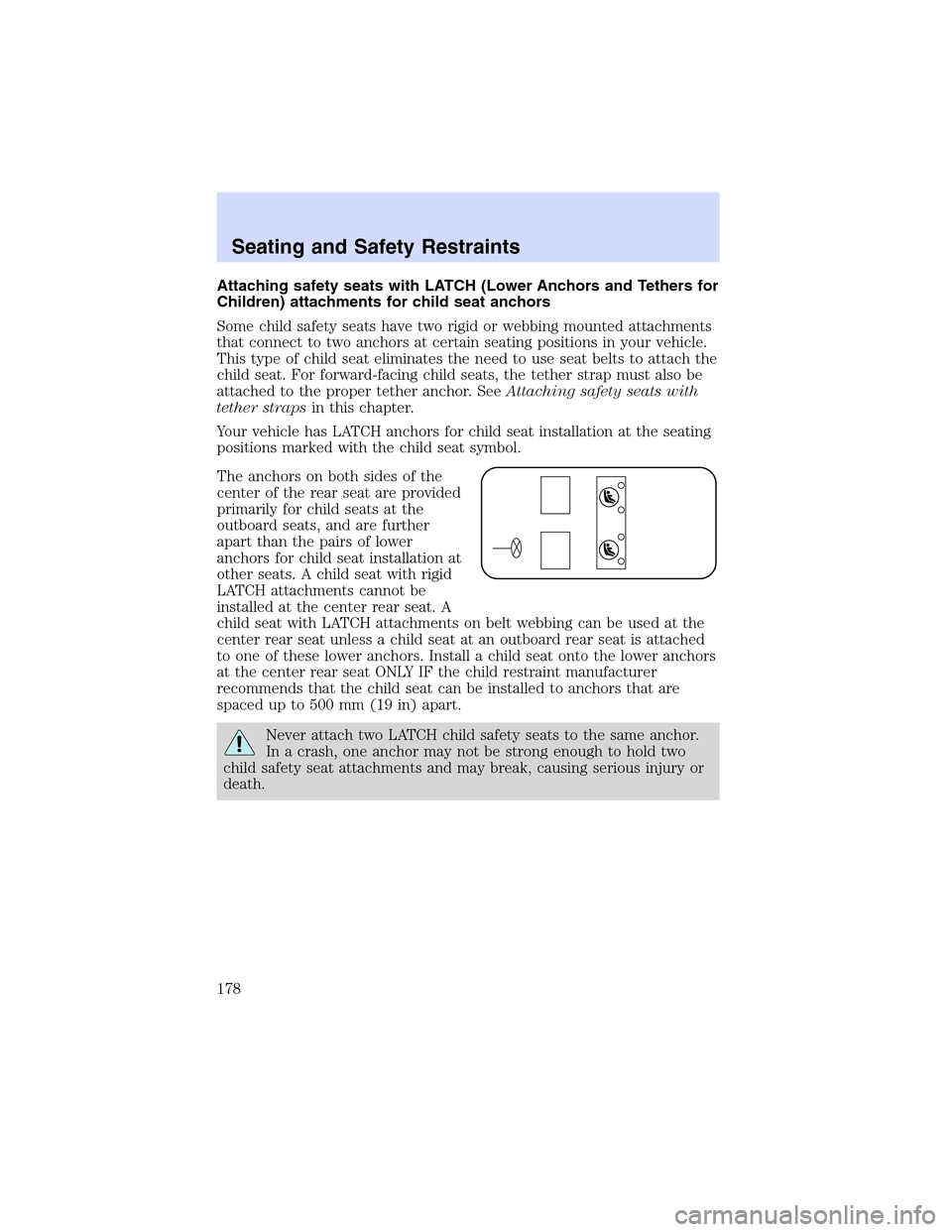
Your vehicle has LATCH anchors for child seat installation at the seating
positions marked with the child seat symbol.
The anchors on both sides of the
center of the rear seat are provided
primarily for child seats at the
outboard seats, and are further
apart than the pairs of lower
anchors for child seat installation at
other seats. A child seat with rigid
LATCH attachments cannot be
installed at the center rear seat. A
child seat with LATCH attachments on belt webbing can be used at the
center rear seat unless a child seat at an outboard rear seat is attached
to one of these lower anchors. Install a child seat onto the lower anchors
at the center rear seat ONLY IF the child restraint manufacturer
recommends that the child seat can be installed to anchors that are
spaced up to 500 mm (19 in) apart.
Never attach two LATCH child safety seats to the same anchor.
In a crash, one anchor may not be strong enough to hold two
child safety seat attachments and may break, causing serious injury or
death.
Seating and Safety Restraints
178
Page 179 of 288
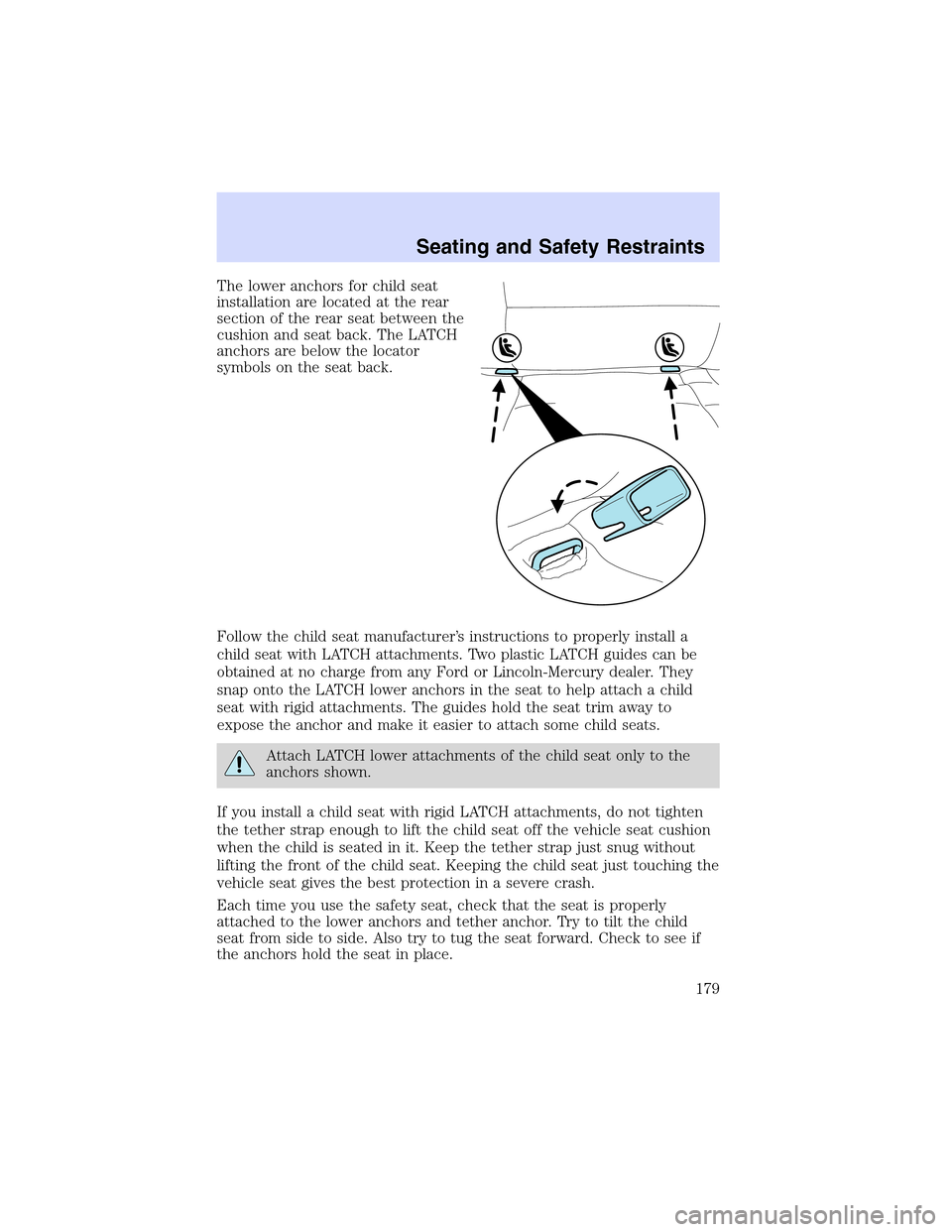
The lower anchors for child seat
installation are located at the rear
section of the rear seat between the
cushion and seat back. The LATCH
anchors are below the locator
symbols on the seat back.
Follow the child seat manufacturer’s instructions to properly install a
child seat with LATCH attachments. Two plastic LATCH guides can be
obtained at no charge from any Ford or Lincoln-Mercury dealer. They
snap onto the LATCH lower anchors in the seat to help attach a child
seat with rigid attachments. The guides hold the seat trim away to
expose the anchor and make it easier to attach some child seats.
Attach LATCH lower attachments of the child seat only to the
anchors shown.
If you install a child seat with rigid LATCH attachments, do not tighten
the tether strap enough to lift the child seat off the vehicle seat cushion
when the child is seated in it. Keep the tether strap just snug without
lifting the front of the child seat. Keeping the child seat just touching the
vehicle seat gives the best protection in a severe crash.
Each time you use the safety seat, check that the seat is properly
attached to the lower anchors and tether anchor. Try to tilt the child
seat from side to side. Also try to tug the seat forward. Check to see if
the anchors hold the seat in place.
Seating and Safety Restraints
179
Page 210 of 288
The high-current fuses are coded as follows.
Fuse/Relay
LocationFuse Amp
RatingPower Distribution Box
Description
1 15A* Decklid release solenoid,
Passenger door lock motors,
Steering column lock
2 10A* Right rear turn lamp, License
plate lamp
3 5A* Left rear stop/tail lamp
4 10A* Fuel door release solenoid,
Decklid lamp
5 10A* Courtesy and map lamps, Radio
antenna module
6 10A* Left rear turn and back-up lamps
7 5A* Right rear stop/tail lamp
8 5A* Center high-mounted stop lamp
9 5A* Heated mirror
10 20A* Power point - console
11 20A* Rear heated seats
12 20A* Power point - ashtray
13—Not used
14 10A* Navigation unit
15 5A* Alternator sense
123456789 19 20 21 22 23 24 25> PBT <
MINI-FUSE
SEE OWNER'S MANUAL CONSULTER LA GUIDECARTRIDGE FUSE
26 27 28 29 30 31 32 10 11
RELAY
001
12 13 14 15 16 17 18
RELAY
002RELAY
003RELAY
004RELAY
005RELAY
006RELAY
007
DIODE 01
DIODE 02
Roadside Emergencies
210
Page 211 of 288
Fuse/Relay
LocationFuse Amp
RatingPower Distribution Box
Description
16 20A* Moonroof
17 15A* Fuel pump motor
18 20A* Navigation amp, Subwoofer
19 20A** REM - Left rear window
20 30A** Front window motors
21 20A** Driver lumbar, Power seats
22 20A** Ignition switch
23 30A** SSP4
24 30A** SSP3
25 40A** P-J/B
26 30A** Climate control seat module
27 30A** SSP1
28 20A** Passenger lumbar, Power seats
29 40A** Rear defroster
30 20A** REM - Right rear window
31 30A** Powertrain main power
32 30A** SSP2
Relay 001—SSP1
Relay 002—SSP4
Relay 003—Rear defroster
Relay 004—SSP3
Relay 005—SSP2
Relay 006—Not used
Relay 007—Fuel pump motor
Diode 01—Not used
Diode 02—Fuel pump motor
*Mini fuses **Maxi fuses
CHANGING THE TIRES
If you get a flat tire while driving, do not apply the brake heavily.
Instead, gradually decrease your speed. Hold the steering wheel firmly
and slowly move to a safe place on the side of the road.
Roadside Emergencies
211