2003 LINCOLN LS air condition
[x] Cancel search: air conditionPage 253 of 288
•NEVER decrease the coolant concentration below 40%.
•Decreased engine coolant concentrations below 40% will
decrease the corrosion protection characteristics of the engine
coolant and may cause engine damage.
•Decreased engine coolant concentrations below 40% will
decrease the freeze protection characteristics of the engine
coolant and may cause engine damage.
•Refer to the chart on the coolant container to ensure the
coolant concentration in your vehicle will provide adequate
protection at the temperatures in which you drive.
Vehicles driven year-round in non-extreme climates should use a 50/50
mixture of engine coolant and distilled water for optimum cooling system
and engine protection.
What you should know about fail-safe cooling
If the engine coolant supply is depleted, this feature allows the vehicle to
be driven temporarily before incremental component damage is incurred.
The“fail-safe”distance depends on ambient temperatures, vehicle load
and terrain.
How fail-safe cooling works
If the engine begins to overheat:
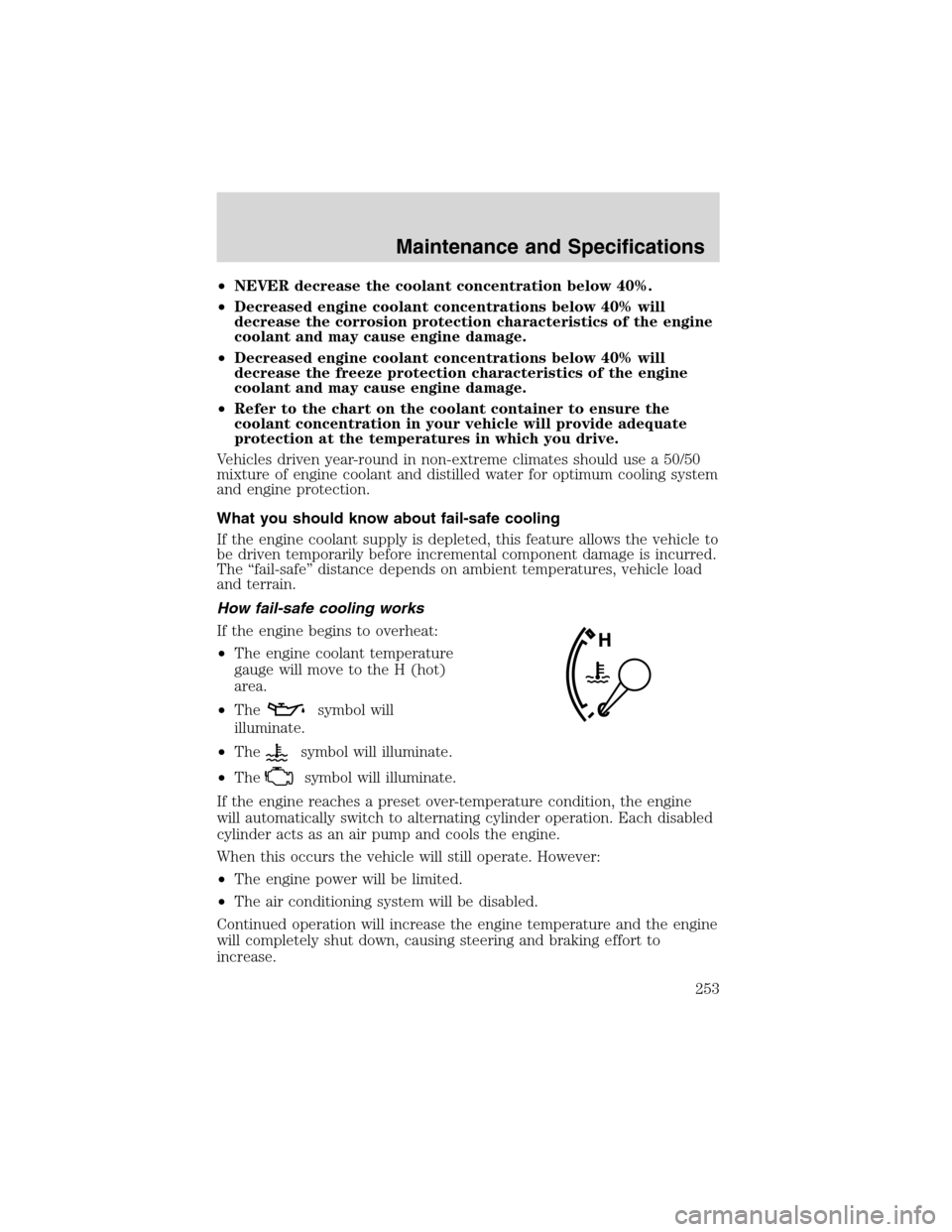
•The engine coolant temperature
gauge will move to the H (hot)
area.
•The
symbol will
illuminate.
•The
symbol will illuminate.
•The
symbol will illuminate.
If the engine reaches a preset over-temperature condition, the engine
will automatically switch to alternating cylinder operation. Each disabled
cylinder acts as an air pump and cools the engine.
When this occurs the vehicle will still operate. However:
•The engine power will be limited.
•The air conditioning system will be disabled.
Continued operation will increase the engine temperature and the engine
will completely shut down, causing steering and braking effort to
increase.
Maintenance and Specifications
253
Page 257 of 288
The fuel system may be under pressure. If the fuel filler cap is
venting vapor or if you hear a hissing sound, wait until it stops
before completely removing the fuel filler cap. Otherwise, fuel may
spray out and injure you or others.
If you do not use the proper fuel filler cap, excessive pressure or
vacuum in the fuel tank may damage the fuel system or cause
the fuel cap to disengage in a collision, which may result in possible
personal injury.
Choosing the right fuel
Use only UNLEADED FUEL. The use of leaded fuel is prohibited by law
and could damage your vehicle.
Do not use fuel containing methanol. It can damage critical fuel system
components.
Your vehicle was not designed to use fuel or fuel additives with metallic
compounds, including manganese-based compounds containing MMT.
Repairs to correct the effects of using a fuel for which your vehicle was
not designed may not be covered by your warranty.
Octane recommendations
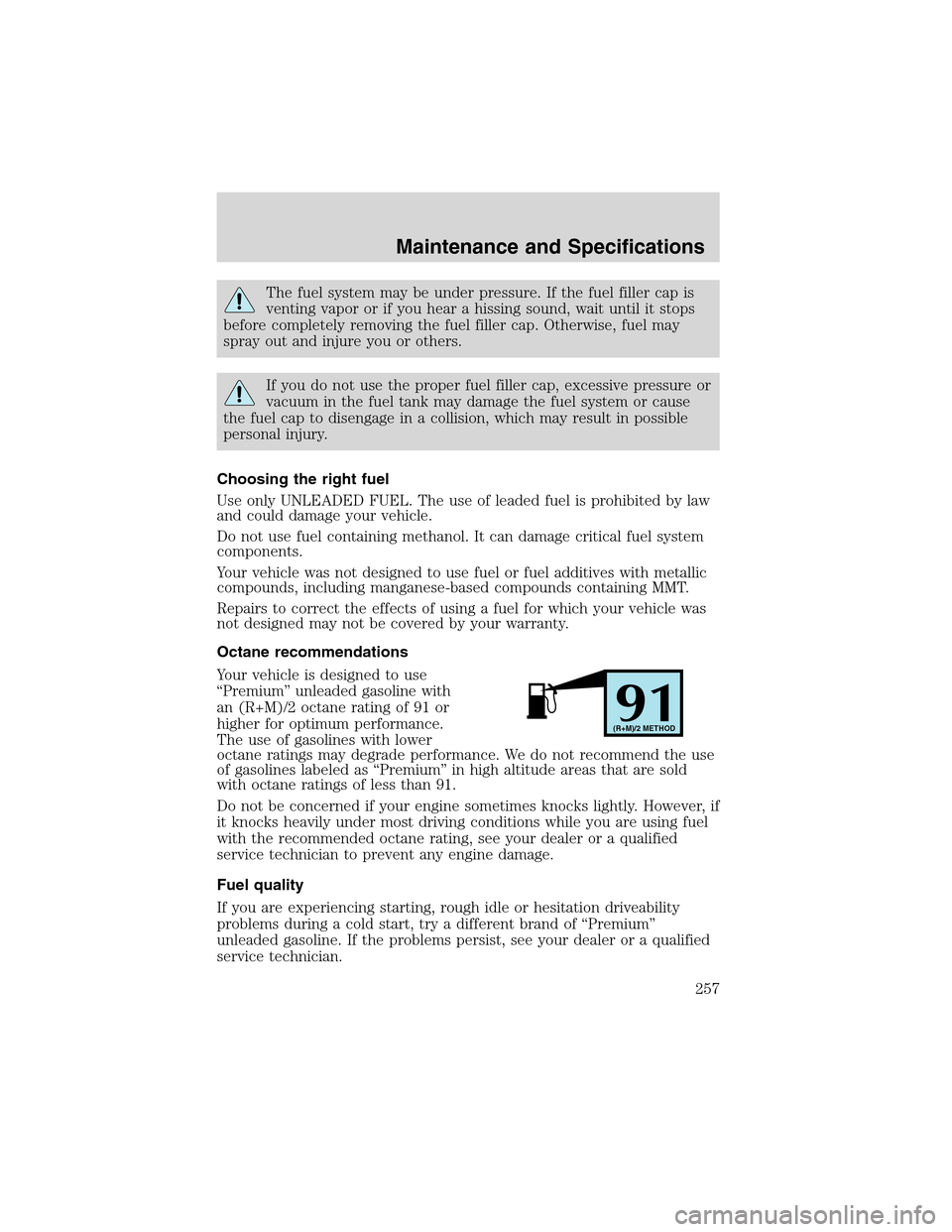
Your vehicle is designed to use
“Premium”unleaded gasoline with
an (R+M)/2 octane rating of 91 or
higher for optimum performance.
The use of gasolines with lower
octane ratings may degrade performance. We do not recommend the use
of gasolines labeled as“Premium”in high altitude areas that are sold
with octane ratings of less than 91.
Do not be concerned if your engine sometimes knocks lightly. However, if
it knocks heavily under most driving conditions while you are using fuel
with the recommended octane rating, see your dealer or a qualified
service technician to prevent any engine damage.
Fuel quality
If you are experiencing starting, rough idle or hesitation driveability
problems during a cold start, try a different brand of“Premium”
unleaded gasoline. If the problems persist, see your dealer or a qualified
service technician.
91(R+M)/2 METHOD
Maintenance and Specifications
257
Page 260 of 288
2. Each time you fill the tank, record the amount of fuel added (in liters
or gallons).
3. After at least three to five tank fill-ups, fill the fuel tank and record
the current odometer reading.
4. Subtract your initial odometer reading from the current odometer
reading.
5. Follow one of the simple calculations in order to determine fuel
economy:
Calculation 1:Multiply liters used by 100, then divide by total
kilometers traveled.
Calculation 2:Divide total miles traveled by total gallons used.
Keep a record for at least one month and record the type of driving (city
or highway). This will provide an accurate estimate of the vehicle’s fuel
economy under current driving conditions. Additionally, keeping records
during summer and winter will show how temperature impacts fuel
economy. In general, lower temperatures give lower fuel economy.
Driving style—good driving and fuel economy habits
Give consideration to the lists that follow and you may be able to change
a number of variables and improve your fuel economy.
Habits
•Smooth, moderate operation can yield up to 10% savings in fuel.
•Steady speeds without stopping will usually give the best fuel
economy.
•Idling for long periods of time (greater than one minute) may waste
fuel.
•Anticipate stopping; slowing down may eliminate the need to stop.
•Sudden or hard accelerations may reduce fuel economy.
•Slow down gradually.
•Driving at reasonable speeds (traveling at 88 km/h [55 mph] uses 15%
less fuel than traveling at 105 km/h [65 mph]).
•Revving the engine before turning it off may reduce fuel economy.
•Using the air conditioner or defroster may reduce fuel economy.
•You may want to turn off the speed control in hilly terrain if
unnecessary shifting between third and fourth gear occurs.
Unnecessary shifting of this type could result in reduced fuel
economy.
Maintenance and Specifications
260
Page 262 of 288
It is important to note the box in the lower left corner of the window
sticker. These numbers represent the Range of L/100 km (MPG)
expected on the vehicle under optimum conditions. Your fuel economy
may vary depending upon the method of operation and conditions.
EMISSION CONTROL SYSTEM
Your vehicle is equipped with various emission control components and a
catalytic converter which will enable your vehicle to comply with
applicable exhaust emission standards. To make sure that the catalytic
converter and other emission control components continue to work
properly:
•Use only the specified fuel listed.
•Avoid running out of fuel.
•Do not turn off the ignition while your vehicle is moving, especially at
high speeds.
•Have the items listed in your scheduled maintenance guide performed
according to the specified schedule.
The scheduled maintenance items listed in the scheduled maintenance
guide are essential to the life and performance of your vehicle and to its
emissions system.
If other than Ford, Motorcraft or Ford-authorized parts are used for
maintenance replacements or for service of components affecting
emission control, such non-Ford parts should be equivalent to genuine
Ford Motor Company parts in performance and durability.
Do not park, idle, or drive your vehicle in dry grass or other dry
ground cover. The emission system heats up the engine
compartment and exhaust system, which can start a fire.
Illumination of the“Check Engine”light, charging system warning light
or the temperature warning light, fluid leaks, strange odors, smoke or
loss of engine power, could indicate that the emission control system is
not working properly.
Exhaust leaks may result in entry of harmful and potentially
lethal fumes into the passenger compartment.
Do not make any unauthorized changes to your vehicle or engine. By
law, vehicle owners and anyone who manufactures, repairs, services,
sells, leases, trades vehicles, or supervises a fleet of vehicles are not
Maintenance and Specifications
262
Page 281 of 288
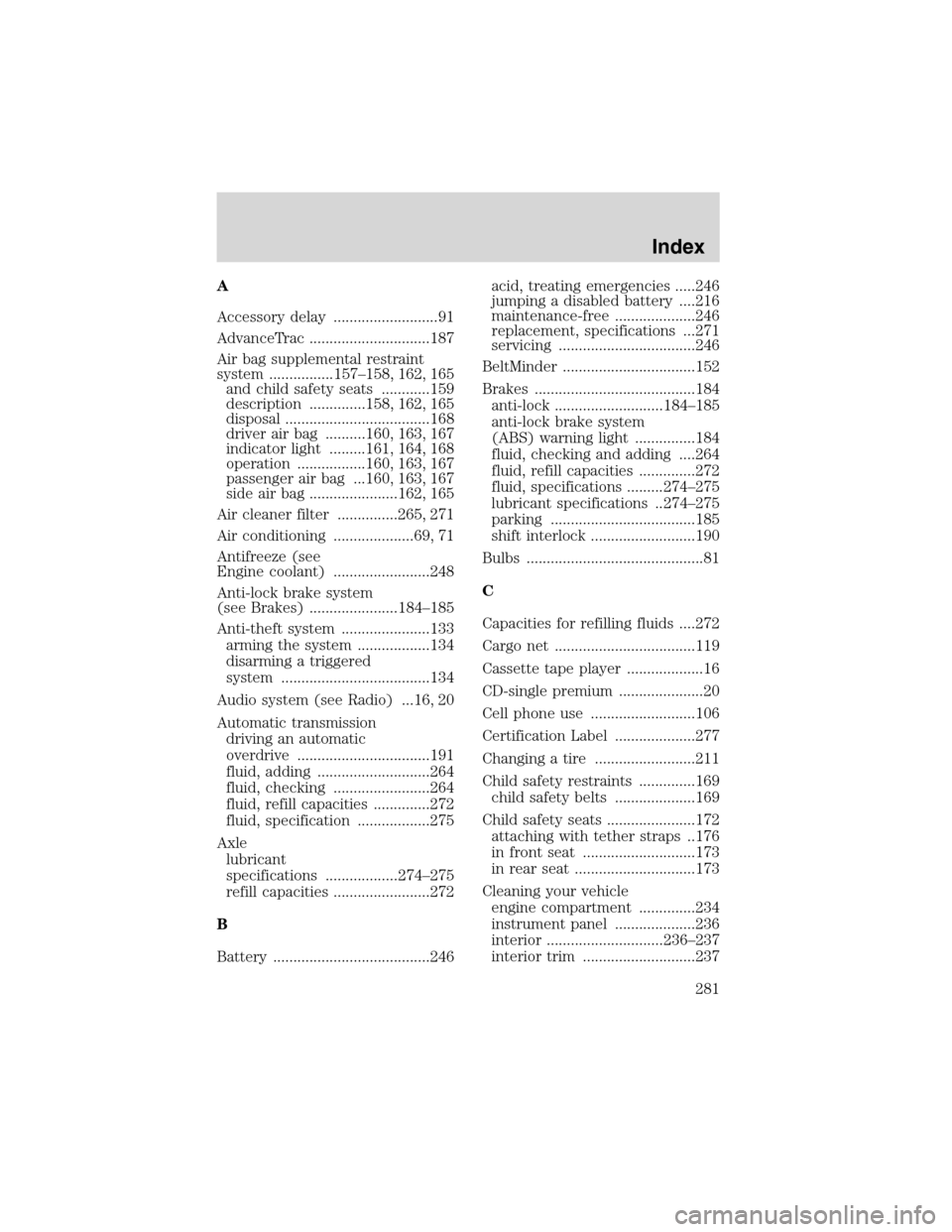
A
Accessory delay ..........................91
AdvanceTrac ..............................187
Air bag supplemental restraint
system ................157–158, 162, 165
and child safety seats ............159
description ..............158, 162, 165
disposal ....................................168
driver air bag ..........160, 163, 167
indicator light .........161, 164, 168
operation .................160, 163, 167
passenger air bag ...160, 163, 167
side air bag ......................162, 165
Air cleaner filter ...............265, 271
Air conditioning ....................69, 71
Antifreeze (see
Engine coolant) ........................248
Anti-lock brake system
(see Brakes) ......................184–185
Anti-theft system ......................133
arming the system ..................134
disarming a triggered
system .....................................134
Audio system (see Radio) ...16, 20
Automatic transmission
driving an automatic
overdrive .................................191
fluid, adding ............................264
fluid, checking ........................264
fluid, refill capacities ..............272
fluid, specification ..................275
Axle
lubricant
specifications ..................274–275
refill capacities ........................272
B
Battery .......................................246acid, treating emergencies .....246
jumping a disabled battery ....216
maintenance-free ....................246
replacement, specifications ...271
servicing ..................................246
BeltMinder .................................152
Brakes ........................................184
anti-lock ...........................184–185
anti-lock brake system
(ABS) warning light ...............184
fluid, checking and adding ....264
fluid, refill capacities ..............272
fluid, specifications .........274–275
lubricant specifications ..274–275
parking ....................................185
shift interlock ..........................190
Bulbs ............................................81
C
Capacities for refilling fluids ....272
Cargo net ...................................119
Cassette tape player ...................16
CD-single premium .....................20
Cell phone use ..........................106
Certification Label ....................277
Changing a tire .........................211
Child safety restraints ..............169
child safety belts ....................169
Child safety seats ......................172
attaching with tether straps ..176
in front seat ............................173
in rear seat ..............................173
Cleaning your vehicle
engine compartment ..............234
instrument panel ....................236
interior .............................236–237
interior trim ............................237
Index
281
Page 282 of 288
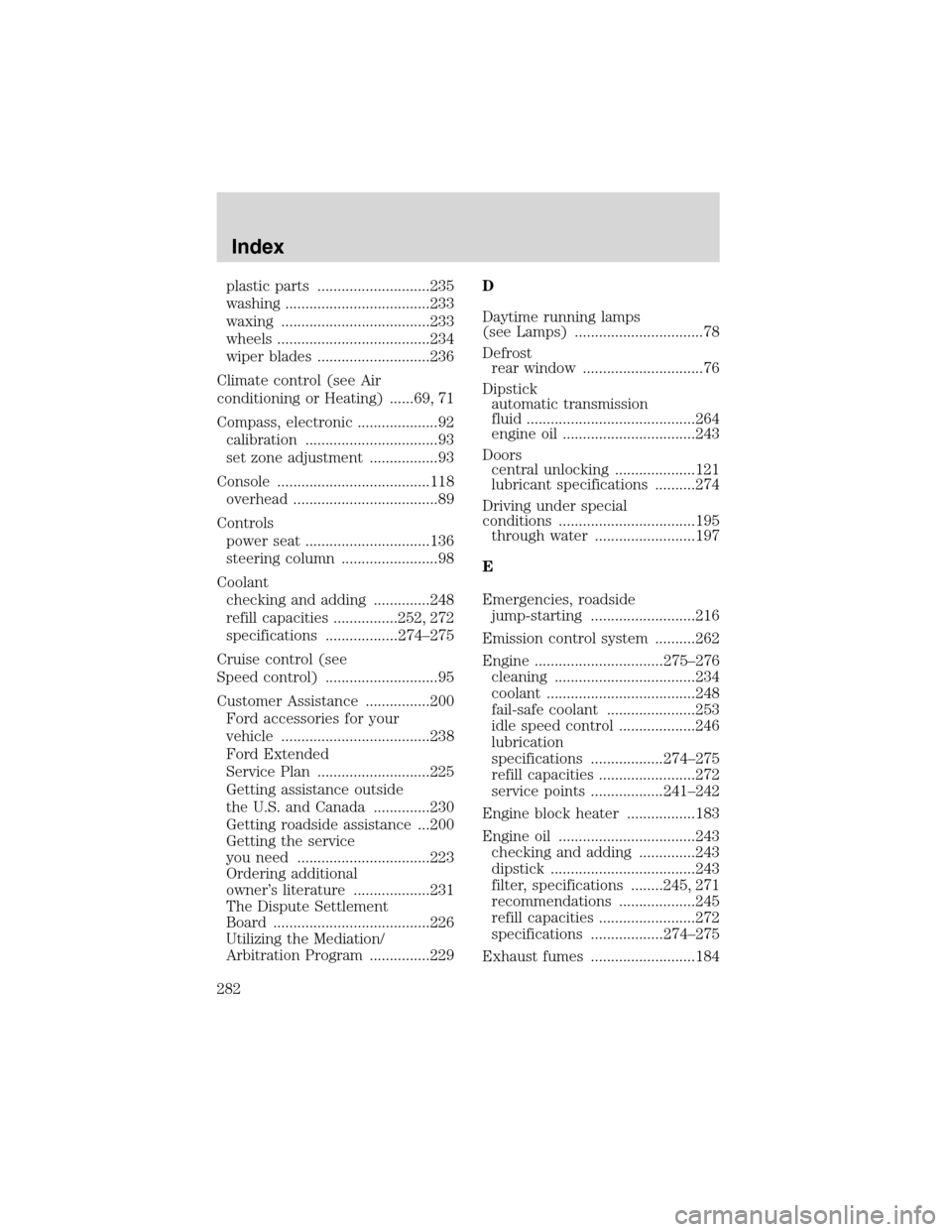
plastic parts ............................235
washing ....................................233
waxing .....................................233
wheels ......................................234
wiper blades ............................236
Climate control (see Air
conditioning or Heating) ......69, 71
Compass, electronic ....................92
calibration .................................93
set zone adjustment .................93
Console ......................................118
overhead ....................................89
Controls
power seat ...............................136
steering column ........................98
Coolant
checking and adding ..............248
refill capacities ................252, 272
specifications ..................274–275
Cruise control (see
Speed control) ............................95
Customer Assistance ................200
Ford accessories for your
vehicle .....................................238
Ford Extended
Service Plan ............................225
Getting assistance outside
the U.S. and Canada ..............230
Getting roadside assistance ...200
Getting the service
you need .................................223
Ordering additional
owner’s literature ...................231
The Dispute Settlement
Board .......................................226
Utilizing the Mediation/
Arbitration Program ...............229D
Daytime running lamps
(see Lamps) ................................78
Defrost
rear window ..............................76
Dipstick
automatic transmission
fluid ..........................................264
engine oil .................................243
Doors
central unlocking ....................121
lubricant specifications ..........274
Driving under special
conditions ..................................195
through water .........................197
E
Emergencies, roadside
jump-starting ..........................216
Emission control system ..........262
Engine ................................275–276
cleaning ...................................234
coolant .....................................248
fail-safe coolant ......................253
idle speed control ...................246
lubrication
specifications ..................274–275
refill capacities ........................272
service points ..................241–242
Engine block heater .................183
Engine oil ..................................243
checking and adding ..............243
dipstick ....................................243
filter, specifications ........245, 271
recommendations ...................245
refill capacities ........................272
specifications ..................274–275
Exhaust fumes ..........................184
Index
282
Page 283 of 288

F
Fail safe cooling ........................253
Floor mats .................................119
Fluid capacities .........................272
Foglamps .....................................78
Fuel ............................................254
calculating fuel economy ......108,
259
cap ...........................................256
capacity ...................................272
choosing the right fuel ...........257
comparisons with EPA
fuel economy estimates .........261
detergent in fuel .....................258
filling your vehicle
with fuel ..................254, 256, 259
filter, specifications ........258, 271
improving fuel economy ........259
octane rating ...........257, 275–276
quality ......................................257
running out of fuel .................258
safety information relating
to automotive fuels ................254
Fuses ..................................202–203
G
Garage door opener ..................102
Gas cap (see Fuel cap) ............256
Gas mileage (see Fuel
economy) ...................................259
Gauges .........................................14
GAWR (Gross Axle
Weight Rating) ..........................198
definition .................................198
driving with a heavy load ......198
location ....................................198GVWR (Gross Vehicle
Weight Rating) ..........................198
calculating ...............................198
definition .................................198
driving with a heavy load ......198
location ....................................198
H
Head restraints .................135, 140
Headlamps ...................................77
aiming ........................................80
autolamp system .......................77
bulb specifications ....................81
daytime running lights .............78
flash to pass ..............................79
replacing bulbs ...................82–83
turning on and off ....................77
Heating
heating and air conditioning
system .................................69, 71
HomeLink universal
transceiver (see Garage
door opener) .............102–103, 105
Hood ..........................................240
I
Ignition .......................181, 275–276
Infant seats
(see Safety seats) .....................172
Inspection/maintenance
(I/M) testing ..............................263
Instrument panel
cleaning ...................................236
cluster ........................................10
lighting up panel
and interior ...............................79
Index
283