2003 LINCOLN LS parking brake
[x] Cancel search: parking brakePage 213 of 288
Tire change procedure
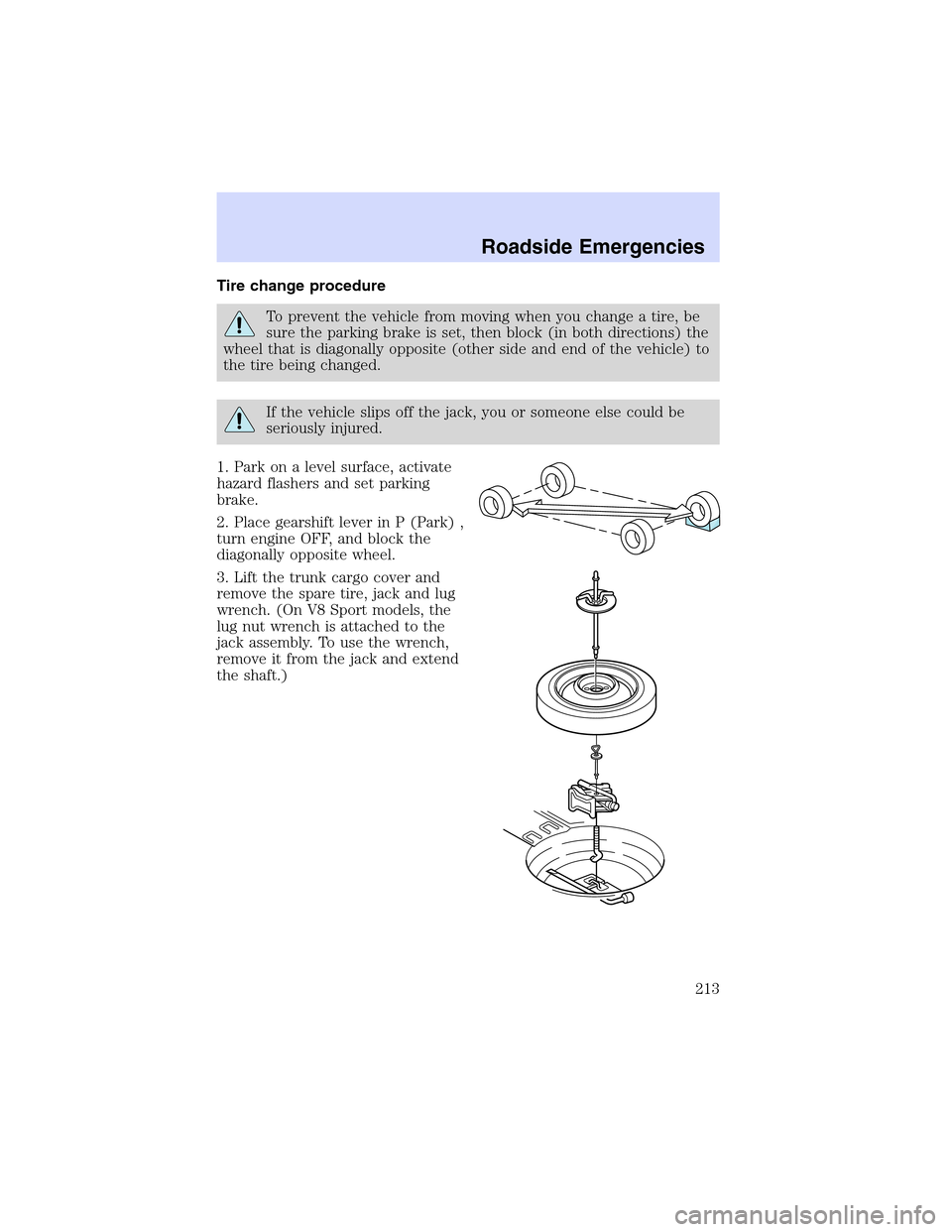
To prevent the vehicle from moving when you change a tire, be
sure the parking brake is set, then block (in both directions) the
wheel that is diagonally opposite (other side and end of the vehicle) to
the tire being changed.
If the vehicle slips off the jack, you or someone else could be
seriously injured.
1. Park on a level surface, activate
hazard flashers and set parking
brake.
2. Place gearshift lever in P (Park) ,
turn engine OFF, and block the
diagonally opposite wheel.
3. Lift the trunk cargo cover and
remove the spare tire, jack and lug
wrench. (On V8 Sport models, the
lug nut wrench is attached to the
jack assembly. To use the wrench,
remove it from the jack and extend
the shaft.)
Roadside Emergencies
213
Page 216 of 288
JUMP STARTING YOUR VEHICLE
The gases around the battery can explode if exposed to flames,
sparks, or lit cigarettes. An explosion could result in injury or
vehicle damage.
Batteries contain sulfuric acid which can burn skin, eyes and
clothing, if contacted.
Do not attempt to push-start your vehicle. Automatic
transmissions do not have push-start capability; also, the
catalytic converter may become damaged.
In the event of battery failure, you can open the trunk by using your
master key on the key cylinderlocated behind the driver’s seat.
Preparing your vehicle
Your battery is located in the trunk of your vehicle.
When the battery is disconnected or a new battery is installed, the
transmission must relearn its shift strategy. As a result, the transmission
may have firm and/or soft shifts. This operation is considered normal and
will not affect function or durability of the transmission. Over time, the
adaptive learning process will fully update transmission operation.
1.Use only a 12–volt supply to start your vehicle.
2. Do not disconnect the battery of your disabled vehicle as this could
damage the vehicle’s electrical system. Keep the battery vent hose
attached at all times.
3. Park the booster vehicle close to the trunk of your disabled vehicle
making sure the two vehiclesdo nottouch. Set the parking brake on
both vehicles and stay clear of the engine cooling fan and other moving
parts.
4. Check all battery terminals and remove any excessive corrosion before
you attach the battery cables. Ensure the vent caps are tight and level.
5. Turn the heater fan on in both vehicles to protect any electrical
surges. Turn all other accessories off.
Roadside Emergencies
216
Page 239 of 288
SERVICE RECOMMENDATIONS
To help you service your vehicle:
•We highlight do-it-yourself items in the engine compartment for easy
location.
•We provide a scheduled maintenance guide which makes tracking
routine service easy.
If your vehicle requires professional service, your dealership can provide
the necessary parts and service. Check yourWarranty Guide/Owner
Information Guideto find out which parts and services are covered.
Use only recommended fuels, lubricants, fluids and service parts
conforming to specifications. Motorcraft parts are designed and built to
provide the best performance in your vehicle.
PRECAUTIONS WHEN SERVICING YOUR VEHICLE
•Do not work on a hot engine.
•Make sure that nothing gets caught in moving parts.
•Do not work on a vehicle with the engine running in an enclosed
space, unless you are sure you have enough ventilation.
•Keep all open flames and other lit material away from the battery and
all fuel related parts.
Working with the engine off
1. Set the parking brake and ensure the gearshift is securely latched in P
(Park).
2. Turn off the engine and remove the key.
3. Block the wheels to prevent the vehicle from moving unexpectedly.
Working with the engine on
1. Set the parking brake and shift to P (Park).
2. Block the wheels.
Note:Do not start your engine with the air cleaner removed and do not
remove it while the engine is running.
Maintenance and Specifications
239
Page 243 of 288
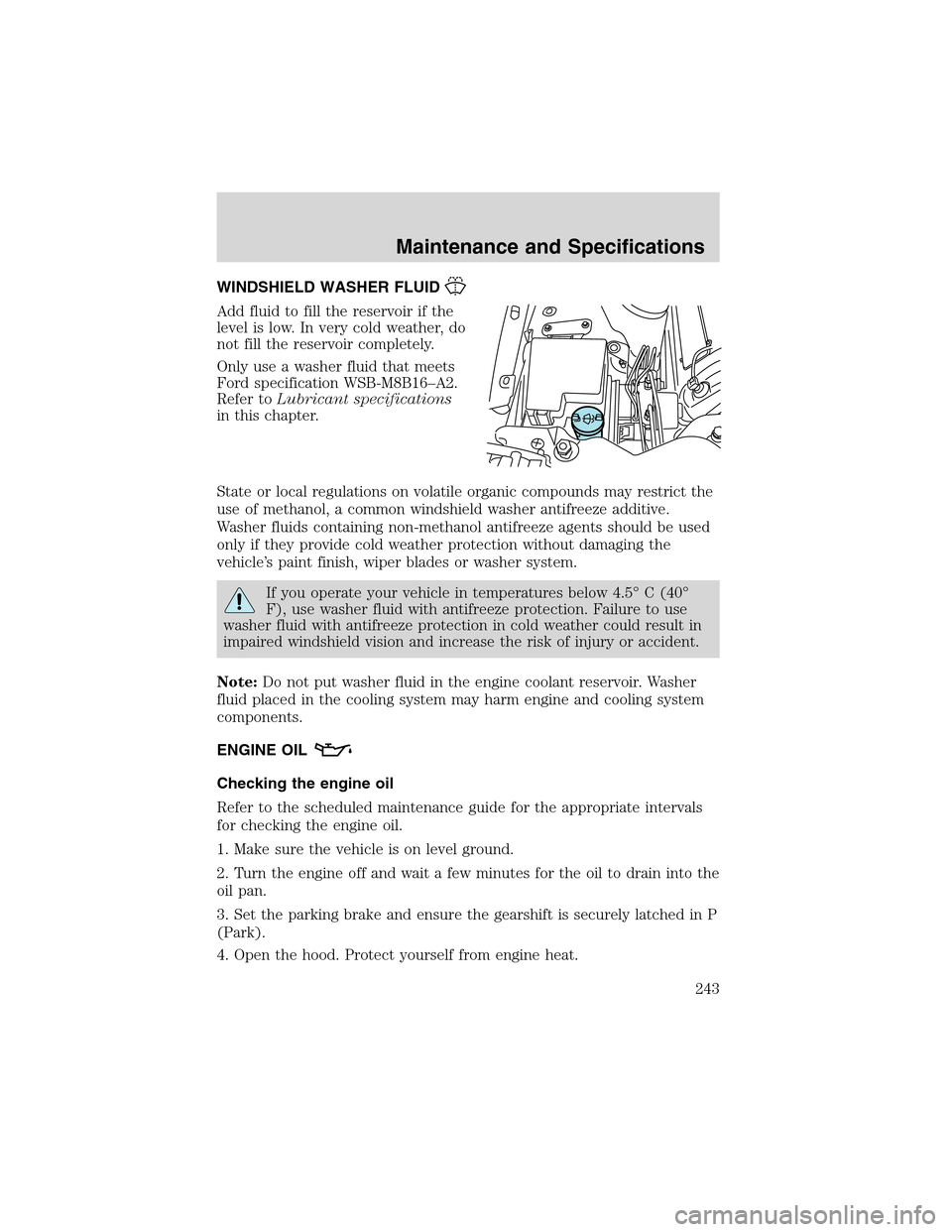
WINDSHIELD WASHER FLUID
Add fluid to fill the reservoir if the
level is low. In very cold weather, do
not fill the reservoir completely.
Only use a washer fluid that meets
Ford specification WSB-M8B16–A2.
Refer toLubricant specifications
in this chapter.
State or local regulations on volatile organic compounds may restrict the
use of methanol, a common windshield washer antifreeze additive.
Washer fluids containing non-methanol antifreeze agents should be used
only if they provide cold weather protection without damaging the
vehicle’s paint finish, wiper blades or washer system.
If you operate your vehicle in temperatures below 4.5°C (40°
F), use washer fluid with antifreeze protection. Failure to use
washer fluid with antifreeze protection in cold weather could result in
impaired windshield vision and increase the risk of injury or accident.
Note:Do not put washer fluid in the engine coolant reservoir. Washer
fluid placed in the cooling system may harm engine and cooling system
components.
ENGINE OIL
Checking the engine oil
Refer to the scheduled maintenance guide for the appropriate intervals
for checking the engine oil.
1. Make sure the vehicle is on level ground.
2. Turn the engine off and wait a few minutes for the oil to drain into the
oil pan.
3. Set the parking brake and ensure the gearshift is securely latched in P
(Park).
4. Open the hood. Protect yourself from engine heat.
Maintenance and Specifications
243
Page 247 of 288
Keep batteries out of reach of children. Batteries contain sulfuric
acid. Avoid contact with skin, eyes or clothing. Shield your eyes
when working near the battery to protect against possible splashing of
acid solution. In case of acid contact with skin or eyes, flush
immediately with water for a minimum of 15 minutes and get prompt
medical attention. If acid is swallowed, call a physician immediately.
Battery posts, terminals and related accessories contain lead and
lead compounds.Wash hands after handling.
Because your vehicle’s engine is electronically controlled by a computer,
some control conditions are maintained by power from the battery. When
the battery is disconnected or a new battery is installed, the engine must
relearn its idle and fuel trim strategy for optimum driveability and
performance. To begin this process:
1. With the vehicle at a complete stop, set the parking brake (Refer to
Parking Brakein theDrivingchapter for information on how to
properly reset parking brake.).
2. Put the gearshift lever in P (Park), turn off all accessories and start
the engine.
3. Run the engine until it reaches normal operating temperature.
4. Allow the engine to idle for at least one minute.
5. Turn the A/C on and allow the engine to idle for at least one minute.
6. Drive the vehicle to complete the relearning process.
•The vehicle may need to be driven to relearn the idle and fuel trim
strategy.
•If you do not allow the engine to relearn its idle trim, the idle
quality of your vehicle may be adversely affected until the idle
trim is eventually relearned.
When the battery is disconnected or a new battery installed, the
transmission must relearn its adaptive strategy. As a result of this, the
transmission may shift firmly. This operation is considered normal and
will not affect function or durability of the transmission. Over time the
adaptive learning process will fully update transmission operation to its
optimum shift feel.
If the battery has been disconnected or a new battery has been installed,
the clock and the preset radio stations must be reset once the battery is
reconnected.
Maintenance and Specifications
247
Page 281 of 288
A
Accessory delay ..........................91
AdvanceTrac ..............................187
Air bag supplemental restraint
system ................157–158, 162, 165
and child safety seats ............159
description ..............158, 162, 165
disposal ....................................168
driver air bag ..........160, 163, 167
indicator light .........161, 164, 168
operation .................160, 163, 167
passenger air bag ...160, 163, 167
side air bag ......................162, 165
Air cleaner filter ...............265, 271
Air conditioning ....................69, 71
Antifreeze (see
Engine coolant) ........................248
Anti-lock brake system
(see Brakes) ......................184–185
Anti-theft system ......................133
arming the system ..................134
disarming a triggered
system .....................................134
Audio system (see Radio) ...16, 20
Automatic transmission
driving an automatic
overdrive .................................191
fluid, adding ............................264
fluid, checking ........................264
fluid, refill capacities ..............272
fluid, specification ..................275
Axle
lubricant
specifications ..................274–275
refill capacities ........................272
B
Battery .......................................246acid, treating emergencies .....246
jumping a disabled battery ....216
maintenance-free ....................246
replacement, specifications ...271
servicing ..................................246
BeltMinder .................................152
Brakes ........................................184
anti-lock ...........................184–185
anti-lock brake system
(ABS) warning light ...............184
fluid, checking and adding ....264
fluid, refill capacities ..............272
fluid, specifications .........274–275
lubricant specifications ..274–275
parking ....................................185
shift interlock ..........................190
Bulbs ............................................81
C
Capacities for refilling fluids ....272
Cargo net ...................................119
Cassette tape player ...................16
CD-single premium .....................20
Cell phone use ..........................106
Certification Label ....................277
Changing a tire .........................211
Child safety restraints ..............169
child safety belts ....................169
Child safety seats ......................172
attaching with tether straps ..176
in front seat ............................173
in rear seat ..............................173
Cleaning your vehicle
engine compartment ..............234
instrument panel ....................236
interior .............................236–237
interior trim ............................237
Index
281
Page 284 of 288

J
Jack ............................................211
positioning ...............................211
storage .....................................211
Jump-starting your vehicle ......216
K
Keyless entry system ...............129
autolock ...................................128
Keys ...........................................120
positions of the ignition .........181
valet key ..................................120
L
Lamps
autolamp system .......................77
bulb replacement
specifications chart ..................81
cargo lamps ...............................79
daytime running light ...............78
fog lamps ...................................78
headlamps .................................77
headlamps, flash to pass ..........79
instrument panel, dimming .....79
interior lamps .....................81–82
replacing bulbs ...................81–85
Lane change indicator
(see Turn signal) ........................81
Lights, warning and indicator ....10
anti-lock brakes (ABS) ..........184
Load limits .................................198
GAWR ......................................198
GVWR ......................................198
trailer towing ..........................198
Locks
autolock ...................................128
childproof ................................122doors ........................................120
Lubricant specifications ...274–275
Lug nuts, anti-theft ...................215
Lumbar support, seats .............136
M
Message center .................106, 108
select button ...........................106
warning messages ...................110
Mirrors ...................................89, 92
automatic dimming
rearview mirror .........................92
fold away ...................................95
heated ........................................94
programmable memory ..........128
side view mirrors (power) .......94
Moon roof ..................................101
Motorcraft parts ................258, 271
N
Navigation system .......................24
cd functions ..............................35
destination mode ......................48
map mode .................................39
quick start .................................27
radio functions ..........................29
O
Octane rating ............................257
Oil (see Engine oil) ..................243
P
Parking brake ............................185
Parts (see Motorcraft parts) ....271
Index
284