Page 156 of 288
Installing child safety seats with combination lap and shoulder
belts
Air bags can kill or injure a child in a child seat.NEVERplace a
rear-facing child seat in front of an active air bag. If you must
use a forward-facing child seat in the front seat, move the seat all the
way back.
Children 12 and under should be properly restrained in the rear
seat whenever possible.
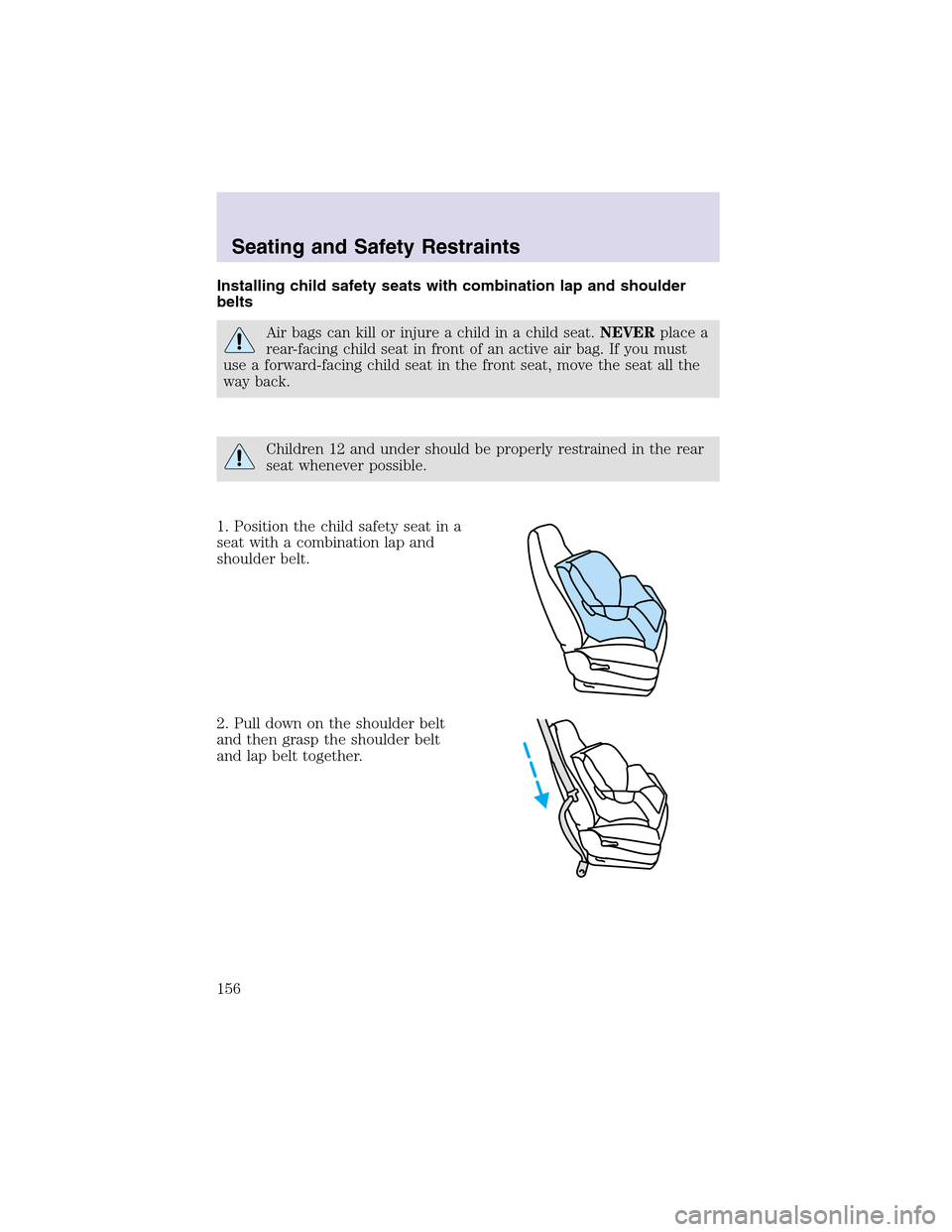
1. Position the child safety seat in a
seat with a combination lapand
shoulder belt.
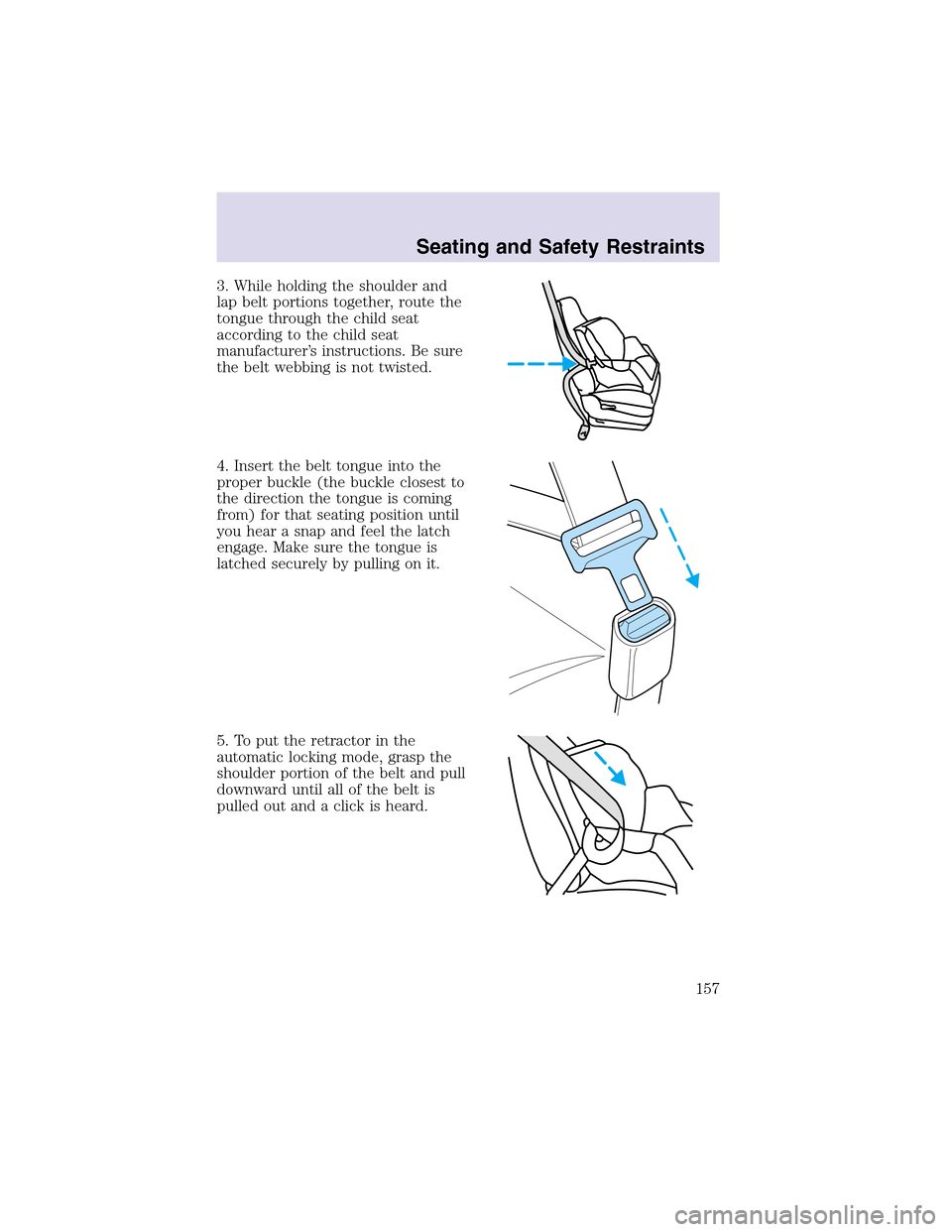
2. Pull down on the shoulder belt
and then graspthe shoulder belt
and lapbelt together.
Seating and Safety Restraints
156
Page 157 of 288
3. While holding the shoulder and
lapbelt portions together, route the
tongue through the child seat
according to the child seat
manufacturer’s instructions. Be sure
the belt webbing is not twisted.
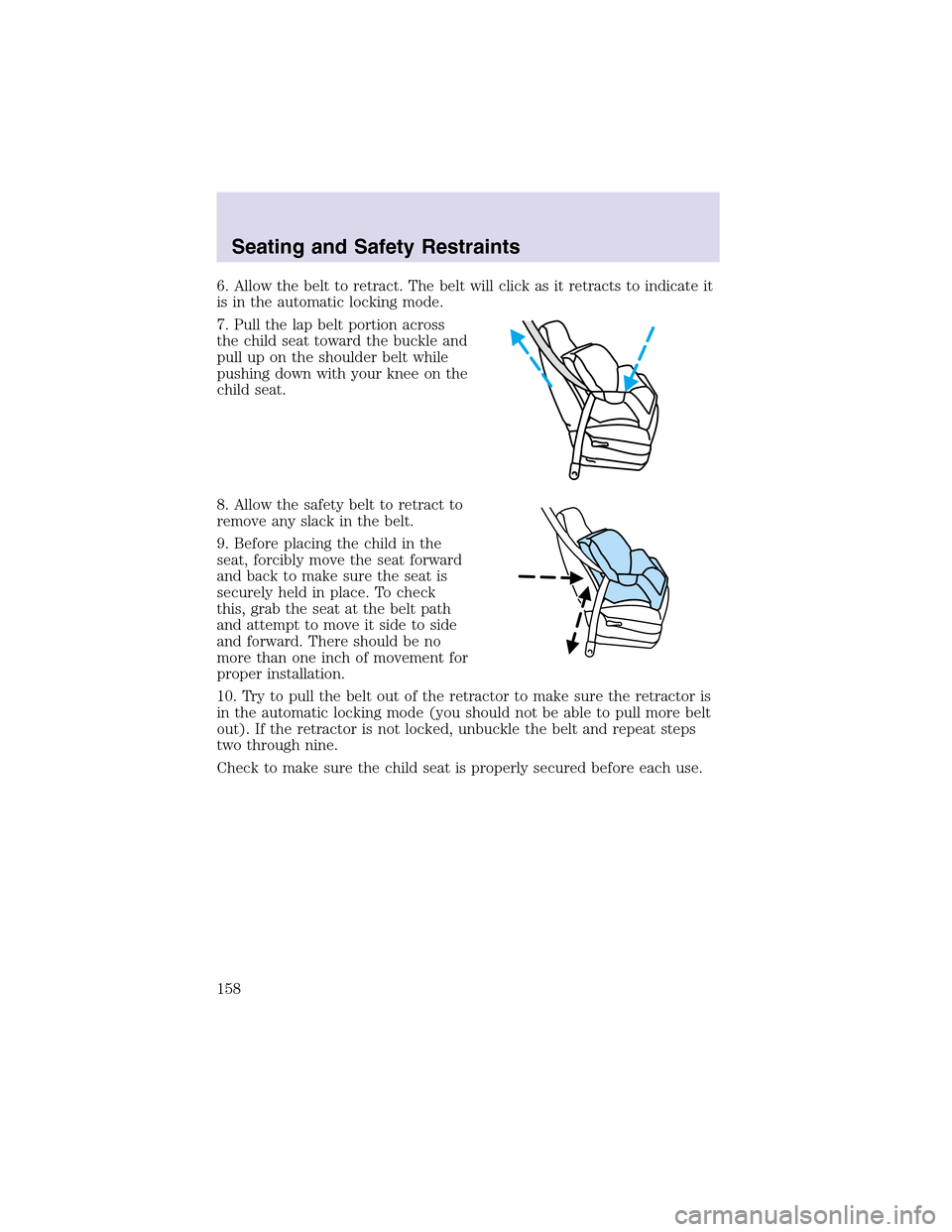
4. Insert the belt tongue into the
proper buckle (the buckle closest to
the direction the tongue is coming
from) for that seating position until
you hear a snapand feel the latch
engage. Make sure the tongue is
latched securely by pulling on it.
5. To put the retractor in the
automatic locking mode, graspthe
shoulder portion of the belt and pull
downward until all of the belt is
pulled out and a click is heard.
Seating and Safety Restraints
157
Page 158 of 288
6. Allow the belt to retract. The belt will click as it retracts to indicate it
is in the automatic locking mode.
7. Pull the lapbelt portion across
the child seat toward the buckle and
pull up on the shoulder belt while
pushing down with your knee on the
child seat.
8. Allow the safety belt to retract to
remove any slack in the belt.
9. Before placing the child in the
seat, forcibly move the seat forward
and back to make sure the seat is
securely held in place. To check
this, grab the seat at the belt path
and attempt to move it side to side
and forward. There should be no
more than one inch of movement for
proper installation.
10. Try to pull the belt out of the retractor to make sure the retractor is
in the automatic locking mode (you should not be able to pull more belt
out). If the retractor is not locked, unbuckle the belt and repeat steps
two through nine.
Check to make sure the child seat is properly secured before each use.
Seating and Safety Restraints
158
Page 159 of 288
Attaching child safety seats with tether straps
Most new forward-facing child safety seats include a tether strapwhich
goes over the back of the seat and hooks to an anchoring point. Tether
straps are available as an accessory for many older safety seats. Contact
the manufacturer of your child seat for information about ordering a
tether strap.
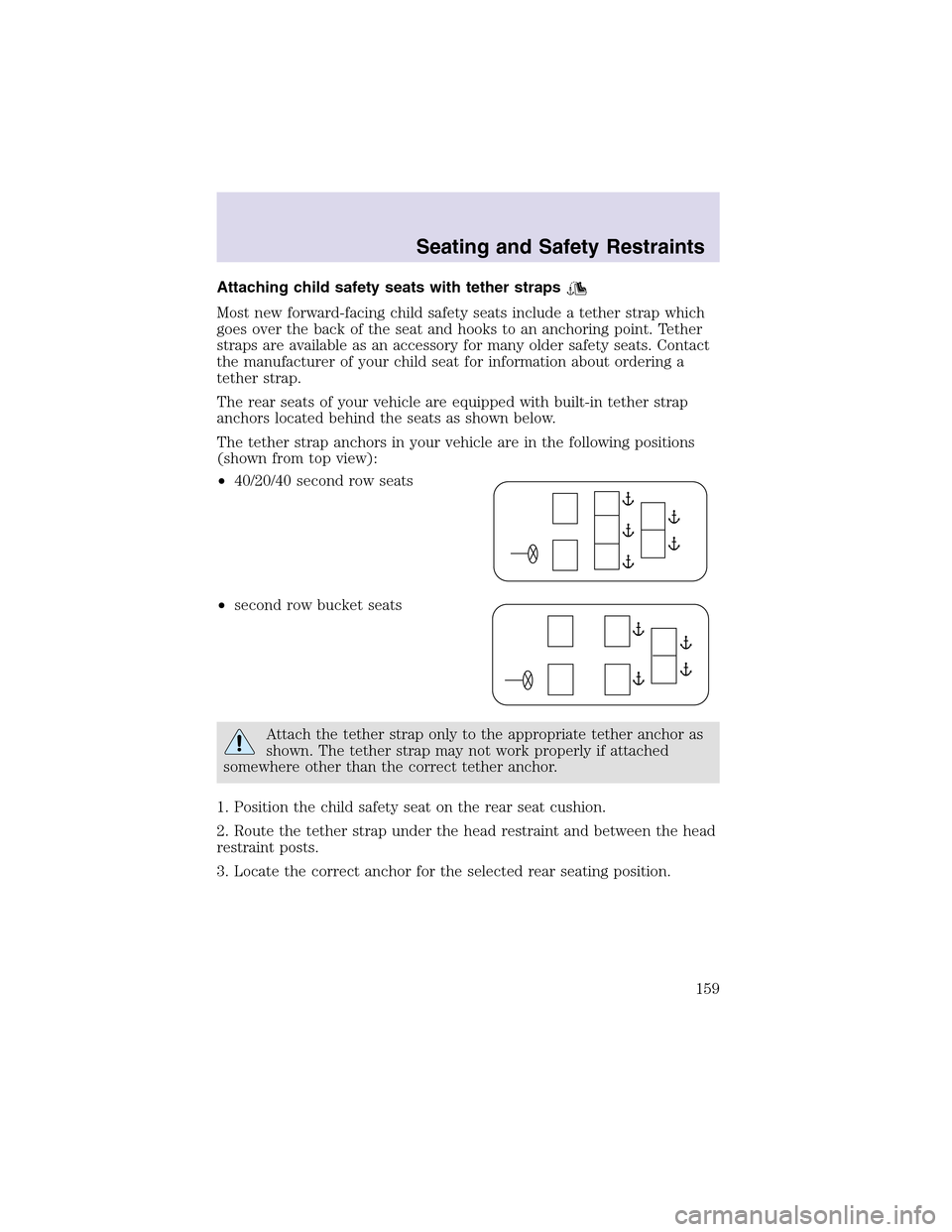
The rear seats of your vehicle are equipped with built-in tether strap
anchors located behind the seats as shown below.
The tether strapanchors in your vehicle are in the following positions
(shown from topview):
•40/20/40 second row seats
•second row bucket seats
Attach the tether strap only to the appropriate tether anchor as
shown. The tether strap may not work properly if attached
somewhere other than the correct tether anchor.
1. Position the child safety seat on the rear seat cushion.
2. Route the tether strapunder the head restraint and between the head
restraint posts.
3. Locate the correct anchor for the selected rear seating position.
Seating and Safety Restraints
159
Page 161 of 288
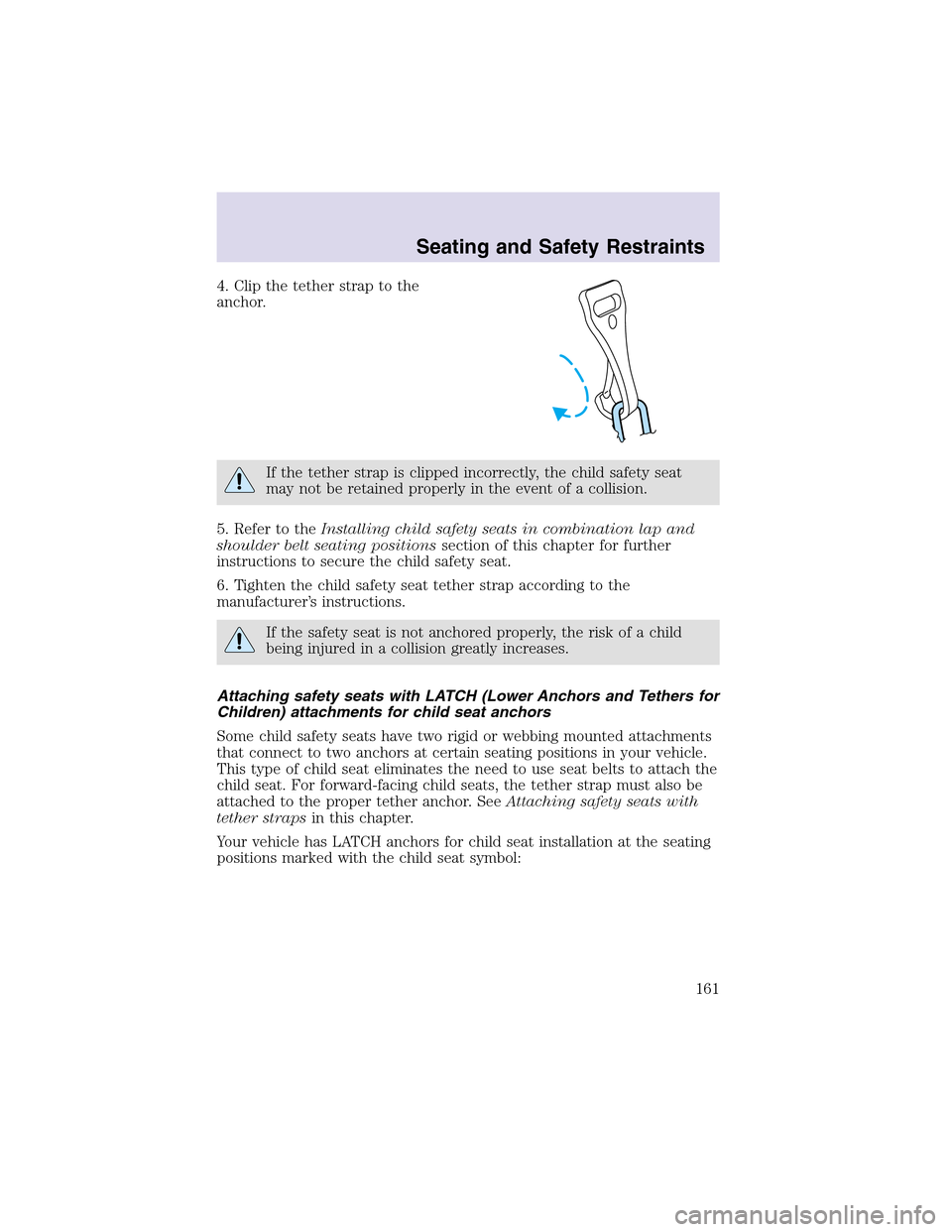
4. Clipthe tether strapto the
anchor.
If the tether strap is clipped incorrectly, the child safety seat
may not be retained properly in the event of a collision.
5. Refer to theInstalling child safety seats in combination lap and
shoulder belt seating positionssection of this chapter for further
instructions to secure the child safety seat.
6. Tighten the child safety seat tether strapaccording to the
manufacturer’s instructions.
If the safety seat is not anchored properly, the risk of a child
being injured in a collision greatly increases.
Attaching safety seats with LATCH (Lower Anchors and Tethers for
Children) attachments for child seat anchors
Some child safety seats have two rigid or webbing mounted attachments
that connect to two anchors at certain seating positions in your vehicle.
This type of child seat eliminates the need to use seat belts to attach the
child seat. For forward-facing child seats, the tether strapmust also be
attached to the proper tether anchor. SeeAttaching safety seats with
tether strapsin this chapter.
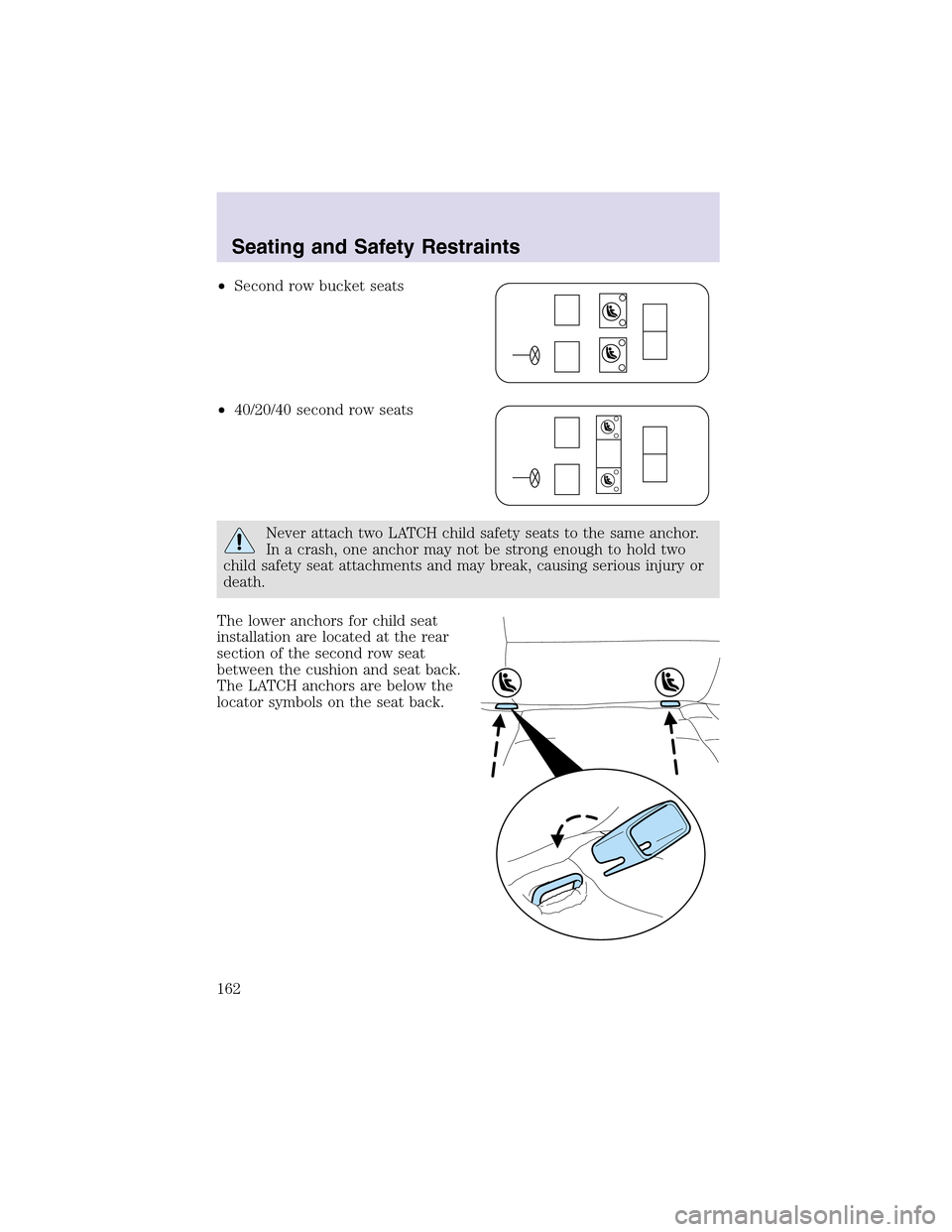
Your vehicle has LATCH anchors for child seat installation at the seating
positions marked with the child seat symbol:
Seating and Safety Restraints
161
Page 162 of 288
•Second row bucket seats
•40/20/40 second row seats
Never attach two LATCH child safety seats to the same anchor.
In a crash, one anchor may not be strong enough to hold two
child safety seat attachments and may break, causing serious injury or
death.
The lower anchors for child seat
installation are located at the rear
section of the second row seat
between the cushion and seat back.
The LATCH anchors are below the
locator symbols on the seat back.
Seating and Safety Restraints
162
Page 163 of 288
Follow the child seat manufacturer’s instructions to properly install a
child seat with LATCH attachments. Two plastic LATCH guides may be
obtained at no charge from any Ford or Lincoln Mercury dealer. They
snaponto the latch lower anchor in the vehicle to helpattach a child
seat with rigid latch attachments. It will hold the seat foam away and
expose the anchor making attachment of the child seat easier.
Attach LATCH lower attachments of the child seat only to the
anchors shown.
If you install a child seat with rigid LATCH attachments, do not tighten
the tether strapenough to lift the child seat off the vehicle seat cushion
when the child is seated in it. Keepthe tether strapjust snug without
lifting the front of the child seat. Keeping the child seat just touching the
vehicle seat gives the best protection in a severe crash.
Each time you use the safety seat, check that the seat is properly
attached to the lower anchors and tether anchor. Try to tilt the child
seat from side to side. Also try to tug the seat forward. Check to see if
the anchors hold the seat in place.
If the safety seat is not anchored properly, the risk of a child
being injured in a crash greatly increases.
Seating and Safety Restraints
163
Page 281 of 288

A
ABS (see Brakes) .....................168
Accessory delay ..........................73
Air bag supplemental
restraint system ........143–144, 147
and child safety seats ............145
description ......................144, 147
disposal ....................................151
driver air bag ..................146, 148
indicator light ...................12, 150
operation .........................146, 148
passenger air bag ...........146, 148
side air bag ..............................147
Air cleaner filter .......................270
Air conditioning ..........................41
auxiliary heater and air
conditioner ................................47
All Wheel Drive (AWD),
driving off road .........................181
Ambulance packages ....................7
Antifreeze
(see Engine coolant) ................251
Anti-lock brake system
(see Brakes) ......................168–169
Anti-theft system ......................117
arming the system ..................117
disarming a triggered
system .....................................118
Audio system (see Radio) ...18, 27
Automatic transmission
driving an automatic
overdrive .................................176
fluid, adding ............................265
fluid, checking ........................265
fluid, refill capacities ..............270
fluid, specification ..................275
Auxiliary power point .................69Axle
lubricant
specifications ..................273, 275
refill capacities ........................270
B
Battery .......................................249
acid, treating emergencies .....249
charging system warning
light ............................................12
jumping a disabled battery ....219
maintenance-free ....................249
replacement, specifications ...270
servicing ..................................249
BeltMinder .................................139
Brakes ........................................167
anti-lock ...........................168–169
anti-lock brake system
(ABS) warning light .........12, 169
brake warning light ..................11
fluid, checking and adding ....265
fluid, refill capacities ..............270
fluid, specifications .........273, 275
lubricant
specifications ..................273, 275
parking ....................................169
shift interlock ..........................174
Bulbs ............................................56
C
Calculating load ........................193
Capacities for refilling fluids ....270
Cargo cover ...............................102
CD-single premium .....................18
Cell phone use ............................98
Certification Label ....................276
Changing a tire .........................211
Index
281