Page 16 of 288
Fuel gauge
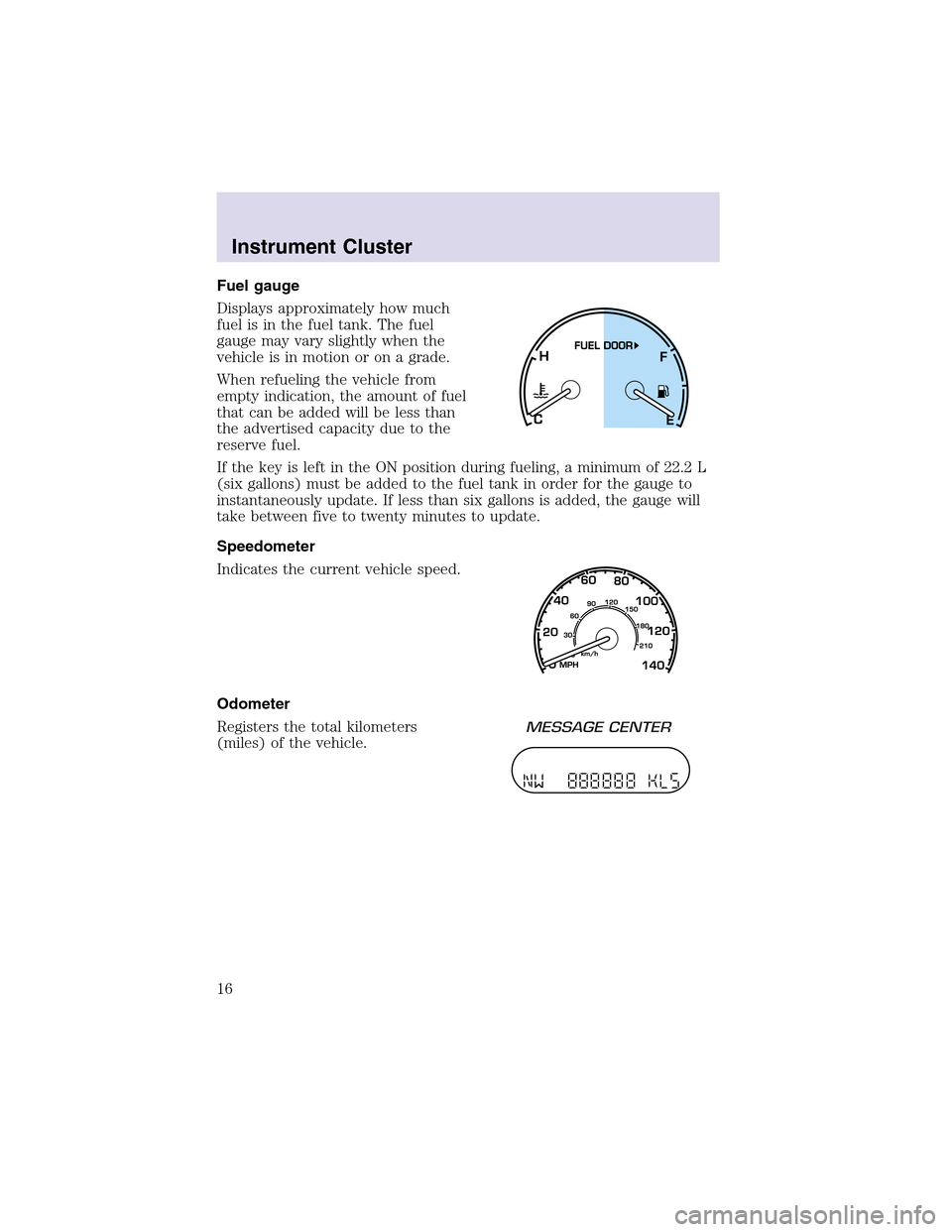
Displays approximately how much
fuel is in the fuel tank. The fuel
gauge may vary slightly when the
vehicle is in motion or on a grade.
When refueling the vehicle from
empty indication, the amount of fuel
that can be added will be less than
the advertised capacity due to the
reserve fuel.
If the key is left in the ON position during fueling, a minimum of 22.2 L
(six gallons) must be added to the fuel tank in order for the gauge to
instantaneously update. If less than six gallons is added, the gauge will
take between five to twenty minutes to update.
Speedometer
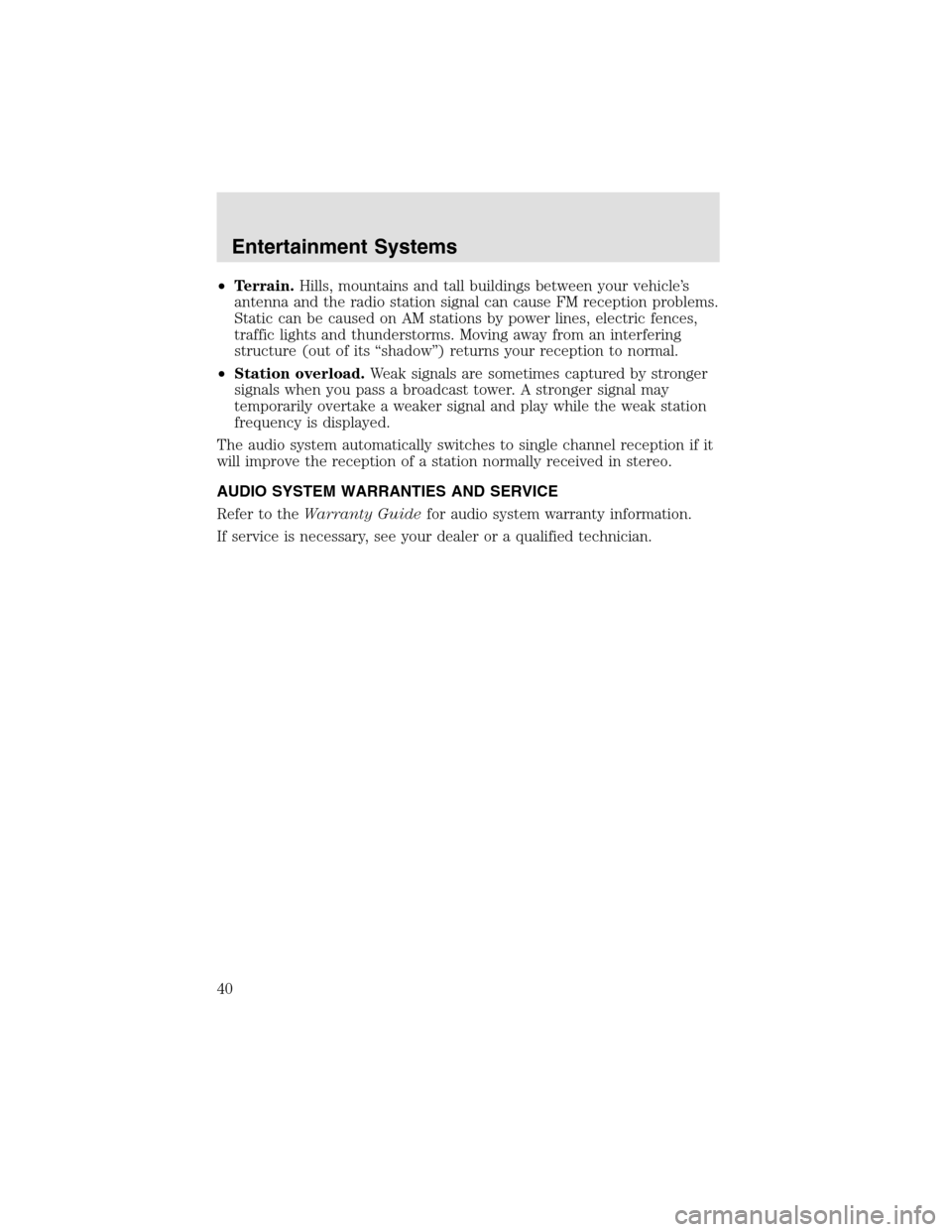
Indicates the current vehicle speed.
Odometer
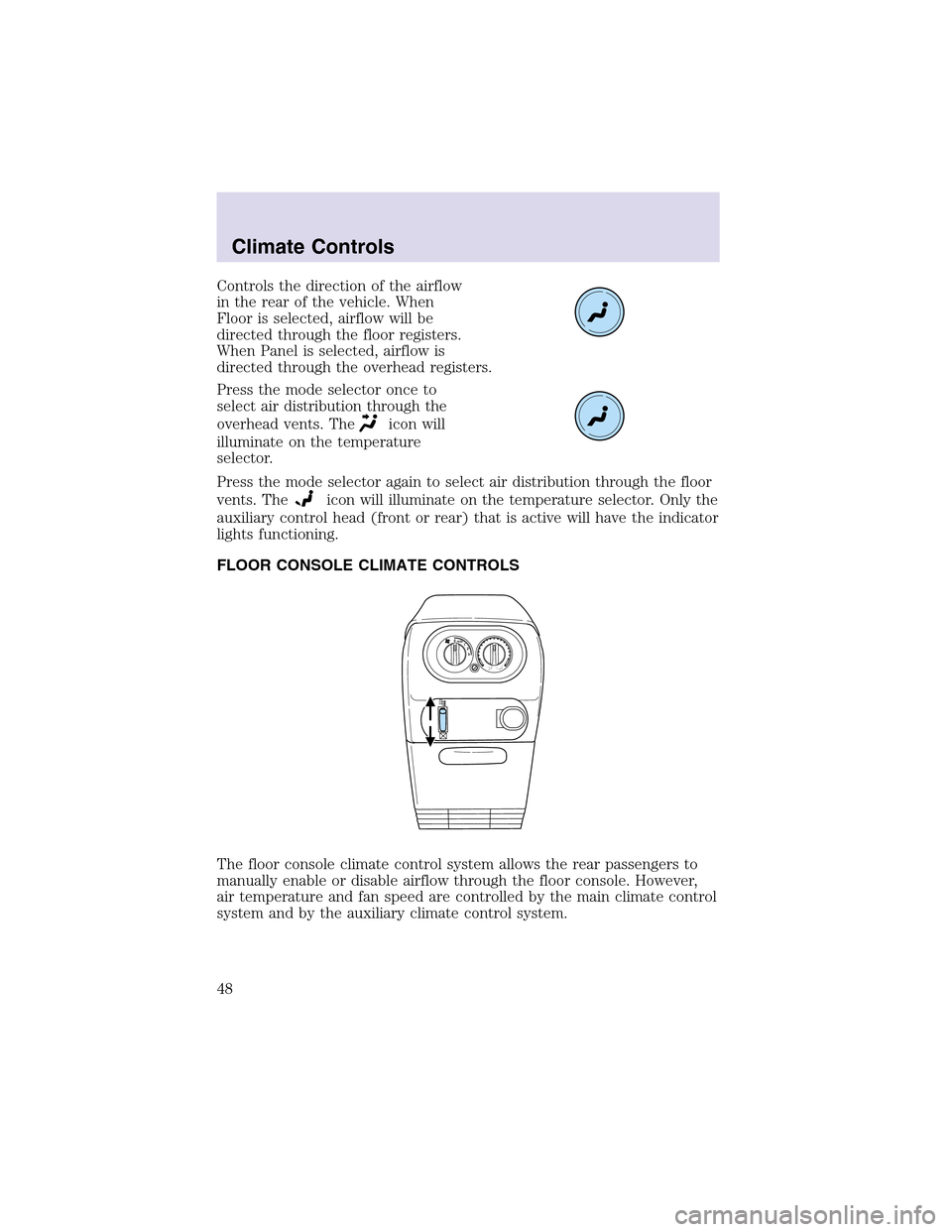
Registers the total kilometers
(miles) of the vehicle.
Instrument Cluster
16
Page 19 of 288
If the volume is set above a certain level and the ignition is turned off,
the volume will come back on at a “nominal” listening level when the
ignition switch is turned back on.
Audio power can also be turned on by pressing the AM/FM select control
or the TAPE/CD select control.
Speed sensitive volume
With this feature, radio volume automatically changes slightly with
vehicle speed to compensate for road and wind noise.
The recommended level for speed sensitive volume is from level 1
through level 3. Level 0 turns the speed sensitive volume off and level 7
is the maximum setting.
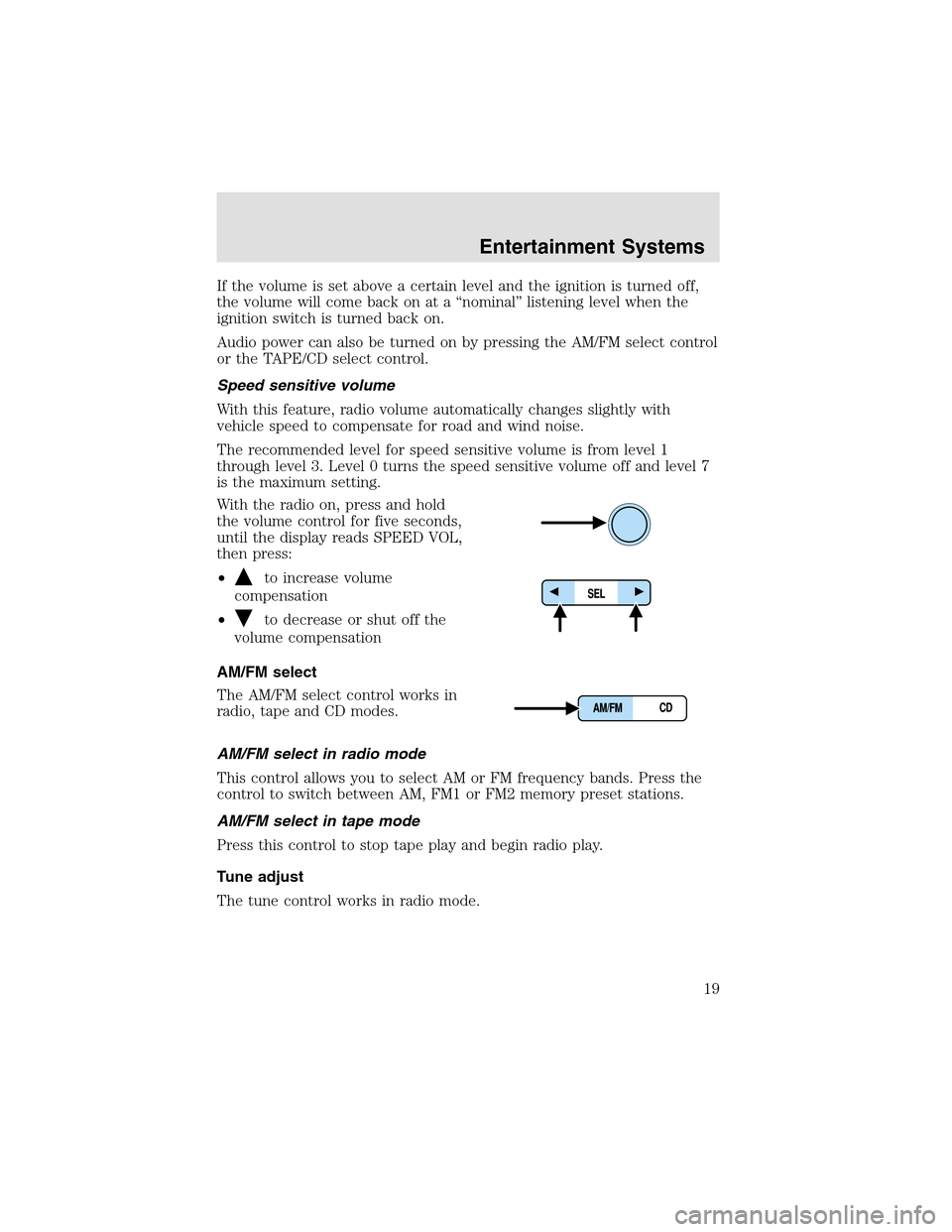
With the radio on, press and hold
the volume control for five seconds,
until the display reads SPEED VOL,
then press:
•
to increase volume
compensation
•
to decrease or shut off the
volume compensation
AM/FM select
The AM/FM select control works in
radio, tape and CD modes.
AM/FM select in radio mode
This control allows you to select AM or FM frequency bands. Press the
control to switch between AM, FM1 or FM2 memory preset stations.
AM/FM select in tape mode
Press this control to stop tape play and begin radio play.
Tune adjust
The tune control works in radio mode.
Entertainment Systems
19
Page 27 of 288
Soft mute
When the vehicle is in reverse, and an obstacle is detected by Rear Park
Assist, the radio volume is reduced to a level that allows the warning to
be heard. After the obstacle warning is gone, the radio will return to the
previously set volume level.
Setting the clock
Your vehicle is equipped with a separate instrument panel mounted
clock. Please refer toClockin theDriver controls chapterfor
instructions on setting the clock.
AUDIOPHILE AM/FM STEREO IN DASH SIX CD RADIO
Volume/power control
Press the control to turn the audio
system on or off. Turn the control to
raise or lower volume.
If the volume is set above a certain level and the ignition is turned off,
the volume will come back on at a “nominal” listening level when the
ignition switch is turned back on.
Speed sensitive volume
With this feature, radio volume changes automatically and slightly with
vehicle speed to compensate for road and wind noise.
PUSH ON
Entertainment Systems
27
Page 31 of 288
If there are fewer than six strong stations available on the frequency
band, the remaining memory preset controls will all store the last strong
station available.
To deactivate autoset and return to your audio system’s manually set
memory stations, press the AM/FM control again.
CD select
CD mode may be entered by
pressing the CD control. The first
track of the disc will begin playing.
After that, CD play will begin where
it stopped last.
If an alternative CD is desired, press the corresponding preset control
(1–6) of a loaded CD, or press the TUNE control to access the other
loaded CDs.
NO CD will display if the CD control is activated when there is not a CD
present in the audio system.
If the CD control is pressed followed by with a preset number and that
particular slot is empty, NO CD will display and the system will begin to
play the next available disc.
Display description
Six circles are always lit in the digital display. These signify the six CD
slots in the audio system. When a disc is loaded into a particular slot
(1–6), the number inside that specific circle lights. If the circle is empty,
there is no CD in that particular slot.
Load
The load feature allows you to load
single CDs into the player internal
to the radio.
This six discCD player is equipped with a CD door. Compact
discs should only be inserted into the player after the CD door
has been opened by the player. Do not attempt to force the door
open. Compact discs should only be loaded by pressing the LOAD
control.
Press the LOAD control. (You can choose which slot will be loaded by
pressing the desired preset number. If you do not choose a slot, the
system will choose the next available one.) Wait until the CD door opens.
Load the CD into the player. LOADING CD# is displayed. When the CD
CD AM
FM
LOAD
Entertainment Systems
31
Page 39 of 288
CLEANING COMPACTDISCS
Inspect all discs for contamination before playing. If necessary, clean
discs only with an approved CD cleaner and wipe from the center out to
the edge. Do not use circular motion.
CD AND CD CHANGER CARE
•Handle discs by their edges only. Never touch the playing surface.
•Do not expose discs to direct sunlight or heat sources for extended
periods of time.
•Do not insert more than one disc into each slot of the CD changer
magazine.
CD units are designed to play commercially pressed 12 cm (4.75
in) audio compact discs only. Due to technical incompatibility,
certain recordable and re-recordable compact discs may not
function correctly when used in Ford CD players. Irregular
shaped CDs, CDs with a scratch protection film attached, and CDs
with homemade paper (adhesive) labels should not be inserted
into the CD player. The label may peel and cause the CD to
become jammed. It is recommended that homemade CDs be
identified with permanent felt tip marker rather than adhesive
labels. Ball point pens may damage CDs. Please contact your
dealer for further information.
RADIO FREQUENCY INFORMATION
The Federal Communications Commission (FCC) and the Canadian Radio
and Telecommunications Commission(CRTC) establish the frequencies
AM and FM stations may use for their broadcasts. Allowable frequencies
are:
AM 530, 540–1600, 1610 kHz
FM 87.7, 87.9–107.7, 107.9 MHz
Not all frequencies are used in a given area.
RADIO RECEPTION FACTORS
Three factors can affect radio reception:
•Distance/strength.The further an FM signal travels, the weaker it is.
The listenable range of the average FM station is approximately 40 km
(24 miles). This range can be affected by “signal modulation.” Signal
modulation is a process radio stations use to increase their
strength/volume relative to other stations.
Entertainment Systems
39
Page 40 of 288
•Terrain.Hills, mountains and tall buildings between your vehicle’s
antenna and the radio station signal can cause FM reception problems.
Static can be caused on AM stations by power lines, electric fences,
traffic lights and thunderstorms. Moving away from an interfering
structure (out of its “shadow”) returns your reception to normal.
•Station overload.Weak signals are sometimes captured by stronger
signals when you pass a broadcast tower. A stronger signal may
temporarily overtake a weaker signal and play while the weak station
frequency is displayed.
The audio system automatically switches to single channel reception if it
will improve the reception of a station normally received in stereo.
AUDIO SYSTEM WARRANTIES AND SERVICE
Refer to theWarranty Guidefor audio system warranty information.
If service is necessary, see your dealer or a qualified technician.
Entertainment Systems
40
Page 46 of 288
•Off-Outside air is shut out and the fan will not operate. This mode will
reduce undesirable odors from entering the vehicle but may increase
the possibility of interior window fogging.
•Panel - Distributes outside or recirculated air through the instrument
panel registers. The A/C compressor will only function if the outside
temperature is above approximately 2°C (35°F). The system will allow
some airflow through the floor ducts.
•Panel and Floor -Distributes outside or recirculated air through the
instrument panel registers and floor ducts. The A/C compressor will
only function if the outside temperature is above approximately 2°C
(35°F). The air distributed through the floor ducts will be slightly
warmer than that sent to the instrument panel registers.
•Floor -Distributes outside or recirculated air through the floor ducts.
The A/C compressor will only function if the outside temperature is
above approximately 2°C (35°F).
•Floor & Defrost -Distributes outside or recirculated air through the
floor ducts, windshield defroster ducts and the side window demisters.
The A/C compressor will operate automatically if the outside
temperature is above approximately 2°C (35°F). The air distributed
through the floor ducts will be slightly warmer than that sent to the
windshield defroster ducts and the side window demisters.
•Defrost-Distributes outside air through the windshield defroster ducts
and the side window demisters. The A/C compressor will operate
automatically if the outside temperature is above approximately 2°C
(35°F). This mode will clear ice and fog from the windshield.
Operating tips
•To reduce fogging in humid weather, place the climate control system
in Defrost mode and Rear Defrost before driving.
•To reduce humidity buildupinside the vehicle in warm weather
conditions, don’t drive with the climate control system in the Off
mode.
•To reduce humidity buildupinside the vehicle in cold weather
conditions, don’t drive with the climate control system in recirculation
mode or Off mode.
•Remove any snow, ice or leaves from the exterior base of the
windshield.
•To increase the efficiency of the A/C, drive with the windows slightly
open for 2–3 minutes after start up or until the vehicle has been
“aired out.”
Climate Controls
46
Page 48 of 288
Controls the direction of the airflow
in the rear of the vehicle. When
Floor is selected, airflow will be
directed through the floor registers.
When Panel is selected, airflow is
directed through the overhead registers.
Press the mode selector once to
select air distribution through the
overhead vents. The
icon will
illuminate on the temperature
selector.
Press the mode selector again to select air distribution through the floor
vents. The
icon will illuminate on the temperature selector. Only the
auxiliary control head (front or rear) that is active will have the indicator
lights functioning.
FLOOR CONSOLE CLIMATE CONTROLS
The floor console climate control system allows the rear passengers to
manually enable or disable airflow through the floor console. However,
air temperature and fan speed are controlled by the main climate control
system and by the auxiliary climate control system.
3 2 1 0REAR
Climate Controls
48