Page 253 of 288
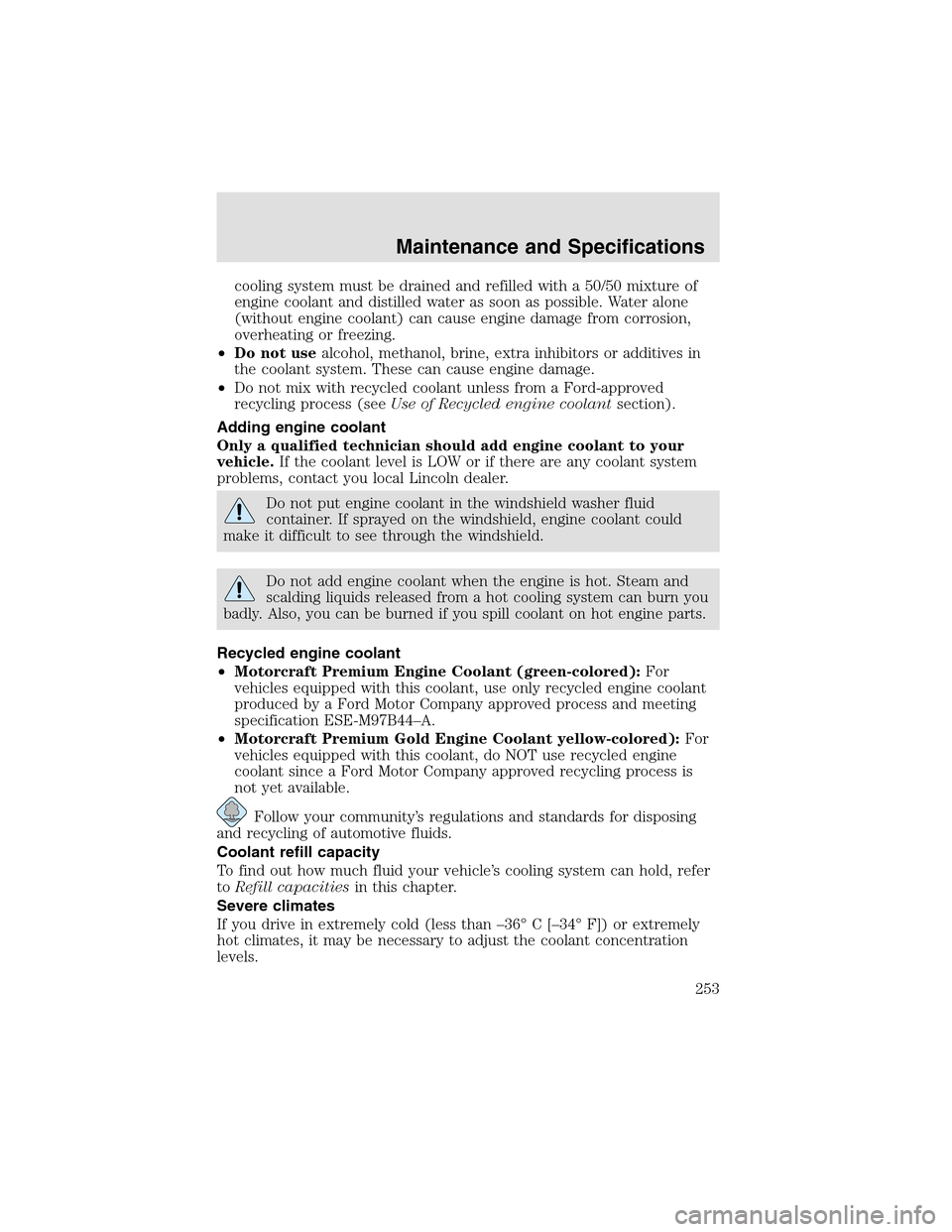
cooling system must be drained and refilled with a 50/50 mixture of
engine coolant and distilled water as soon as possible. Water alone
(without engine coolant) can cause engine damage from corrosion,
overheating or freezing.
•Do not usealcohol, methanol, brine, extra inhibitors or additives in
the coolant system. These can cause engine damage.
•Do not mix with recycled coolant unless from a Ford-approved
recycling process (seeUse of Recycled engine coolantsection).
Adding engine coolant
Only a qualified technician should add engine coolant to your
vehicle.If the coolant level is LOW or if there are any coolant system
problems, contact you local Lincoln dealer.
Do not put engine coolant in the windshield washer fluid
container. If sprayed on the windshield, engine coolant could
make it difficult to see through the windshield.
Do not add engine coolant when the engine is hot. Steam and
scalding liquids released from a hot cooling system can burn you
badly. Also, you can be burned if you spill coolant on hot engine parts.
Recycled engine coolant
•Motorcraft Premium Engine Coolant (green-colored):For
vehicles equipped with this coolant, use only recycled engine coolant
produced by a Ford Motor Company approved process and meeting
specification ESE-M97B44–A.
•Motorcraft Premium Gold Engine Coolant yellow-colored):For
vehicles equipped with this coolant, do NOT use recycled engine
coolant since a Ford Motor Company approved recycling process is
not yet available.
Follow your community’s regulations and standards for disposing
and recycling of automotive fluids.
Coolant refill capacity
To find out how much fluid your vehicle’s cooling system can hold, refer
toRefill capacitiesin this chapter.
Severe climates
If you drive in extremely cold (less than –36° C [–34° F]) or extremely
hot climates, it may be necessary to adjust the coolant concentration
levels.
Maintenance and Specifications
253
Page 255 of 288

When fail-safe mode is activated
You have limited engine power when in the fail-safe mode, so drive the
vehicle with caution. The vehicle will not be able to maintain high speed
operation and the engine will run rough. Remember that the engine is
capable of completely shutting down automatically to prevent engine
damage, therefore:
1. Pull off the road as soon as safely possible and turn off the engine.
2. Arrange for the vehicle to be taken to a service facility.
3. If this is not possible, wait a short period for the engine to cool.
4. Check the coolant level and replenish if low.
Never remove the coolant reservoir capwhile the engine is
running or hot.
5. Restart the engine and take your vehicle to a service facility.
Driving the vehicle without repairing the engine problem
increases the chance of engine damage. Take your vehicle to a
service facility as soon as possible.
WHATYOU SHOULD KNOW ABOUTAUTOMOTIVE FUELS
Important safety precautions
Do not overfill the fuel tank. The pressure in an overfilled tank
may cause leakage and lead to fuel spray and fire.
The fuel system may be under pressure. If the fuel filler cap is
venting vapor or if you hear a hissing sound, wait until it stops
before completely removing the fuel filler cap. Otherwise, fuel may
spray out and injure you or others.
If you do not use the proper fuel filler cap, excessive pressure or
vacuum in the fuel tank may damage the fuel system or cause
the fuel capto disengage in a collision, which may result in possible
personal injury.
Automotive fuels can cause serious injury or death if misused or
mishandled.
Maintenance and Specifications
255
Page 265 of 288

1. Start the engine and let it run
until it reaches normal operating
temperature (the engine coolant
temperature gauge indicator will be
near the center of the normal area
between H and C).
2. While the engine idles, turn the
steering wheel left and right several
times.
3. Turn the engine off.
4. Check the fluid level in the
reservoir. It should be between the
MIN and MAX lines. Do not add
fluid if the level is in this range.
5. If the fluid is low, add fluid in
small amounts, continuously
checking the level until it reaches
the range between the MIN and
MAX lines. Be sure to put the cap
back on the reservoir.
BRAKE FLUID RESERVOIR
The fluid level will dropslowly as
the brakes wear, and will rise when
the brake components are replaced.
Fluid levels below the “MAX” line
that do not trigger the brake system
warning lampare within the normal
operating range, there is no need to
add fluid. If the fluid levels are outside of the normal operating range,
the performance of your brake system could be compromised, seek
service from your dealer immediately.
TRANSMISSION FLUID
Checking automatic transmission fluid
The automatic transmission does not have a transmission fluid dipstick.
Maintenance and Specifications
265
Page 272 of 288
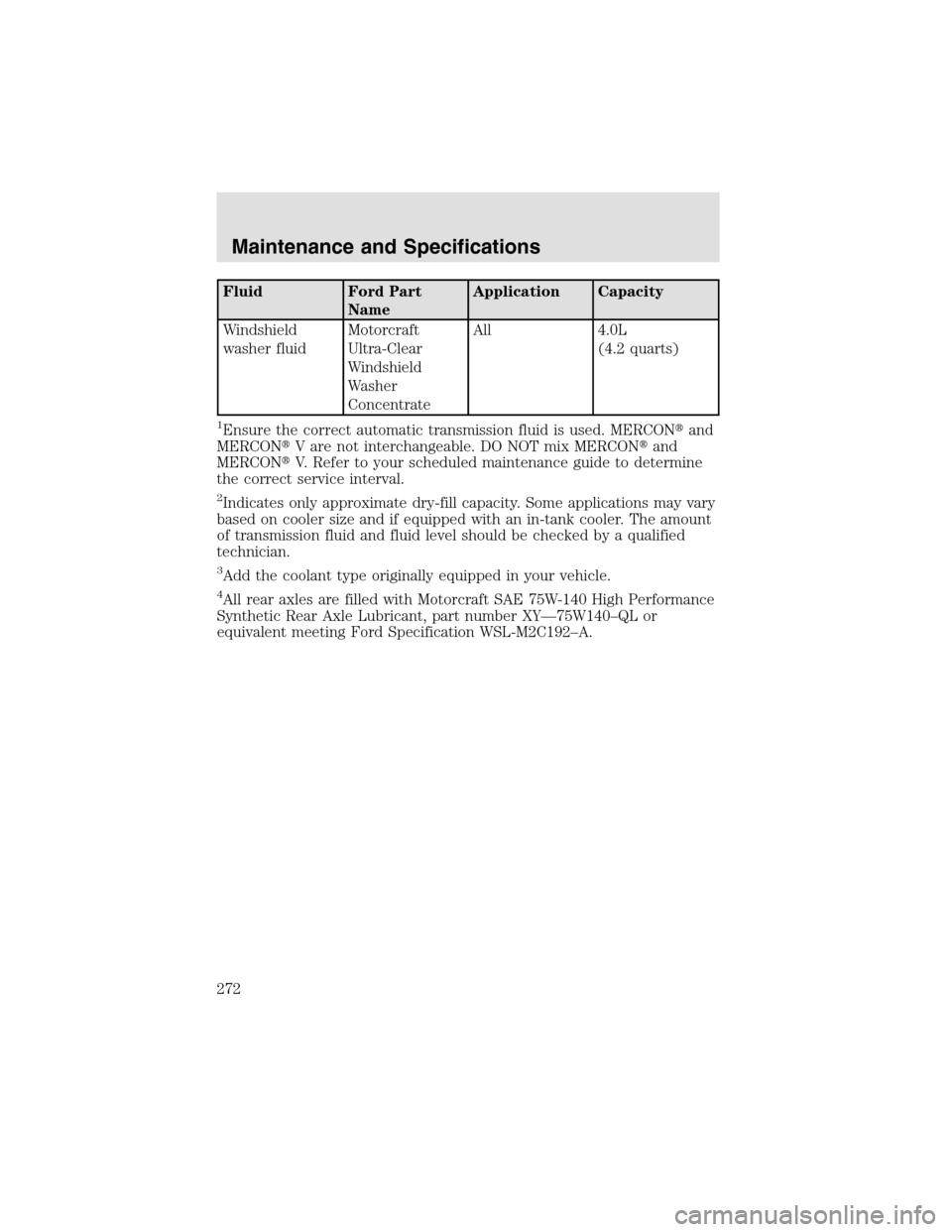
Fluid Ford Part
NameApplication Capacity
Windshield
washer fluidMotorcraft
Ultra-Clear
Windshield
Washer
ConcentrateAll 4.0L
(4.2 quarts)
1Ensure the correct automatic transmission fluid is used. MERCON�and
MERCON�V are not interchangeable. DO NOT mix MERCON�and
MERCON�V. Refer to your scheduled maintenance guide to determine
the correct service interval.
2Indicates only approximate dry-fill capacity. Some applications may vary
based on cooler size and if equipped with an in-tank cooler. The amount
of transmission fluid and fluid level should be checked by a qualified
technician.
3Add the coolant type originally equipped in your vehicle.
4All rear axles are filled with Motorcraft SAE 75W-140 High Performance
Synthetic Rear Axle Lubricant, part number XY—75W140–QL or
equivalent meeting Ford Specification WSL-M2C192–A.
Maintenance and Specifications
272