2003 INFINITI G35 warning
[x] Cancel search: warningPage 16 of 256
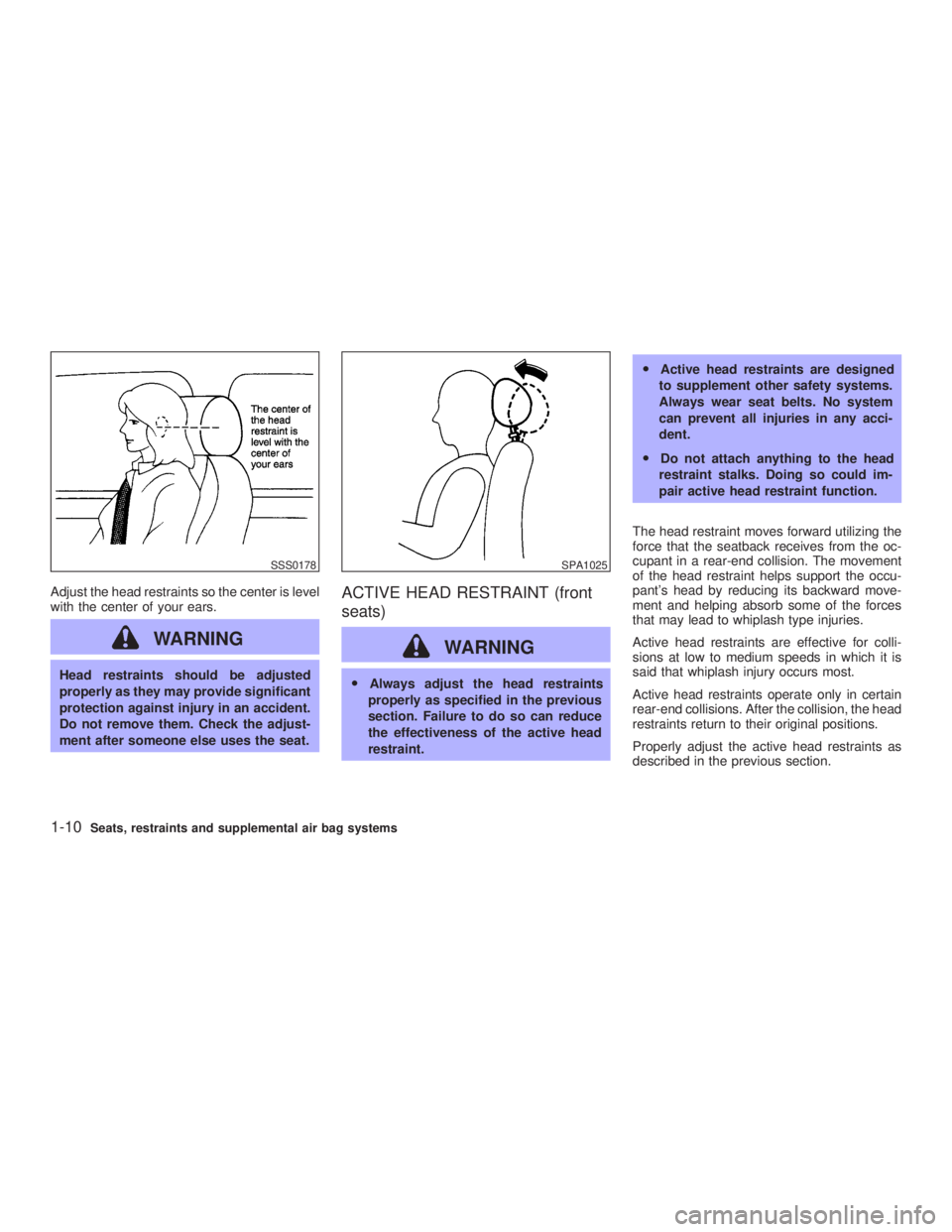
Adjust the head restraints so the center is level
with the center of your ears.
WARNINGHead restraints should be adjusted
properly as they may provide significant
protection against injury in an accident.
Do not remove them. Check the adjust-
ment after someone else uses the seat. ACTIVE HEAD RESTRAINT (front
seats)
WARNING O Always adjust the head restraints
properly as specified in the previous
section. Failure to do so can reduce
the effectiveness of the active head
restraint. O Active head restraints are designed
to supplement other safety systems.
Always wear seat belts. No system
can prevent all injuries in any acci-
dent.
O Do not attach anything to the head
restraint stalks. Doing so could im-
pair active head restraint function.
The head restraint moves forward utilizing the
force that the seatback receives from the oc-
cupant in a rear-end collision. The movement
of the head restraint helps support the occu-
pant's head by reducing its backward move-
ment and helping absorb some of the forces
that may lead to whiplash type injuries.
Active head restraints are effective for colli-
sions at low to medium speeds in which it is
said that whiplash injury occurs most.
Active head restraints operate only in certain
rear-end collisions. After the collision, the head
restraints return to their original positions.
Properly adjust the active head restraints as
described in the previous section.SSS0178 SPA1025
1-10 Seats, restraints and supplemental air bag systems
Z 02.7.29/V35-D/V5.0
X
Page 17 of 256
PRECAUTIONS ON
SUPPLEMENTAL RESTRAINT
SYSTEM This Supplemental Restraint System (SRS)
section contains important information con-
cerning the driver and passenger front impact
supplemental air bags, front seat side-impact
supplemental air bags, curtain air bags and
front seat pre-tensioner seat belts.
Supplemental front impact air bag system:
This system can help cushion the impact force
to the face and chest of the driver and front
passenger in certain frontal collisions.
Supplemental side-impact air bag system:
This system can help cushion the impact force
to the chest area of the driver and front pas-
senger in certain side impact collisions. The
front seat side-impact supplemental air bags
are designed to inflate on the side where the
vehicle is impacted.
Supplemental curtain side-impact air bag
system: This system can help cushion the
impact force to the head of occupants in front
and rear outboard seating positions in certain
side impact collisions. The curtain side-impact
air bags are designed to inflate on the side
where the vehicle is impacted.
These supplemental restraint systems are de-
signed to supplement the crash protection provided by the driver and passenger seat
belts and are not a substitute for them. Seat
belts should always be correctly worn and the
occupant seated a suitable distance away
from the steering wheel, instrument panel and
door finishers. (See ªSeat beltsº later in this
section for instructions and precautions on
seat belt usage.)
After turning the ignition key to the ON
position, the supplemental air bag warning
light illuminates. The supplemental air bag
warning light will turn off after about 7
seconds if the systems are operational.SUPPLEMENTAL RESTRAINT
SYSTEM
Seats, restraints and supplemental air bag systems
1-11
Z 02.7.29/V35-D/V5.0
X
Page 18 of 256
WARNINGO The supplemental front air bags ordi-
narily will not inflate in the event of a
side impact, rear impact, roll over, or
lower severity frontal collision. Al-
ways wear your seat belts to help
reduce the risk or severity of injury in
various kinds of accidents.
O The seat belts and the supplemental
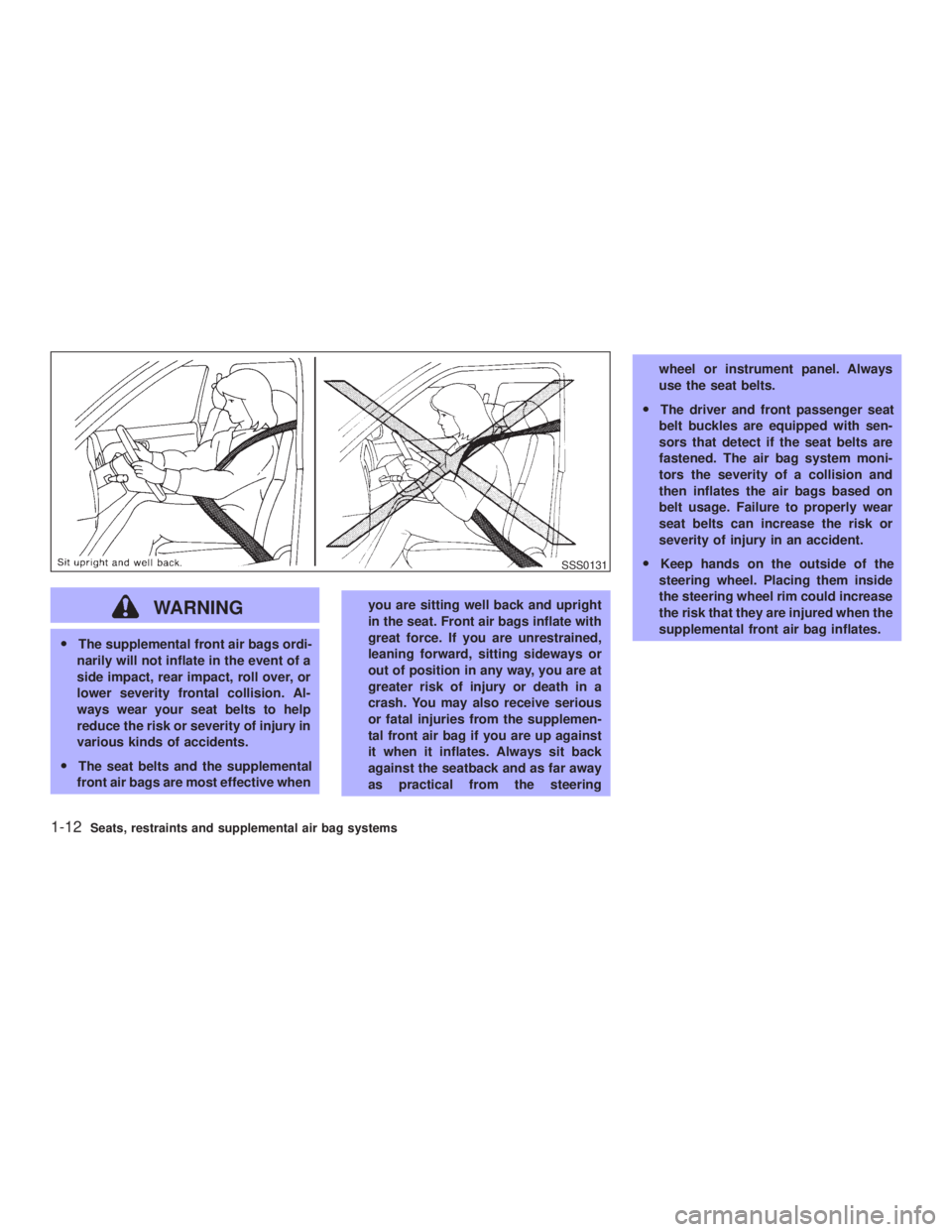
front air bags are most effective when you are sitting well back and upright
in the seat. Front air bags inflate with
great force. If you are unrestrained,
leaning forward, sitting sideways or
out of position in any way, you are at
greater risk of injury or death in a
crash. You may also receive serious
or fatal injuries from the supplemen-
tal front air bag if you are up against
it when it inflates. Always sit back
against the seatback and as far away
as practical from the steering wheel or instrument panel. Always
use the seat belts.
O The driver and front passenger seat
belt buckles are equipped with sen-
sors that detect if the seat belts are
fastened. The air bag system moni-
tors the severity of a collision and
then inflates the air bags based on
belt usage. Failure to properly wear
seat belts can increase the risk or
severity of injury in an accident.
O Keep hands on the outside of the
steering wheel. Placing them inside
the steering wheel rim could increase
the risk that they are injured when the
supplemental front air bag inflates. SSS0131
1-12 Seats, restraints and supplemental air bag systems
Z 02.7.29/V35-D/V5.0
X
Page 20 of 256
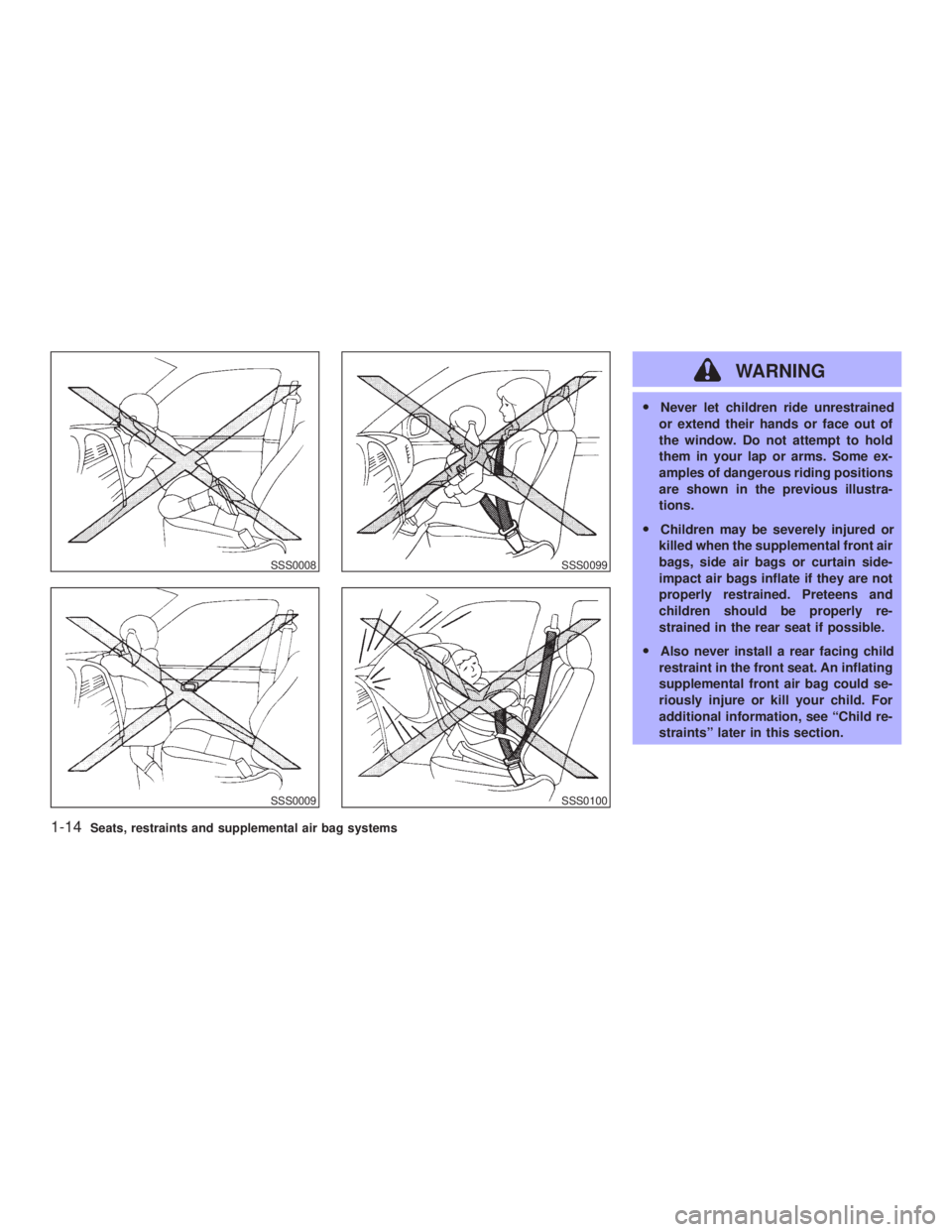
WARNING O Never let children ride unrestrained
or extend their hands or face out of
the window. Do not attempt to hold
them in your lap or arms. Some ex-
amples of dangerous riding positions
are shown in the previous illustra-
tions.
O Children may be severely injured or
killed when the supplemental front air
bags, side air bags or curtain side-
impact air bags inflate if they are not
properly restrained. Preteens and
children should be properly re-
strained in the rear seat if possible.
O Also never install a rear facing child
restraint in the front seat. An inflating
supplemental front air bag could se-
riously injure or kill your child. For
additional information, see ªChild re-
straintsº later in this section.SSS0008
SSS0009 SSS0099
SSS0100
1-14 Seats, restraints and supplemental air bag systems
Z 02.7.29/V35-D/V5.0
X
Page 21 of 256
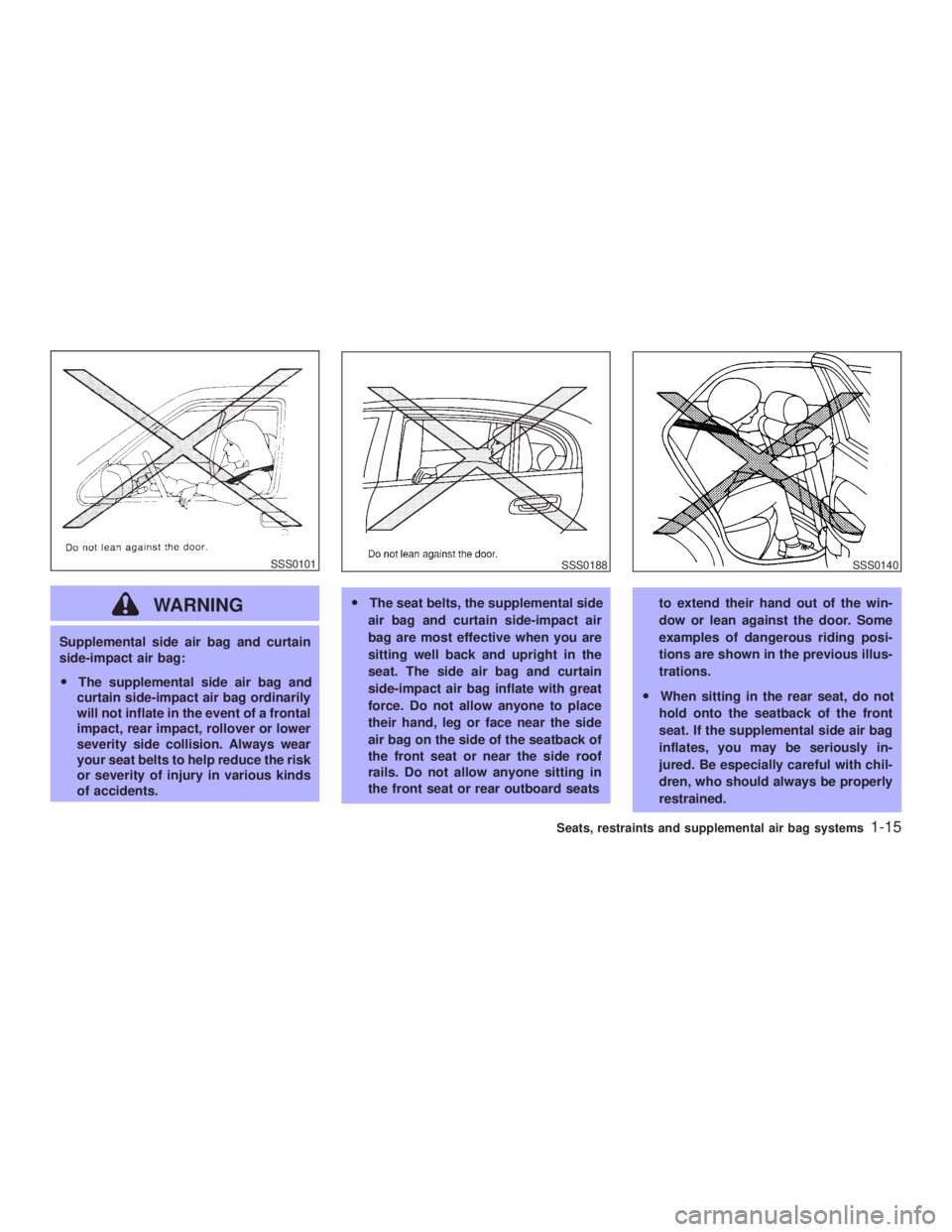
WARNINGSupplemental side air bag and curtain
side-impact air bag:
O The supplemental side air bag and
curtain side-impact air bag ordinarily
will not inflate in the event of a frontal
impact, rear impact, rollover or lower
severity side collision. Always wear
your seat belts to help reduce the risk
or severity of injury in various kinds
of accidents. O The seat belts, the supplemental side
air bag and curtain side-impact air
bag are most effective when you are
sitting well back and upright in the
seat. The side air bag and curtain
side-impact air bag inflate with great
force. Do not allow anyone to place
their hand, leg or face near the side
air bag on the side of the seatback of
the front seat or near the side roof
rails. Do not allow anyone sitting in
the front seat or rear outboard seats to extend their hand out of the win-
dow or lean against the door. Some
examples of dangerous riding posi-
tions are shown in the previous illus-
trations.
O When sitting in the rear seat, do not
hold onto the seatback of the front
seat. If the supplemental side air bag
inflates, you may be seriously in-
jured. Be especially careful with chil-
dren, who should always be properly
restrained.SSS0101
SSS0188 SSS0140
Seats, restraints and supplemental air bag systems
1-15
Z 02.7.29/V35-D/V5.0
X
Page 24 of 256

The driver supplemental air bag is located in
the center of the steering wheel; the front
passenger supplemental air bag is mounted in
the instrument panel above the glove box.
These systems are designed to meet optional
certification requirements under U.S. regula- tions. They are also permitted in Canada. The
optional certification allows front air bags to be
designed to inflate somewhat less forcefully
than previously. However, all of the informa-
tion, cautions and warnings in this manual
still apply and must be followed. The front air bags are designed to inflate in higher
severity frontal collisions, although they may
inflate if the forces in another type of collision
are similar to those of a higher severity frontal
impact. They may not inflate in certain frontal
collisions. Vehicle damage (or lack of it) is not
always an indication of proper supplemental
air bag operation.
The supplemental air bag system has dual
stage inflators for both the driver and passen-
ger air bags. The system monitors information
from the crash zone sensor, the diagnosis
sensor unit and seat belt buckle sensors that
detect if the seat belts are fastened, inflator
operation is based on the severity of a collision
and whether the seat belts are being used.
Only one front air bag may inflate in a crash,
depending on the crash severity and whether
the front occupants are belted or unbelted.
This does not indicate improper performance
of the system. If you have any questions about
the performance of your air bag system,
please contact your INFINITI retailer.
When the supplemental front air bag inflates, a
fairly loud noise may be heard, followed by
release of smoke. This smoke is not harmful
and does not indicate a fire. Care should be
taken not to inhale it, as it may cause irritation
and choking. Those with a history of a breath- SSS0221
1-18 Seats, restraints and supplemental air bag systems
Z 02.7.29/V35-D/V5.0
X
Page 25 of 256
ing condition should get fresh air promptly.
Supplemental front air bags, along with the
use of seat belts, helps to cushion the impact
force on the face and chest of the front occu-
pants. They can help save lives and reduce
serious injuries. However, an inflating front air
bag may cause facial abrasions or other inju-
ries. Front air bags do not provide restraint to
the lower body.
The seat belts should be correctly worn and
the driver and passenger seated upright as far
as practical away from the steering wheel or
instrument panel. The supplemental front air
bags inflates quickly in order to help protect
the front occupants. Because of this, the force
of the front air bag inflating can increase the
risk of injury if the occupant is too close to, or
is against, the air bag module during inflation.
The air bag will deflate quickly after the colli-
sion is over.
After turning the ignition key to the ON
position, the supplemental air bag warning
light illuminates. The supplemental air bag
warning light will turn off after about 7
seconds if the system is operational. WARNING O Do not place any objects on the steer-
ing wheel pad or on the instrument
panel. Also, do not place any objects
between any occupant and the steer-
ing wheel or instrument panel. Such
objects may become dangerous pro-
jectiles and cause injury if the supple-
mental front air bag inflates.
O Right after inflation, several air bag
system components will be hot. Do
not touch them; you may severely
burn yourself.
O No unauthorized changes should be
made to any components or wiring of
the supplemental front air bag sys-
tem. This is to prevent accidental
inflation of the air bag or damage to
the air bag system.
O Do not make unauthorized changes
to your vehicle's electrical system,
suspension system or front end
structure. This could affect proper operation of the supplemental air bag
system.
O Tampering with the supplemental
front air bag system may result in
serious personal injury. Tampering
includes changes to the steering
wheel and the instrument panel as-
sembly by placing material over the
steering wheel pad, above the dash-
board, or by installing additional trim
material around the air bag system.
O Work around and on the supplemen-
tal front air bag system should be
done by an authorized INFINITI re-
tailer. Installation of electrical equip-
ment should also be done by an au-
thorized INFINITI retailer. The yellow
and orange Supplemental Restraint
System (SRS) wiring and connectors
should not be modified or discon-
nected. Unauthorized electrical test
equipment and probing devices
should not be used on the air bag
system.
Seats, restraints and supplemental air bag systems
1-19
Z 02.7.29/V35-D/V5.0
X
Page 26 of 256
O A cracked windshield should be re-
placed immediately by a qualified re-
pair facility. A cracked windshield
could affect inflation of the supple-
mental air bag system.
O The SRS wiring harness connectors
are yellow and orange for easy iden-
tification.
When selling your vehicle, we request that you
inform the buyer about the supplemental front
air bag system and guide the buyer to the
appropriate sections in this Owner's Manual.
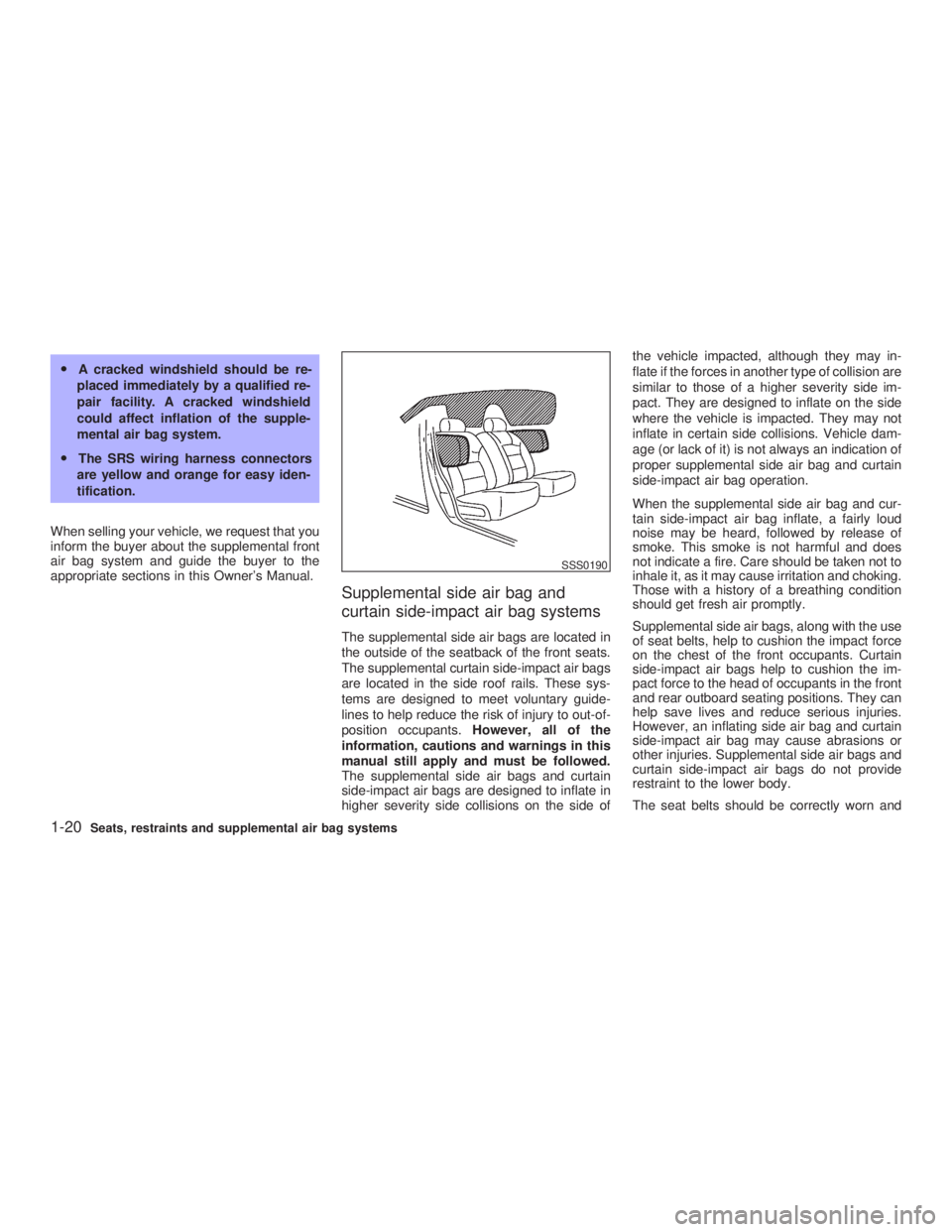
Supplemental side air bag and
curtain side-impact air bag systems The supplemental side air bags are located in
the outside of the seatback of the front seats.
The supplemental curtain side-impact air bags
are located in the side roof rails. These sys-
tems are designed to meet voluntary guide-
lines to help reduce the risk of injury to out-of-
position occupants. However, all of the
information, cautions and warnings in this
manual still apply and must be followed.
The supplemental side air bags and curtain
side-impact air bags are designed to inflate in
higher severity side collisions on the side of the vehicle impacted, although they may in-
flate if the forces in another type of collision are
similar to those of a higher severity side im-
pact. They are designed to inflate on the side
where the vehicle is impacted. They may not
inflate in certain side collisions. Vehicle dam-
age (or lack of it) is not always an indication of
proper supplemental side air bag and curtain
side-impact air bag operation.
When the supplemental side air bag and cur-
tain side-impact air bag inflate, a fairly loud
noise may be heard, followed by release of
smoke. This smoke is not harmful and does
not indicate a fire. Care should be taken not to
inhale it, as it may cause irritation and choking.
Those with a history of a breathing condition
should get fresh air promptly.
Supplemental side air bags, along with the use
of seat belts, help to cushion the impact force
on the chest of the front occupants. Curtain
side-impact air bags help to cushion the im-
pact force to the head of occupants in the front
and rear outboard seating positions. They can
help save lives and reduce serious injuries.
However, an inflating side air bag and curtain
side-impact air bag may cause abrasions or
other injuries. Supplemental side air bags and
curtain side-impact air bags do not provide
restraint to the lower body.
The seat belts should be correctly worn and SSS0190
1-20 Seats, restraints and supplemental air bag systems
Z 02.7.29/V35-D/V5.0
X