2003 INFINITI G35 warning
[x] Cancel search: warningPage 208 of 256
If you have a flat tire, see ªFlat tireº in the
ª6. In case of emergencyº section.
TIRE PRESSURE
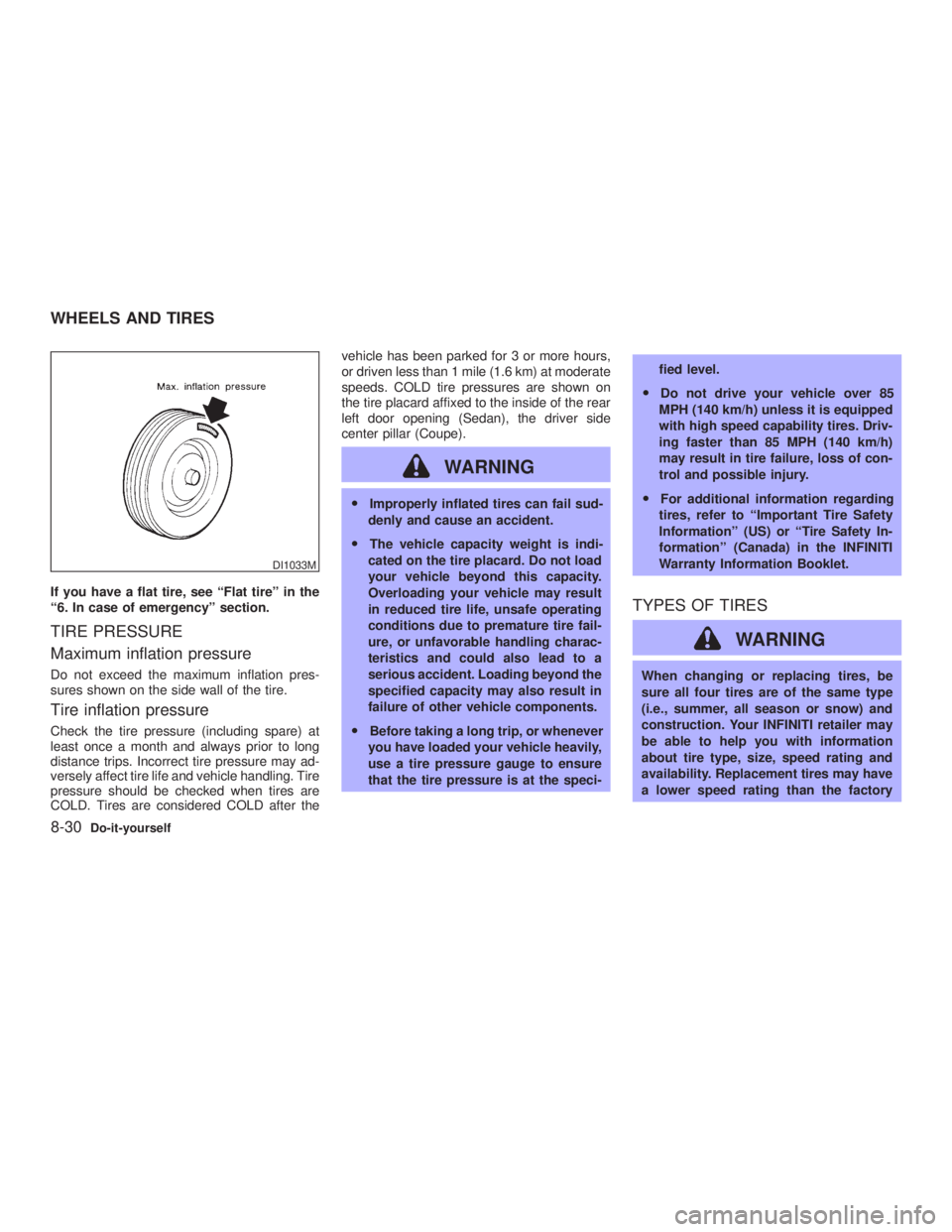
Maximum inflation pressure Do not exceed the maximum inflation pres-
sures shown on the side wall of the tire.
Tire inflation pressure Check the tire pressure (including spare) at
least once a month and always prior to long
distance trips. Incorrect tire pressure may ad-
versely affect tire life and vehicle handling. Tire
pressure should be checked when tires are
COLD. Tires are considered COLD after the vehicle has been parked for 3 or more hours,
or driven less than 1 mile (1.6 km) at moderate
speeds. COLD tire pressures are shown on
the tire placard affixed to the inside of the rear
left door opening (Sedan), the driver side
center pillar (Coupe).
WARNING O Improperly inflated tires can fail sud-
denly and cause an accident.
O The vehicle capacity weight is indi-
cated on the tire placard. Do not load
your vehicle beyond this capacity.
Overloading your vehicle may result
in reduced tire life, unsafe operating
conditions due to premature tire fail-
ure, or unfavorable handling charac-
teristics and could also lead to a
serious accident. Loading beyond the
specified capacity may also result in
failure of other vehicle components.
O Before taking a long trip, or whenever
you have loaded your vehicle heavily,
use a tire pressure gauge to ensure
that the tire pressure is at the speci- fied level.
O Do not drive your vehicle over 85
MPH (140 km/h) unless it is equipped
with high speed capability tires. Driv-
ing faster than 85 MPH (140 km/h)
may result in tire failure, loss of con-
trol and possible injury.
O For additional information regarding
tires, refer to ªImportant Tire Safety
Informationº (US) or ªTire Safety In-
formationº (Canada) in the INFINITI
Warranty Information Booklet.
TYPES OF TIRES
WARNING When changing or replacing tires, be
sure all four tires are of the same type
(i.e., summer, all season or snow) and
construction. Your INFINITI retailer may
be able to help you with information
about tire type, size, speed rating and
availability. Replacement tires may have
a lower speed rating than the factoryDI1033M
WHEELS AND TIRES
8-30 Do-it-yourself
Z 02.7.29/V35-D/V5.0
X
Page 210 of 256
CHANGING WHEELS AND TIRES
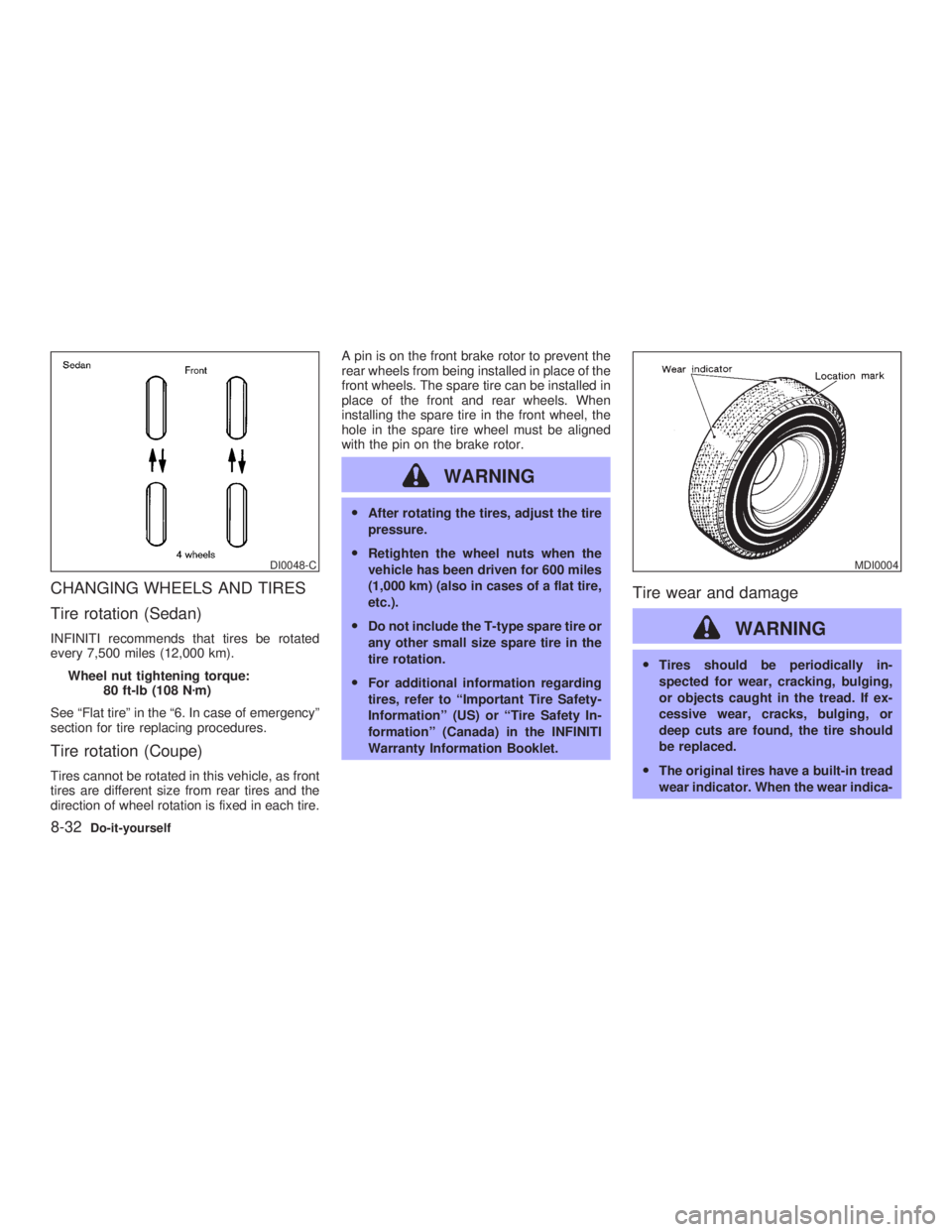
Tire rotation (Sedan) INFINITI recommends that tires be rotated
every 7,500 miles (12,000 km).
Wheel nut tightening torque:
80 ft-lb (108 N z m)
See ªFlat tireº in the ª6. In case of emergencyº
section for tire replacing procedures.
Tire rotation (Coupe) Tires cannot be rotated in this vehicle, as front
tires are different size from rear tires and the
direction of wheel rotation is fixed in each tire. A pin is on the front brake rotor to prevent the
rear wheels from being installed in place of the
front wheels. The spare tire can be installed in
place of the front and rear wheels. When
installing the spare tire in the front wheel, the
hole in the spare tire wheel must be aligned
with the pin on the brake rotor.
WARNING O After rotating the tires, adjust the tire
pressure.
O Retighten the wheel nuts when the
vehicle has been driven for 600 miles
(1,000 km) (also in cases of a flat tire,
etc.).
O Do not include the T-type spare tire or
any other small size spare tire in the
tire rotation.
O For additional information regarding
tires, refer to ªImportant Tire Safety-
Informationº (US) or ªTire Safety In-
formationº (Canada) in the INFINITI
Warranty Information Booklet. Tire wear and damage
WARNING O Tires should be periodically in-
spected for wear, cracking, bulging,
or objects caught in the tread. If ex-
cessive wear, cracks, bulging, or
deep cuts are found, the tire should
be replaced.
O The original tires have a built-in tread
wear indicator. When the wear indica-DI0048-C MDI0004
8-32 Do-it-yourself
Z 02.11.1/V35-D/V5.0
X
Page 211 of 256

tor is visible, the tire should be re-
placed.
O Improper service for a spare tire may
result in serious personal injury. If it
is necessary to repair the spare tire,
contact your INFINITI retailer.
O For additional information regarding
tires, refer to ªImportant Tire Safety
Informationº (US) or ªTire Safety In-
formationº (Canada) in the INFINITI
Warranty Information Booklet.
Replacing wheels and tires When replacing a tire, use the same size,
speed rating and load carrying capacity as
originally equipped. See ªSpecificationsº in the
ª10. Technical and consumer informationº sec-
tion for recommended types and sizes of tires
and wheels.
WARNINGO The use of tires other than those
recommended or the mixed use of tires of different brands, construction
(bias, bias-belted or radial), or tread
patterns can adversely affect the ride,
braking, handling, ground clearance,
body-to-tire clearance, tire chain
clearance, speedometer calibration,
headlight aim and bumper height.
Some of these effects may lead to
accidents and could result in serious
personal injury.
O If the wheels are changed for any
reason, always replace with wheels
which have the same offset dimen-
sion. Wheels of a different offset
could cause early tire wear, possibly
degraded vehicle handling character-
istics and/or interference with the
brake discs. Such interference can
lead to decreased braking efficiency
and/or early brake pad wear.
O Do not install a deformed wheel or
tire even if it has been repaired. Such
wheels or tires could have structural
damage and could fail without
warning. O The use of retread tires is not recom-
mended.
O For additional information regarding
tires, refer to ªImportant Tire Safety
Informationº (US) or ªTire Safety In-
formationº (Canada) in the INFINITI
Warranty Information Booklet.
Wheel balance Unbalanced wheels may affect vehicle han-
dling and tire life. Even with regular use,
wheels can get out of balance. Therefore, they
should be balanced as required.
Wheel balance service should be performed
with the wheels off the vehicle. Spin balancing
the rear wheels on the vehicle could lead to
transmission damage.
For additional information regarding tires, refer
to ªImportant Tire Safety Informationº (US) or
ªTire Safety Informationº (Canada) in the
INFINITI Warranty Information Booklet.
Care of wheels O Wash the wheels when washing the vehicle
to maintain their appearance.
O Clean the inner side of the wheels when the Do-it-yourself
8-33
Z 02.7.29/V35-D/V5.0
X
Page 215 of 256

EXPLANATION OF MAINTENANCE
ITEMS Additional information on the following
items with ª*º is found in the ª8. Do-it-
yourselfº section.
Outside the vehicle The maintenance items listed here should be
performed from time to time, unless otherwise
specified.
Tires*: Check the pressure with a gauge at
least once a month and always prior to long
distance trips. If necessary, adjust the pres-
sure in all tires, including the spare, to the
specified pressure. Check carefully for dam-
age, cuts or excessive wear.
Wheel nuts*: When checking the tires, make
sure no nuts are missing, and check for any
loose nuts. Tighten if necessary.
Tire rotation*: Tires should be rotated every
7,500 miles (12,000 km) (Sedan).
Tires cannot be rotated (Coupe).
Wheel alignment and balance: If the vehicle
pulls to either side while driving on a straight
and level road, or if you detect uneven or
abnormal tire wear, there may be a need for
wheel alignment. If the steering wheel or seat vibrates at normal
highway speeds, wheel balancing may be
needed.
For additional information regarding tires, refer
to ªImportant Tire Safety Informationº (US) or
ªTire Safety Informationº (Canada) in the
INFINITI Warranty Information booklet.
Windshield: Clean the windshield on a regu-
lar basis. Check the windshield at least every
six months for cracks or other damage. Have a
damaged windshield repaired by a qualified
repair facility.
Windshield wiper blades*: Check for cracks
or wear if they do not wipe properly.
Doors and engine hood: Check that all doors
and the engine hood, operate properly. Also
ensure that all latches lock securely. Lubricate
hinges and latches if necessary. Make sure
that the secondary latch keeps the hood from
opening when the primary latch is released.
When driving in areas using road salt or other
corrosive materials, check lubrication fre-
quently.
Inside the vehicle The maintenance items listed here should be
checked on a regular basis, such as when performing periodic maintenance, cleaning the
vehicle, etc.
Lights*: Clean the headlights on a regular
basis. Make sure that the headlights, stop
lights, tail lights, turn signal lights, and other
lights are all operating properly and installed
securely. Also check headlight aim.
Warning lights and chimes: Make sure that
all warning lights and chimes are operating
properly.
Windshield wiper and washer*: Check that
the wipers and washer operate properly and
that the wipers do not streak.
Windshield defroster: Check that the air
comes out of the defroster outlets properly and
in sufficient quantity when operating the heater
or air conditioner.
Steering wheel: Check for changes in the
steering conditions, such as excessive free
play, hard steering or strange noises.
Seats: Check seat position controls such as
seat adjusters, seatback recliner, etc. to en-
sure they operate smoothly and that all latches
lock securely in every position. Check that the
head restraints move up and down smoothly
and that the locks (if so equipped) hold se-
curely in all latched positions. Maintenance
9-3
Z 02.7.29/V35-D/V5.0
X
Page 236 of 256
7. Install the license plate bracket with screws.
8. Install the license plate with bolts that are
no longer than 0.55 in (14 mm).
WARNING O It is extremely dangerous to ride in a
cargo area inside of a vehicle. In a
collision, people riding in these areas
are more likely to be seriously injured
or killed
O Do not allow people to ride in any
area of your vehicle that is not
equipped with seats and seat belts.
O Be sure everyone in your vehicle is in
a seat and using a seat belt properly.
TERMS It is important to familiarize yourself with the
following terms before loading your vehicle:
O Curb Weight (actual weight of your vehicle)
- vehicle weight including: standard and
optional equipment, fluids, emergency
tools, and spare tire assembly. This weight
does not include passengers and cargo.
O GVW (Gross Vehicle Weight) - curb weight
plus the combined weight of passengers
and cargo. O GVWR (Gross Vehicle Weight Rating) -
maximum total weight (load) limit specified
for the vehicle.
O GAWR (Gross Axle Weight Rating) - maxi-
mum weight (load) limit specified for the
front or rear axle.
DETERMINING VEHICLE LOAD
CAPACITY The load capacity of this vehicle is determined
by weight, not by available cargo space. For
example, a luggage rack, bike carrier, cartop
carrier or similar equipment does not increase
load carrying capacity of your vehicle.
To determine vehicle load capacity:
Vehicle weight can be determined by using a
commercial-grade scale, found at places such
as a truck stop, gravel quarry, grain elevator,
or a scrap metal recycling facility.
1. Determine the curb weight of your vehicle.
2. Compare the curb weight amount to the
GVWR specified for your vehicle to deter-
mine how much more weight your vehicle
can carry.
3. After loading (cargo and passengers), re-
weigh your vehicle to determine if either
GVWR or GAWR for your vehicle is ex-VEHICLE LOADING
INFORMATION
10-14 Technical and consumer information
Z 02.7.29/V35-D/V5.0
X
Page 237 of 256
ceeded. If GVWR is exceeded, remove
cargo as necessary. If either the front or
rear GAWR is exceeded, shift the load or
remove cargo as necessary.
LOADING TIPS O The GVW must not exceed GVWR or
GAWR as specified on the F.M.V.S.S. cer-
tification label.
O Do not load the front and rear axle to the
GAWR. Doing so will exceed the GVWR.
WARNINGO Properly secure all cargo to help pre-
vent it from sliding or shifting. Do not
place cargo higher than the seat-
backs. In a sudden stop or collision,
unsecured cargo could cause per-
sonal injury.
O Do not load your vehicle any heavier
than the GVWR or the maximum front
and rear GAWRs. If you do, parts on
your vehicle can break, or it can
change the way your vehicle handles.
This could result in loss of control and cause personal injury.
O Overloading can shorten the life of
your vehicle. Failures caused by
overloading are not covered by your
warranty.
Your new vehicle was designed to be used
primarily to carry passengers and cargo. Re-
member that towing a trailer will place addi-
tional loads on your vehicle's engine, drive
train, steering, braking and other systems.
Information on trailer towing ability and the
special equipment required should be ob-
tained from your INFINITI retailer. Your retailer
can obtain an INFINITI Trailer Towing Guide
for you. TI1011M
TOWING A TRAILER
Technical and consumer information
10-15
Z 02.7.29/V35-D/V5.0
X
Page 238 of 256
MAXIMUM LOAD LIMITS
Maximum trailer loads Never allow the total trailer load to exceed
1,000 lb (454 kg). The total trailer load equals
trailer weight plus its cargo weight. Towing
loads greater than 1,000 lb (454 kg) or using
improper towing equipment could adversely
affect vehicle handling, braking and perfor-
mance.
The ability of your vehicle to tow a trailer is not
only related to the maximum trailer loads, but
also the places you plan to tow. Tow weights
appropriate for level highway driving may have
to be reduced on very steep grades or in low
traction situations (for example, on slippery
boat ramps).
WARNINGVehicle damage and/or personal injury
resulting from improper towing proce-
dures are not covered by INFINITI war-
ranties. An INFINITI Trailer Towing Guide
(U.S. only) containing information on
trailer towing ability and the special equipment required may be obtained
from an authorized INFINITI retailer.
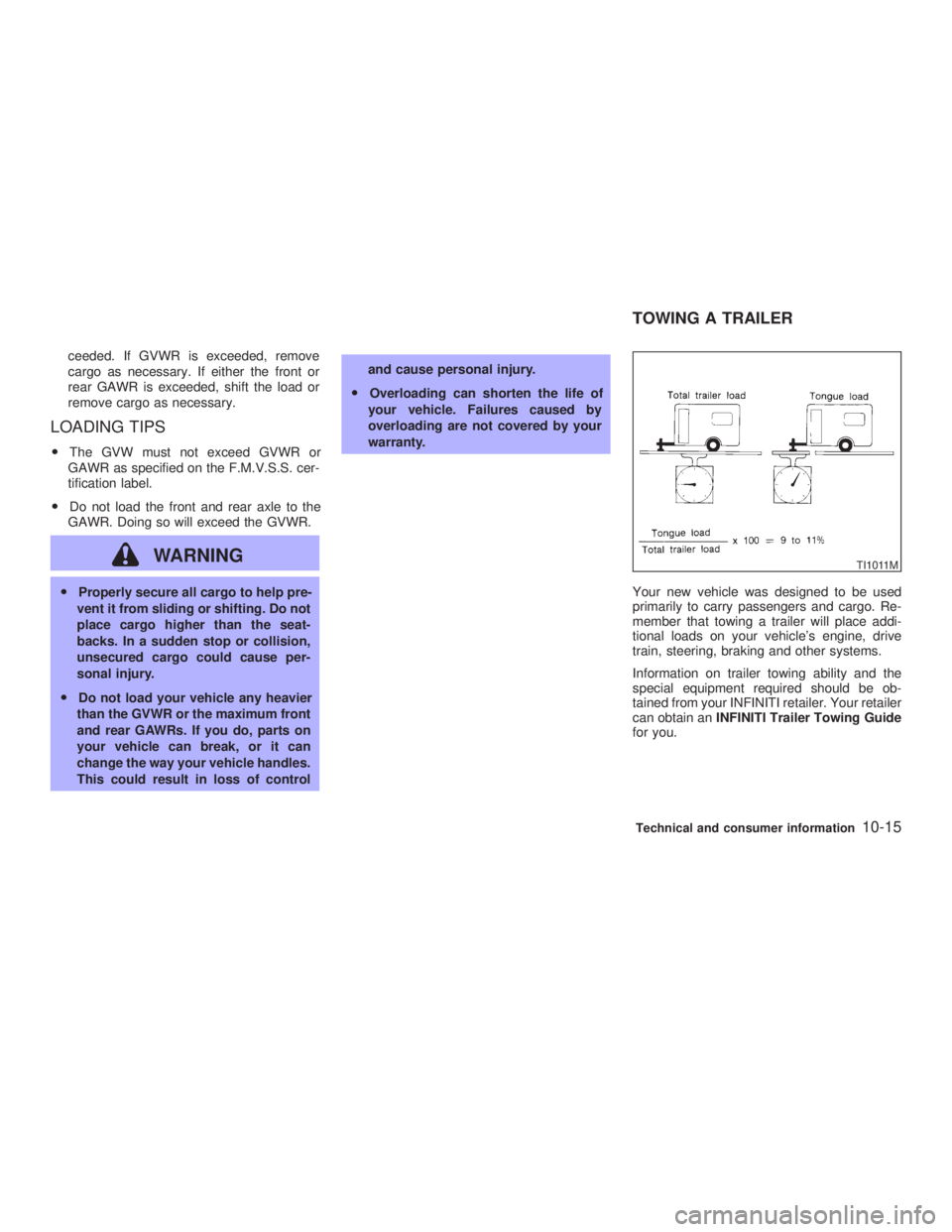
Tongue load Keep the tongue load between 9 and 11% of
the total trailer load. If the tongue load be-
comes excessive, rearrange cargo to allow for
proper tongue load.
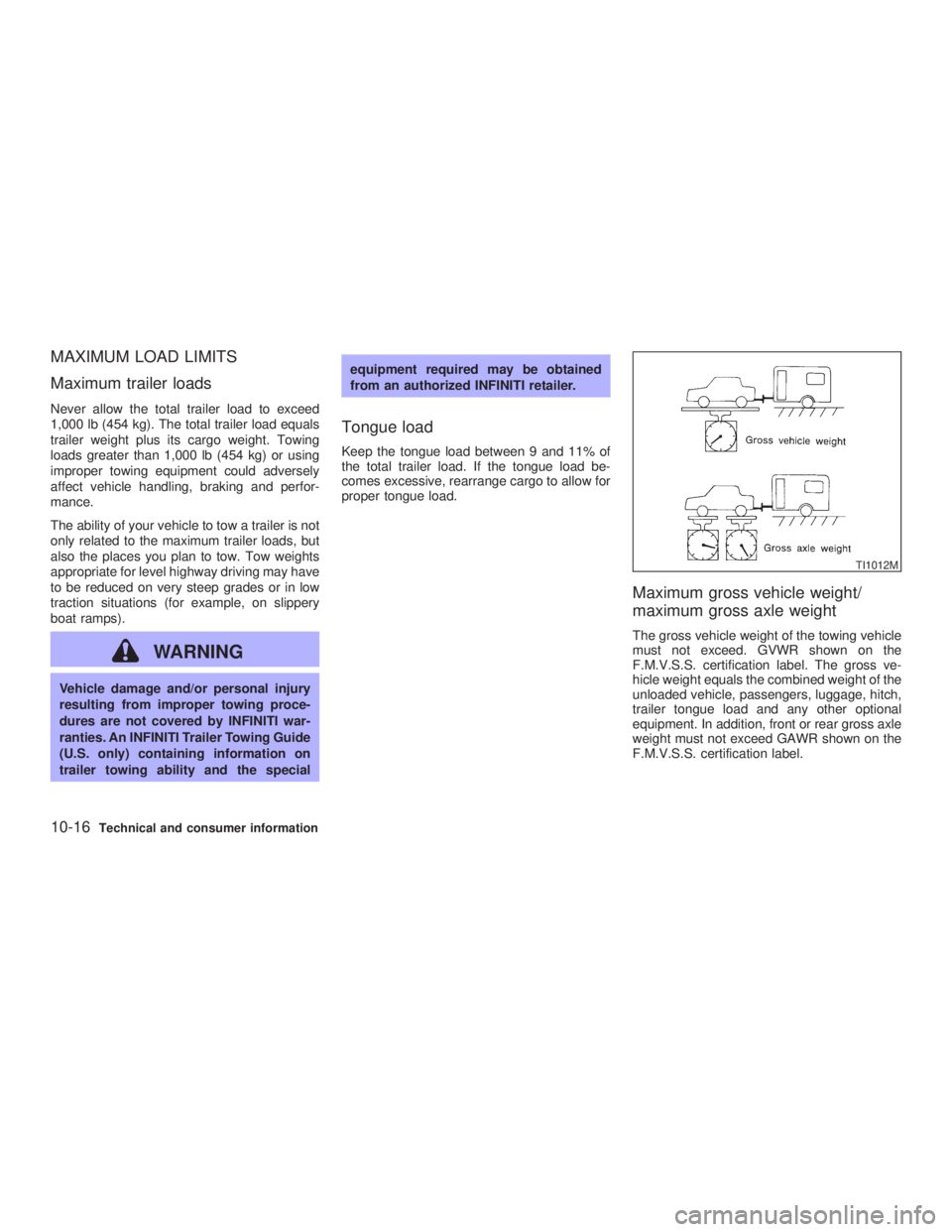
Maximum gross vehicle weight/
maximum gross axle weight The gross vehicle weight of the towing vehicle
must not exceed. GVWR shown on the
F.M.V.S.S. certification label. The gross ve-
hicle weight equals the combined weight of the
unloaded vehicle, passengers, luggage, hitch,
trailer tongue load and any other optional
equipment. In addition, front or rear gross axle
weight must not exceed GAWR shown on the
F.M.V.S.S. certification label. TI1012M
10-16 Technical and consumer information
Z 02.7.29/V35-D/V5.0
X
Page 239 of 256

TOWING LOAD/SPECIFICATION CHART
Unit: lb (kg)
MAXIMUM
TOWING LOAD 1,000 (454)
MAXIMUM
TONGUE LOAD 110 (49)
TOWING SAFETY
Trailer hitch Choose a proper hitch for your vehicle and
trailer. Make sure the trailer hitch is securely
attached to the vehicle, to help avoid personal
injury or property damage due to sway caused
by crosswinds, rough road surfaces or passing
trucks.
CAUTIONO Do not use axle-mounted hitches.
O The hitch should not be attached to
or affect the operation of the impact-
absorbing bumper.
O Do not modify the vehicle exhaust
system, brake system, etc. to install a
trailer hitch. O To reduce the possibility of additional
damage if your vehicle is struck from
the rear, where practical, remove the
hitch and/or receiver when not in use.
After the hitch is removed, seal the
bolt holes to prevent exhaust fumes,
water or dust from entering the pas-
senger compartment.
O Regularly check that all hitch mount-
ing bolts are securely mounted.
Tire pressures O When towing a trailer, inflate the vehicle
tires to the recommended cold tire pressure
indicated on the tire placard (located on the
inside of the rear left door opening (Sedan),
the driver side center pillar (Coupe).
O Trailer tire condition, size, load rating and
proper inflation pressure should be in ac-
cordance with the trailer and tire manufac-
turers' specifications.
Safety chain Always use a suitable chain between your
vehicle and the trailer. The chain should be
crossed and should be attached to the hitch, not to the vehicle bumper or axle. Be sure to
leave enough slack in the chain to permit
turning corners.
Trailer lights Trailer lights should comply with federal and/or
local regulations. When wiring the vehicle for
towing, connect the stop and tail light pickup
into the vehicle electrical circuit at a point
between the sensor and stop light or light
switch.
Trailer brakes If your trailer is equipped with a braking sys-
tem, make sure it conforms to federal and/or
local regulations and that it is properly in-
stalled.
WARNING Never connect a trailer brake system
directly to the vehicle brake system.
Pre-towing tips O Be certain your vehicle maintains a level
position when a loaded and/or unloaded
trailer is hitched. Do not drive the vehicle if
it has an abnormal nose-up or nose-down Technical and consumer information
10-17
Z 02.7.29/V35-D/V5.0
X