2003 Hyundai Tiburon warning
[x] Cancel search: warningPage 19 of 169

FEATURES OF YOUR HYUNDAI
1- 11
B150E01A-AAT
Injured Person
A seat belt should be used when an injured
person is being transported. When this is nec-
essary, you should consult a physician for
recommendations.
B150F01A-AAT
One Person Per Belt
Two people (including children) should never
attempt to use a single seat belt. This could
increase the severity of injuries in case of an
accident.
B150G01A-AAT
Do Not Lie Down
To reduce the chance of injuries in the event of
an accident, and to achieve maximum effec-
tiveness of the restraint system, all passengers
should be sitting up and the front seats should
be in an upright position when the car is mov-
ing. A seat belt cannot provide proper protec-
tion if the person is lying down in the rear seat
or if the front seat is in a reclined position.
WARNING:Sitting in a reclined position or lying down
when your vehicle is in motion can be dan-
gerous. Even if you buckle up, your seat
belts can't do their job when you're reclined.
The shoulder belt can't do its job because it
won't be against your body.
Instead, it will be in front of you. In a crash
you could go into it with great force, receiv-
ing serious neck or other injuries.
The lap belt can't do its job either. In a crash
the belt could go up over your abdomen.
The belt forces would be applied there, not
at your pelvic bones.
This could cause serious internal injuries.
For proper protection when the vehicle is in
motion, have the seatback upright.
Then sit back in the seat and wear your seat
belt properly. See page 1-12.
B160A01A-AAT
CARE OF SEAT BELTS
Seat belt systems should never be disassem-
bled or modified. In addition, care should be
taken to assure that seat belts and belt hard-
ware are not damaged by seat hinges, doors or
other abuse.
WARNING:When you return the rear seatback to its
upright position after the rear seatback was
folded down, be careful not to damage the
seat belt webbing or buckle. Be sure that the
webbing or buckle does not get caught or
pinched in the rear seat.
B160B01A-AAT
Periodic Inspection
It is recommended that all seat belts be inspected
periodically for wear or damage of any kind.
Parts of the system that are damaged should be
replaced as soon as possible.
B160C01A-AAT
Keep Belts Clean and Dry
Seat belts should be kept clean and dry. If belts
become dirty, they can be cleaned by using a
mild soap solution and warm water. Bleach, dye,
strong detergents or abrasives should not be
used because they may damage and weaken the
fabric.
B160D01A-AAT
When to Replace Seat Belts
Entire in-use seat belt assembly or assemblies
should be replaced if the vehicle has been in-
volved in an accident. This should be done even
if no damage is visible. Additional questions
concerning seat belt operation should be direct-
ed to your Hyundai Dealer.
B170A04A-AATHEIGHT ADJUSTABLE FRONT SEAT
SHOULDER BELT (If installed)
HGK109
Page 20 of 169
FEATURES OF YOUR HYUNDAI
1- 12
B190A01GK-AAT
SEAT BELTS Rear Seat 3-Point Sys-
tem with Combination Locking Re-
tractor
To Fasten Your Belt
Combination retractor type seat belts are in-
stalled in the rear seat positions to help accom-
modate the installation of child restraint sys-
tems. Although a combination retractor is also
installed in the front passenger seat position,
Hyundai strongly recommends that children al-
ways be seated in the rear seat. NEVER place
any infant restraint system in the front seat of
the vehicle.
This type of seat belt combines the features of
both an emergency locking retractor seat belt
and an automatic locking retractor seat belt. To
fasten your seat belt, pull it out of the retractor
and insert the metal tab into the buckle. There
will be an audible "click" when the tab locks into
the buckle. When not securing a child restraint,
the seat belt operates in the same way as
driver's seat belt (Emergency Locking Retrac-
tor Type). It automatically adjusts to the proper
length only after the lap belt portion of the seat
FUA1090P B180A01GK-AAT
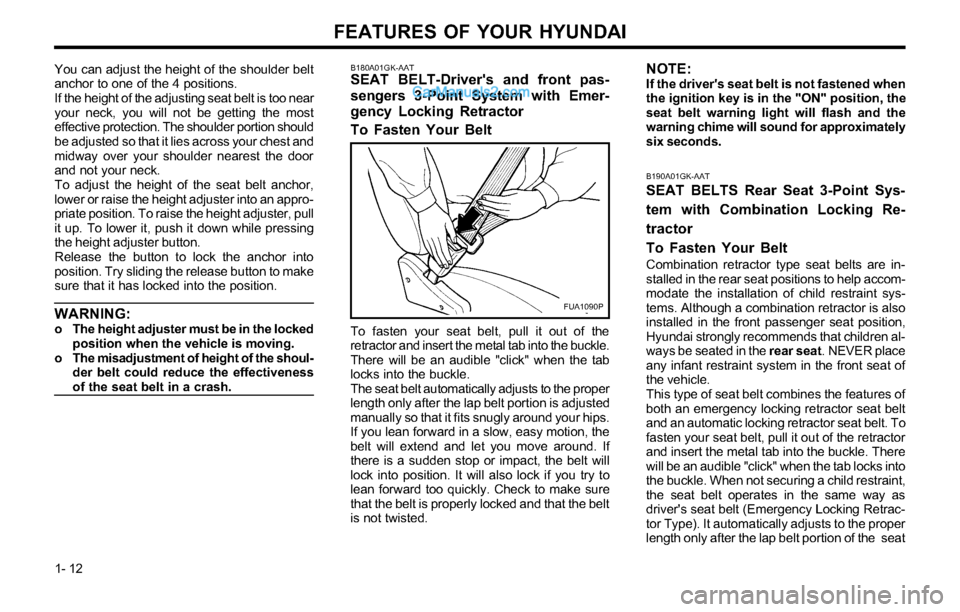
SEAT BELT-Driver's and front pas-
sengers 3-Point System with Emer-
gency Locking Retractor
To Fasten Your BeltYou can adjust the height of the shoulder belt
anchor to one of the 4 positions.
If the height of the adjusting seat belt is too near
your neck, you will not be getting the most
effective protection. The shoulder portion should
be adjusted so that it lies across your chest and
midway over your shoulder nearest the door
and not your neck.
To adjust the height of the seat belt anchor,
lower or raise the height adjuster into an appro-
priate position. To raise the height adjuster, pull
it up. To lower it, push it down while pressing
the height adjuster button.
Release the button to lock the anchor into
position. Try sliding the release button to make
sure that it has locked into the position.
WARNING:o The height adjuster must be in the locked
position when the vehicle is moving.
o The misadjustment of height of the shoul-
der belt could reduce the effectiveness
of the seat belt in a crash.To fasten your seat belt, pull it out of the
retractor and insert the metal tab into the buckle.
There will be an audible "click" when the tab
locks into the buckle.
The seat belt automatically adjusts to the proper
length only after the lap belt portion is adjusted
manually so that it fits snugly around your hips.
If you lean forward in a slow, easy motion, the
belt will extend and let you move around. If
there is a sudden stop or impact, the belt will
lock into position. It will also lock if you try to
lean forward too quickly. Check to make sure
that the belt is properly locked and that the belt
is not twisted.
NOTE:If the driver's seat belt is not fastened when
the ignition key is in the "ON" position, the
seat belt warning light will flash and the
warning chime will sound for approximately
six seconds.
Page 21 of 169

FEATURES OF YOUR HYUNDAI
1- 13 belt is adjusted manually so that it fits snugly
around your hips. When the seat belt is fully
extended from the retractor to allow the instal-
lation of a child restraint system, the seat belt
operation changes to allow the belt to retract,
but not to extend. (Automatic Locking Retractor
Type)
NOTE:Although the combination retractor provides
the same level of protection for seated pas-
sengers in either emergency or automatic
locking modes, it is recommended that
seated passengers use the emergency lock-
ing feature for improved convenience. The
automatic locking function is intended to
facilitate child restraint installation. To con-
vert from the automatic locking feature to
the emergency locking operation mode, al-
low the unbuckled seat belt to fully retract.
WARNING:o For maximum restraint system protec-
tion, seat belts must always be used
whenever the car is moving.
o Seat belts are most effective when
seatbacks are in the upright position.
o Children must always be seatbelted in
the rear seats. Never allow children to
ride in the front passenger seat.
o The shoulder belt should be positioned
midway over the shoulder nearest the
door for the most effective protection.
Never wear the seat belt under the arm
nearest the door. Wearing the belt under
the arm nearest the door could cause
serious or fatal injuries in an accident.
o Avoid wearing twisted seat belts. A twist-
ed belt can't do its job as well. In a
collision, it could even cut into you. Be
sure the belt is straight and not twisted.
o Be careful not to damage the belt web-
bing or hardware. If the belt webbing or
hardware is damaged, replace it.
WARNING:You should place the lap belt portion as low
as possible and snugly across your hips,
not on your waist. If the lap belt is located
too high on your waist, it may increase the
chance of injury in the event of a collision.
Both arms should not be under or over the
B200A01A-AAT
Adjusting Your Seat Belt
FUA1090Q
B210A01A-AAT
To Release the Seat Belt
The seat belt is released by pressing the release
button in the locking buckle. When it is released,
the belt should automatically draw back into the
retractor.
If this does not happen, check the belt to be sure
it is not twisted, then try again.
FUA1090R
belt. Rather, one should be over and the
other under, as shown in the illustration.
Never wear the seat belt under the arm
nearest the door.
Page 22 of 169

FEATURES OF YOUR HYUNDAI
1- 14
WARNING:o A child restraint system must be placed
in the rear seat. Never install a child or
infant seat on the front passenger's seat.
Should an accident occur and cause the
passenger side airbag to deploy, it could
severely injure or kill an infant or child
seated in an infant or child seat. Thus,
only use a child restraint in the rear seat
of your vehicle.
o Since a safety belt or child restraint sys-
tem can become very hot if it is left in a
closed vehicle, be sure to check the seat
cover and buckles before placing a child
there.
o When the child restraint system is not in
use, store it in the trunk or fasten it with
a safety belt so that it will not be thrown
forward in the case of a sudden stop or
an accident.
o Children who are too large to be in a
child restraint should still sit in the rear
seat and be restrained with the available
lap/shoulder belts. Never allow children
to ride in the front passenger seat.
o Always make sure that the shoulder belt
portion of the lap/shoulder belt is posi-
tioned midway over the shoulder, never
across the neck or behind the back. Mov-
ing the child closer to the center of the
vehicle may help provide a good shoul-
der belt fit. The lap belt portion of the lap/
shoulder belt or the center seat lap belt
must always be positioned as low as
possible on the child's hips and as snug
as possible.
o If the seat belt will not properly fit the
child, we recommend the use of an ap-
proved booster seat in the rear seat in
order to raise the child's seating height
so that the seat belt will properly fit the
child. Before purchasing a booster seat,
make sure that it meets applicable Feder-
al Motor Vehicle Safety Standards
(FMVSS) and that it is satisfactory for
use with this vehicle.
o Never allow a child to stand up or kneel
on the seat.
o Never use an infant carrier or child safety
seat that "hooks" over a seatback; it may
not provide adequate security in an acci-
dent.
o Never allow a child to be held in a per-
son's arms while they are in a moving
vehicle, as this could result in serious
injury to the child in the event of an
accident or a sudden stop. Holding a
child in a moving vehicle does not pro-
vide the child with any means of protec-
tion during an accident, even if the per-
son holding the child is wearing a seat
belt.B230A02A-AAT
CHILD RESTRAINT SYSTEM
Children riding in the car should sit in the rear
seat and must always be properly restrained to
minimize the risk of injury in an accident, sud-
den stop or sudden maneuver. According to
accident statistics provided by the National High-
way Traffic Safety Administration (NHTSA),
children are safer when properly restrained in
the rear seats than in the front seat. Larger
children should use one of the seat belts pro-
vided.
All 50 states have child restraint laws. You
should be aware of the specific requirements in
your state. Child and/or infant safety seats must
be properly placed and installed in the rear
seat. You must use a commercially available
child restraint system that meets the require-
ments of the Federal Motor Vehicle Safety
Standards (FMVSS).
Children could be injured or killed in a crash if
their restraints are not properly secured. For
small children and babies, a child seat or infant
seat must be used. Before buying a particular
child restraint system, make sure it fits your car
and seat belts, and fits your child. Follow all the
instructions provided by the manufacturer when
installing the child restraint system.
Page 24 of 169

FEATURES OF YOUR HYUNDAI
1- 16
B230D01GK-AAT
Securing the Child Restraint Seat with
the "ISOFIX" System
B230F01GK
Some child seat manufacturers make child re-
straint seats that are labeled as ISOFIX or
ISOFIX-compatible child restraint seats. These
seats include two rigid or webbing mounted
attachments that connect to two ISOFIX an-
chors at specific seating positions in your ve-
hicle. This type of child restraint seat eliminates
the need to use seat belts to attach the child
seat for forward-facing child restraint seats.
ISOFIX anchors have been provided in your
vehicle. The ISOFIX anchors are located in the
left and right outboard rear seating positions.
Their locations are shown in the illustration.
There is no center rear seating position.
WARNING:o There is no center rear seat position.
o Do not install a child restraint seat at the
center of the rear seat using the vehicle's
ISOFIX anchors. The ISOFIX anchors are
only provided for the left and right out-
board of the rear seat. Do not misuse the
ISOFIX anchors by attempting to attach a
child restraint seat in the middle of rear
seat position to the ISOFIX anchors. In a
crash, the child restraint seat ISOFIX at-
tachments may not be strong enough to
secure the child restraint seat properly in
the center of the rear seat and may break,
causing serious injury or death.
o Do not mount more than one child re-
straint to a single tether or to a child
restraint lower anchorage point. The im-
proper increased load may cause the
anchorage points or tether anchor to
break, causing serious injury or death.
o Attach the ISOFIX or ISOFIX-compatible
child restraint seat only to the appropri-
ate locations shown in the illustration.
o Always follow the installation and use
instructions provided by the manufac-
turer of the child restraint.
installed. If you need to tighten the belt, pull
more webbing toward the retractor. When you
unbuckle the seat belt and allow it to retract, the
retractor will automatically revert back to its
normal seated passenger emergency locking
usage condition.
NOTE:o Before installing the child restraint sys-
tem in any seating position, read the
instructions supplied by the child restraint
system manufacturer.
o If the seat belt does not operate as de-
scribed, have the system checked imme-
diately by your authorized Hyundai deal-
er.
WARNING:o If the retractor is not in the Automatic
Locking mode, the child restraint system
can move when your vehicle turns or
stops abruptly.
o Do not install a child restraint system in
the front passenger seat. Should an acci-
dent occur and cause the passenger side
supplemental airbag to deploy, it could
severely injure or kill an infant or child
seated in an infant or child seat. There-
fore, only use a child restraint system in
the rear seat of your vehicle.
Page 25 of 169

FEATURES OF YOUR HYUNDAI
1- 17
The ISOFIX anchors are located between the
seatback and the seat cushion of the rear seat
left and right outboard seating positions.
Follow the child seat manufacturer's instruc-
tions to properly install child restraint seats with
ISOFIX or ISOFIX-compatible attachments.
Once you have installed the ISOFIX child re-
straint, assure that the seat is properly attached
to the ISOFIX and tether anchors. Also, test the
child restraint seat before you place the child in
it. Tilt the seat from side to side. Also try to tug
the seat forward. Check to see if the anchors
hold the seat in place.
WARNING:If the child restraint is not anchored prop-
erly, the risk of a child being seriously in-
jured or killed in a collision greatly increases.
B230D02GK
B180B01GK-GAT
Pre-tensioner Seat Belt (If Installed)
Your Hyundai vehicle is equipped with driver's
and front passenger's pre-tensioner seat belts.
The purpose of the pre-tensioner is to make
sure that the seat belts fit tightly against the
occupant's body in certain frontal collisions.
The pre-tensioner seat belts can be activated
alone or, where the frontal collision is severe
enough, together with the airbags.
B180B01S
The pre-tensioner seat belt operates in the
same way as an Emergency Locking Retractor
(ELR) type of seat belt. When the vehicle stops
suddenly, or if the occupant tries to lean for-
ward too quickly, the seat belt retractor will lock
into position. However, in certain frontal colli-
sions, the pre-tensioner will activate and pull
the seat belt into tighter contact against the
occupant's body.
B180B01GK
Driver's airbag1
23Passenger's
airbag
The seat belt pre-tensioner system consists
mainly of the following components.
Their locations are shown in the illustration.
1. SRS airbag warning light
2. Seat belt pre-tensioner assembly
3. SRS control module
WARNING:To obtain maximum benefit from a pre-
tensioner seat belt:
1. The seat belt must be worn correctly.
2. The seat belt must be adjusted to the
correct position.
ISOFIX
AnchorISOFIX
Anchor Position
Indicator
Page 26 of 169

FEATURES OF YOUR HYUNDAI
1- 18
B240A01GK-GAT
SUPPLEMENTAL RESTRAINT
(AIRBAG) SYSTEM (SRS) (If Installed)
Your Hyundai is equipped with a Supplemental
Restraint (Airbag) System. The indications of
the system's presence are the letters "SRS AIR
BAG" embossed on the ornament in the steer-
ing wheel and the passenger's side front panel
pad above the glove box.
The Hyundai SRS consists of airbags installed
under the pad covers in the center of the
steering wheel and the passenger's side front
panel above the glove box. The purpose of the
SRS is to provide the vehicle's driver and/or the
front passenger with additional protection than
that offered by the seat belt system alone, in
case of a frontal impact of sufficient severity.
NOTE:o Both the driver's and front passenger's
pre-tensioner seat belts will be activated
in certain frontal collisions. The pre-
tensioner seat belts can be activated alone
or, where the frontal collision is severe
enough, together with the airbags.
o When the pre-tensioner seat belts are
activated, a loud noise may be heard and
fine dust, which may appear to be smoke,
may be visible in the passenger compart-
ment. These are normal operating condi-
tions and are not hazardous.
o Although it is harmless, the fine dust
may cause skin irritation and should not
be breathed for prolonged periods. Wash
your hands and face thoroughly after an
accident in which the pre-tensioner seat
belts were activated.
CAUTION:o The control module that activates the
SRS airbag controls the pre-tensioner
seat belt also.
o If there is some malfunction in the pre-
tensioner seat belt circuit, the warning
light will illuminate even if there is no
malfunction in the SRS airbag system. If
the SRS airbag warning light does not
illuminate or illuminates continuously
when the ignition key is turned to "ON",
or if it remains illuminated after blinking
for approximately 6 seconds, or if it illu-
minates while the vehicle is being driven,please have an authorized Hyundai deal-
er inspect the pre-tensioner seat belt or
SRS airbag system as soon as possible.
WARNING:o Pre-tensioners are designed to operate
only one time. After activation, pre-
tensioner seat belts must be replaced.
All seat belts, of any type, should always
be replaced after they have been worn
during a collision.
o The pre-tensioner seat belt assembly
mechanisms become hot during activa-
tion. Do not touch the pre-tensioner seat
belt assemblies for several minutes after
they have been activated.
o Do not attempt to inspect or replace the
pre-tensioner seat belts yourself. This
must be done by an authorized Hyundai
dealer.
o Do not strike the pre-tensioner seat belt
assemblies.
o Do not attempt to service or repair the
pre-tensioner seat belt system in any
manner.
o Improper handling of the pre-tensioner
seat belt assemblies, and failure to heed
the warnings to not strike, modify, in-
spect, replace, service or repair the pre-
tensioner seat belt assemblies may lead
to improper operation or inadvertent ac-
tivation and serious injury.
o Always wear the seat belts when driving
or riding in a motor vehicle.
B240A01GK
Page 27 of 169

FEATURES OF YOUR HYUNDAI
1- 19
NOTE:Be sure to read information about the SRS
on the labels provided on the backside of
the sun visor and in the glove box.
WARNING:o As its name implies, the SRS is designed
to work with, and be supplemental to, the
driver's and the passenger's three point
seat belt systems and is not a substitute
for them. Therefore, your seat belts must
be worn at all times while the vehicle is in
motion. The airbags deploy only in cer-
tain frontal impact conditions severe
enough to cause significant injury to the
vehicle occupants.
o The SRS is designed to deploy the airbags
only when an impact is sufficiently severe
and when the impact angle is less than
30° from the forward longitudinal axis of
the vehicle and will not deploy in side,
rear or rollover impacts. Additionally, the
airbags will only deploy once. Thus, seat
belts must be worn at all times.
o Front airbags are not intended deploy in
light collisions in which protection can
be provided by the seat belt.
o Front airbags are not intended to deploy
in side-impact, rear-impact or rollover
crashes. In addition, airbags will not de-
ploy in frontal crashes below the deploy-
ment threshold speed.
o The driver should sit back as far as pos-
sible while still maintaining control of the
vehicle. If you are sitting too close to the
airbag, it can cause death or serious
injury when it inflates.
o No objects should be placed over or near
the airbag modules on the steering wheel,
instrument panel, and the front
passenger's panel above the glove
box, because any such object could
cause harm if the vehicle is in a crash
severe enough to cause the airbags to
deploy.
o If the airbags deploy, they must be re-
placed by an authorized Hyundai dealer.
B240A02GK
Rear impact
Side Impact
Rollovero Do not tamper with or disconnect SRS
wiring, or other components of the SRS
system. Doing so could result in injury,
due to accidental firing of the airbags or
by rendering the SRS inoperative.
o Do not install a child restraint system in
the front passenger seat position. A child
restraint system must never be placed in
the front seat. The infant or child could be
severely injured or killed by an airbag
deployment in case of an accident.
o Do not allow children to ride in the front
passenger seat. If older children (teenag-
ers and older) must ride in the front seat,
make sure they are always properly belted
and that the seat is moved back as far as
possible.
o For maximum safety protection in all
types of crashes, all occupants including
the driver should always wear their seat
belts whether or not an airbag is also
provided at their seating position to mini-
mize the risk of severe injury or death in
the event of a crash. Do not sit or lean
unnecessarily close to the airbag while
the vehicle is in motion.
o The SRS airbag system must deploy very
rapidly to provide protection in a crash. If
an occupant is out of position because of
not wearing a seat belt, the airbag may
forcefully contact the occupant causing
serious or fatal injuries.