2003 Hyundai Terracan service
[x] Cancel search: servicePage 229 of 349
CONTROLS AND EQUIPMENT1- 35
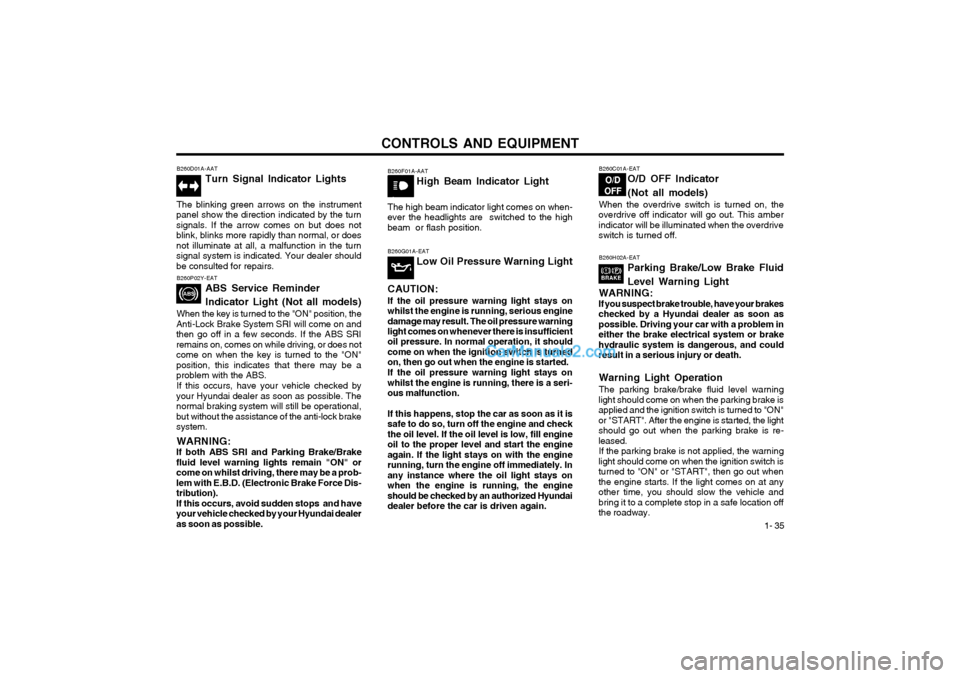
B260P02Y-EAT
ABS Service Reminder Indicator Light (Not all models)
When the key is turned to the "ON" position, the
Anti-Lock Brake System SRI will come on and then go off in a few seconds. If the ABS SRIremains on, comes on while driving, or does notcome on when the key is turned to the "ON"position, this indicates that there may be aproblem with the ABS.
If this occurs, have your vehicle checked by
your Hyundai dealer as soon as possible. Thenormal braking system will still be operational,but without the assistance of the anti-lock brakesystem.
WARNING:
If both ABS SRI and Parking Brake/Brakefluid level warning lights remain "ON" orcome on whilst driving, there may be a prob-
lem with E.B.D. (Electronic Brake Force Dis-tribution).If this occurs, avoid sudden stops and haveyour vehicle checked by your Hyundai dealeras soon as possible. B260F01A-AAT
High Beam Indicator Light
The high beam indicator light comes on when-
ever the headlights are switched to the highbeam or flash position.
B260D01A-AAT
Turn Signal Indicator Lights
The blinking green arrows on the instrument
panel show the direction indicated by the turn signals. If the arrow comes on but does notblink, blinks more rapidly than normal, or doesnot illuminate at all, a malfunction in the turnsignal system is indicated. Your dealer shouldbe consulted for repairs. B260G01A-EAT
Low Oil Pressure Warning Light
CAUTION:
If the oil pressure warning light stays onwhilst the engine is running, serious enginedamage may result. The oil pressure warninglight comes on whenever there is insufficient oil pressure. In normal operation, it should come on when the ignition switch is turnedon, then go out when the engine is started. If the oil pressure warning light stays on
whilst the engine is running, there is a seri-ous malfunction.
If this happens, stop the car as soon as it is
safe to do so, turn off the engine and checkthe oil level. If the oil level is low, fill engineoil to the proper level and start the engineagain. If the light stays on with the enginerunning, turn the engine off immediately. Inany instance where the oil light stays onwhen the engine is running, the engineshould be checked by an authorized Hyundaidealer before the car is driven again.B260C01A-EAT
O/D OFF Indicator (Not all models)
When the overdrive switch is turned on, the
overdrive off indicator will go out. This amber indicator will be illuminated when the overdriveswitch is turned off.
B260H02A-EAT
Parking Brake/Low Brake Fluid Level Warning Light
WARNING:
If you suspect brake trouble, have your brakes checked by a Hyundai dealer as soon aspossible. Driving your car with a problem ineither the brake electrical system or brakehydraulic system is dangerous, and couldresult in a serious injury or death.
Warning Light Operation The parking brake/brake fluid level warning
light should come on when the parking brake is applied and the ignition switch is turned to "ON"or "START". After the engine is started, the lightshould go out when the parking brake is re-leased. If the parking brake is not applied, the warning
light should come on when the ignition switch isturned to "ON" or "START", then go out whenthe engine starts. If the light comes on at anyother time, you should slow the vehicle andbring it to a complete stop in a safe location offthe roadway.
Page 230 of 349

CONTROLS AND EQUIPMENT
1- 36
B260M01A-AAT Low Fuel Level Warning Light
The low fuel level warning light comes on when the fuel tank is approaching empty. When itcomes on, you should add fuel as soon aspossible. Driving with the fuel level warning lighton or with the fuel level below "E" can cause theengine to misfire and damage the catalyticconverter. B260K01B-EAT Hatchback Door Open Warning Light
This light remains on unless the tail gate is completely closed.
B260E01HP-GAT
Seat Belt Warning Light
The seat belt warning light blinks for about 6seconds when the ignition key is turned fromthe "OFF" position to "ON" or "START".
B260L01A-GAT Door Ajar Warning Light
The door ajar warning light warns you that a door is not completely closed.
B260A01B-GAT Front Fog Indicator Light
Front fog indicator light comes on whenever the fog light switch is on.
B260J01S-EAT Charging System Warning Light
The charging system warning light should come
on when the ignition is turned on, then go out when the engine is running. If the light stays onwhilst the engine is running, there is a malfunc-tion in the electrical charging system. If the lightcomes on whilst you are driving, stop, turn offthe engine and check under the bonnet. First,make certain the generator drive belt is inplace. If it is, check the tension of the belt. And then, have the system checked by your
Hyundai dealer.
CAUTION: If the drive belt (generator belt) is loose,
broken, or missing whilst the vehicle is driv- ing, there may be a serious malfunction,engine could overheat because this belt alsodrives the water pump.
B260Q01HP-EAT
Cruise Indicator Light (Not all models)
The cruise indicator light in the instrument clus- ter is illuminated only when the vehicle cruisingspeed has been set using the control switch onthe steering wheel. The indicator light does not illuminate when the main cruise control switch is activated.Information on the use of cruise control may befound on page 1-60.
The brake fluid level warning light indicates that
the brake fluid level in the brake master cylinderis low and hydraulic brake fluid conforming toDOT 3 or DOT 4 specifications should beadded. After adding fluid, if no other trouble isfound, the car should be immediately and care-fully driven to a Hyundai dealer for inspection.If further trouble is experienced, the vehicleshould not be driven at all but taken to a dealerby a professional towing service or some othersafe method.
Your Hyundai is equipped with dual-diagonal
braking systems. This means you still havebraking on two wheels even if one of the dualsystems should fail. With only one of the dualsystems working, more than normal pedal traveland greater pedal pressure are required to stopthe car. Also, the car will not stop in as short adistance with only half of the brake systemworking. If the brakes fail whilst you are driving,shift to a lower gear for additional engine brak-ing and stop the car as soon as it is safe to doso.
Page 231 of 349

CONTROLS AND EQUIPMENT1- 37
B260T01HP-EAT4WD Engaged Indicator Light (Part-time 4WD only)
When the key is turned to the "ON" position, the 4WD(Four Wheel Drive) engaged indicator lightwill come on and then go off in a few seconds. The 4WD engaged indicator light will illuminate when the transfer shift knob is set to 4Hposition(Part-time 4WD only). CAUTION: If the 4WD engaged indicator light ( )blinks (Full-time 4WD type) or illuminates
with the 4WD LOW indicator light ( ) (Part-time 4WD type) whilst driving, this indicatesthat there is a malfunction in the 4WD system.If this occurs, have your vehicle checked byan authorized Hyundai dealer as soon aspossible. B260U01HP-EAT
A/T(Automatic Transmission)
Oil Temperature Warning Light(Not all models)
The A/T oil temperature warning light comes on when the automatic transmission oil temperaturegoes up to the temperature that may result inserious damage of automatic transmission. If the A/T oil temperature warning light comes on
whilst driving, park your vehicle in at a safe
place as soon as possible. With the selectorlever shifted into "P" position, allow the engineto idle until the warning light goes off. When thewarning light goes off, the vehicle can be driven
normally.
CAUTION:If the warning light doesn't go off or blinks,this indicates that there is a malfunction inthe automatic transmission or T.C.U (Trans-mission Control Unit). If this occurs, haveyour vehicle checked by an authorizedHyundai dealer.
A/T
B260N01A-EAT Malfunction Indicator Light
This light illuminates when there is a malfunction of an exhaust gas related component, and thesystem is not functioning properly so that theexhaust gas regulation values are not satisfied.This light will also illuminate when the ignitionkey is turned to the "ON" position, and will go out
in a few seconds. If it illuminates whilst driving,or does not illuminate when the ignition key isturned to the "ON" position, take your car to yournearest authorized Hyundai dealer and have thesystem checked.
B260R01HP-GAT 4WD LOW Indicator Light
When the key is turned to the "ON" position, the
4WD(Four Wheel Drive) LOW indicator light willcome on and then go off in a few seconds.
The 4WD LOW indicator light comes on when the transfer shift knob is set to low position(Part-time 4WD type : 4L position, Full-time
4WD type : LOW position).B260B01A-EAT SRS (Airbag) Service Reminder Indicator (SRI) Light
The SRS service reminder indicator (SRI) comes on and flashes for about 6 seconds after theignition key is turned to the "ON" position orafter the engine is started, after which it will goout. This light also comes on when the SRS is not working properly. If the SRI does not come on,or continuously remains on after flashing forabout 6 seconds when you turned the ignitionkey to the "ON" position or started the engine,or if it comes on whilst driving, have the SRSinspected by an authorized Hyundai Dealer.
Page 232 of 349

CONTROLS AND EQUIPMENT
1- 38 B270A01A-EAT BRAKE PAD WEAR WARNING SOUND (Not all models) The front disc brake pads have wear indicators that should make a high-pitched squealing orscraping noise when new pads are needed.The sound may come and go or be heard all thetime when the vehicle is moving. It may also beheard when the brake pedal is pushed downfirmly. Excessive rotor damage will result if theworn pads are not replaced. See your Hyundaidealer immediately.
NOTE: If the engine were not started within 2 sec- onds after the preheating is completed, turnthe ignition key once more to the "LOCK"position during 10 seconds, and then to the"ON" position, in order to preheat again.
it to a complete stop in a safe location off theroadway. After starting the engine, do not drive the vehi- cle until the vacuum level is above 275 mmHgbelow atmosphere and warning light has turnedoff. If further trouble is experienced, the vehicleshould not be driven at all but taken to a dealerby a professional towing service. B265C02HP-EAT
Diesel Preheat Indication Light-amber
The indication light illuminates amber when the
ignition switch is placed at the "ON" position. The engine can be started after the preheatindication light goes off. The illuminating timevaries with the water temperature.
B265A01B-EAT Fuel Filter Warning Light(Diesel Engine)
This light illuminates when the ignition switch is set to the "ON" position and goes off after theengine has started. If it lights up whilst theengine is running, it indicates that water hasaccumulated inside the fuel filter. If this hap-pens, remove the water from the fuel filter. (Refer to "Owner Maintenance") B265B01HP-GAT Brake Vacuum Warning Light(Diesel Engine)
WARNING:
If you suspect brake trouble, have your brakes checked by a Hyundai dealer as soon aspossible. Driving your car with a problem ineither the brake electrical system or brakehydraulic system is dangerous, and couldresult in serious injury or death.
The brake vacuum warning light should come onwhen the vacuum level in brake booster de-scends to about 275 mmHg or below. The brakesystem is designed to stop the vehicle withreserve assist if brake pedal is held down. Thisreserve is greatly reduced each time you releasethe brake. Without vacuum assist your vehiclecan still be stopped by pushing much harder onbrake pedal, however the stopping distance maybe much longer. If the light comes on at anyother time, you should slow the vehicle and bring
Water temperature (°F)(°C)
Below -22(-30)
-13(-25)-4(-20)
5(-15)
14(-10) 23(-5)32(0)
68(20) Illuminating time
(sec.)
26 201510
5.53.5 20
Page 276 of 349

DRIVING YOUR HYUNDAI 2- 5
DC090C1-E
FUEL ECONOMY
The following suggestions are made to assist in
achieving the greatest degree of fuel economy.
o Maintaining a constant check on fuel con- sumption will enable the most economical use pattern and driving style to be adopted.
o Avoid using the vehicle for very short jour- neys if possible, particularly when a coldstart is involved.
o Ensure that tyre pressures are maintained at the correct level.
o Use only the recommended grade of fuel.
o Avoid carrying unnecessary weight, and if a roof rack is in use, remove it as soon as possible after use.
o Anticipate the road and conditions ahead to enable adjustments in speed to be madesmoothly. Avoid heavy acceleration andsharp braking.
o Avoid cruising at unnecessary high speeds.
o Always ensure that the periodic maintenance services are performed by a Hyundai dealer at the time and/or mileage intervals speci-fied.
o Use the air conditioner only when neces- sary. HPC090A2-E MANUAL TRANSMISSION
The five speed fully synchronized transmission
is controlled by a floor mounted shift lever upon which the shift pattern is indicated. It is impor-tant that when changing gear, the clutch pedalis fully depressed to avoid transmission dam-age. CAUTION:
o Do not attempt to engage reverse gear when the car is in motion.
o To avoid damaging the selector mecha- nism, do not use the gear shift lever as a hand rest. Release the lever immediatelythe shift is completed.
o To avoid premature clutch wear, do not use the clutch pedal as a foot rest, anddo not hold the vehicle on a gradientusing the clutch.
C055B01HP-GAT
STARTING AND STOPPING THE EN- GINE FOR TURBO CHARGER INTER- COOLER (Diesel Engine)
(1) Do not race the engine or sudden accelerate
the engine immediately after starting it. If the engine is cold, allow the engine to idle forseveral seconds before it is driven to ensuresufficient lubrication of the turbo chargerunit.
(2) After high speed or extended driving, requir- ing a heavy engine load, the engine shouldbe allowed to idle, as shown in the chartbelow, before turning it off. This idle time will allow the turbo charger to cool prior to shutting the engine off.
Required Idle Time
High speed driving Driving Condition
Normal drivingNot necessary About 20 seconds About 1 minute
Up to 62 mph
Up to 50 mph
Steep mountain slopes or contin-
ued driving in excess of 62 mphAbout 2 minutes
WARNING: Do not turn the engine off immediately after
it has been subjected to a heavy load. Doingso may cause severe damage to the engineor turbo charger unit.
SSA2090A
Page 286 of 349

DRIVING YOUR HYUNDAI 2- 15
DC170A1-E
WINTER MOTORING The onset of winter conditions subject motor
vehicles to greater operating demands. There- fore, the following suggestions will assist inmaintaining peak performance and reliabilityduring these periods:
C140A01A-EAT
DRIVING FOR ECONOMY
You can save fuel and get more miles from your
car if you follow these suggestions:
o Drive smoothly. Accelerate at a moderate rate. Don't make "jack-rabbit" starts or full- throttle shifts and maintain a steady cruisingspeed. Don't race between stoplights. Try toadjust your speed to that of the other trafficso you don't have to change speeds unnec-essarily. Avoid heavy traffic whenever pos-sible. Always maintain a safe distance fromother vehicles so you can avoid unneces-sary braking. This also reduces brake wear.
o Drive at a moderate speed. The faster you drive, the more fuel your car uses. Driving ata moderate speed, especially on the high-way, is one of the most effective ways toreduce fuel consumption.
o Don't "ride" the brake or clutch pedal. This can increase fuel consumption and alsoincrease wear on these components. In ad-dition, driving with your foot resting on thebrake pedal may cause the brakes to over-heat, which reduces their effectiveness andmay lead to more serious consequences.
o Take care of your tyres. Keep them inflated to the recommended pressure. Incorrect in-flation, either too much or too little, results inunnecessary tyre wear. Check the tyre pres-sures at least once a month. o Be sure that the wheels are aligned correct-
ly. Improper alignment can result from hittingcurbs or driving too fast over irregular sur-faces. Poor alignment causes faster tyrewear and may also result in other problemsas well as greater fuel consumption.
o Keep your car in good condition. For better fuel economy and reduced maintenancecosts, maintain your car in accordance withthe maintenance schedule in Section 5. Ifyou drive your car in severe conditions,more frequent maintenance is required (seeSection 5 for details).
o Keep your car clean. For maximum service, your Hyundai should be kept clean and freeof corrosive materials. It is especially impor-tant that mud, dirt, ice, etc. not be allowed toaccumulate on the underside of the car. Thisextra weight can result in increased fuelconsumption and also contribute to corro-sion.
o Travel lightly. Don't carry unnecessary weight in your car. Weight reduces fuel economy.
o Don't let the engine idle longer than neces- sary. If you are waiting (and not in traffic),turn off your engine and restart only whenyou're ready to go.
o Remember, your Hyundai does not require extended warm-up. As soon as the engineis running smoothly, you can drive away. Invery cold weather, however, give your en-gine a slightly longer warm-up period. o Don't "labour" or "over-rev" the engine.
Labouring is driving too slowly in too high agear resulting in the vehicle kangarooing. Ifthis happens, shift to a lower gear. Over-revving is racing the engine beyond its safelimit. This can be avoided by shifting at therecommended speeds.
o Use your air conditioning sparingly. The air conditioning system is operated by enginepower so your fuel economy is reducedwhen you use it.
C150A01A-EAT SMOOTH CORNERINGAvoid braking or gear changing in corners, especially when roads are wet. Ideally, cornersshould always be taken under gentle accelera-tion. If you follow these suggestions, tyre wearwill be held to a minimum.
Page 299 of 349

IN CASE OF EMERGENCY 3-9
D060J01HP
Lower the car to the ground by moving the jack
handle up and down. Then position the wheel brace as shown in the drawing and tighten thewheel nuts. Be sure the socket is seated com-pletely over the nut. Do not stand on the wrenchor use an extension pipe over the wrenchhandle.
Go around the wheel tightening every other nut
until they are all tight. Then double-check eachnut for tightness. After changing wheels, have atechnician tighten the wheel nuts to their propertorque as soon as possible.
Wheel nut tightening torque: Steel wheel & aluminium alloy wheel:90-110 N.m (65-80 lb.ft) D060J02O-EAT
AFTER CHANGING WHEELS
If you have a tyre gauge, remove the valve cap
and check the air pressure. If the pressure is lower than recommended, drive slowly to thenearest service station and inflate to the correctpressure. If it is too high, adjust it until it iscorrect. Always reinstall the valve cap afterchecking or adjusting tyre pressure. If the capis not replaced, air may leak from the tyre. If youlose a valve cap, buy another and install it assoon as possible.
After you have changed wheels, always secure
the flat tyre in its place and return the jack andtools to their proper storage locations. D080A02A-EAT
IF YOUR CAR MUST BE TOWED
o OK for 4WD
o OK for Automatic or Manual Transmission Equipped Vehicle D080A01HP
CAUTION:Your car can be damaged if towed incor-
rectly!
If your car has to be towed, it should be done by
your Hyundai dealer or a commercial tow truck service. This will help assure that your car isnot damaged in towing. Also, professionals aregenerally aware of local laws governing towing.In any case, rather than risk damage to yourcar, it is suggested that you show this informa-tion to the tow truck operator. Be sure that asafety cable system is used and that all currentlaws associated with vehicle towing are ob-served.
Page 305 of 349

VEHICLE MAINTENANCE REQUIREMENTS 5-1
NOTE:
The inspection and testing of certain elec-
tronic fuel injection/engine management and automatic transmission control sys-tems require specialised electronic equip-ment specifically designed for Hyundai ve-hicles. The use of general purpose electri-cal test equipment may result in damage tothe control unit microprocessors.
YF010A1-A
5. VEHICLE MAINTE-
NANCE REQUIRE- MENTS
DF020A1-E
MAINTENANCE AND SERVICING REQUIREMENTS To ensure the continued reliability and safety
of the vehicle, certain routine maintenance operations are required at specific mileage ortime intervals.
It is the responsibility of the vehicle owner to
ensure that the maintenance schedules shownin both this Owner's Manual and the Warrantyand Service Passport are adhered to.
The new vehicle warranty may be invalidated
if the routine maintenance operations are notperformed in line with the recommendationsoutlined and the safety and durability of thevehicle adversely affected.
It is recommended that all maintenance op-
erations with the exception of the daily oper-ating checks are entrusted to a Hyundai dealerto ensure that the latest repair and mainte-nance procedures and specialized servicingtools are employed. In addition, the use ofgenuine Hyundai replacement parts will en-sure that the vehicle safety and performancewill not be compromised. DF020C1-E
Specified Scheduled Procedures The specified scheduled procedures are listed
in the maintenance charts beginning at page5-2. The operations specified must be per-formed at the time or mileage intervals shownirrespective of whether the mileage interval has been reached before the specified time interval.
Certain lubricants and components degrade
with both time and mileage (eg, engine oil andbrake fluid) and therefore it is not permissableto base the maintenance schedule upon mile-age alone. It is strongly recommended thatthe maintenance operations are performed bya Hyundai dealer because of the need forspecialized knowledge and tooling and to en-sure that no possibility of invalidating themanufacturers warranty exists.
The maintenance schedules relate to vehicles
operated under normal conditions, vehicleswhich are operated under adverse conditionswill require more frequent maintenance whichis described at page 5-5. DF020F1-E
SERVICE HISTORY
It is important that all scheduled maintenance
services are recorded in the warranty andservice passport to ensure that proof of main-tenance is available when warranty service isrequired.
5