2003 Hyundai Matrix fuel
[x] Cancel search: fuelPage 250 of 312

DRIVING YOUR HYUNDAI
2- 8 o Always engage the parking brake when
the vehicle is unattended, never use the "P" position in place of the parking brake.
o Under normal circumstances, the selector should be placed in the "D" position andthe transaxle allowed to select the mostideal ratio for the circumstances. In thisposition maximum fuel economy will beachieved.
o When descending steep gradients where engine braking is required, the selectorshould be placed at the "2" or "L" positiondepending upon the vehicle speed.
o When ascending steep gradients using large throttle openings, the transaxle mayre-peatedly change between two adjacentratios. This is a normal characteristic andmay be prevented by cancelling the over-drive facility if the shifting occurs betweenthird and fourth ratios, selecting position"2" if the shifting occurs between third andsecond ratios or selecting position "1" if theshifting occurs between first and secondratios.
o Never move the selector to or from the "P" or "N" position with the accelerator de-pressed.
o Ensure that the overdrive switch is at the "ON" position for maximum economy. o If rapid acceleration is required, fully de-
press the accelerator pedal. In this condi-tion, the kickdown mechanism will be oper-ated and the transaxle will automaticallydownshift according to the vehicle speed.
o The automatic transaxle may be used to great effect if the vehicle becomes stuck insnow or mud by allowing the vehicle to berocked to and fro. The engine speed shouldbe held at approximately 1,000rpm bymeans of the accelerator pedal and theselector lever moved between the "D" and"R" positions to induce a rocking motion.
o Do not depress the accelerator pedal with the brakes applied and the selector at the"R", "D", "2" or "L" position.
o Turn the overdrive switch on for good fuel economy and smooth driving. But if enginebraking is needed in the "D" range or ifrepeated upshifting and downshifting be-tween the 3rd and 4th gear is neededwhen climbing a gentle slope, it is recom-mended that the overdrive switch be turnedoff. Turn the overdrive switch back onimmediately afterward.
C090I02A-EAT
CAUTION:
o Shift into "R" and "P" only when the vehicle has completely stopped.
o Do not accelerate the engine in reverse or any of the forward positions with the brakes applied.
o Always apply the footbrake when shift- ing from "P" or "N", to "R", "D", "2" or"L" position.
o Do not use the "P" (Park) position in place of the parking brake. Always setthe parking brake, shift the transaxleinto "P" (Park) and turn off the ignitionwhen you leave the vehicle, even mo-mentarily. Never leave the vehicle unat-tended whilst the engine is running.
o Check the automatic transaxle fluid level regularly, and add fluid as necessary. See the maintenance schedule for the proper fluid recommendation.
FC120D1-E
General Operating Instructions
o The button in the selector handle must be depressed before the selector can be moved.
o The engine may only be started when the selector is at position "P" or "N".
o Ensure that the footbrake is firmly applied when shifting from "P" or "N" to "D", "2", "L"or "R" and vice versa.
Page 251 of 312

DRIVING YOUR HYUNDAI 2- 9
SC130A1-E
OVERDRIVE SWITCH
The overdrive switch prevents the transaxle
upshifting higher than third gear when the switch is turned "OFF". The transaxle will startfrom rest in first gear and upshift to secondand third gear depending upon the roadspeedand throttle opening but will not upshift tofourth gear. When the overdrive switch isturned "ON", the transaxle will start from restin first gear and will upshift, depending uponroadspeed and throttle opening to second,third and fourth gear. Therefore, when theoverdrive switch is turned "OFF", the transaxleperforms as a three speed unit and the over-drive warning light located in the instrumentcluster will be illuminated. When the overdriveswitch is turned "ON", the transaxle functionsas a fully automatic four speed unit with themaximum fuel economy potential of the ve-hicle being realized. o Do not hold the vehicle on the upgrade
with the accelerator pedal. This can causethe transmission to overheat. Always usethe brake pedal or parking brake.
SC140A1-E EFFECTIVE BRAKING Braking system performance and friction ma- terial life are greatly affected by the drivingstyle adopted. The following suggestions aremade to assist in achieving the best resultsfrom the braking system.
o Anticipate the road and conditions ahead
in order that heavy braking may be avoided.
o When descending long gradients, use the engine to assist in retarding the vehicle to minimize the possibility of brake fade oc-curring.
o When trailer towing, ensure that the trailer brakes function correctly and use enginebraking to assist the vehicle braking system.
o Use only genuine Hyundai replacement brake pads and shoes to ensure consis-tent friction characteristics and wear rates.
o After driving through deep water (e.g. fording), the brakes may become wet andperformance reduced. Always check brakeefficiency after emerging from the waterand dry the brakes by lightly depressingthe brake pedal several times whilst driv-ing slowly.
o Apply the parking brake only when the vehicle is at rest.
o Since the power assistance provided by the brake servo is derived from the engine,coasting with the engine turned off or tow-ing of the vehicle with the engine turned offwill result in greatly increased pedal pres-sures being required to stop the vehicle. SC140B1-E
ANTI-LOCK BRAKE SYSTEM (Not all models)
The Anti-Lock Brake System (ABS) is de-
signed to prevent wheel lock-up during sud- den braking or on hazardous road surfaces.The ABS control module monitors the wheelspeed and controls the pressure applied toeach brake. Thus, in emergency situations oron slick roads, ABS will increase vehicle con-trol during braking.
NOTE: During ABS operation, a slight pulsation
may be felt in the brake pedal when the brakes are applied. Also, a noise may beheard in the engine compartment whilstbraking. These conditions are normal andindicate that the anti-lock brake system isfunctioning properly.
WARNING:ABS will not prevent accidents due to im-
proper or dangerous driving maneuvers.Even though vehicle control is improvedduring emergency braking, always maintaina safe distance between you and objectsahead. Vehicle speeds should always bereduced during extreme road conditions.
HFC3023-D
Page 253 of 312

DRIVING YOUR HYUNDAI 2- 11
o Don't "lug" or "over-rev" the engine. Lug-
ging is driving too slowly in too high a gear resulting in the engine bucking. If thishappens to you, shift to a lower gear. Over-revving is racing the engine beyond its safe limit. This can be avoided byshifting at the recommended speeds.
o Use your air conditioning sparingly. The air conditioning system is operated by theengine power so your fuel economy isreduced when you use it.
SC150A1-F
DRIVING FOR ECONOMY
You can save fuel and get more miles fromyour car if you follow these suggestions:
o Drive smoothly. Accelerate at a moderate rate. Don't make "jack-rabbit" starts or full-throttle shifts and maintain a steady cruis-ing speed. Don't race between stoplights.Try to adjust your speed to that of the othertraffic so you don't have to change speedsunnecessarily. Avoid heavy traffic whenever possible. Al- ways maintain a safe distance from othervehicles so you can avoid unnecessarybraking. This also reduces brake wear.
o Drive at a moderate speed. The faster you drive, the more fuel your car uses. Drivingat a moderate speed, especially on thehighway, is one of the most effective waysto reduce fuel consumption.
o Don't "ride" the brake or clutch pedal. This can increase fuel consumption and alsoincrease wear on these components. Inaddition, driving with your foot resting onthe brake pedal may cause the brakes tooverheat, which reduces their effective-ness and may lead to more serious con-
sequences.
o Take care of your tyres. Keep them inflated to the recommended pressure. Incorrectinfla-tion, either too much or too little, re-sults in unnecessary tyre wear. Check thetyre pres-sures at least once a month. o Be sure that the wheels are aligned cor-
rectly. Improper alignment can result fromhitting curbs or driving too fast over irregu-lar surfaces. Poor alignment causes fastertyre wear and may also result in otherproblems as well as greater fuel consump-tion.
o Keep your car in good condition. For better fuel economy and reduced maintenancecosts, maintain your car in accordancewith the maintenance schedule in Section5. If you drive your car in severe condi-tions, more frequent maintenance is re-quired (see Section 5 for details).
o Keep your car clean. For maximum ser- vice, your car should be kept clean andfree of corrosive materials. It is especiallyimportant that mud, dirt, ice, etc. not beallowed to accumulate on the underside ofthe car. This extra weight can result inincreased fuel consumption and also con-tribute to corrosion.
o Travel lightly. Don't carry unnecessary weight in your car. Weight is an enemy ofgood fuel economy.
o Don't let the engine idle longer than neces- sary. If you are waiting (and not in traffic),turn off your engine and restart only whenyou're ready to go.
o Remember, your car does not require extended warm-up. As soon as the engineis running smoothly, you can drive away.In very cold weather, however, give yourengine a slightly longer warm-up period. SC160A1-F SMOOTH CORNERING Avoid braking or gear changing in corners, especially when roads are wet. Ideally, cor-ners should always be taken under gentleacceleration. If you follow these suggestions,tyre wear will be held to a minimum. SC170A1-E WINTER MOTORING The onset of winter conditions subject motor vehicles to greater operating demands. There-fore, the following suggestions will assist inmaintaining peak performance and reliabilityduring these periods:
Page 255 of 312

DRIVING YOUR HYUNDAI 2- 13
SC200B3-E TOWING ATTACHMENTS It is strongly recommended that only an Hyundai Approved towing attachment is usedto ensure that the loads placed upon the bodystructure are correctly distributed. The use ofa non approved attachment will result in theinvalidation of the vehicle warranty. Hyundaitowing attachments are designed and con-structed to ensure maximum towing perfor-mance and ease of fitment. A range of acces-sories including electrical kits are availablethrough the Hyundai dealer network. It is of the utmost importance that those areas of the vehicle which are subjected to greaterstress during towing are maintained in accor-dance with the recommendations given at theend of this book. In addition, the daily operatingchecks relating to engine oil, transmission oiland tyres must be performed at each refuellingto ensure maximum reliability and safety. The use of a proprietary stabiliser will assist in achieving an inherently stable outfit but whilstthe use of such equipment will improve thecharacteristics of a balanced outfit, it will notcompensate for a badly loaded and thereforeunstable outfit. The tyres and braking equipment fitted to the trailer or caravan must be maintained in ac-cordance with the recommendations of themanufacturer. Special attention should be paidto tyres which deteriorate through time and
WARNING:
It is not recommended that the vehicle be
used for towing until the first 1,000 milesof Running In has been completed. AllHyundai MATRIX models are suited to tow-ing trailers and caravans up to the limitsindicated below. MATRIX models fitted withautomatic transaxle have a transaxle oilcooler and further transaxle cooling shouldnot be required. C190E01FC-EAT
TRAILER AND CARAVAN TOWING
Tongue loadSSA2200B
Total trailer weight
exposure rather than as a result of the dis- tances towed. The inside walls of the tyresshould be inspected along with the outsidewalls for cracking and damage. The trailerwheel nut torque must be checked on a regularbasis, preferably before each towing session.
The trailer hitch and the safety catch mecha-
nism must be maintained in good workingorder. The trailer break away cable or chainshould be inspected for damage and shouldbe attached to the vehicle towing attachmenteach and every time the trailer is hitched tothe vehicle.
Whilst towing, the performance of the vehicle
will be reduced in terms of acceleration, brak-ing and handling due to the increased loadsplaced upon the vehicle. The driver shouldanticipate the change in characteristics andadjust the driving style in keeping with thesechanges. Care should be exercised whencornering and braking to prevent the outfitbecoming uncontrollable by reducing corner-ing speeds and allowing increased brakingdistances.
The driver should exercise care to ensure that
when pulling away from rest particularly onuphill gradients the clutch unit is not subjectedto excessive slippage which will reduce theuseful life of this component. Use of the"Overdrive Off" "2" and "L" positions whendriving vehicles with automatic transmission
Page 256 of 312
DRIVING YOUR HYUNDAI
2- 14 YC200E2-E Trailer or Vehicle Towing Tips
1. Before towing, check hitch and safety chain
connections as well as proper operation of the trailer running lights, brake lights, andturn signals.
2. Always drive your vehicle at a moderate speed (Less than 62 MPH)
3. Trailer towing requires more fuel than nor- mal conditions.
4. To maintain engine braking efficiency and electrical charging performance, do not usefifth gear (manual transaxle) or overdrive(automatic transaxle). Towing Bracket Attachment Location
NOTE:
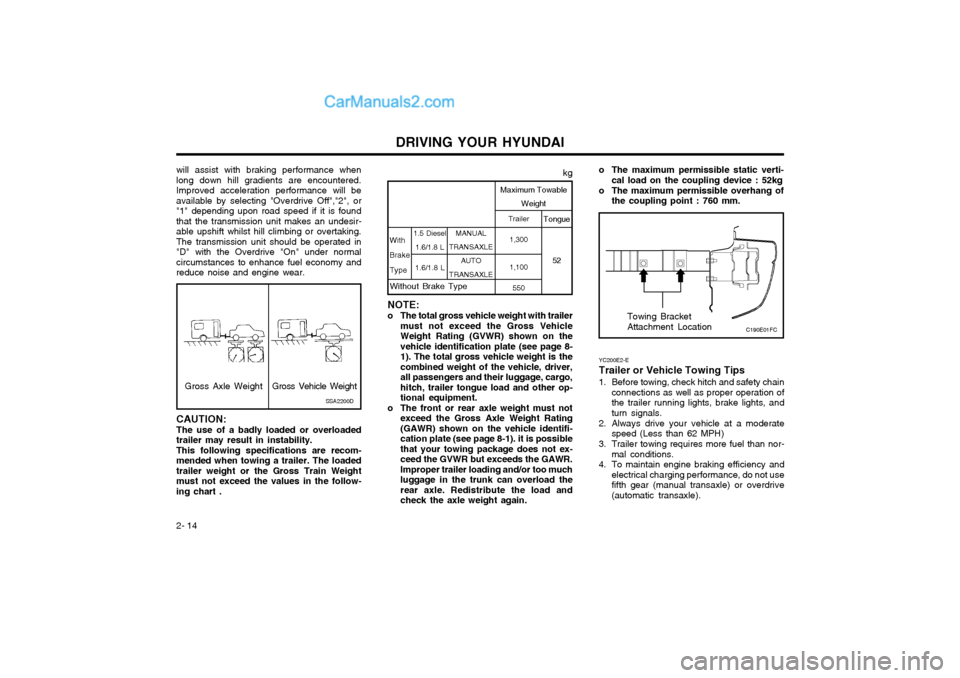
o The total gross vehicle weight with trailer must not exceed the Gross Vehicle Weight Rating (GVWR) shown on thevehicle identification plate (see page 8-1). The total gross vehicle weight is thecombined weight of the vehicle, driver,all passengers and their luggage, cargo,hitch, trailer tongue load and other op-tional equipment.
o The front or rear axle weight must not exceed the Gross Axle Weight Rating(GAWR) shown on the vehicle identifi-cation plate (see page 8-1). it is possiblethat your towing package does not ex-ceed the GVWR but exceeds the GAWR.Improper trailer loading and/or too muchluggage in the trunk can overload therear axle. Redistribute the load andcheck the axle weight again. MANUAL
TRANSAXLE
AUTO
TRANSAXLE Trailer
1,300 1,100 550 Tongue
52
kg
Maximum Towable Weight
With BrakeType
1.5 Diesel 1.6/1.8 L
1.6/1.8 L
Without Brake Type
o The maximum permissible static verti- cal load on the coupling device : 52kg
o The maximum permissible overhang of the coupling point : 760 mm.
C190E01FC
will assist with braking performance when long down hill gradients are encountered.Improved acceleration performance will beavailable by selecting "Overdrive Off","2", or"1" depending upon road speed if it is foundthat the transmission unit makes an undesir-able upshift whilst hill climbing or overtaking.The transmission unit should be operated in"D" with the Overdrive "On" under normalcircumstances to enhance fuel economy andreduce noise and engine wear.
Gross Axle Weight
CAUTION: The use of a badly loaded or overloaded trailer may result in instability.This following specifications are recom-mended when towing a trailer. The loadedtrailer weight or the Gross Train Weightmust not exceed the values in the follow-ing chart . SSA2200DGross Vehicle Weight
Page 258 of 312

3-1
IN CASE OF EMERGENCY
SD000A1-E
3. IN CASE OF
EMERGENCY
SD020A1-E
IF THE ENGINE WILL NOT START Seek assistance from the nearest Hyundai dealer with regard to the method of ignition andfuel system diagnosis.
CAUTION:If the engine refuses to start, no attempt
should be made to push or tow start thevehicle. Vehicles with automatic transaxleor fuel injection will not be able to bestarted in this manner since no drive istransmitted through the automatic transaxlewhilst the engine is not running, and in thecase of fuel injected derivatives, the fuelpump will not operate under tow start con-ditions. In addition, if the vehicle isequipped with an exhaust catalyst, dam-age to the catalyst may result if the vehicleis tow started. SD020B1-E
IF THE ENGINE CANNOT BE
CRANKED SD020C1-F
If Engine Turns Over Normally but Does Not Start
SSA3020C
1. Check fuel Level
2. Check all connectors at ignition coil and spark plugs.Replace any that may be disconnected or loose.
3. Check fuel line in the engine room.
4. If engine still refuses to start, call a Hyundai dealer or seek other qualified assistance.
1. If the vehicle is fitted with manual transaxle,
ensure that the clutch pedal is depressed whilst cranking the engine. If the vehicle isfitted with automatic transaxle, ensurethat the transaxle selector is at the "P"or"N" position.
2. Check the battery terminals and connec- tions to ensure that these are clean andalso tight.
3. If the ignition warning lights dim when the engine is cranked and the battery termi-nals have been checked, a dischargedbattery is indicated.
4. Do not attempt to push or tow start the vehicle, refer to "Jump Starting" for infor-mation regarding engine starting when thebattery is discharged. AD020D1-A
If Engine Stalls While Driving
1. Reduce your speed gradually, keeping a straight line. Move cautiously off the road to a safe place.
2. Turn on your emergency flashers.
3. Try starting the engine again. If your ve- hicle will not start, see "IF THE ENGINE WILL NOT START"
3
D010B01FC
Page 259 of 312

IN CASE OF EMERGENCY
3-2
CAUTION:
Personal injury and damage to the vehicle
may occur if jump starting is not per- formed correctly. If any doubt exists as tohow this operation should be performed,seek assistance from qualified personnel. WARNING:
Motor vehicle batteries contain sulphuric
acid and emit hydrogen gas. Protective clothing should be worn and care exer-cised to prevent the acid from coming intocontact with skin or clothing and the ve-hicle. Naked lights should not be permittedin the vicinity of the battery. Care shouldbe exercised to prevent sparks occurringduring connection. If acid accidentallycomes into contact with skin or eyes, theaffected area should immediately be flushed ponents such as the Fuel Injection system
computer and the Automatic Transaxlecomputer. The battery must never be dis-connected whilst the engine is running. SD040A2-E IF THE ENGINE OVERHEATS If the temperature gauge indicates overheat- ing:
1. Pull off the road and stop as soon as it is
safe to do so.
2. Place the gear selector lever in "P" (auto- matic), or neutral (manual transaxle) and set the parking brake. If the air condition-ing is on, turn it off.
3. If coolant is running out under the car or steam is coming out from under the bonnetstop the engine. Do not open the bonnetuntil the coolant has stopped running orthe steaming has stopped. If there is novisible loss of coolant and no steam, leavethe engine running and check to be surethe engine cooling fan is operating. If the fan is not running, turn the engine off.
4. Check to see if the water pump drive belt is missing. If it is not missing, check to see that it is tight. If the drive belt seems to besatisfactory, check for coolant leaking fromthe radiator, hoses or under the car. (If theair conditioning had been in use, it isnormal for cold water to be draining fromit).
SD030A1-E JUMP STARTING
with copious amounts of water and medi- cal assistance sought.
1. Ensure that the booster battery is 12 volt type. If the booster battery is installed inanother vehicle, ensure that the two vehi-cles are not touching.
2. Turn off all unnecessary electrical equip- ment in both vehicles.
3. Ensure that the engine of the vehicle pro- viding the jump start is running prior toconnection of the jump cables.
4. Connect the red jump cable to the positive (+) terminal of the booster battery and theother end to the positive (+) terminal of thedischarged battery.
5. Attach the black jump cable to the nega- tive (-) terminal of the booster battery, andthe other end to a ground point within theengine compartment of the vehicle withthe flat battery. Do not connect to thenegative battery terminal of the flat batterysince sparks may be generated with thesubsequent risk of explosion.
6. Raise the booster vehicle engine speed to 2,000 r.p.m. and start the engine of thevehicle with the flat battery.
7. Remove jump cables in the reverse order of installation (black cable first).
CAUTION:If the jump cable is incorrectly installed,damage to the vehicle electrical systemmay occur, in particular the electronic com-
HFC4002
Booster battery Discharged battery
Page 260 of 312

3-3
IN CASE OF EMERGENCY
WARNING: While the engine is running, keep hands
and clothing away from moving parts such as the fan and drive belts to preventinjury.
WARNING (Diesel only): Never work on injection system with en-
gine running or within 30 seconds after shutting off engine. High pressure pump,rail, injectors and high pressure pipes aresubject to high pressure even after theengine stopped. The fuel jet produced byfuel leaks may cause serious injury, if ittouch the body. People using pacemak-ers should not move than 30cm closer tothe ECU or wiring harness within theengine room while engine is running,since the high currents in the CommonRail system produce considerable mag-netic fields.
5. If the water pump drive belt is broken or coolant is leaking out, stop the engine immediately and call the nearest Hyundaidealer for assistance.
WARNING: Do not remove the radiator cap when the
engine is hot since steam and boiling wa- ter may be ejected from the radiator result-ing in burns or scalding. D040A01FC-EAT TEMPORARY SPARE TYREThe following instructions for the temporary spare tyre should be observed:
1. Check inflation pressure as soon as pos-
sible after installing the spare tyre, and adjust to the specified pressure. The tyrepressure should be periodically checkedand maintained at the specified pressurewhile the tyre is stored. 2. The spare tyre should only be used tem-
porarily and should be returned to theluggage compartment as soon as the origi-nal tyre can be repaired or replaced.
3. Continuous use at speeds of over 80 km/h (50 mph) is not recommended.
4. As the temporary spare tyre is specifically designed for your car, it should not beused on any other vehicle.
5. The temporary spare tyre should not be used on any other wheels, nor shouldstandard tyre, snow tyre, wheel covers ortrim rings be used with the temporaryspare wheel. If such use is attempted,damage to these items or other car com-ponents may occur.
6. The temporary spare tyre pressure should be checked once a month while the tyre isstored.
CAUTION:
o Do not use snow chains with your tem- porary spare tyre.
o Do not use more than one temporary spare tyre at a time.
Spare Tyre Pressure
Type Size Inflation Pressure T115/70R(D)15420 kPa (60 psi)6. If the cause of the overheating cannot be
found, wait until the engine temperature has returned to normal. Then, if coolanthas been lost, carefully remove the radia-tor cap and add water to bring the fluid levelin the reservoir up to the base of theradiator fill opening. Fill the coolant expan-sion tank to the halfway mark.
7. Proceed with caution until it is established that the engine is operating normally. If theengine overheats repeatedly, the advice ofa Hyundai dealer should be sought.
CAUTION: Serious loss of coolant indicates there is a leak in the cooling system and thisshould be checked as soon as possibleby a Hyundai dealer.