2003 Hyundai Matrix battery
[x] Cancel search: batteryPage 188 of 312

1- 7
CONTROLS AND EQUIPMENT
SB060A1-E DOOR WINDOWS The front door windows may be opened or closed by turning the window regulator handle.Ensure that when the windows are closed,nothing may become trapped between theglass and the door frame. WARNING: When opening or closing the windows, make sure your passenger's arms andhands are safety out of the way.B060A01E-EAT
POWER WINDOWS (Not all models) The power windows operate when the ignition key is in the "ON" position. The main switchesare located on the driver's armrest and control the front and rear windows on both sides of the vehicle. The windows may be opened bydepressing the appropriate window switch andclosed by pulling up the switch. To open thewindow on the driver's side, press the switch(1)down. The window moves as long as theswitch is operated.
MSO-0048-1
MSO-0048-2
Screwdriver
Case
Battery
B050A01FC-D
Close Open
B060A01FC-D
(1)
Replacement instructions:
1. Separate the case with a blade screw- driver as shown in the illustration.
2. Remove the old battery from the case and note the polarity. Make sure the polarity of the new battery is the same(+side facingdown), then insert it in the transmitter.
Page 204 of 312

1- 23
CONTROLS AND EQUIPMENT
WARNING:
o When the SRS is activated, there maybe a loud noise and fine dust will be released throughout the vehicle. Theseconditions are normal and are not haz-ardous. However, the fine dust generat-ed during airbag deployment may causeskin irritation. Be sure to wash yourhands and face thoroughly with luke-warm water and a mild soap after anaccident in which the airbags were de-ployed.
o The SRS can function only when the ignition key is in the "ON" position. Ifthe SRS SRI does not come on, orcontinuously remains on, after flashingfor about 6 seconds when the ignitionkey is turned to the "ON" position, orafter the engine is started, or comes onwhile driving, the SRS is not workingproperly. If this occurs, have your ve-hicle immediately inspected by yourHyundai dealer.
o Before you replace a fuse or disconnect a battery terminal, turn the ignition keyto the "LOCK" position or remove theignition key. Never remove or replacethe air bag related fuse(s) when theignition key is in the "ON" position.Failure to heed this warning will causethe SRS SRI to illuminate.
Passenger's Airbag
After complete inflation, the airbag immedi- ately starts deflating, enabling the driver tomaintain forward visibility. CAUTION: When installing a container of liquid air freshener inside a vehicle, do not place itnear the instrument cluster nor on theinstrument panel pad surface. If there isany leakage from the air freshener ontothese areas (instrument cluster, instrumentpanel pad or air ventilator), it may damagethese parts. If the liquid from the air fresh-ener does leak onto these areas, washthem with water immediately. YR10353A
dangerous projectiles and cause injury ifthe passenger's side air bag inflates.
B990B04Y-EAT
Side Impact Airbag
Your Hyundai is equipped with a side impact airbag in each front seat. The purpose of theairbag is to provide the vehicle's driver and/orthe front passenger with additional protectionthan that offered by the seat belt alone. Theside impact airbags are designed to deployonly during certain side impact collisions, de-pending on the crash severity, angle, speedand point of impact. The air bags are notdesigned to deploy in all side impact situa-tions. B990B02Y
Page 212 of 312

1- 31
CONTROLS AND EQUIPMENTSB210S1-E BRAKE PAD WEAR INDICATOR The front brake disc pads are fitted with an audible wear indicator which will cause a highpitched noise to be emitted when the remain-ing amount of friction lining is below the speci-fied value. When the wear indicator is heard,the brake pads should be replaced withoutdelay to avoid damage occurring to the brakediscs and a severe reduction in braking effi-ciency.
B260N02FC-EAT
MALFUNCTION INDICATOR LIGHT
This light illuminates when there is a malfunc- tion of an exhaust gas related component,and the system is not functioning properly sothat the exhaust gas regulation values are notsatisfied. This light will illuminate when theignition key is tuned to the "ON" position, andwill go out after the engine start. If it illumi-nates while driving, or does not illuminatewhen the ignition key is turned to the "ON"position, take your car to your nearest autho-rized Hyundai dealer and have the systemchecked.
B260S01B-GAT DIESEL PRE-HEAT INDICATOR LIGHT-AMBER(Diesel Engine)
The indicator light illuminates amber when the ignition switch is placed at the "ON" position.The engine can be started after the pre-heatindicator light goes off. The illuminating timevaries with the water temperature, air tem-perature and battery condition. NOTE: If the engine were not started 10 seconds after the preheating is completed, turn theignition key once more to the "LOCK"position, and then to the "ON" position, inorder to preheat again.
B265A01B-GAT FUEL FILTER WARNING LIGHT-RED (Diesel Engine)
This light illuminates when the ignition switch
is set to the "ON" position and goes off after the engine has started. If it lights up while theengine is running, it indicates that water hasaccumulated inside the fuel filter. If this hap-pens, remove the water from the fuel filter.
(Refer to "6-19 page")
B260C02E-EAT
TRACTION CONTROL INDICATOR LIGHT(Not all models)
The traction control indicator changes opera- tion according to the ignition switch positionand whether or not the system is in operation. It will also illuminate when the ignition key is turned to the "ON" position, and then go off ina few seconds. If the TCS indicator stays on,take your car to your authorized Hyundaidealer and have the system checked. Seesection 2 for more information about the TCSsystem.
B270B02O-EAT
PARKING START WARNING SOUND (Not all models)
If the vehicle is driven at 6mph(10km/h) for
more than 2~3 seconds, the warning chime will sound continuously when the parking brake engaged.
B900A01A-EAT ACOUSTIC WARNING SOUND (Not all models) The acoustic warning chime sounds when the tail lights are on and the door in driver side isopen. This prevents the battery from dis-charging when the car is left with the tail lightson. The chime sounds until the tail lights areturned off.
Page 215 of 312

CONTROLS AND EQUIPMENT
1- 34
The trip computer is the microcomputer-con- trolled driver information gauge that displaysinformation related to driving, such as dis-tance to empty, average speed and drive timeon the LCD.
B310B02FC
B400B01FC-EAT TRIP COMPUTER (Not all models)Reset switch
1. DISTANCE TO EMPTYDISTANCE TO EMPTY
AVERAGE SPEED DRIVE TIME
Distance to empty symbol
Distance to empty (mile)
o This mode indicates the estimated dis- tance to empty from the current fuel in the fuel tank and distance to empty symbol.
o When refueling with more than 6.3 quarts, the trip computer will recognize refueling.
o When the battery has been reinstalled af- ter being discharged or disconnected, drivemore than 20 miles for an accurate dis-tance to empty. NOTE:
o If the distance to empty is indicated "- -",
have the trip computer system checked by your authorized Hyundai dealer.
o The distance to empty can differ from the actual tripmeter according to driv-ing conditions.
o The distance to empty can vary accord- ing to the driving conditions, drivingpattern or vehicle speed.
2. AVERAGE SPEED
o This mode indicates the average speed travelled since the last average speed re- set.
o Pressing the reset switch for more than 1 second, when the average speed is beingdisplayed, clears the average speed tozero.
Average speed symbol
Average speed (mph)
HFC2052 B400B02FC
TRIP B:
Second distance from the first des-
tination to the final destination. To shift from TRIP A to TRIP B, press the reset switch. When pressed for 1 second, itwill reset to 0.
RESET SWITCH
o The reset switch is used to zero the multi- functional display mode.
o Pushing in the reset switch changes the display as follows;
Page 245 of 312
DRIVING YOUR HYUNDAI 2- 3
SB050B1-E
STEERING WHEEL LOCK When the key is removed, the steering col-
umn lock will be activated and will engage when the steering wheel is turned to theappropriate position. It is not necessary toturn the wheel until locked each time the keyis removed since in the event of any unautho-rized attempt at removal, the lock will becomeeffective as soon as the steering wheel isturned. To unlock the steering, insert the keyand turn to the "ACC" position. If the steeringis locked, it may be necessary to rock thesteering wheel slightly to facilitate turning thekey. Under no circumstances should the keybe forced since breakage of the key will occur. SC060A1-E
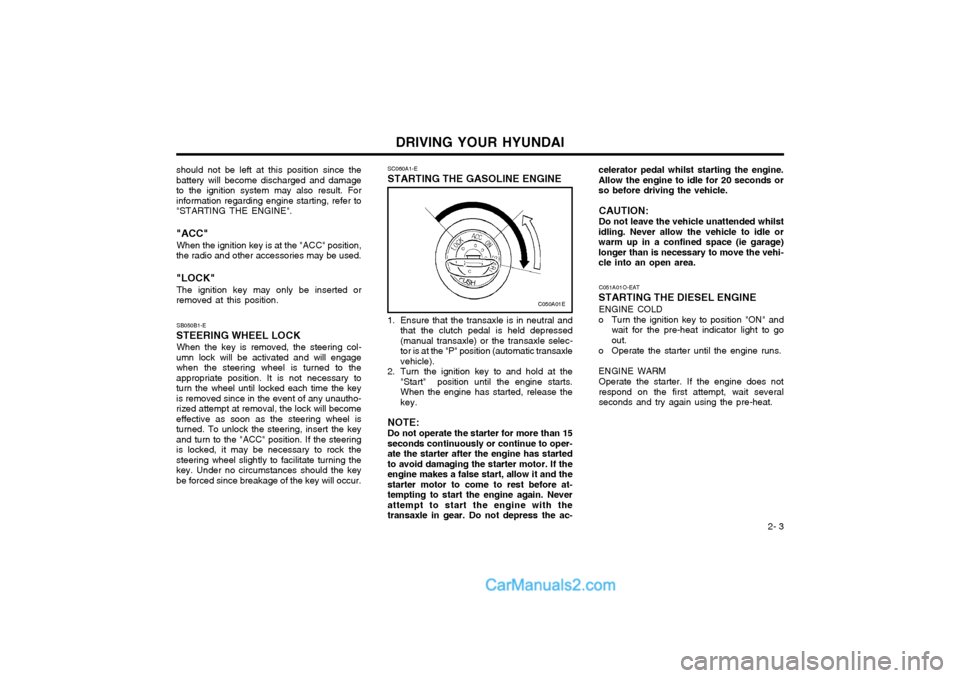
STARTING THE GASOLINE ENGINE
1. Ensure that the transaxle is in neutral and that the clutch pedal is held depressed (manual transaxle) or the transaxle selec-tor is at the "P" position (automatic transaxlevehicle).
2. Turn the ignition key to and hold at the "Start" position until the engine starts.When the engine has started, release thekey.
NOTE: Do not operate the starter for more than 15
seconds continuously or continue to oper- ate the starter after the engine has startedto avoid damaging the starter motor. If theengine makes a false start, allow it and thestarter motor to come to rest before at-tempting to start the engine again. Neverattempt to start the engine with thetransaxle in gear. Do not depress the ac-
C050A01E
should not be left at this position since the battery will become discharged and damageto the ignition system may also result. Forinformation regarding engine starting, refer to"STARTING THE ENGINE". "ACC"
When the ignition key is at the "ACC" position,
the radio and other accessories may be used."LOCK"
The ignition key may only be inserted or
removed at this position. celerator pedal whilst starting the engine. Allow the engine to idle for 20 seconds orso before driving the vehicle.
CAUTION: Do not leave the vehicle unattended whilst
idling. Never allow the vehicle to idle or warm up in a confined space (ie garage)longer than is necessary to move the vehi-cle into an open area.
C051A01O-EAT
STARTING THE DIESEL ENGINE
ENGINE COLD
o Turn the ignition key to position "ON" and wait for the pre-heat indicator light to goout.
o Operate the starter until the engine runs. ENGINE WARM Operate the starter. If the engine does not respond on the first attempt, wait severalseconds and try again using the pre-heat.
Page 254 of 312

DRIVING YOUR HYUNDAI
2- 12 NOTE: Never allow undiluted screen washer fluid additive to spill upon the paintwork or useengine coolant anti-freeze since damage tothe paintwork may result.
o When driving in extreme conditions, the windscreen wiper blades may fail to clearthe screen properly due to the formation ofice upon the blade edge. It will therefore benecessary to periodically remove such iceto restore their efficiency.
o If the power operated door mirrors become frozen, attempts to adjust these may dam-age the mechanism.
o The formation of snow or ice built up inside the wheel arches may interfere with theroad wheels or steering mechanism. Insuch instances, unusual noises or an in-crease in steering effort may result. There-fore, ensure that the wheel arches arechecked periodically and any accumulatedsnow or ice removed.
o It is advisable to carry emergency equip- ment including, torch, shovel, tow rope,blankets etc., if a journey is to be under-taken into areas of severe road conditions.
ZC170D1-E
Door Locks
Should the door lock mechanism becomefrozen, a proprietary lock de-icer should beused. Alternatively, warming the door keymay thaw the door lock. However, the keyshould be handled carefully to avoid burningthe fingers. Never attempt to thaw a frozen door lock using hot water, since the water will eventu-ally freeze and compound the problem. NOTE: The proper temperature for using the im-mobilizer key is from -40°F to 176°F (-40°Cto 80°C). If you heat the immobilizer keyover 176°F (80°C) to open the frozen lock,it may cause damage to the transponderin its head.
SC170E1-E Windscreen Washers and Wipers The windscreen washer bottle should be filled
with a solution of water and a proprietary winter screen wash additive. The windscreenwipers should not be used if the blades arefrozen to the windscreen or if they are cov-ered with snow, before this is removed.
ZC170B1-E
Electrical System
Winter conditions impose severe demandsupon vehicle electrical systems, particularlythe charging circuit. The battery condition andperformance along with the alternator perfor-mance and drive belt condition should bechecked prior to the onset of winter. ZC170C1-E Anti-freeze/Corrosion inhibitorThe cooling system must always contain an Ethylene-Glycol based anti-freeze solution.The system is filled during manufacture withsolution of the correct strength which shouldbe checked before the onset of winter andadjusted or changed as required. NOTE: The anti-freeze solution contains a corro-sion inhibitor to prevent degradation of thealuminum castings contained within theengine. Therefore, never, drain the systemand refill with water only. In addition, anti-freeze solution must ALWAYS be used in vehicles fitted with air conditioning,to prevent the heater matrix from freezing andsubsequently bursting with the refrigerationsystem in use.
Page 258 of 312

3-1
IN CASE OF EMERGENCY
SD000A1-E
3. IN CASE OF
EMERGENCY
SD020A1-E
IF THE ENGINE WILL NOT START Seek assistance from the nearest Hyundai dealer with regard to the method of ignition andfuel system diagnosis.
CAUTION:If the engine refuses to start, no attempt
should be made to push or tow start thevehicle. Vehicles with automatic transaxleor fuel injection will not be able to bestarted in this manner since no drive istransmitted through the automatic transaxlewhilst the engine is not running, and in thecase of fuel injected derivatives, the fuelpump will not operate under tow start con-ditions. In addition, if the vehicle isequipped with an exhaust catalyst, dam-age to the catalyst may result if the vehicleis tow started. SD020B1-E
IF THE ENGINE CANNOT BE
CRANKED SD020C1-F
If Engine Turns Over Normally but Does Not Start
SSA3020C
1. Check fuel Level
2. Check all connectors at ignition coil and spark plugs.Replace any that may be disconnected or loose.
3. Check fuel line in the engine room.
4. If engine still refuses to start, call a Hyundai dealer or seek other qualified assistance.
1. If the vehicle is fitted with manual transaxle,
ensure that the clutch pedal is depressed whilst cranking the engine. If the vehicle isfitted with automatic transaxle, ensurethat the transaxle selector is at the "P"or"N" position.
2. Check the battery terminals and connec- tions to ensure that these are clean andalso tight.
3. If the ignition warning lights dim when the engine is cranked and the battery termi-nals have been checked, a dischargedbattery is indicated.
4. Do not attempt to push or tow start the vehicle, refer to "Jump Starting" for infor-mation regarding engine starting when thebattery is discharged. AD020D1-A
If Engine Stalls While Driving
1. Reduce your speed gradually, keeping a straight line. Move cautiously off the road to a safe place.
2. Turn on your emergency flashers.
3. Try starting the engine again. If your ve- hicle will not start, see "IF THE ENGINE WILL NOT START"
3
D010B01FC
Page 259 of 312

IN CASE OF EMERGENCY
3-2
CAUTION:
Personal injury and damage to the vehicle
may occur if jump starting is not per- formed correctly. If any doubt exists as tohow this operation should be performed,seek assistance from qualified personnel. WARNING:
Motor vehicle batteries contain sulphuric
acid and emit hydrogen gas. Protective clothing should be worn and care exer-cised to prevent the acid from coming intocontact with skin or clothing and the ve-hicle. Naked lights should not be permittedin the vicinity of the battery. Care shouldbe exercised to prevent sparks occurringduring connection. If acid accidentallycomes into contact with skin or eyes, theaffected area should immediately be flushed ponents such as the Fuel Injection system
computer and the Automatic Transaxlecomputer. The battery must never be dis-connected whilst the engine is running. SD040A2-E IF THE ENGINE OVERHEATS If the temperature gauge indicates overheat- ing:
1. Pull off the road and stop as soon as it is
safe to do so.
2. Place the gear selector lever in "P" (auto- matic), or neutral (manual transaxle) and set the parking brake. If the air condition-ing is on, turn it off.
3. If coolant is running out under the car or steam is coming out from under the bonnetstop the engine. Do not open the bonnetuntil the coolant has stopped running orthe steaming has stopped. If there is novisible loss of coolant and no steam, leavethe engine running and check to be surethe engine cooling fan is operating. If the fan is not running, turn the engine off.
4. Check to see if the water pump drive belt is missing. If it is not missing, check to see that it is tight. If the drive belt seems to besatisfactory, check for coolant leaking fromthe radiator, hoses or under the car. (If theair conditioning had been in use, it isnormal for cold water to be draining fromit).
SD030A1-E JUMP STARTING
with copious amounts of water and medi- cal assistance sought.
1. Ensure that the booster battery is 12 volt type. If the booster battery is installed inanother vehicle, ensure that the two vehi-cles are not touching.
2. Turn off all unnecessary electrical equip- ment in both vehicles.
3. Ensure that the engine of the vehicle pro- viding the jump start is running prior toconnection of the jump cables.
4. Connect the red jump cable to the positive (+) terminal of the booster battery and theother end to the positive (+) terminal of thedischarged battery.
5. Attach the black jump cable to the nega- tive (-) terminal of the booster battery, andthe other end to a ground point within theengine compartment of the vehicle withthe flat battery. Do not connect to thenegative battery terminal of the flat batterysince sparks may be generated with thesubsequent risk of explosion.
6. Raise the booster vehicle engine speed to 2,000 r.p.m. and start the engine of thevehicle with the flat battery.
7. Remove jump cables in the reverse order of installation (black cable first).
CAUTION:If the jump cable is incorrectly installed,damage to the vehicle electrical systemmay occur, in particular the electronic com-
HFC4002
Booster battery Discharged battery