2003 Hyundai Matrix ECU
[x] Cancel search: ECUPage 184 of 312

1- 3
CONTROLS AND EQUIPMENT
B880C02A-GAT
Key Numbers
The vehicle key number is recorded upon a
metal tag attached to the keys when the vehicle is first delivered to you. The key number should be recorded and kept
in a safe place in case the need to orderfurther keys arises. New keys are availablefrom any Hyundai dealer by quoting the rel-evant key number.
In the interest of security, the metal tag at-
tached to the keys which bears the key num-ber should be removed from the key ring afteryou receive your new vehicle. In addition, keynumbers cannot be provided by Hyundai forsecurity reasons.
If you need additional keys or if you should
lose your keys, your authorized Hyundai dealercan make new keys. SB040B1-F Locking, unlocking front doors with key
o The door can be locked or unlocked with a
key.
o Lock the door by turning the key toward the front of the vehicle and unlock it by turning the key toward the rear.
AX10030A-1
B040A02Y-AAT DOOR LOCKS WARNING:
o Unlocked doors can be dangerous. Be- fore you drive away (especially if there are children in the car), be sure that allthe doors are securely closed and lockedso that the doors cannot be inadvert-ently opened from the inside. This helpsensure that doors will not be openedaccidentally. Also, when combined withthe proper use of seat belts, locking thedoors helps keep occupants from beingejected from the car in case of an acci-dent.
o Before opening the door, always look for and avoid oncoming traffic.
o In case of accident the door is unlocked automatically (If installed)
LOCK
UNLOCK
HFC2004-D
Page 192 of 312

1- 11
CONTROLS AND EQUIPMENTCAUTION: To prevent damage, ensure that the rear
drinkholder, located in the rear console, is closed before folding the rear seatbackand seat cushion.
4. Pull the seat cushion release lever up-
ward, then fold up the seat cushion.
HFC2075
HFC2076
Seat cushion release lever
Securing strap
B090A01FC
Lock Knob
SB070D2-E
Head Restraint Adjustment
To raise the head restraint, pull it up. To lower
it, push it down while pressing the lock knob. For maximum effectiveness in the event of anaccident, the restraint must be adjusted sothat the restraint is approximately at the levelof the seat occupant's ears. The restraintmust never be so adjusted that it is centredabout the level of the seat occupant's neck.
WARNING:Do not operate the vehicle with the re-
straints removed. The restraints provideprotection against neck injury when in-stalled and correctly adjusted. B090B01FC-GAT
Folding Rear Seatback and Seat Cushion
For greater convenience, the entire seatback
and seat cushion may be folded down and up.
HFC2074
Seatback folding lever
1. Move the rear seat to the rearmost posi- tion.
2. Remove the headrests.
3. To fold down the seatback , push and hold the seatback folding lever toward the head- rest, then push down the seatback.
Page 193 of 312

CONTROLS AND EQUIPMENT
1- 12 o Objects should not extend higher than
the top of the front seatbacks. This could allow cargo to slide forward andcause injury or damage during suddenstops.
o When you return the folded down seatback to its upright position, alwaysbe sure to install the headrests in theirproper positions. Headrests are impor-tant to the safety of occupants in a rearcollision. If the headrests are not in-stalled in their proper position, seriousinjury or death could result if a rear endcollision occurs.
B100A01FC-EAT SEAT WARMER (Not all models)
The seat warmer is provided to warm the front seats during cold weather. When the engine isrunning, push either of the switches to warmthe driver's seat or the passenger's seat.
B100A01FC
During mild weather or under conditions where
the operation of the seat warmer is not needed, keep the switches in the "OFF" position. B140A01B-GAT
REAR SEAT WARNING
B140A01FC
For the safety of all passengers, luggage or other cargo should not be piled higher thanthe top of the seatback.
5. To secure the seat, hook the securing strap under the seat cushion to the head- rest stay of front driver and passengerseat.
6. Insert the removed headrests between the seatback and seat cushion, so that theywill not be thrown forward in the case of asudden stop or an accident.
7. To return the seatback and seat cushion to its normal position, reverse the above pro-cedure.
o When you return the seatback to its upright position, always be sure it is locked intoposition by pulling and pushing on the topof seatback.
WARNING:
o When you return the folded down seat back to its upright position, make sure the seat belts are in position to beaccessible and to function properly.
o The purpose of the fold down rear seat back and the fold forward rear seatcushion is to increase cargo space. Donot allow passengers to sit in the cargoarea while the car is moving. This is nota proper seating position and no seatbelts are available for use when the seatback is folded down. Passengers whoare not properly seated and wearingseat belts could sustain serious injuriesor death in case of an accident or asudden stop.
Page 197 of 312
CONTROLS AND EQUIPMENT
1- 16 o Since a safety belt or child restraint
system can become very hot if it is left in a closed vehicle, be sure to check theseat cover and buckles before placing achild there.
o When the child restraint system is not in use, fasten it with a safety belt so thatit will not be thrown forward in the caseof a sudden stop or an accident.
o Children who are too large to be in a child restraint should still sit in the rearseat and be restrained with the avail-able lap/shoulder belts. Never allowchildren to ride in the front passengerseat.
o Always make sure that the shoulder belt portion of the outboard lap/shoulder beltis positioned midway over the shoul-der, never across the neck or behindthe back. Moving the child closer to thecenter of the vehicle may help provide agood shoulder belt fit. The lap belt por-tion of the lap/shoulder belt or the cen-ter seat lap belt must always be posi-tioned as low as possible on the child'ships and as snug as possible.
o If the seat belt will not properly fit the child, we recommend the use of anapproved booster seat in the rear seatin order to raise the child's seatingheight so that the seat belt will properlyfit the child.
o Never allow a child to stand up or kneel on the seat.
B230A03P-EAT CHILD RESTRAINT SYSTEM Children riding in the car should sit in the rear seat and must always be properly restrainedto minimize the risk of injury in an accident,sudden stop or sudden maneuver. Accordingto accident statistics, children are safer whenproperly restrained in the rear seats than inthe front seat. Larger children should use oneof the seat belts provided. You are required by law to use safety re- straints for children. If small children ride inyour vehicle you must put them in a childrestraint system (safety seat). Children could be injured or killed in a crash if their restraints are not properly secured. Forsmall children and babies, a child seat orinfant seat must be used. Before buying aparticular child restraint system, make sure itfits your car and seat belts, and fits your child.Follow all the instructions provided by themanufacturer when installing the child restraintsystem. WARNING:
o A child restraint system must be placed
in the rear seat. Never install a child or infant seat on the front passenger's seat. Should an accident occur and cause the passenger side airbag to deploy, itcould severely injure or kill an infant orchild seated in an infant or child seat.Thus, only use a child restraint in therear seat of your vehicle.
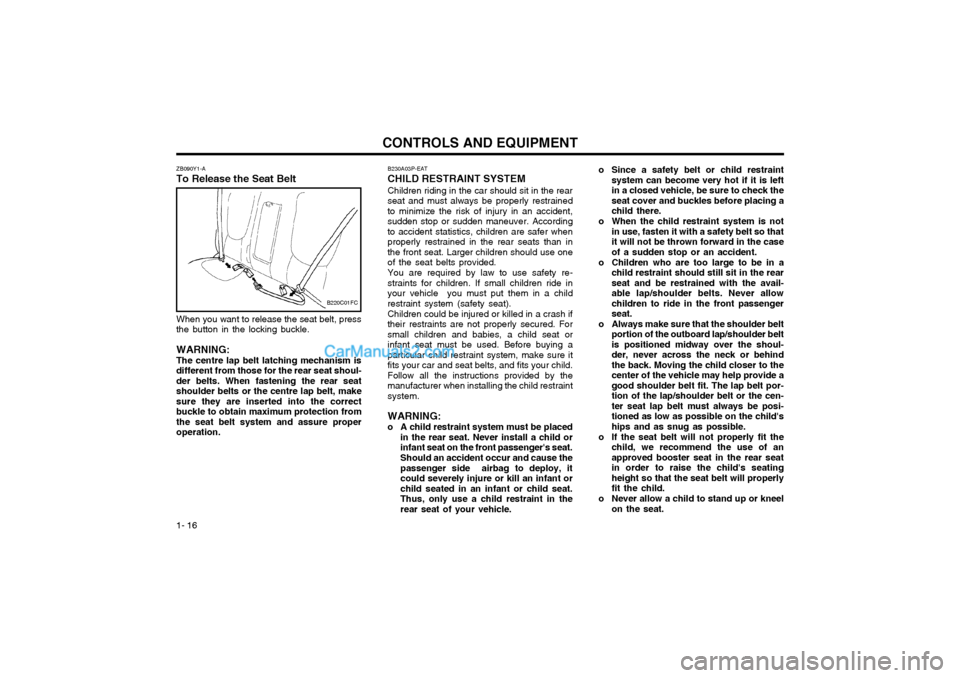
ZB090Y1-A To Release the Seat Belt
B220C01FC
When you want to release the seat belt, press the button in the locking buckle. WARNING: The centre lap belt latching mechanism is different from those for the rear seat shoul-der belts. When fastening the rear seatshoulder belts or the centre lap belt, makesure they are inserted into the correctbuckle to obtain maximum protection fromthe seat belt system and assure properoperation.
Page 198 of 312
1- 17
CONTROLS AND EQUIPMENT
o Never use an infant carrier or child safety seat that "hooks" over a seatback; it may not provide adequate security in anaccident.
o Never allow a child to be held in a person's arms while they are in a mov-ing vehicle, as this could result in seri-ous injury to the child in the event of anaccident or a sudden stop. Holding achild in a moving vehicle does not pro-vide the child with any means of protec-tion during an accident, even if the per-son holding the child is wearing a seatbelt.
B230E01FC
Back panel
Front of Vehicle
Tether straphook
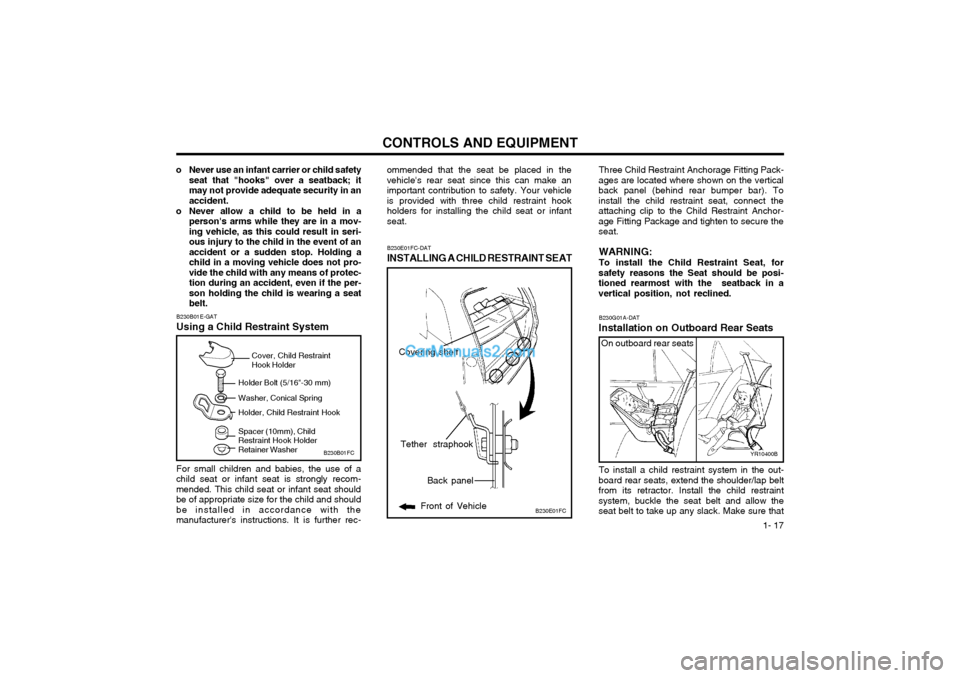
B230E01FC-DAT INSTALLING A CHILD RESTRAINT SEAT Three Child Restraint Anchorage Fitting Pack-
ages are located where shown on the vertical back panel (behind rear bumper bar). Toinstall the child restraint seat, connect theattaching clip to the Child Restraint Anchor-age Fitting Package and tighten to secure theseat.
WARNING:
To install the Child Restraint Seat, for
safety reasons the Seat should be posi- tioned rearmost with the seatback in avertical position, not reclined.
B230B01E-GAT
Using a Child Restraint System
B230B01FC
Cover, Child Restraint Hook Holder
Holder Bolt (5/16"-30 mm) Washer, Conical Spring Holder, Child Restraint Hook Spacer (10mm), Child Restraint Hook Holder Retainer Washer
Covering shelf
ommended that the seat be placed in the vehicle's rear seat since this can make animportant contribution to safety. Your vehicleis provided with three child restraint hookholders for installing the child seat or infantseat.
For small children and babies, the use of a
child seat or infant seat is strongly recom-mended. This child seat or infant seat shouldbe of appropriate size for the child and shouldbe installed in accordance with themanufacturer's instructions. It is further rec- B230G01A-DAT
Installation on Outboard Rear Seats
YR10400B
On outboard rear seats
To install a child restraint system in the out-
board rear seats, extend the shoulder/lap belt from its retractor. Install the child restraintsystem, buckle the seat belt and allow theseat belt to take up any slack. Make sure that
Page 199 of 312
CONTROLS AND EQUIPMENT
1- 18 WARNING:
o Do not install a child restraint seat at
the rear centre seating position using the vehicle's ISOFIX anchors. The ISOFIXanchors are only provided for the leftand right outboard rear seating posi-tions. Do not misuse the ISOFIX an-chors by attempting to attach a childrestraint seat in the middle rear seatingposition to the ISOFIX anchors. In acrash, the child restraint seat ISOFIXattachments may not be strong enoughto secure the child restraint seat prop-erly in the centre seating position andmay break, causing serious injury ordeath.
o Do not mount more than one child re- straint to a child restraint lower anchor-age point. The improper increased loadmay cause the anchorage points ortether anchor to break, causing seriousinjury or death.
o Attach the ISOFIX or ISOFIX-compatible child restraint seat only to the appropri-ate locations shown in the illustration.
o Always follow the installation and use instructions provided by the manufac-turer of the child restraint.
the lap portion of the belt is tight around thechild restraint system and the shoulder por-tion of the belt is positioned so that it cannotinterfere with the child's head or neck. Afterinstallation of the child restraint system, try tomove it in all directions to be sure the childrestraint system is securely installed. If you need to tighten the belt, pull more webbing toward the retractor. When you un-buckle the seat belt and allow it to retract, theretractor will automatically revert back to itsnormal seated passenger emergency lockingusage condition. NOTE:
o Before installing the child restraint sys-
tem, read the instructions supplied by the child restraint system manufacturer.
o If the seat belt does not operate as described, have the system checkedimmediately by your authorized Hyundaidealer.
WARNING: Do not install any child restraint system in the front passenger seat. Should an acci-dent occur and cause the passenger sideairbag to deploy, it could severely injure orkill an infant or child seated in an infant orchild seat. Therefore, only use a child re-straint system in the rear seat of yourvehicle. B230D01FC-EAT
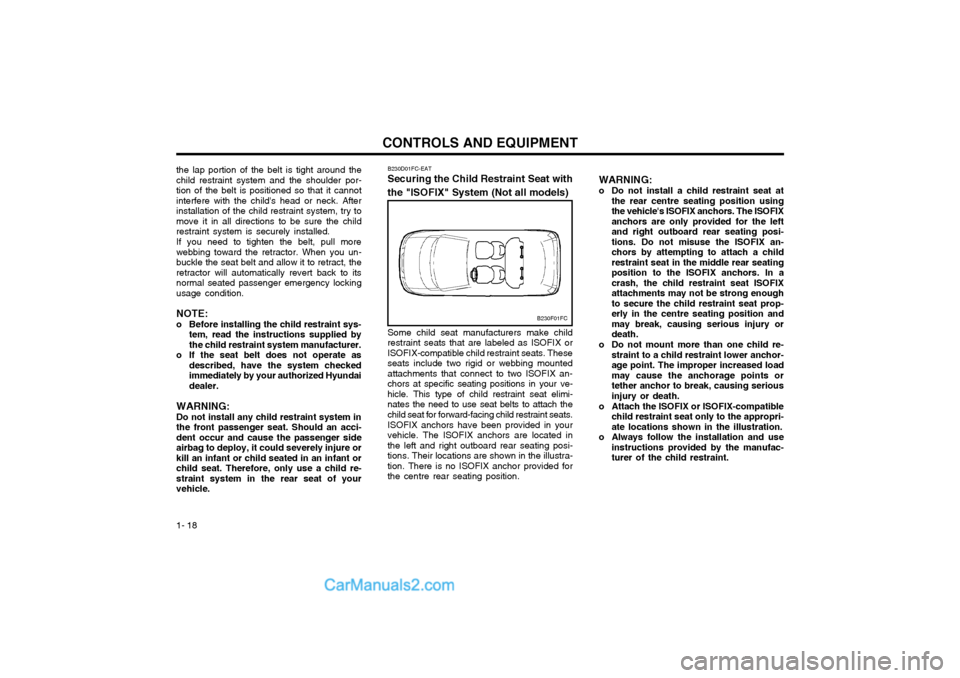
Securing the Child Restraint Seat with
the "ISOFIX" System (Not all models)
B230F01FC
Some child seat manufacturers make child restraint seats that are labeled as ISOFIX orISOFIX-compatible child restraint seats. Theseseats include two rigid or webbing mountedattachments that connect to two ISOFIX an-chors at specific seating positions in your ve-hicle. This type of child restraint seat elimi-nates the need to use seat belts to attach thechild seat for forward-facing child restraint seats. ISOFIX anchors have been provided in your vehicle. The ISOFIX anchors are located inthe left and right outboard rear seating posi-tions. Their locations are shown in the illustra-tion. There is no ISOFIX anchor provided forthe centre rear seating position.
Page 231 of 312

CONTROLS AND EQUIPMENT
1- 50
70 kg (154 lb)
EVENLY DISTRBUTED
HFC2106
B630A01FC-EAT
ROOF RACK (Not all models) If your Hyundai has a roof rack, you can load things on top of your vehicle. Crossrails andfixing components to adapt the roof rack onyour vehicle may be obtained from an autho-rized Hyundai dealer. CAUTION:
o The following specifications are recom-
mended when loading cargo or luggage.
ROOF RACK
o Loading cargo or luggage above 70 kg (154 lb) on the roof rack may damage your vehicle. When you carry large objects, never let them hang over the rear or the sides ofyour vehicle.
o To prevent damage or loss of cargo as you are driving, check frequently tomake sure the luggage carrier and cargoare still securely fastened.
o Always drive your vehicle at a moderate speed.
o To use the roof rails as a roof rack, you must fit the roof rails with two or morecrossrails or equivalent before carryingcargo or lugguage on the roof.
o When crossrail is adapted, you can load things on the roof rack.
o Loading cargo or luggage over specifi- cation on the roof rack may damagestability of your vehicle.
B650A01FC-DAT CARGO AREA COVER
B640A01FC
Nothing should be carried on top of the lug- gage cover. Loose materials could result in injury to vehicle occupants during sudden brak- ing. B560B01O-GAT Auto Fuel Cut Switch (Gasoline Engine)HFC4001
The auto fuel cut switch is located on the driver's side of the engine compartment. In the event of a collision or sudden impact, the auto fuel cut device cuts off the fuelsupply. If this device is activated, it must bereset by pressing in on the top of the switchbefore the engine can be restarted. WARNING: Before resetting the auto fuel cut switch, the fuel line should be checked for fuelleaks.
Page 232 of 312

1- 51
CONTROLS AND EQUIPMENTB610A01S-DAT
HORN (With Airbag)
Press the pad of the steering wheel to sound
the horn.
B580A01E-EAT
SUN-VISOR
Sun visors are fitted to both the driver and
passenger side of the vehicle. Certain deriva- tives are equipped with a vanity mirror whichis located on the back of the driver andpassenger visor. The visor may be lowered toreduce the amount of glare from directly ahead,or may be moved towards the side window toreduce glare from the side of the vehicle, oncethe inner pivot has been unclipped from thebracket.
NOTE: The Supplemental Restraint System (SRS)
label containing useful information can be found on the back of each sun visor.
WARNING: Do not place the sun-visor in such a man-
ner that it obscures visibility of the road- way, traffic or other objects. SB520A1-F STEERING WHEEL TILT LEVER
HFC2099HFC2041HFC2094-D
Vanity mirror
To adjust the steering wheel:
1. Push the lever downward to unlock.
2. Raise or lower the steering wheel to the
desired position.
3. After adjustment, securely tighten the lever by pulling it upward
WARNING: Do not attempt to adjust the steering wheel
while driving as this may result in loss ofcontrol of the vehicle and result in death orserious injury.