2003 Hyundai Matrix child lock
[x] Cancel search: child lockPage 185 of 312
CONTROLS AND EQUIPMENT
1- 4
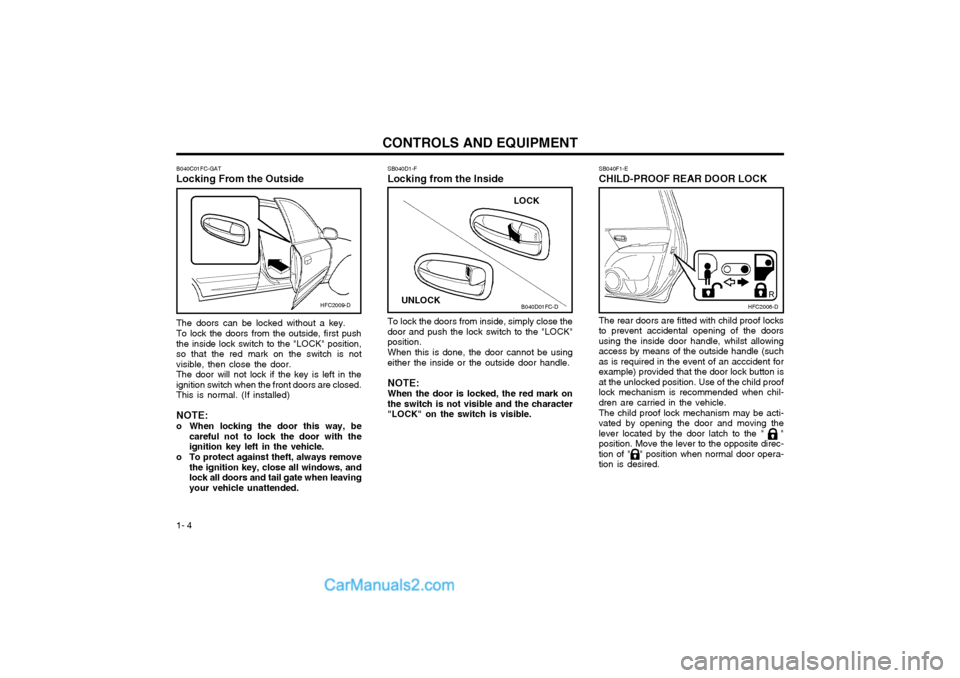
SB040F1-E CHILD-PROOF REAR DOOR LOCK The rear doors are fitted with child proof locks to prevent accidental opening of the doorsusing the inside door handle, whilst allowingaccess by means of the outside handle (suchas is required in the event of an acccident forexample) provided that the door lock button isat the unlocked position. Use of the child prooflock mechanism is recommended when chil-dren are carried in the vehicle. The child proof lock mechanism may be acti- vated by opening the door and moving thelever located by the door latch to the " "position. Move the lever to the opposite direc-tion of " " position when normal door opera-tion is desired.
SB040D1-F Locking from the Inside
B040D01FC-D
To lock the doors from inside, simply close the
door and push the lock switch to the "LOCK" position.
When this is done, the door cannot be using
either the inside or the outside door handle.
NOTE:When the door is locked, the red mark on
the switch is not visible and the character"LOCK" on the switch is visible.HFC2006-D
LOCK
UNLOCK
B040C01FC-GAT Locking From the Outside The doors can be locked without a key. To lock the doors from the outside, first push the inside lock switch to the "LOCK" position,so that the red mark on the switch is notvisible, then close the door.The door will not lock if the key is left in theignition switch when the front doors are closed.This is normal. (If installed) NOTE:
o When locking the door this way, be
careful not to lock the door with the ignition key left in the vehicle.
o To protect against theft, always remove the ignition key, close all windows, andlock all doors and tail gate when leavingyour vehicle unattended.
HFC2009-D
Page 189 of 312
CONTROLS AND EQUIPMENT
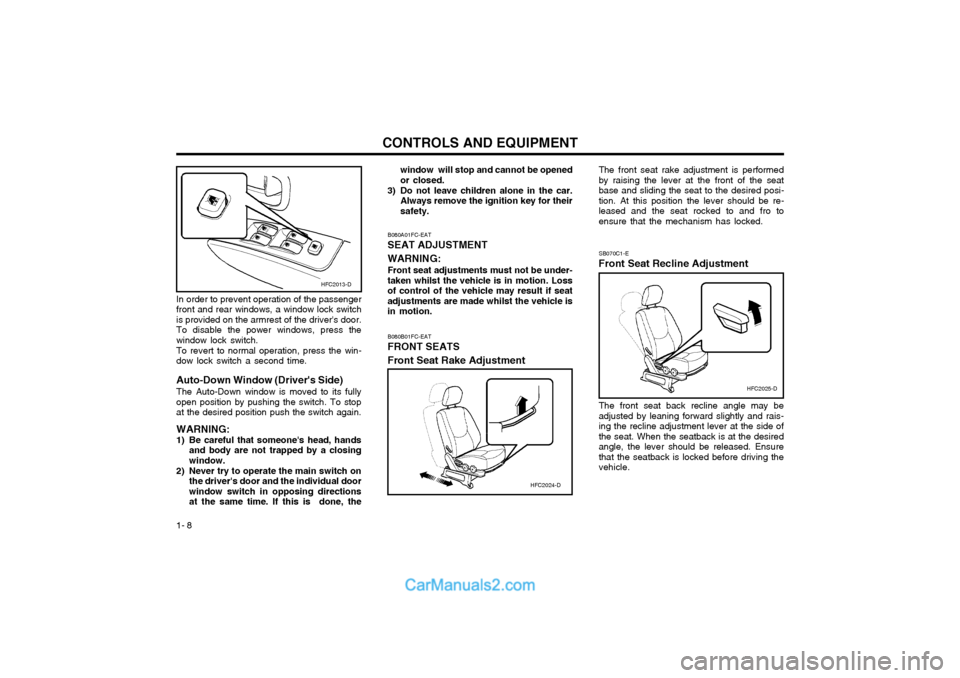
1- 8 The front seat rake adjustment is performed by raising the lever at the front of the seatbase and sliding the seat to the desired posi-tion. At this position the lever should be re-leased and the seat rocked to and fro toensure that the mechanism has locked. SB070C1-E
Front Seat Recline Adjustment
The front seat back recline angle may be adjusted by leaning forward slightly and rais-ing the recline adjustment lever at the side ofthe seat. When the seatback is at the desiredangle, the lever should be released. Ensurethat the seatback is locked before driving thevehicle.
B080B01FC-EAT FRONT SEATS Front Seat Rake Adjustment
HFC2024-D
HFC2025-D
B080A01FC-EAT SEAT ADJUSTMENT WARNING: Front seat adjustments must not be under- taken whilst the vehicle is in motion. Lossof control of the vehicle may result if seatadjustments are made whilst the vehicle isin motion. window will stop and cannot be openedor closed.
3) Do not leave children alone in the car. Always remove the ignition key for theirsafety.
In order to prevent operation of the passengerfront and rear windows, a window lock switchis provided on the armrest of the driver's door.To disable the power windows, press thewindow lock switch. To revert to normal operation, press the win- dow lock switch a second time. Auto-Down Window (Driver's Side) The Auto-Down window is moved to its fully open position by pushing the switch. To stopat the desired position push the switch again. WARNING:
1) Be careful that someone's head, hands and body are not trapped by a closing window.
2) Never try to operate the main switch on the driver's door and the individual doorwindow switch in opposing directionsat the same time. If this is done, the
HFC2013-D
Page 197 of 312
CONTROLS AND EQUIPMENT
1- 16 o Since a safety belt or child restraint
system can become very hot if it is left in a closed vehicle, be sure to check theseat cover and buckles before placing achild there.
o When the child restraint system is not in use, fasten it with a safety belt so thatit will not be thrown forward in the caseof a sudden stop or an accident.
o Children who are too large to be in a child restraint should still sit in the rearseat and be restrained with the avail-able lap/shoulder belts. Never allowchildren to ride in the front passengerseat.
o Always make sure that the shoulder belt portion of the outboard lap/shoulder beltis positioned midway over the shoul-der, never across the neck or behindthe back. Moving the child closer to thecenter of the vehicle may help provide agood shoulder belt fit. The lap belt por-tion of the lap/shoulder belt or the cen-ter seat lap belt must always be posi-tioned as low as possible on the child'ships and as snug as possible.
o If the seat belt will not properly fit the child, we recommend the use of anapproved booster seat in the rear seatin order to raise the child's seatingheight so that the seat belt will properlyfit the child.
o Never allow a child to stand up or kneel on the seat.
B230A03P-EAT CHILD RESTRAINT SYSTEM Children riding in the car should sit in the rear seat and must always be properly restrainedto minimize the risk of injury in an accident,sudden stop or sudden maneuver. Accordingto accident statistics, children are safer whenproperly restrained in the rear seats than inthe front seat. Larger children should use oneof the seat belts provided. You are required by law to use safety re- straints for children. If small children ride inyour vehicle you must put them in a childrestraint system (safety seat). Children could be injured or killed in a crash if their restraints are not properly secured. Forsmall children and babies, a child seat orinfant seat must be used. Before buying aparticular child restraint system, make sure itfits your car and seat belts, and fits your child.Follow all the instructions provided by themanufacturer when installing the child restraintsystem. WARNING:
o A child restraint system must be placed
in the rear seat. Never install a child or infant seat on the front passenger's seat. Should an accident occur and cause the passenger side airbag to deploy, itcould severely injure or kill an infant orchild seated in an infant or child seat.Thus, only use a child restraint in therear seat of your vehicle.
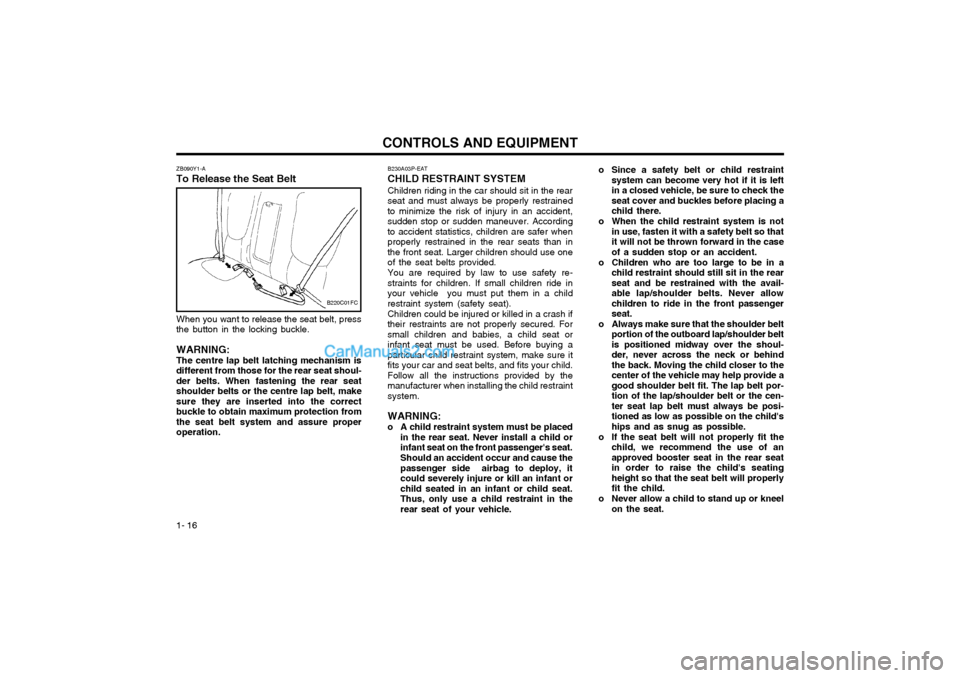
ZB090Y1-A To Release the Seat Belt
B220C01FC
When you want to release the seat belt, press the button in the locking buckle. WARNING: The centre lap belt latching mechanism is different from those for the rear seat shoul-der belts. When fastening the rear seatshoulder belts or the centre lap belt, makesure they are inserted into the correctbuckle to obtain maximum protection fromthe seat belt system and assure properoperation.
Page 199 of 312
CONTROLS AND EQUIPMENT
1- 18 WARNING:
o Do not install a child restraint seat at
the rear centre seating position using the vehicle's ISOFIX anchors. The ISOFIXanchors are only provided for the leftand right outboard rear seating posi-tions. Do not misuse the ISOFIX an-chors by attempting to attach a childrestraint seat in the middle rear seatingposition to the ISOFIX anchors. In acrash, the child restraint seat ISOFIXattachments may not be strong enoughto secure the child restraint seat prop-erly in the centre seating position andmay break, causing serious injury ordeath.
o Do not mount more than one child re- straint to a child restraint lower anchor-age point. The improper increased loadmay cause the anchorage points ortether anchor to break, causing seriousinjury or death.
o Attach the ISOFIX or ISOFIX-compatible child restraint seat only to the appropri-ate locations shown in the illustration.
o Always follow the installation and use instructions provided by the manufac-turer of the child restraint.
the lap portion of the belt is tight around thechild restraint system and the shoulder por-tion of the belt is positioned so that it cannotinterfere with the child's head or neck. Afterinstallation of the child restraint system, try tomove it in all directions to be sure the childrestraint system is securely installed. If you need to tighten the belt, pull more webbing toward the retractor. When you un-buckle the seat belt and allow it to retract, theretractor will automatically revert back to itsnormal seated passenger emergency lockingusage condition. NOTE:
o Before installing the child restraint sys-
tem, read the instructions supplied by the child restraint system manufacturer.
o If the seat belt does not operate as described, have the system checkedimmediately by your authorized Hyundaidealer.
WARNING: Do not install any child restraint system in the front passenger seat. Should an acci-dent occur and cause the passenger sideairbag to deploy, it could severely injure orkill an infant or child seated in an infant orchild seat. Therefore, only use a child re-straint system in the rear seat of yourvehicle. B230D01FC-EAT
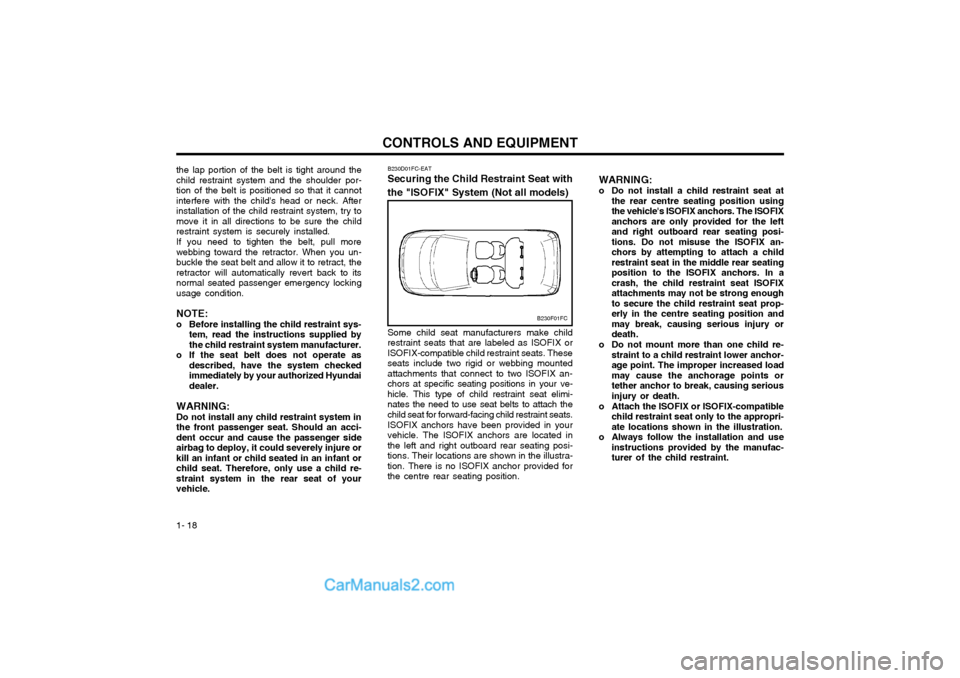
Securing the Child Restraint Seat with
the "ISOFIX" System (Not all models)
B230F01FC
Some child seat manufacturers make child restraint seats that are labeled as ISOFIX orISOFIX-compatible child restraint seats. Theseseats include two rigid or webbing mountedattachments that connect to two ISOFIX an-chors at specific seating positions in your ve-hicle. This type of child restraint seat elimi-nates the need to use seat belts to attach thechild seat for forward-facing child restraint seats. ISOFIX anchors have been provided in your vehicle. The ISOFIX anchors are located inthe left and right outboard rear seating posi-tions. Their locations are shown in the illustra-tion. There is no ISOFIX anchor provided forthe centre rear seating position.
Page 200 of 312
1- 19
CONTROLS AND EQUIPMENT
Age GroupSeating PositionFront
Passenger Rear
Outboard Rear
Centre
0 : Up to 10 kg (0 ~ 9 months)0+ : Up to 13 kg(0 ~ 2 years)I : 9kg to 18kg (9 months ~ 4 years)II & III : 15kg to 36kg (4 ~ 12 years)XUX
XUX
XUU F
XU FUF
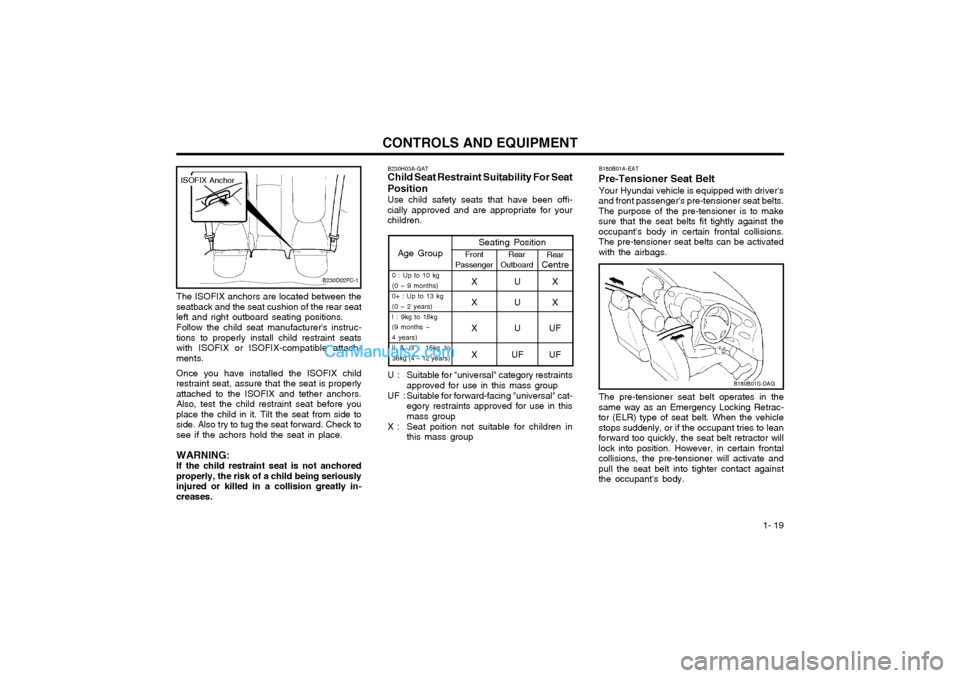
The ISOFIX anchors are located between the
seatback and the seat cushion of the rear seat left and right outboard seating positions.
Follow the child seat manufacturer's instruc-
tions to properly install child restraint seatswith ISOFIX or ISOFIX-compatible attach-ments.
Once you have installed the ISOFIX child
restraint seat, assure that the seat is properlyattached to the ISOFIX and tether anchors.Also, test the child restraint seat before youplace the child in it. Tilt the seat from side toside. Also try to tug the seat forward. Check tosee if the achors hold the seat in place.
WARNING:If the child restraint seat is not anchored
properly, the risk of a child being seriouslyinjured or killed in a collision greatly in-creases.
B230D02FC-1
ISOFIX Anchor
B180B01S-DAG
B180B01A-EAT
Pre-Tensioner Seat Belt
Your Hyundai vehicle is equipped with driver's
and front passenger's pre-tensioner seat belts. The purpose of the pre-tensioner is to makesure that the seat belts fit tightly against theoccupant's body in certain frontal collisions.The pre-tensioner seat belts can be activatedwith the airbags.
The pre-tensioner seat belt operates in the
same way as an Emergency Locking Retrac- tor (ELR) type of seat belt. When the vehiclestops suddenly, or if the occupant tries to leanforward too quickly, the seat belt retractor willlock into position. However, in certain frontalcollisions, the pre-tensioner will activate andpull the seat belt into tighter contact againstthe occupant's body.
B230H03A-GAT Child Seat Restraint Suitability For Seat Position Use child safety seats that have been offi- cially approved and are appropriate for yourchildren.
U : Suitable for "universal" category restraints approved for use in this mass group
UF : Suitable for forward-facing "universal" cat- egory restraints approved for use in this mass group
X : Seat poition not suitable for children in this mass group
Page 205 of 312

CONTROLS AND EQUIPMENT
1- 24
YT10355A
WARNING:
o Do not install a child restraint system in the front passenger seat position.
A child restraint system must never be placed in the front seat. The infant orchild could be severely injured by anairbag deployment in case of an accident.
o Extreme Hazard! Do not use a rearward facing child restraint on a seat pro-tected by an airbag in front of it!
o Modification to SRS components or wir- ing, including the addition of any kindof badges to the pad covers or modifi-cations to the body structure, can ad-versely affect SRS performance and leadto possible injury.
WARNING:
o For best protection from the side airbag
system and to avoid being injured is by the deploying side impact airbag, both front seat occupants should sit in an upright position with the seat belt prop-erly fastened. The driver's hands shouldbe placed on the steering wheel at the9:00 and 3:00 o'clock positions. Thepassenger's arms and hands should beplaced in their laps.
o Do not use any accessory seat covers.
o Use of seat covers could reduce or prevent the effectiveness of the system.
o Do not install any accessories on the side or near the side impact airbag.
o Do not use excessive force on the side of the seat.
o Do not place any objects over the airbag or between the airbag and yourself. B240C03Y-GAT SRS Care The SRS is virtually maintenance-free and there are no parts you can safely service byyourself. The entire SRS system must beinspected by an authorized Hyundai dealer in10 years after the date that the vehicle wasmanufactured. Any work on the SRS system, such as remov- ing, installing, repairing, or any work on thesteering wheel must be performed by a quali-fied Hyundai technician. Improper handling ofthe SRS system may result in serious per-sonal injury.
HFC2092-DSide airbag sensor
o Do not place any objects (an umbrella,
bag, etc.) between the front door and the front seat. Such objects may be-come dangerous projectiles and causeinjury if the supplemental side impactair bag inflates.
o To prevent unexpected deployment of the side impact air bag that may resultin personal injury, avoid impact to theside airbag sensor when the ignitionkey is on.
Page 289 of 312

OWNER MAINTENANCE
6-14 SG130A1-C CHECKING THE CLUTCH FLUID To Check the Clutch Fluid
SG130B2-E
Adding Fluid
Recommended brake fluid conforming to DOT 3 or DOT 4 should be used. The reservoir capmust be fully tightened to avoid contaminationfrom foreign matter or moisture. CAUTION: Brake fluid is hygroscopic and should never be stored in an unsealed container.Do not allow petroleum base fluid tocontaminate the brake fluid since damageto the rubber seals of the system mayresult. WARNING: Brake fluid will cause rapid and serious damage to paintwork. If accidental spillageoccurs, the affected area must be rinsedwith water immediately. Do not allow brakefluid to come into contact with the eyes or tobe ingested and ensure that fluid is safelystored away form the reach of children.
HFC5005
Gasoline engine
The clutch fluid level in the master cylinder should be checked when performing other un-der bonnet checks. The system should bechecked for leakage at the same time.
G120D02FC
Diesel engine
WARNING: Brake fluid is hygroscopic and should never be stored in an unsealed container.The presence of water in the brakingsystem will cause vapour locks and in-crease the possibility of brake fade alongwith promoting corrosion within the brak-ing system. The brake fluid must bechanged at the specified time or mileageinterval to ensure continued safe opera-tion of the system. Brake fluid will causerapid and serious damage to paintwork. Ifaccidental spillage occurs, the affectedarea must be rinsed with water immedi-ately. Do not allow brake fluid to comeinto contact with the eyes or to be in-gested and ensure that fluid is safelystored away form the reach of children.
G120D02FC
Diesel engine
Ensure that the clutch fluid level is always between the "MAX" and "MIN" level markingson the fluid reservoir. Fill as required. Fluidloss indicates a leak in the clutch systemwhich should be inspected and repaired im-mediately.
Page 309 of 312

INDEX10-1
A ACCESSORY TRAY ...................................................................... 1-47AIR CONDITIONING SWITCH ....................................................... 1-56AIR CONDITIONING SYSTEM MAINTENANCE ............................ 6-15AIR CLEANER ELEMENT REPLACEMENT .................................. 6-10ANTENNA ...................................................................................... 1-61 ANTI-THEFT ALARM SYSTEM ............................................ 1-5 ~ 1-7 AUTO FUEL CUT SWITCH ............................................................ 1-50AUTOMATIC TRANSAXLE .................................................... 2-6 ~ 2-9AUTOMATIC TRANSAXLE FLUID ...................................... 6-12 ~ 6-13 B BATTERY MAINTENANCE ........................................................... 6-17BEFORE STARTING THE ENGINE ................................................ 2-2BONNET RELEASE ...................................................................... 1-48BRAKE PEDAL FREEPLAY .......................................................... 6-16BRAKE TRACTION CONTROL SYSTEM .................................... 2-10 BRAKE SYSTEM CHECKING ....................................................... 6-13 C CARE OF SEAT BELTS ................................................................ 1-13CARGO AREA COVER ................................................................. 1-50 CATALYTIC CONVERTOR OPERATING PRECAUTIONS ............. 7-1CENTRE VENTILATOR ................................................................. 1-52CENTRAL DOOR LOCKS ............................................................... 1-5 CHANGING A FLAT TYRE .............................................................. 3-4 CHECKING THE CLUTCH FLUID .................................................. 6-14CHILD-PROOF REAR DOOR LOCK ............................................... 1-4CHILD RESTRAINT SYSTEM ............................................ 1-16 ~ 1-17CIGAR LIGHTER ........................................................................... 1-39CLUTCH PEDAL FREEPLAY ............................................ 6-15 ~ 6-16 COMBINATION IGNITION SWITCH AND STEERING LOCK ......... 2-2 COOLANT TEMPERATURE GAUGE ............................................ 1-32 D DAILY OPERATING CHECKS ......................................................... 6-4DIGITAL CLOCK ........................................................................... 1-39 DOOR LOCKS ................................................................................. 1-3 DOOR WINDOWS ........................................................................... 1-7DRINK HOLDER ............................................................................ 1-40DRIVE BELTS ............................................................................... 6-16DRIVING FOR ECONOMY ............................................................ 2-11 E EFFECTIVE BRAKING .................................................................... 2-9ELECTRIC COOLING FANS ......................................................... 6-18EMISSION CONTROL SYSTEM ..................................................... 7-1
JK000A1-A 10. INDEX
10