2003 Hyundai Matrix lock
[x] Cancel search: lockPage 262 of 312
3-5
IN CASE OF EMERGENCY
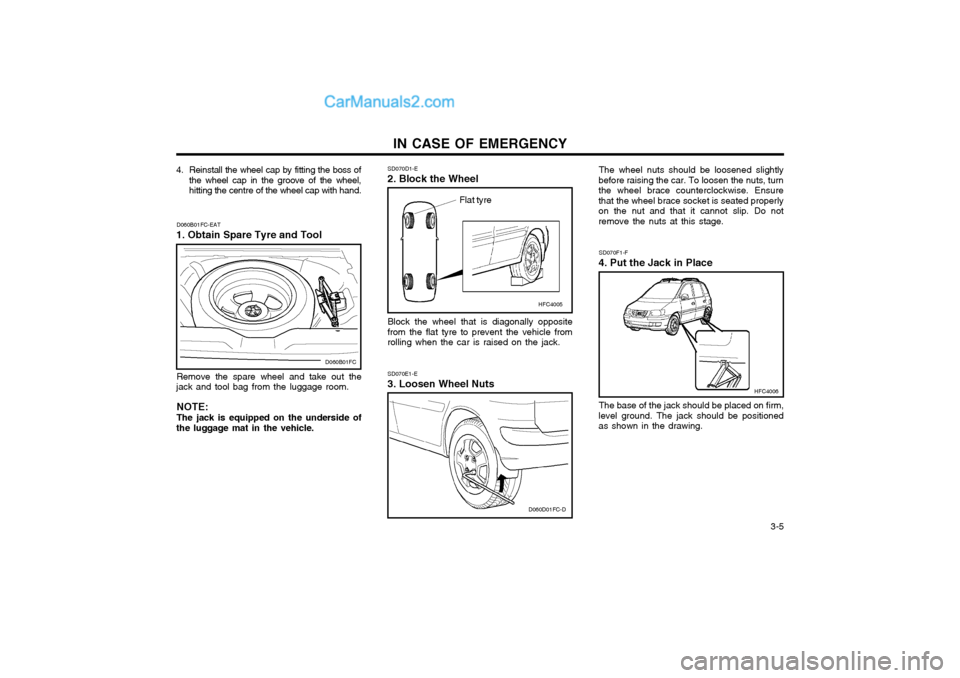
Remove the spare wheel and take out the
jack and tool bag from the luggage room.
NOTE: The jack is equipped on the underside of
the luggage mat in the vehicle. Block the wheel that is diagonally opposite
from the flat tyre to prevent the vehicle from rolling when the car is raised on the jack.
D060B01FC-EAT
1. Obtain Spare Tyre and Tool SD070D1-E
2. Block the Wheel SD070E1-E 3. Loosen Wheel Nuts The wheel nuts should be loosened slightly
before raising the car. To loosen the nuts, turn the wheel brace counterclockwise. Ensurethat the wheel brace socket is seated properlyon the nut and that it cannot slip. Do notremove the nuts at this stage.
SD070F1-F
4. Put the Jack in Place
The base of the jack should be placed on firm,
level ground. The jack should be positionedas shown in the drawing.
4. Reinstall the wheel cap by fitting the boss of
the wheel cap in the groove of the wheel,
hitting the centre of the wheel cap with hand.
Flat tyre
HFC4005
D060D01FC-D
D060B01FC
HFC4006
Page 263 of 312
IN CASE OF EMERGENCY
3-6 WARNING: It is important that the faces of the wheel and hub are clean prior to installing thewheel. The prescence of dirt or other mat-ter in the wheel or hub faces could result inthe wheel nuts becoming loose whilst thevehicle is being driven. SD070I1-E
7. Re-install Wheel Nuts
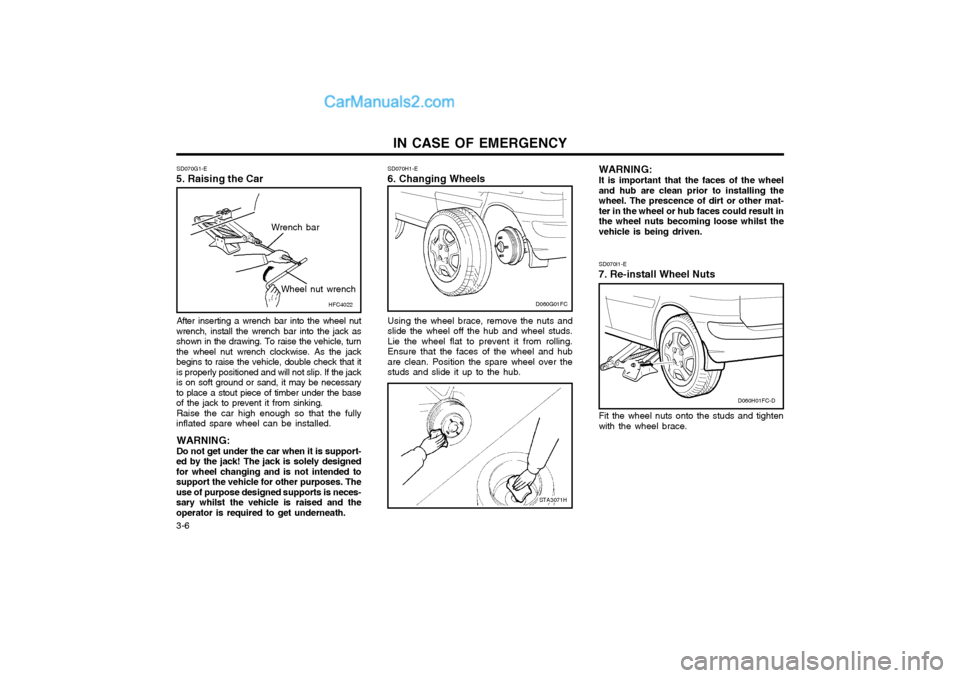
Fit the wheel nuts onto the studs and tighten with the wheel brace.
SD070G1-E
5. Raising the Car SD070H1-E 6. Changing Wheels
After inserting a wrench bar into the wheel nut
wrench, install the wrench bar into the jack as shown in the drawing. To raise the vehicle, turnthe wheel nut wrench clockwise. As the jackbegins to raise the vehicle, double check that itis properly positioned and will not slip. If the jackis on soft ground or sand, it may be necessaryto place a stout piece of timber under the baseof the jack to prevent it from sinking. Raise the car high enough so that the fully
inflated spare wheel can be installed.
WARNING: Do not get under the car when it is support-
ed by the jack! The jack is solely designed for wheel changing and is not intended tosupport the vehicle for other purposes. Theuse of purpose designed supports is neces-sary whilst the vehicle is raised and theoperator is required to get underneath. Using the wheel brace, remove the nuts andslide the wheel off the hub and wheel studs.Lie the wheel flat to prevent it from rolling.Ensure that the faces of the wheel and hubare clean. Position the spare wheel over thestuds and slide it up to the hub.
STA3071H
D060H01FC-D
D060G01FCHFC4022
Wrench bar
Wheel nut wrench
Page 264 of 312
3-7
IN CASE OF EMERGENCY
SD070J1-E
8. Lower Vehicle and Tighten Nuts
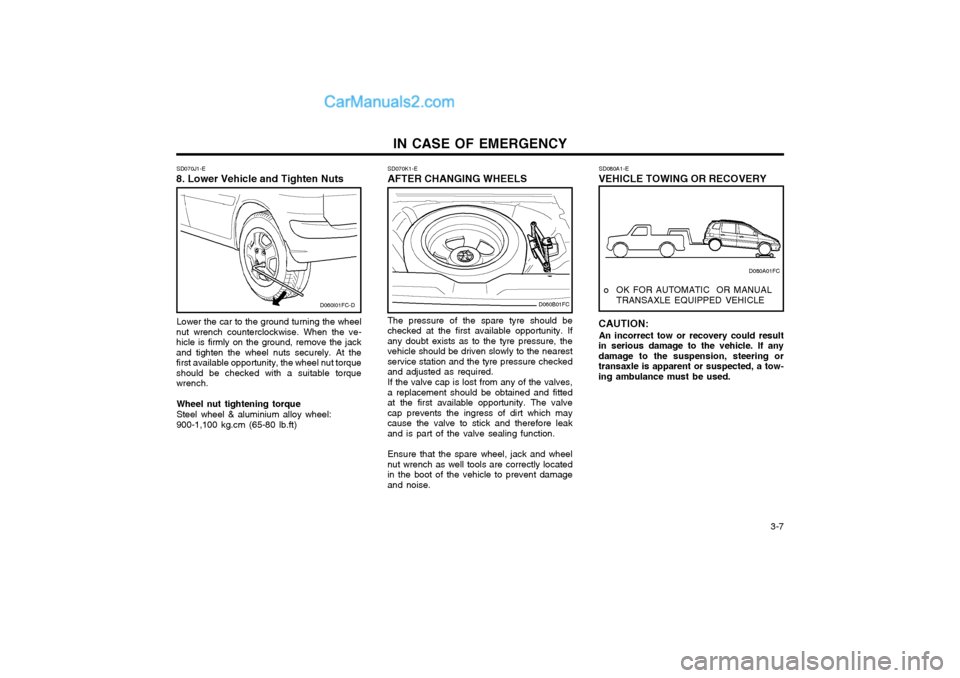
Lower the car to the ground turning the wheel
nut wrench counterclockwise. When the ve- hicle is firmly on the ground, remove the jackand tighten the wheel nuts securely. At thefirst available opportunity, the wheel nut torqueshould be checked with a suitable torquewrench.
Wheel nut tightening torque Steel wheel & aluminium alloy wheel:900-1,100 kg.cm (65-80 lb.ft) SD070K1-E AFTER CHANGING WHEELS
SD080A1-E
VEHICLE TOWING OR RECOVERY
The pressure of the spare tyre should be checked at the first available opportunity. Ifany doubt exists as to the tyre pressure, thevehicle should be driven slowly to the nearestservice station and the tyre pressure checkedand adjusted as required. If the valve cap is lost from any of the valves, a replacement should be obtained and fittedat the first available opportunity. The valvecap prevents the ingress of dirt which maycause the valve to stick and therefore leakand is part of the valve sealing function. Ensure that the spare wheel, jack and wheel nut wrench as well tools are correctly locatedin the boot of the vehicle to prevent damageand noise. CAUTION:
An incorrect tow or recovery could result
in serious damage to the vehicle. If anydamage to the suspension, steering ortransaxle is apparent or suspected, a tow-ing ambulance must be used.
D060I01FC-DD060B01FC
o OK FOR AUTOMATIC OR MANUAL
TRANSAXLE EQUIPPED VEHICLE D080A01FC
Page 265 of 312

IN CASE OF EMERGENCY
3-8 The vehicle may be towed by the conven-
tional method using the towing eye at the front of the vehicle as an attachment point. Inaddition, a suspended tow with or without anambulance may be used with either the frontor the rear wheels being suspended, providedthe above caution is observed. In addition, the following points must be noted:
o If towing by conventional means, the ignition key must be at the "ACC" posi- tion, otherwise the steering lock will beactivated.
o Because the brake system and steering system power assistance is derived fromthe engine, the amount of effort re-quired to stop or steer the vehicle willbe greater than normal. o If a suspended tow is being given to the
rear, the ignition key must be at the"ACC" position since the steering lockis not designed to withstand the forcerequired to hold the front wheels straightduring the tow.
o The vehicle must not be towed with the front wheels on the ground for morethan thirty miles.
o OK FOR AUTOMATIC OR MANUAL
TRANSAXLE EQUIPPED VEHICLE
SD100A2-E
Automatic Transaxle Vehicle
o NOT OK FOR AUTOMATIC TRANSAXLE EQUIPPED VEHICLE
o OK FOR MANUAL TRANSAXLE
The vehicle may be towed by the conven- tional method using the towing eye at the frontof the vehicle as an attachment point. In addition, a suspended tow may be given to the front of the vehicle without an ambulance.In the event of a suspended tow being givento the rear of the vehicle, the use of anambulance is imperative. D120A01A-EAT
IF YOU LOSE YOUR KEYS
Information about the key of immobilizer sys-tem will be found on page 1-2.
CAUTION: The following restriction must be observed in order to avoid serious damage to thetransaxle . The vehicle must never be towed from the rear with the front wheels on the ground. The vehicle must not be towed until transaxle fluid has been added to bringthe level up to the "HOT" marking on thedipstick. (The level will need to be reducedagain after towing). The vehicle must not be towed at speeds faster than 25 mph. or distances greaterthan fifty miles. The general points regard-ing the steering lock etc. described in thepreceding section (Manual transaxle ve-hicle) should be observed.
SD090A1-E
Manual Transaxle Vehicle
o OK FOR AUTOMATIC OR MANUAL TRANSAXLE EQUIPPED VEHICLE WITH NO DAMAGE
D080C01FC
D080B01FC
D080C02FC
Page 271 of 312

VEHICLE MAINTENANCE REQUIREMENTS
5- 4 F030C01E-EAT
R : REPLACE I : INSPECT AND, AFTER INSPECTION, CLEAN, ADJUST, REPAIR OR REPLACE IF NECESSARY
GENERAL MAINTENANCE COOLING SYSTEMCOOLANT GASOLINE ENGINEDIESEL ENGINE
ENGINE COOLANT SPECIFIC GRAVITYMANUAL TRANSAXLE OILAUTOMATIC TRANSAXLE FLUIDBRAKE PIPES, HOSES, AND CONNECTIONSBRAKE FLUIDCLUTCH FLUIDREAR BRAKE LININGS AND CYLINDERSBRAKE PADSSUSPENSION AND STEERING SYSTEMFRONT SUSPENSION BALL JOINTSPOLLEN FILTER (IN FRONT OF BLOWER UNIT)REAR WHEEL BEARINGSTYRE CONDITION AND PRESSURE (incl. Spare)LUBRICATE LOCKS AND HINGESCHECK ALL ELECTRICAL SYSTEMSROAD TESTCHECK ALL SYSTEMS WITH HI-SCAN
60 72
50 60
4048
I
R R
I I
R I
R R I I II
R
IIIII I
I I IIII I I I I
R I III I I
I
R IIII
R R I I I I
R I III I I
30 36
2024
I
R
I IIII I I II
R IIIIII
I
R IIII
R R I I I I
R I III I I
10 12
I I IIII I I I I
R I III I I
MILES X 1,000 MONTHS
NO. DESCRIPTION
1 2 3 456789
10111213141516171819
Page 280 of 312

OWNER MAINTENANCE 6-5
SG030C1-E
Engine Oil Level NOTE: SAE 0W-30 oil is for extra cold zone and
to be restricted by driving condition and dealing area. (Especially, not recommend-ed for sustained high loaded and highspeed operation.) The engine oil level should be checked with
the engine at normal operating temperatureand the vehicle parked upon level ground.
Prior to checking the level, the vehicle should
be allowed to stand for several minutes after theengine has been switched off to allow the oil todrain back to the sump.
Withdraw the dipstick and wipe it with a clean
rag. Replace the dipstick fully and withdrawagain when the oil level may be read from thestick. Normal oil level is indicated when the oilis present between the two marks on thestick. It is not necessary to add oil if the levelis above the lower mark and in any case, oilmust not be added to the degree that the levelexceeds the upper mark. Replace the dip-stick fully after checking the level. SG030D2-E
ENGINE OIL REPLENISHMENT
If the indicated oil level is at or below the lower
mark of the dipstick, oil should be added untilthe level is at or below the upper mark.
To add oil to the engine, remove the filler cap by
rotating in an counterclockwise direction andpour engine oil into the engine. Before checking
HFC5007
HFC5009
G030C02FC
Gasoline engine
Diesel engine
G030D02FC
Gasoline engine
Diesel engine
Page 281 of 312

OWNER MAINTENANCE
6-6 the level again, allow several minutes for the oil to drain into the sump. Replace the oil fillercap rotating it in a clockwise direction untiltight. The quantity of oil required to raise the level from the minimum to maximum level is approx-imately 1 litre. The distance between the "F" and "L" marks is equal to about 1 liter(Gasoline Engine)/1.2liter(Diesel Engine) of oil.
o The engine oil consumption is strongly
effected by the viscosity and quality of oil,engine rpm and driving condition etc. The engine oil is more consumed under severe driving conditions such as highspeeds and frequent acceleration and de-celeration than normal driving condition.
ZG030E1-A
ENGINE OIL CONSUMPTION Function of engine oil
Engine oil has the primary function of lubricat-
ing and cooling the inside of the engine. Engine oil consumption
It is normal that an engine should consume
some engine oil while normal driving. The cause of oil consumption in a normal engine are asfollows;
o Engine oil is used to lubricate pistons, piston rings and cylinders. A thin film of oil is left on the cylinder wallwhen a piston moves downwards in thecylinder. High negative pressure generatedduring engine operation sucks some of theoil into the combustion chamber. This oil with some oil of the cylinder wall is burned by the high temperature combustiongases during the combustion process. SG040A1-E
ENGINE OIL AND FILTER
REPLACEMENT
SSA6040A
Oil filler cap
Drain plug
Oil filter The engine oil and filter must be changed at
the time or mileage interval specified in the maintenance schedule. If the vehicle is oper-ated under severe or adverse conditions, theoil and filter must be replaced more frequently.
To replace the oil and filter, proceed as fol-
lows:
1. Ensure that the engine is at normal operat- ing temperature and park the vehicle on level ground with the parking brake se-curely applied and the engine turned off.
2. Open the bonnet and remove the oil filler cap.
3. Prepare a suitable receptacle to collect the displaced oil and remove the drain plugfrom the sump.
CAUTION: The oil being drained from the engine will
be hot. Care should be exercised to pre- vent scalding.
Diesel engine
Gasoline engine Drain plug
Oil filter
KCHB001A-1
Page 282 of 312

OWNER MAINTENANCE 6-7
SG050A1-E
ENGINE COOLANT CHECKING AND REPLACING WARNING: Do not remove the radiator cap when the
engine is hot, since the system is pressur- ized and coolant may be ejected from theradiator resulting in scalding.
SG050B1-E
Coolant recommendations
G050B01FC
G050B02FC
Gasoline engine Diesel engine
Only ethylene glycol based coolant with a
corrosion inhibitor suited to aluminium alloy engine components should be used in thecooling system. No further additives or inhibi- tors should be used. The coolant specific gravity should be checked as prescribed inthe maintenance schedule to ensure adequatefrost and corrosion protection. In addition, theengine coolant must be replaced at the speci-fied interval since the corrosion inhibitor prop-erties deteriorate with time.
It is important to note that whilst an increase
in the concentration of anti freeze gives anincrease in the level of frost protection, asolution which is in excess of 65% anti freezewill result in reduced frost protection andengine overheating. Therefore the recom-mended concentration of 50% should not beexceeded for general use.
The use of methanol based anti freeze com-
pounds may result in engine overheating andwill invalidate the vehicle warranty.
4. When the oil has drained from the sump,
replace the drain plug using a new washerensuring that the plug is not over tight-ened.
5. Remove the oil filter by rotating counter- clockwise, using a proprietary oil filter re-moval tool if necessary. Note that the oilfilter will contain approximately 0.5 litres ofoil and this should be collected in a suit-able receptacle.
6. Install a new oil filter having smeared the sealing ring with clean oil and rotatingclockwise until the filter contacts the mount-ing and then a further one half turn. Do notover-tighten Tightening torque: 2.3 ~ 2.5 kgf.m
7. Pour the specified quantity of the recom- mended oil into the engine and replace the filler cap. Start the engine and ensure thatno oil leaks exist. Turn off the engine andafter a couple minutes, recheck the oillevel.
WARNING:Prolonged and repeated contact with used
engine oils may result in serious skin dis-orders including dermatitis and cancer.Avoid contact with skin as far as possibleand always wash thoroughly after any con-tact. Keep used oils out of reach of chil-dren. It is illegal to pollute drains, watercourses and soil. Use only authorized wastecollection facilities including civic amenity sites and garages for the disposal of usedoil and oil filters. If in doubt, contact thelocal authority for disposal instructions.