2003 Hyundai Elantra Electrical
[x] Cancel search: ElectricalPage 40 of 172

FEATURES OF YOUR HYUNDAI FEATURES OF YOUR HYUNDAIFEATURES OF YOUR HYUNDAI FEATURES OF YOUR HYUNDAI
FEATURES OF YOUR HYUNDAI
1- 31
B260H03A-AAT
Parking Brake/ Parking Brake/Parking Brake/ Parking Brake/
Parking Brake/
Low Brake Fluid Level Low Brake Fluid LevelLow Brake Fluid Level Low Brake Fluid Level
Low Brake Fluid Level
Level Warning Light Level Warning LightLevel Warning Light Level Warning Light
Level Warning Light
WARNING: WARNING:WARNING: WARNING:
WARNING:
If you suspect brake trouble, have your If you suspect brake trouble, have yourIf you suspect brake trouble, have your If you suspect brake trouble, have your
If you suspect brake trouble, have your
brakes checked by a Hyundai dealer as brakes checked by a Hyundai dealer asbrakes checked by a Hyundai dealer as brakes checked by a Hyundai dealer as
brakes checked by a Hyundai dealer as
soon as possible. Driving your car with a soon as possible. Driving your car with asoon as possible. Driving your car with a soon as possible. Driving your car with a
soon as possible. Driving your car with a
problem in either the brake electrical sys- problem in either the brake electrical sys-problem in either the brake electrical sys- problem in either the brake electrical sys-
problem in either the brake electrical sys-
tem or brake hydraulic system is danger- tem or brake hydraulic system is danger-tem or brake hydraulic system is danger- tem or brake hydraulic system is danger-
tem or brake hydraulic system is danger-
ous, and could result in a serious injury or ous, and could result in a serious injury orous, and could result in a serious injury or ous, and could result in a serious injury or
ous, and could result in a serious injury or
death. death.death. death.
death.
Warning Light Operation Warning Light OperationWarning Light Operation Warning Light Operation
Warning Light OperationThe parking brake/brake fluid level warning
light should come on when the parking brake is
applied and the ignition switch is turned to "ON"
or "START". After the engine is started, the light
should go out when the parking brake is re-
leased.
If the parking brake is not applied, the warning
light should come on when the ignition switch is
turned to "ON" or "START", then go out when
the engine starts. If the light comes on at any
other time, you should slow the vehicle and
bring it to a complete stop in a safe location off
the roadway.
The brake fluid level warning light indicates that
the brake fluid level in the brake master cylinder
is low and hydraulic brake fluid conforming to
DOT 3 or DOT 4 specifications should be
added. After adding fluid, if no other trouble isfound, the car should be immediately and care-
fully driven to a Hyundai dealer for inspection.
If further trouble is experienced, the vehicle
should not be driven at all but taken to a dealer
by a professional towing service or some other
safe method.
Your Hyundai is equipped with dual-diagonal
braking systems. This means you still have
braking on two wheels even if one of the dual
systems should fail. With only one of the dual
systems working, more than normal pedal travel
and greater pedal pressure are required to stop
the car. Also, the car will not stop in as short a
distance with only half of the brake system
working. If the brakes fail while you are driving,
shift to a lower gear for additional engine brak-
ing and stop the car as soon as it is safe to do
so.
B260J01A-AATCharging System Warning Charging System WarningCharging System Warning Charging System Warning
Charging System Warning
Light LightLight Light
Light
The charging system warning light should come
on when the ignition is turned on, then go out
when the engine is running. If the light stays on
while the engine is running, there is a malfunc-
tion in the electrical charging system. If the light
comes on while you are driving, stop, turn off
the engine and check under the hood. First,
make certain the generator drive belt is in
place. If it is, check the tension of the belt.
Do this as shown on page 6-13 by pushing
down on the center of the belt. And then, have
the system checked by your Hyundai dealer.
B260M01A-AATLow Fuel Level Warning Light Low Fuel Level Warning LightLow Fuel Level Warning Light Low Fuel Level Warning Light
Low Fuel Level Warning Light
The low fuel level warning light comes on when
the fuel tank is approaching empty. When it
comes on, you should add fuel as soon as
possible. Driving with the fuel level warning
light on or with the fuel level below "E" can
cause the engine to misfire and damage the
catalytic converter.
B260L01Y-AATDoor Ajar Warning Light
and Chime
The door ajar warning light warns you that a
door is not completely closed and the chime
warns you that driver's side front door is not
completely closed.
NOTE:To remind you not to lock the key inside the
car, the warning light comes on whenever
the key is in the "LOCK" position and a door
is open. The warning chime only sounds
whenever the key is in the "LOCK" position
and the driver's side front door is open. The
chime sounds and the light remains on until
the key is removed from the ignition.
B260K01E-GATTrunk Lid (4 door)/Tail Gate
(5 door) Open Warning Light
This light remains on unless the trunk lid/tail
gate is completely closed.
Page 51 of 172

FEATURES OF YOUR HYUNDAI FEATURES OF YOUR HYUNDAIFEATURES OF YOUR HYUNDAI FEATURES OF YOUR HYUNDAI
FEATURES OF YOUR HYUNDAI
1- 42
B460C01S-AAT
Tilting the Sunroof Tilting the SunroofTilting the Sunroof Tilting the Sunroof
Tilting the Sunroof
The sunroof can be tilted by pushing the button
with the sunroof closed. Release the button
when the sunroof reaches the desired position.
NOTE:After washing the car or after there is rain,
be sure to wipe off any water that is on the
sunroof before operating it.
B460A01S-AAT
SUNROOF (If Installed) SUNROOF (If Installed)SUNROOF (If Installed) SUNROOF (If Installed)
SUNROOF (If Installed)The sunroof can be operated with the ignition
key in the "ON" position
B460C01E/SSA1331C
B460B01E-AATOPERATING THE SUNROOF SYSTEM
Opening or Closing the Sunroof
B460B01E
The sunroof can be only electrically opened or
closed. To open or to close, press and hold the
button located in the front overhead console.
Release the button when the sunroof reaches
the desired position.
WARNING: WARNING:WARNING: WARNING:
WARNING:o oo o
o
Do not close a sunroof if anyone's hands, Do not close a sunroof if anyone's hands,Do not close a sunroof if anyone's hands, Do not close a sunroof if anyone's hands,
Do not close a sunroof if anyone's hands,
arms or body are between the sliding arms or body are between the slidingarms or body are between the sliding arms or body are between the sliding
arms or body are between the sliding
glass and the sunroof sash, as this could glass and the sunroof sash, as this couldglass and the sunroof sash, as this could glass and the sunroof sash, as this could
glass and the sunroof sash, as this could
result in an injury. result in an injury.result in an injury. result in an injury.
result in an injury.
o oo o
o
Do not place your head or arms out of the Do not place your head or arms out of theDo not place your head or arms out of the Do not place your head or arms out of the
Do not place your head or arms out of the
sunroof opening at any time. sunroof opening at any time.sunroof opening at any time. sunroof opening at any time.
sunroof opening at any time.
CAUTION:o Do not open the sunroof in severely cold
temperature or when it is covered with
ice or snow.
o Periodically remove any dirt that may
have accumulated on the guide rails.
B470A01S-AAT
SUNSHADE SUNSHADESUNSHADE SUNSHADE
SUNSHADE
JN10680A
The sunshade can be opened and closed by
sliding it forward or rearward when the sunroof
is closed. The sunshade will open automati-
cally when the sunroof is opened, but it must be
closed manually.
Page 52 of 172

FEATURES OF YOUR HYUNDAI FEATURES OF YOUR HYUNDAIFEATURES OF YOUR HYUNDAI FEATURES OF YOUR HYUNDAI
FEATURES OF YOUR HYUNDAI
1- 43 3. Insert the hexagonal head wrench provided
with the vehicle into the socket. This wrench
can be found in the vehicle's trunk or glove
box.
HFC1038B480A01E-AAT
FRONT INTERIOR LIGHT
Map Light
B480A01E
The two map light switches are located on both
sides of the front overhead console. Push in the
map light switch to turn the light on or off. This
light produces a spot beam for convenient use
as a map light at night or as a personal light for
the driver and the passenger.
B480B01E
With Sunroof
Without Sunroof
4. Turn the wrench clockwise to open or coun-
terclockwise to close.
B460D01E-AATManual Operation of Sunroof
HFC1036
If the sunroof does not electrically operate:
1. Remove the rectangular plastic interior light
lens in the front overhead console.
HFC1037
2. Turn the hexagonal bolts with a socket
wrench counterclockwise to remove the front
overhead console .
Page 54 of 172

FEATURES OF YOUR HYUNDAI FEATURES OF YOUR HYUNDAIFEATURES OF YOUR HYUNDAI FEATURES OF YOUR HYUNDAI
FEATURES OF YOUR HYUNDAI
1- 45
B510A01S-AAT
OUTSIDE REARVIEW MIRROR OUTSIDE REARVIEW MIRROROUTSIDE REARVIEW MIRROR OUTSIDE REARVIEW MIRROR
OUTSIDE REARVIEW MIRROR
Manual Type Manual TypeManual Type Manual Type
Manual Type
The outside rearview mirror on the driver's side
is equipped with a remote control for your
convenience. It is operated by the control lever
in the bottom front corner of the window.
Before driving away, always check that your
mirrors are positioned so you can see behind
you, both to the left and right sides, as well as
directly behind your vehicle. When using the
mirror, always exercise caution when attempt-
ing to judge the distance of vehicles behind or
along side of you.
B510B01Y-AAT
Electric Type (If Installed)
B510C01E
The outside rearview mirrors can be adjusted to
your preferred rear vision, both directly behind
the vehicle, and to the rear of the left and right
sides.
The remote control outside rearview mirror
switch controls the adjustments for both right
and left outside mirrors.
B510A01E
NOTE: NOTE:NOTE: NOTE:
NOTE:If the mirror control is jammed with ice, do If the mirror control is jammed with ice, doIf the mirror control is jammed with ice, do If the mirror control is jammed with ice, do
If the mirror control is jammed with ice, do
not attempt to break it free using the control not attempt to break it free using the controlnot attempt to break it free using the control not attempt to break it free using the control
not attempt to break it free using the control
handle or by manipulating the face of the handle or by manipulating the face of thehandle or by manipulating the face of the handle or by manipulating the face of the
handle or by manipulating the face of the
mirror. Use an approved spray de-icer (not mirror. Use an approved spray de-icer (notmirror. Use an approved spray de-icer (not mirror. Use an approved spray de-icer (not
mirror. Use an approved spray de-icer (not
radiator antifreeze) to release the frozen radiator antifreeze) to release the frozenradiator antifreeze) to release the frozen radiator antifreeze) to release the frozen
radiator antifreeze) to release the frozen
mechanism or move the vehicle to warm mechanism or move the vehicle to warmmechanism or move the vehicle to warm mechanism or move the vehicle to warm
mechanism or move the vehicle to warm
place and allow the ice to melt. place and allow the ice to melt.place and allow the ice to melt. place and allow the ice to melt.
place and allow the ice to melt.
HXDOM301
The multi box may be opened by pulling it out
by its grip.
It is used for storing small articles.
If the muti box is removed, the fuse box for the
lights and other electrical accessories will be
exposed.
B500B02E-GATMULTI BOX
Page 76 of 172

FEATURES OF YOUR HYUNDAI FEATURES OF YOUR HYUNDAIFEATURES OF YOUR HYUNDAI FEATURES OF YOUR HYUNDAI
FEATURES OF YOUR HYUNDAI
1- 67
B750B02Y-AATUsing a cellular phone or a two-way
radio
When a cellular phone is used inside the ve-
hicle, noise may be produced from the audio
equipment. This does not mean that something
is wrong with the audio equipment. In such a
case, use the cellular phone at a place as far as
possible from the audio equipment.
CAUTION:When using a communication system such
a cellular phone or a radio set inside the
vehicle, a separate external antenna must
be fitted. When a cellular phone or a radio
set is used with an internal antenna alone, it
may interfere with the vehicle's electrical
system and adversely affect safe operation
of the vehicle.
WARNING:Don't use a cellular phone when you are
driving, you must stop at a safe place to use
a cellular phone.
SSAR014A
o Station Swapping - As an FM signal weak-
ens, another more powerfanul signal near
the same frequency may begin to play. This
is because your radio is designed to lock
onto the clearest signal. If this occurs, select
another station with a stronger signal.
o Multi-Path Cancellation - Radio signals be-
ing received from several directions can cause
distortion or fluttering. This can be caused by
a direct and a reflected signal from the same
station, or by signals from two stations with
close frequencies. If this occurs, select an-
other station until the condition has passed.
SSAR013A
o Fading - As your car moves away from the
radio station, the signal will weaken and
sound will begin to fade. When this occurs,
we suggest that you select another stronger
station.
o Flutter/Static - Weak FM signals or large
obstructions between the transmitter and
your radio can disturb the signal causing
static or fluttering noises to occur. Reducing
the treble level may lessen this effect until
the disturbance clears.
Page 114 of 172
DRIVING YOUR HYUNDAI DRIVING YOUR HYUNDAIDRIVING YOUR HYUNDAI DRIVING YOUR HYUNDAI
DRIVING YOUR HYUNDAI
2- 13 Tongue
187.4 (85)
100 (45.3)
C190E01E-AAT
Trailer Weight Limit Trailer Weight LimitTrailer Weight Limit Trailer Weight Limit
Trailer Weight Limit
Tongue load Total trailer weightSSA2200B
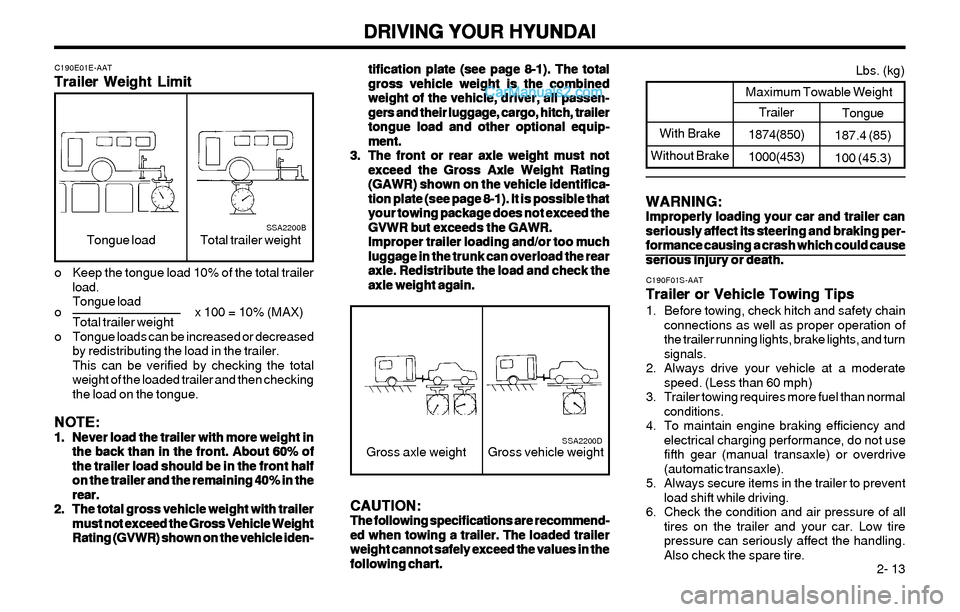
o Keep the tongue load 10% of the total trailer
load.
Tongue load
Total trailer weight
o Tongue loads can be increased or decreased
by redistributing the load in the trailer.
This can be verified by checking the total
weight of the loaded trailer and then checking
the load on the tongue.
NOTE: NOTE:NOTE: NOTE:
NOTE:1. 1.1. 1.
1.
Never load the trailer with more weight in Never load the trailer with more weight inNever load the trailer with more weight in Never load the trailer with more weight in
Never load the trailer with more weight in
the back than in the front. About 60% of the back than in the front. About 60% ofthe back than in the front. About 60% of the back than in the front. About 60% of
the back than in the front. About 60% of
the trailer load should be in the front half the trailer load should be in the front halfthe trailer load should be in the front half the trailer load should be in the front half
the trailer load should be in the front half
on the trailer and the remaining 40% in the on the trailer and the remaining 40% in theon the trailer and the remaining 40% in the on the trailer and the remaining 40% in the
on the trailer and the remaining 40% in the
rear. rear.rear. rear.
rear.
2. 2.2. 2.
2.
The total gross vehicle weight with trailer The total gross vehicle weight with trailerThe total gross vehicle weight with trailer The total gross vehicle weight with trailer
The total gross vehicle weight with trailer
must not exceed the Gross Vehicle Weight must not exceed the Gross Vehicle Weightmust not exceed the Gross Vehicle Weight must not exceed the Gross Vehicle Weight
must not exceed the Gross Vehicle Weight
Rating (GVWR) shown on the vehicle iden- Rating (GVWR) shown on the vehicle iden-Rating (GVWR) shown on the vehicle iden- Rating (GVWR) shown on the vehicle iden-
Rating (GVWR) shown on the vehicle iden-tification plate (see page 8-1). The total tification plate (see page 8-1). The totaltification plate (see page 8-1). The total tification plate (see page 8-1). The total
tification plate (see page 8-1). The total
gross vehicle weight is the combined gross vehicle weight is the combinedgross vehicle weight is the combined gross vehicle weight is the combined
gross vehicle weight is the combined
weight of the vehicle, driver, all passen- weight of the vehicle, driver, all passen-weight of the vehicle, driver, all passen- weight of the vehicle, driver, all passen-
weight of the vehicle, driver, all passen-
gers and their luggage, cargo, hitch, trailer gers and their luggage, cargo, hitch, trailergers and their luggage, cargo, hitch, trailer gers and their luggage, cargo, hitch, trailer
gers and their luggage, cargo, hitch, trailer
tongue load and other optional equip- tongue load and other optional equip-tongue load and other optional equip- tongue load and other optional equip-
tongue load and other optional equip-
ment. ment.ment. ment.
ment.
3. 3.3. 3.
3.
The front or rear axle weight must not The front or rear axle weight must notThe front or rear axle weight must not The front or rear axle weight must not
The front or rear axle weight must not
exceed the Gross Axle Weight Rating exceed the Gross Axle Weight Ratingexceed the Gross Axle Weight Rating exceed the Gross Axle Weight Rating
exceed the Gross Axle Weight Rating
(GAWR) shown on the vehicle identifica- (GAWR) shown on the vehicle identifica-(GAWR) shown on the vehicle identifica- (GAWR) shown on the vehicle identifica-
(GAWR) shown on the vehicle identifica-
tion plate (see page 8-1). It is possible that tion plate (see page 8-1). It is possible thattion plate (see page 8-1). It is possible that tion plate (see page 8-1). It is possible that
tion plate (see page 8-1). It is possible that
your towing package does not exceed the your towing package does not exceed theyour towing package does not exceed the your towing package does not exceed the
your towing package does not exceed the
GVWR but exceeds the GAWR. GVWR but exceeds the GAWR.GVWR but exceeds the GAWR. GVWR but exceeds the GAWR.
GVWR but exceeds the GAWR.
Improper trailer loading and/or too much Improper trailer loading and/or too muchImproper trailer loading and/or too much Improper trailer loading and/or too much
Improper trailer loading and/or too much
luggage in the trunk can overload the rear luggage in the trunk can overload the rearluggage in the trunk can overload the rear luggage in the trunk can overload the rear
luggage in the trunk can overload the rear
axle. Redistribute the load and check the axle. Redistribute the load and check theaxle. Redistribute the load and check the axle. Redistribute the load and check the
axle. Redistribute the load and check the
axle weight again. axle weight again.axle weight again. axle weight again.
axle weight again.Gross axle weight Gross vehicle weightSSA2200D
CAUTION: CAUTION:CAUTION: CAUTION:
CAUTION:The following specifications are recommend- The following specifications are recommend-The following specifications are recommend- The following specifications are recommend-
The following specifications are recommend-
ed when towing a trailer. The loaded trailer ed when towing a trailer. The loaded trailered when towing a trailer. The loaded trailer ed when towing a trailer. The loaded trailer
ed when towing a trailer. The loaded trailer
weight cannot safely exceed the values in the weight cannot safely exceed the values in theweight cannot safely exceed the values in the weight cannot safely exceed the values in the
weight cannot safely exceed the values in the
following chart. following chart.following chart. following chart.
following chart.Lbs. (kg)
Maximum Towable Weight
Trailer
1874(850)
1000(453)
WARNING: WARNING:WARNING: WARNING:
WARNING:Improperly loading your car and trailer can Improperly loading your car and trailer canImproperly loading your car and trailer can Improperly loading your car and trailer can
Improperly loading your car and trailer can
seriously affect its steering and braking per- seriously affect its steering and braking per-seriously affect its steering and braking per- seriously affect its steering and braking per-
seriously affect its steering and braking per-
formance causing a crash which could cause formance causing a crash which could causeformance causing a crash which could cause formance causing a crash which could cause
formance causing a crash which could cause
serious injury or death. serious injury or death.serious injury or death. serious injury or death.
serious injury or death.
o x 100 = 10% (MAX)
C190F01S-AAT
Trailer or Vehicle Towing Tips Trailer or Vehicle Towing TipsTrailer or Vehicle Towing Tips Trailer or Vehicle Towing Tips
Trailer or Vehicle Towing Tips1. Before towing, check hitch and safety chain
connections as well as proper operation of
the trailer running lights, brake lights, and turn
signals.
2. Always drive your vehicle at a moderate
speed. (Less than 60 mph)
3. Trailer towing requires more fuel than normal
conditions.
4. To maintain engine braking efficiency and
electrical charging performance, do not use
fifth gear (manual transaxle) or overdrive
(automatic transaxle).
5. Always secure items in the trailer to prevent
load shift while driving.
6. Check the condition and air pressure of all
tires on the trailer and your car. Low tire
pressure can seriously affect the handling.
Also check the spare tire.
With Brake
Without Brake
Page 115 of 172
DRIVING YOUR HYUNDAI DRIVING YOUR HYUNDAIDRIVING YOUR HYUNDAI DRIVING YOUR HYUNDAI
DRIVING YOUR HYUNDAI
2- 1415. If you have to stop while going uphill, do not
hold the vehicle in place by pressing on the
accelerator. This can cause the automatic
transaxle to overheat. Use the parking brake
or footbrake.
NOTE: NOTE:NOTE: NOTE:
NOTE:When towing check transaxle fluid more fre- When towing check transaxle fluid more fre-When towing check transaxle fluid more fre- When towing check transaxle fluid more fre-
When towing check transaxle fluid more fre-
quently. quently.quently. quently.
quently.
CAUTION: CAUTION:CAUTION: CAUTION:
CAUTION:If overheating should occur when towing, If overheating should occur when towing,If overheating should occur when towing, If overheating should occur when towing,
If overheating should occur when towing,
(the temperature gauge reads near red zone), (the temperature gauge reads near red zone),(the temperature gauge reads near red zone), (the temperature gauge reads near red zone),
(the temperature gauge reads near red zone),
taking the following action may reduce or taking the following action may reduce ortaking the following action may reduce or taking the following action may reduce or
taking the following action may reduce or
eliminate the problem. eliminate the problem.eliminate the problem. eliminate the problem.
eliminate the problem.
1. 1.1. 1.
1.
Turn off the air conditioner. Turn off the air conditioner.Turn off the air conditioner. Turn off the air conditioner.
Turn off the air conditioner.
2. 2.2. 2.
2.
Reduce highway speed. Reduce highway speed.Reduce highway speed. Reduce highway speed.
Reduce highway speed.
3. 3.3. 3.
3.
Select a lower gear when going uphill. Select a lower gear when going uphill.Select a lower gear when going uphill. Select a lower gear when going uphill.
Select a lower gear when going uphill.
4. 4.4. 4.
4.
While in stop and go traffic, place the gear While in stop and go traffic, place the gearWhile in stop and go traffic, place the gear While in stop and go traffic, place the gear
While in stop and go traffic, place the gear
selector in park or neutral and idle the selector in park or neutral and idle theselector in park or neutral and idle the selector in park or neutral and idle the
selector in park or neutral and idle the
engine at a higher speed. engine at a higher speed.engine at a higher speed. engine at a higher speed.
engine at a higher speed. 7. The vehicle/trailer combination is more af-
fected by crosswind and buffeting.
When being passed by a large vehicle, keep
a constant speed and steer straight ahead. If
there is too much wind buffeting slow down to
get out of the other vehicle's air turbulence.
8. When parking your car and trailer, especially
on a hill, be sure to follow all the normal
precautions. Turn your front wheel into the
curb, set the parking brake firmly, and put the
transaxle in 1st or Reverse (manual) or Park
(automatic). In addition, place wheel chocks
at each of the trailer's tires.
9. If the trailer has electric brakes, start your
vehicle and trailer moving, and then apply the
trailer brake controller by hand to be sure the
brakes are working. This lets you check your
electrical connection at the same time.
10. During your trip, occasionally check to be
sure that the load is secure, and that the
lights and any trailer brakes are still working.
11. Avoid jerky starts, sudden acceleration or
sudden stops.
12. Avoid sharp turns and rapid lane changes.
13. Avoid holding the brake pedal down too long
or too frequently. This could cause the brakes
to overheat, resulting in reduced braking effi-
ciency.
14. When going down a hill, shift into a lower gear
and use the engine braking effect.
When ascending a long grade, downshift the
transaxle to a lower gear and reduce speed to
reduce chances of engine overloading and/or
overheating.
Page 151 of 172

DO-IT-YOURSELF MAINTENANCE DO-IT-YOURSELF MAINTENANCEDO-IT-YOURSELF MAINTENANCE DO-IT-YOURSELF MAINTENANCE
DO-IT-YOURSELF MAINTENANCE
6-15
G200B01E-AAT
Replacing Accessory Fuse Replacing Accessory FuseReplacing Accessory Fuse Replacing Accessory Fuse
Replacing Accessory Fuse
The fuse box for the lights and other electrical
accessories will be found in the backside of multi
box located in the left side of driver. Inside the box
you will find a list showing the circuits protected
by each fuse.
If any of your car's lights or other electrical
accessories stop working, a blown fuse could
be the reason. If the fuse has burned out, you
will see that the metal strip inside the fuse has
burned through. If you suspect a blown fuse,
follow this procedure:
1. Turn off the ignition and all other switches.
2. Open the fuse box and examine each fuse.
Remove each fuse by pulling it toward you
(a small "fuse puller" tool is contained in the
fuse box to simplify this operation).
3. Be sure to check all other fuses even if you
find one that appears to have burned out.
B200B01E
G190A01A-AAT
CHECKING DRIVE BELTS CHECKING DRIVE BELTSCHECKING DRIVE BELTS CHECKING DRIVE BELTS
CHECKING DRIVE BELTS
G200A01A-AAT
CHECKING AND REPLACING CHECKING AND REPLACINGCHECKING AND REPLACING CHECKING AND REPLACING
CHECKING AND REPLACING
FUSES FUSESFUSES FUSES
FUSES
Replacing a Fusible Link Replacing a Fusible LinkReplacing a Fusible Link Replacing a Fusible Link
Replacing a Fusible Link
Drive belts should be checked periodically for
proper tension and adjusted if necessary. At the
same time, belts should be examined for cracks,
wear, fraying or other evidence of deterioration
and replaced if necessary.
Belt routing should also be checked to be sure
there is no interference between the belts and
other parts of the engine. After a belt is re-
placed, the new belt should be adjusted again
after two or three weeks to eliminate slack
resulting from initial stretching after use.A fusible link will melt if the electrical circuits
from the battery are ever overloaded, thus pre-
venting damage to the entire wiring harness.
(This could be caused by a short in the system
drawing too much current.) If this ever happens,
have a Hyundai dealer determine the cause,
repair the system and replace the fusible link.
The fusible links are located in a relay box for
easy inspection.
CAUTION: CAUTION:CAUTION: CAUTION:
CAUTION:When replacing a fusible link, never use When replacing a fusible link, never useWhen replacing a fusible link, never use When replacing a fusible link, never use
When replacing a fusible link, never use
anything but a new fusible link with the anything but a new fusible link with theanything but a new fusible link with the anything but a new fusible link with the
anything but a new fusible link with the
same or lower amperage rating. Never use a same or lower amperage rating. Never use asame or lower amperage rating. Never use a same or lower amperage rating. Never use a
same or lower amperage rating. Never use a
piece of wire or a higher-rated fusible link. piece of wire or a higher-rated fusible link.piece of wire or a higher-rated fusible link. piece of wire or a higher-rated fusible link.
piece of wire or a higher-rated fusible link.
This could result in serious damage and This could result in serious damage andThis could result in serious damage and This could result in serious damage and
This could result in serious damage and
create a fire hazard. create a fire hazard.create a fire hazard. create a fire hazard.
create a fire hazard.
SSA6190A
Water Pump Pulley
Generator Pulley
Crankshaft Pulley0.2 ~ 0.24 in.
(5.1 ~ 6 mm)
GoodBad
AS60310A