2003 Hyundai Atos ECU
[x] Cancel search: ECUPage 75 of 127

DRIVING YOUR HYUNDAI 2- 13
4. To maintain engine braking efficiency andelectrical charging performance, do not use fifth gear (manual transaxle) or overdrive(automatic transaxle).
5. Always secure items in the trailer to prevent load shift while driving.
6. Check the condition and air pressure of all tires on the trailer and your car. Low tirepressure can seriously affect the handling.Also check the spare tire.
7. The vehicle/trailer combination is more af- fected by crosswind and buffeting. When being passed by a large vehicle, keep a constant speed and steer straight ahead.If there is too much wind buffeting slowdown to get out of the other vehicle's airturbulence.
8. When parking your car and trailer, especial- ly on a hill, be sure to follow all the normalprecautions. Turn your front wheel into thecurb, set the parking brake firmly, and putthe transaxle in 1st or Reverse (manual) orPark (automatic). In addition, place wheelchocks at each of the trailer's tires.
9. If the trailer has electric brakes, start your vehicle and trailer moving, and then applythe trailer brake controller by hand to besure the brakes are working. This lets youcheck your electrical connection at the sametime.
10. During your trip, check occasionally to be sure that the load is secure, and that thelights and any trailer brakes are still working.
WARNING:
o The tongue load should never exceed;
Auto: 25kgManual : 28kg
o Maximun permissible mass of the cou- pling device (ATOS VAN only) : 20kg
o Improperly loading your car and trailer can seriously affect its steering and brak- ing performance causing a crash whichcould cause serious injury or death. kg.
Maximum Towable Weight Trailer
Manual
TransaxleAuto
Transaxle
With Brake TypeWithoutBrake Type 400 400
C190F01A-GAT Trailer or Vehicle Towing Tips
1. Before towing, check hitch and safety chain
connections as well as proper operation of the trailer running lights, brake lights, andturn signals.
2. Always drive your vehicle at a moderate speed (Less than 100 km/h)
3. Trailer towing requires more fuel than nor- mal conditions.
Gross axle weight Gross vehicle weightSSA2200D
CAUTION: The following specifications are recommend-
ed when towing a trailer. The loaded trailer weight cannot safely exceed the values inthe chart. Coupling point
C190E03X
ÏÏ
ÏÏ
Ï
ÏÏ
ÏÏ
Ï
700 400
Page 77 of 127
WHAT TO DO IN AN EMERGENCY 3-1
D010B01A-AAT
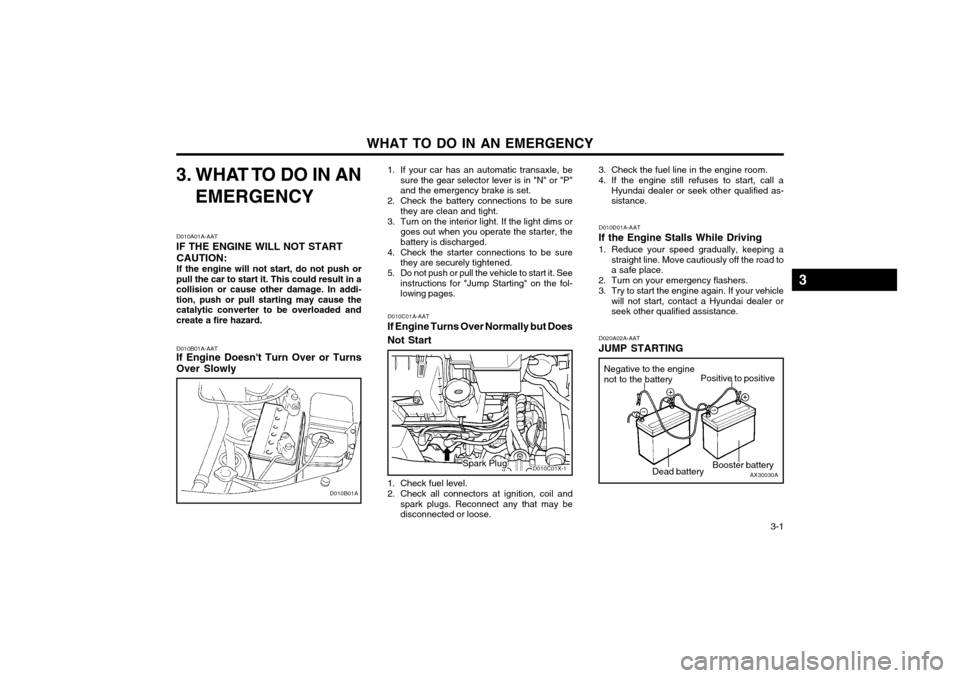
If Engine Doesn't Turn Over or Turns Over Slowly
3. WHAT TO DO IN AN
EMERGENCY
D010A01A-AAT
IF THE ENGINE WILL NOT START CAUTION: If the engine will not start, do not push or
pull the car to start it. This could result in a collision or cause other damage. In addi-tion, push or pull starting may cause thecatalytic converter to be overloaded andcreate a fire hazard. 1. If your car has an automatic transaxle, be
sure the gear selector lever is in "N" or "P"and the emergency brake is set.
2. Check the battery connections to be sure they are clean and tight.
3. Turn on the interior light. If the light dims or goes out when you operate the starter, thebattery is discharged.
4. Check the starter connections to be sure they are securely tightened.
5. Do not push or pull the vehicle to start it. See instructions for "Jump Starting" on the fol-lowing pages.
D010C01A-AAT
If Engine Turns Over Normally but Does Not Start
1. Check fuel level.
2. Check all connectors at ignition, coil and spark plugs. Reconnect any that may be disconnected or loose. D010D01A-AAT
If the Engine Stalls While Driving
1. Reduce your speed gradually, keeping a straight line. Move cautiously off the road to a safe place.
2. Turn on your emergency flashers.
3. Try to start the engine again. If your vehicle will not start, contact a Hyundai dealer or seek other qualified assistance.
D010B01A
3. Check the fuel line in the engine room.
4. If the engine still refuses to start, call aHyundai dealer or seek other qualified as- sistance.
D020A02A-AAT
JUMP STARTING
AX30030A
Negative to the engine not to the battery
Booster battery
Positive to positive
Dead battery
D010C01X-1Spark Plug
3
Page 83 of 127

WHAT TO DO IN AN EMERGENCY 3-7
D060J01FC-GAT
After Changing Wheels
If you have a tire gauge, remove the valve cap
and check the air pressure. If the pressure is lower than recommended, drive slowly to thenearest service station and inflate to the correctpressure. If it is too high, adjust it until it iscorrect. Always reinstall the valve cap afterchecking or adjusting tire pressure. If the cap isnot replaced, air may leak from the tire. If youlose a valve cap, buy another and install it assoon as possible.
After you have changed wheels, always secure
the flat tire in its place in the luggage room andreturn the jack and tools to their proper storagelocations. D080A01A-GAT
IF YOUR CAR MUST BE TOWED D080B01A-AAT
Towing a Car With a Manual Transaxle
o OK FOR AUTOMATIC OR MANUAL TRANSAXLE EQUIPPED VEHICLE WITH NO DAMAGE
o OK FOR AUTOMATIC OR MANUAL
TRANSAXLE EQUIPPED VEHICLE
CAUTION: Your car can be damaged if towed incor- rectly! If your car has to be towed, it should be done by
your Hyundai dealer or a commercial tow truckservice. This will help assure that your car isnot damaged in towing. Also, professionals aregenerally aware of state and local laws govern-ing towing. In any case, rather than risk dam-age to your car, it is suggested that you showthis information to the tow truck operator. Besure that a safety chain system is used and thatlocal laws are observed. o If the car is being towed with the rear wheels
on the ground, be sure the parking brake isreleased.
o If the car is being towed with the front wheels on the ground, be sure that thetransaxle is in neutral. Also, be sure that theignition key is in the "ACC" position. This isnecessary to prevent damage to the steer-ing lock mechanism, which is not designedto hold the front wheels straight while the caris being towed.
o If any of the loaded wheels or suspension components are damaged, a towing dollymust be used.
D080A01AD080B01AD060J01X
Page 93 of 127

VEHICLE MAINTENANCE REQUIREMENTS 5-5
F060A01A-AAT
EXPLANATION OF SCHEDULED MAIN- TENANCE ITEMS
F060M01A-AAT
o Engine oil and filter The engine oil and filter should be changed at
the intervals specified in the maintenance sched- ule. If the car is being driven in severe condi-tions, more frequent oil and filter changes arerequired.
F060B01A-AAT
o Drive belts
Inspect all drive belts for evidence of cuts,
cracks, excessive wear or oil and replace ifnecessary. Drive belts should be checked pe-
riodically for proper tension and adjusted asnecessary.
F060C01A-GAT
o Fuel filter
A clogged filter can limit the speed at which the
vehicle may be driven, damage the emissionsystem and cause hard starting. If an exces-sive amount of foreign matter accumulates inthe fuel tank, the filter may require replacementmore frequently.
After installing a new filter, run the engine for
several minutes, and check for leaks at theconnections. F060D01A-GAT
o Fuel lines, fuel hoses and connec-
tions
Check the fuel lines, fuel hoses and connec-
tions for leakage and damage. Replace anydamaged or leaking parts immediately. Inspect the hose routing to assure that the
hoses do not come in contact with any heatsource, sharp edges or moving component
which might cause heat damage or mechanicalwear. Inspect all hose connections, such as
clamps and couplings, to make sure they aresecure, and that no leaks are present. Hoses
should be replaced immediately if there is any
evidence of deterioration or damage.
F060H01A-AAT
o Air cleaner filter
A Genuine Hyundai air cleaner filter is recom-
mended when filter is replaced.
F060J01A-AAT
o Spark plugs
Make sure to install new spark plugs of the
correct heat range.
F060E01A-AAT
o Timing belt Inspect all parts related to the timing belt for
damage and deformation. Replace any dam-aged parts immediately.
F060G01A-AAT
o Vapor hose and fuel filler cap The vapor hose and fuel filler cap should be
inspected at those intervals specified in themaintenance schedule. Make sure that a newvapor hose or fuel filler cap is correctly re-placed.
F060F01A-AAT
o Vacuum, crankcase ventilation hos-
es
Inspect the surface of hoses for evidence of
heat and/or mechanical damage. Hard and brit-tle rubber, cracking, tears, cuts, abrasions, and
excessive swelling indicate deterioration. Par-ticular attention should be paid to examinethose hose surfaces nearest to high heat sourc-es, such as the exhaust manifold. F060N01X-GAT
o Valve clearances Incorrect valve clearance will not only result in
unsteady engine operation, but will also causeexcessive noise and reduced engine perfor-
mance. Inspect valve clearance and adjust asrequired while the engine is hot.
Valve-to-rocker arm clearance Intake valves ..... 0.2 mm (0.008 in.)Exhaust valves .... 0.25 mm (0.010 in.)
Page 101 of 127

DO-IT-YOURSELF MAINTENANCE
6-6 -15 (5)
-25 (-13) -35 (-31)-45 (-49)
G050B01A-AAT
Recommended Engine Coolant
Use a high quality ethylene-glycol coolant in a
50/50 mix with water. The engine coolant should be compatible with aluminum engine parts. Ad-ditional corrosion inhibitors or additives shouldnot be used. The cooling system must be main-tained with the correct concentration and typeof engine coolant to prevent freezing and corro-sion. Never allow the concentration of antifreeze to exceed the 60% level or go below the 35% levelor damage to the coolant system may result. Forproper concentration when adding or replacingthe coolant, refer to the following table.
35% 40%50%60% G050C01A-AAT
To Check the Coolant Level
The coolant level can be seen on the side of the plastic coolant reservoir. The level of the cool-ant should be between the "LOW" and "FULL"lines on the reservoir when the engine is cold.If the level is below the "LOW" mark, addengine coolant to bring it up between "LOW"and "FULL". If the level is low, inspect forcoolant leaks and recheck the fluid level fre-quently. If the level drops again, visit yourHyundai dealer for an inspection and diagnosisof the reason. G050D02A-AAT
To Change the Engine Coolant
The engine coolant should be changed at thoseintervals specified in the vehicle maintenanceschedule in Section 5. CAUTION: Engine coolant can damage the finish of your car. If you spill engine coolant on thecar, wash it off thoroughly with clean water.
1. Park the car on level ground, set the parking brake and remove the radiator cap whencool.
2. Be sure your drain receptacle is in place. Open the drain cock on the radiator. Allowall the engine coolant to drain from thecooling system, then securely close the draincock.
3. Check Section 9 for the capacity of the cooling system in your car. Then, followingthe manufacturer's directions on the enginecoolant container, add the appropriate quan-tity of engine coolant to the radiator.
G050C01A
65% 60%50%40%
Water
Antifreeze
solution
Ambient
temperature °C ( °F) Engine coolant concentration
Page 105 of 127

DO-IT-YOURSELF MAINTENANCE
6-10 G110A01A-AAT
CHECKING THE TRANSAXLE FLUID (AUTOMATIC)
Transaxle fluid in the automatic transaxle should be checked at those intervals specified in thevehicle maintenance schedule in Section 5. G110B01X-AAT Recommended Fluid Your Hyundai automatic transaxle is specially designed to operate with ESSO JWS3314. Dam-age caused by a nonspecified fluid is not cov-ered by your new vehicle limited warranty. G110C01X-GAT
Transaxle Fluid Capacity The fluid capacity of the automatic transaxle is
5.2 liters (5.48 U.S. quarts). WARNING: The transaxle fluid level should be checked
when the engine is at normal operating tem-perature. This means that the engine, radia-
tor, exhaust system etc., are very hot. Exer-
cise great care not to burn yourself duringthis procedure.
G100A04X-GAT CHECKING THE TRANSAXLE OIL (MANUAL) Transaxle lubricant in the manual and transaxle should be checked at those intervals specified in the vehicle maintenance schedule in Section5. Recommended Oil Use only HYUNDAI GENUINE PARTS MTF 75W/90 (API GL-4) in the manual transaxle. Manual Transaxle Oil Capacity The oil capacity of the manual transaxle is 2.45 liters (2.58 U.S. quarts). WARNING: It is always better to check the transaxle oil level when the engine is cool or cold. If theengine is hot, you should exercise greatcaution to avoid burning yourself on hotengine or exhaust parts. G100B01A-AAT
To check the Manual Transaxle Fluid Level
SSA6100B
Park the car on level ground with the engine off.
1. Using a wrench of the correct size, loosen the oil filler plug by turning it counterclock- wise and remove it with your fingers.
2. Use your finger or suitable tool to feel inside the hole. The oil level should be at its bottomedge. If it is not, check for leaks beforeadding oil. To refill the transaxle or bring theoil level up, add oil slowly until it reaches theproper level. Do not overfill.
3. Replace the plug and washer, screw it in with your fingers and then tighten securelywith the wrench.
G100A01X
Filler plug
Drain plug