Page 38 of 415
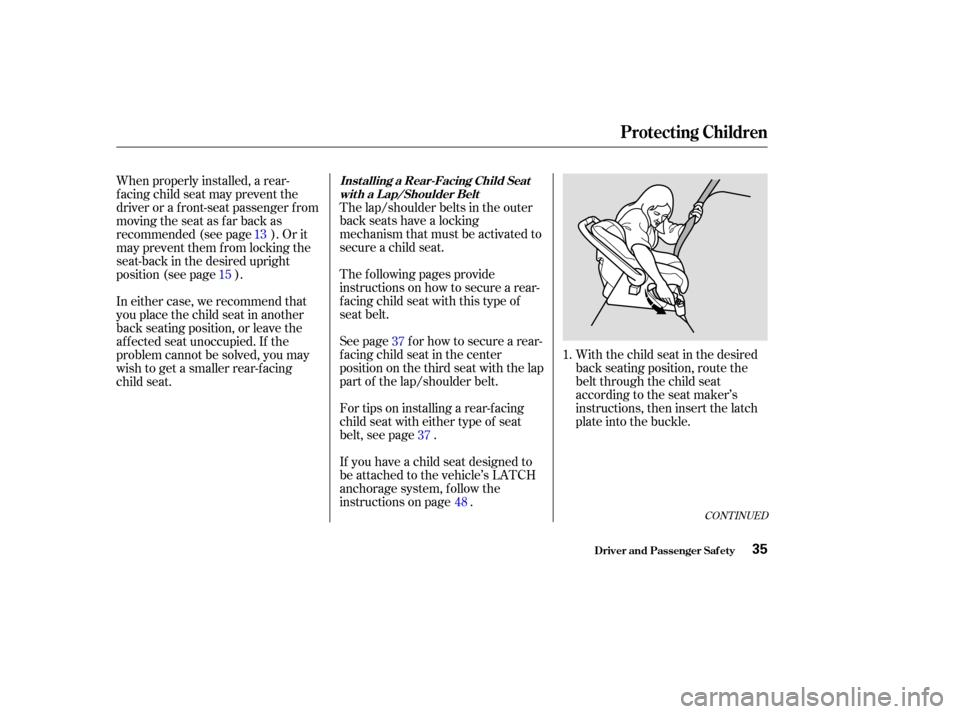
With the child seat in the desired
back seating position, route the
belt through the child seat
according to the seat maker’s
instructions, then insert the latch
plate into the buckle.
The lap/shoulder belts in the outer
back seats have a locking
mechanism that must be activated to
secure a child seat.
The f ollowing pages provide
instructions on how to secure a rear-
facing child seat with this type of
seat belt.
See page f or how to secure a rear-
f acing child seat in the center
position on the third seat with the lap
part of the lap/shoulder belt.
For tips on installing a rear-f acing
child seat with either type of seat
belt, see page .
When properly installed, a rear-
f acing child seat may prevent the
driver or a f ront-seat passenger f rom
moving the seat as far back as
recommended (see page ). Or it
may prevent them f rom locking the
seat-back in the desired upright
position (see page ).
In either case, we recommend that
you place the child seat in another
back seating position, or leave the
af f ected seat unoccupied. If the
problem cannot be solved, you may
wish to get a smaller rear-f acing
child seat.
If you have a child seat designed to
be attached to the vehicle’s LATCH
anchorage system, follow the
instructions on page .1.
13
15
3748
37
CONT INUED
Inst alling a Rear-Facing Child Seat
wit h a L ap/Shoulder Belt
Protecting Children
Driver and Passenger Saf ety35
Page 41 of 415
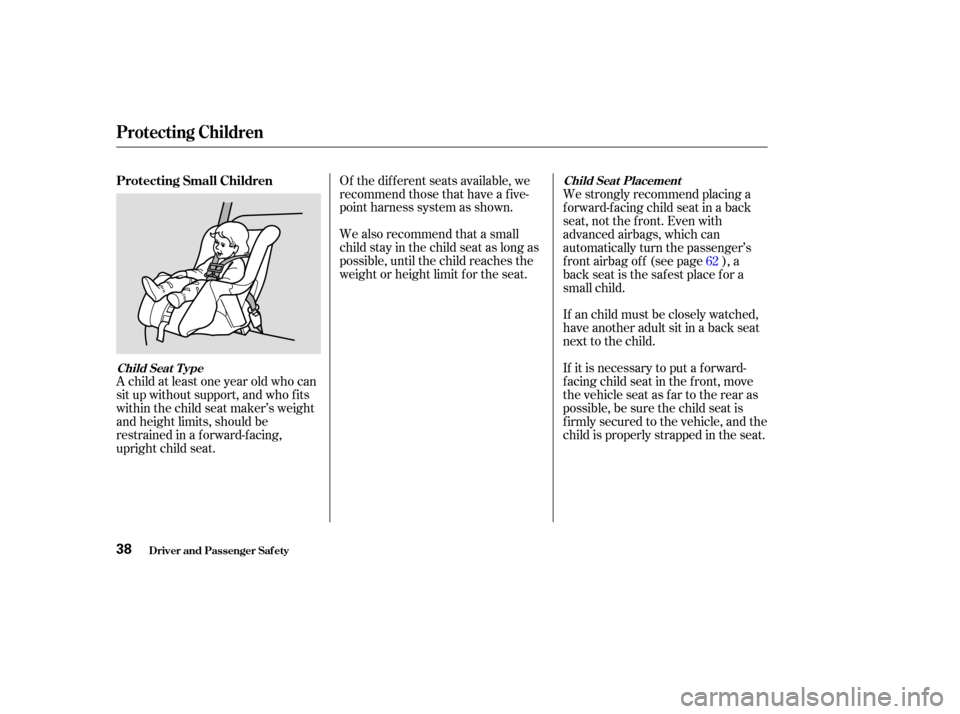
We also recommend that a small
child stay in the child seat as long as
possible, until the child reaches the
weight or height limit f or the seat. Of the different seats available, we
recommend those that have a f ive-
point harness system as shown.
A child at least one year old who can
sit up without support, and who f its
within the child seat maker’s weight
and height limits, should be
restrained in a f orward-f acing,
upright child seat. We strongly recommend placing a
forward-facing child seat in a back
seat,notthefront.Evenwith
advanced airbags, which can
automatically turn the passenger’s
front airbag off (see page ), a
back seat is the safest place for a
small child.
If an child must be closely watched,
have another adult sit in a back seat
next to the child.
If it is necessary to put a f orward-
f acing child seat in the f ront, move
the vehicle seat as far to the rear as
possible, be sure the child seat is
f irmly secured to the vehicle, and the
child is properly strapped in the seat.
62
Protecting Small Children
Child Seat T ype Child Seat Placement
Protecting Children
Driver and Passenger Saf ety38
Page 49 of 415
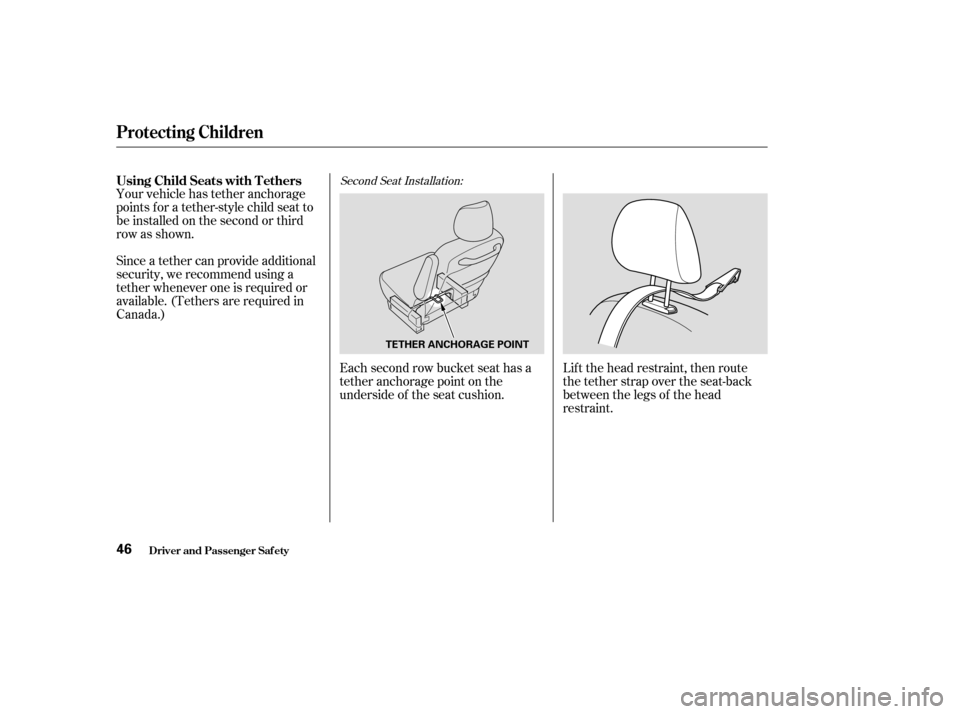
Second Seat Installation:
Lift the head restraint, then route
the tether strap over the seat-back
between the legs of the head
restraint.
Your vehicle has tether anchorage
points f or a tether-style child seat to
be installed on the second or third
row as shown.
Since a tether can provide additional
security, we recommend using a
tether whenever one is required or
available. (Tethers are required in
Canada.)
Each second row bucket seat has a
tether anchorage point on the
underside of the seat cushion.
Using Child Seats with T ethers
Driver and Passenger Saf ety
Protecting Children
46
TETHER ANCHORAGE POINT
Page 51 of 415
Put the child seat in a second row
vehicle seat and attach the child
seat to the lower anchors
according to the child seat maker’s
instructions.
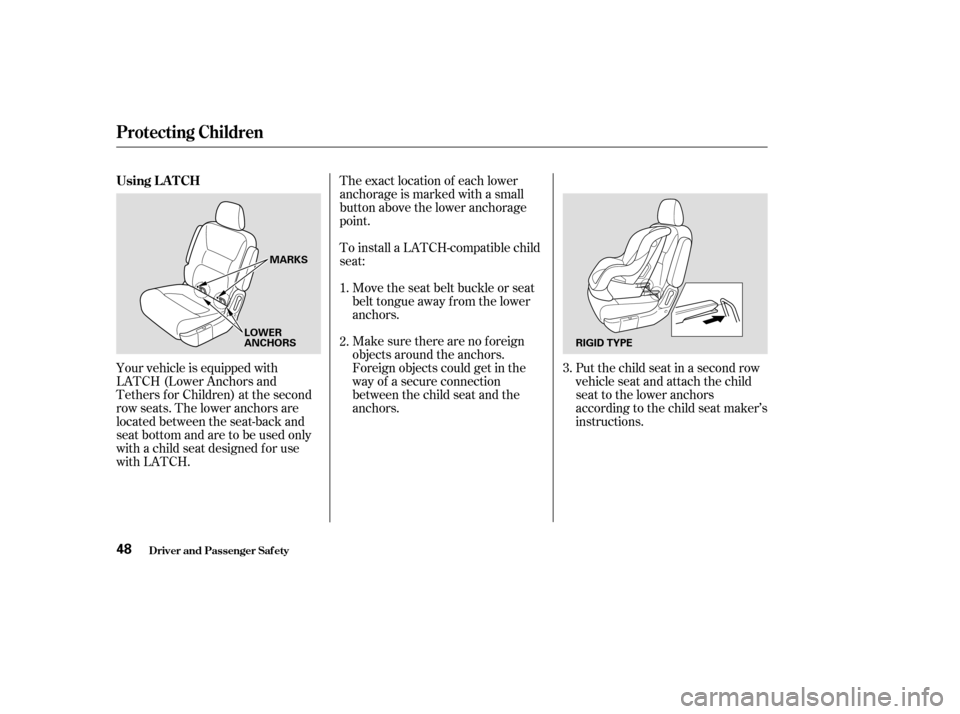
Your vehicle is equipped with
LATCH (Lower Anchors and
Tethers f or Children) at the second
row seats. The lower anchors are
located between the seat-back and
seat bottom and are to be used only
with a child seat designed f or use
with LATCH. Make sure there are no f oreign
objects around the anchors.
Foreign objects could get in the
way of a secure connection
between the child seat and the
anchors. Move the seat belt buckle or seat
belt tongue away f rom the lower
anchors.
To install a LATCH-compatible child
seat: The exact location of each lower
anchorage is marked with a small
button above the lower anchorage
point.
1.
2.
3.
Using L A T CH
Protecting Children
Driver and Passenger Saf ety48
RIGID TYPE
LOWER
ANCHORS MARKS
Page 52 of 415
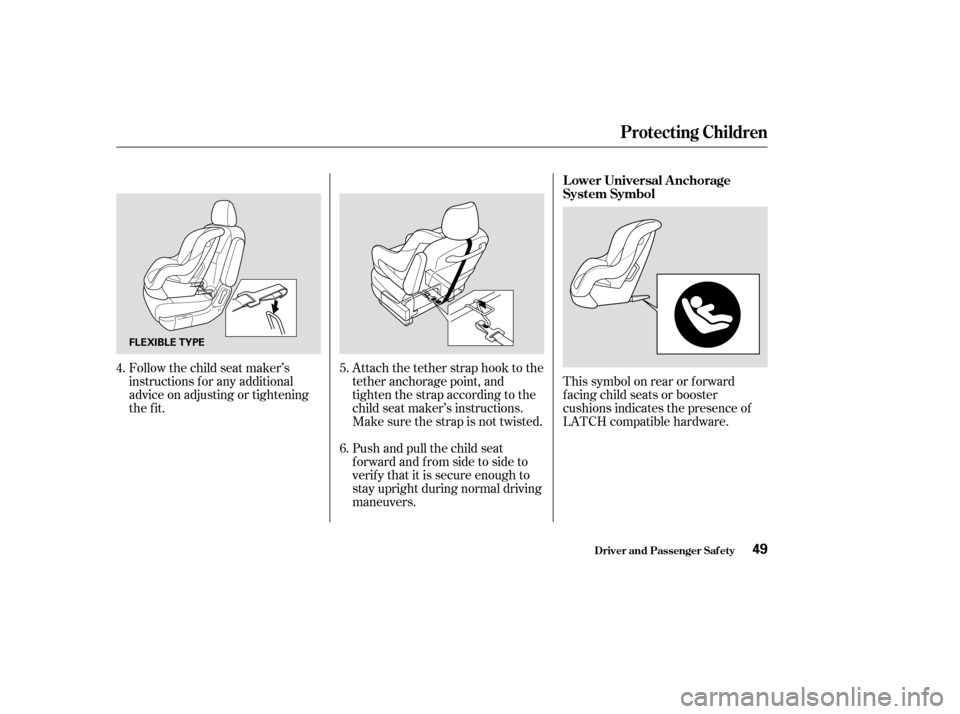
Follow the child seat maker’s
instructions f or any additional
advice on adjusting or tightening
the fit.Push and pull the child seat
f orward and f rom side to side to
verif y that it is secure enough to
stay upright during normal driving
maneuvers. Attach the tether strap hook to the
tether anchorage point, and
tighten the strap according to the
child seat maker’s instructions.
Make sure the strap is not twisted.This symbol on rear or f orward
f acing child seats or booster
cushions indicates the presence of
LATCH compatible hardware.
4.
5.
6.
Protecting Children
Driver and Passenger Saf ety
L ower Universal Anchorage
System Symbol
49
FLEXIBLE TYPE
Page 54 of 415
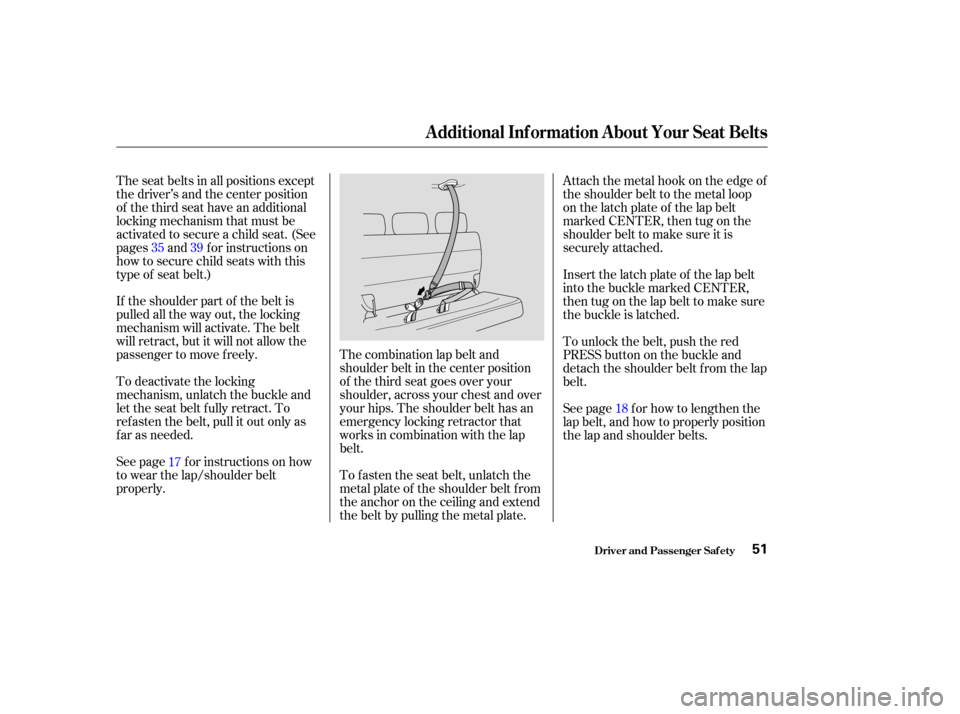
The combination lap belt and
shoulder belt in the center position
of the third seat goes over your
shoulder, across your chest and over
your hips. The shoulder belt has an
emergency locking retractor that
works in combination with the lap
belt.
The seat belts in all positions except
the driver’s and the center position
of the third seat have an additional
locking mechanism that must be
activated to secure a child seat. (See
pages and f or instructions on
how to secure child seats with this
type of seat belt.)
If the shoulder part of the belt is
pulled all the way out, the locking
mechanism will activate. The belt
will retract, but it will not allow the
passenger to move f reely.
To deactivate the locking
mechanism, unlatch the buckle and
let the seat belt f ully retract. To
ref asten the belt, pull it out only as
f ar as needed.
See page f or instructions on how
to wear the lap/shoulder belt
properly.
To f asten the seat belt, unlatch the
metal plate of the shoulder belt from
the anchor on the ceiling and extend
the belt by pulling the metal plate.Attach the metal hook on the edge of
the shoulder belt to the metal loop
on the latch plate of the lap belt
marked CENTER, then tug on the
shoulder belt to make sure it is
securely attached.
Insert the latch plate of the lap belt
into the buckle marked CENTER,
then tug on the lap belt to make sure
the buckle is latched.
To unlock the belt, push the red
PRESS button on the buckle and
detach the shoulder belt f rom the lap
belt.
See page f or how to lengthen the
lap belt, and how to properly position
the lap and shoulder belts.
39
17 18
35
Additional Inf ormation About Your Seat Belts
Driver and Passenger Saf ety51
Page 61 of 415
The driver’s and f ront passenger’s
seat sensors may not work properly
if :Be caref ul not to spill any liquids.
Spilled liquids could damage the
sensors under the f ront seats.
If your vehicle sustains a severe
impact, have the driver’s seat
position sensor and the f ront
passenger’s weight sensors
inspected by your Honda dealer.
You do not wear your seat belt
properly.
You do not sit upright and as f ar
back as possible f rom the steering
wheel or the dashboard (see page
).
You do not secure the child seat
properly, and move the f ront seat
as far back as possible. For additional information on how
your airbags work, see the booklet
titled
that came with your
owner’s manual.
For additional information on how
your airbags work, ask your dealer
f or a copy of the booklet titled
20
SRS: What You Need to Know
About Airbags
SRS:
What You Need to Know About Airbags
.
Driver and Passenger Saf ety
Additional Inf ormation About Your Airbags
U.S.Owners
Canadian Owners
58
Page 62 of 415

Your vehicle is equipped with side
airbags f or the driver and a f ront
seat passenger. The airbags are
stored in the outer edges of the f ront
seat-backs, and both are marked
‘‘SIDE AIRBAG.’’If you ever have a moderate to
severe side impact, the sensors will
detect rapid deceleration and signal
the control unit to instantly inf late
either the driver’s or the passenger’s
side airbag.
Only one airbag will deploy during a
side impact. If the impact is on the
passenger’s side, the passenger’s
side airbag will deploy even if there
is no passenger.
To get the best protection f rom the
side airbags, front seat occupants
should wear their seat belts and sit
upright and well back in their seats.
The SRS indicator light
alerts you to a potential
problem with your f ront airbags and
automatic seat belt tensioners.
This light will also alert you to a
potential problem with your side
airbags, passenger’s side airbag
automatic cutoff system (see page ), or the driver’s seat position
sensor and the f ront passenger’s
weight sensors (see pages and ).
When you turn the ignition ON (II),
this indicator will light brief ly then
go out. This tells you that the system
is working properly. 60
57
62
CONT INUED
Driver and Passenger Saf ety
How Your Side A irbags Work How the SRS Indicator L ight
Works
Additional Inf ormation About Your Airbags
59